Get in touch with UD Packaging Company

Printed stretch film carries a repeated message on film wrapped around a load. A clean artwork proof is helpful, but the final purchase decision hinges on what survives stretching, overlap and handling. Combine the approved artwork revision with a sample application before releasing a production order.
Updated October 2026
Approval essentials
- Specify: film construction, roll dimensions, print side and artwork revision.
- Measure: unstretched repeat in mm, applied repeat in mm and readable faces.
- Record: wrapper settings, elapsed time, temperature and load condition.
- Release: agreed appearance and load checks, each with a named owner.
Printed stretch film requires separate approval for the artwork and applied sample. Confirm roll repeat and unwind direction, then check the actual wrapped load. A flat proof can’t establish stretched legibility or transport performance.
Key takeaways
- A wrapper’s pre-stretch setting isn’t a measurement of the final logo spacing.
- Repeated branding and a unique pallet identifier serve different purposes.
- Ink abrasion, readable print and load containment require separate evidence.
- Repeat orders need the approved material and setup record as well as the artwork file.
What printed stretch film must do on a pallet
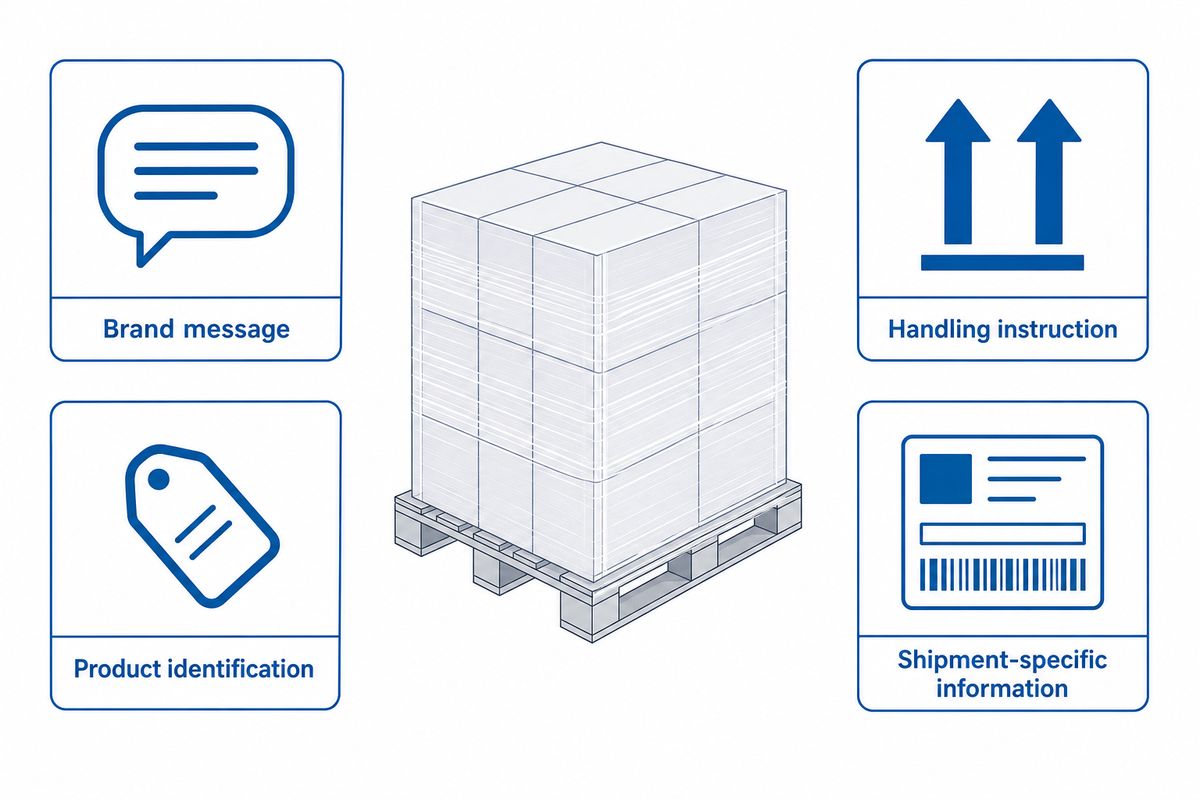
Printed pallet film has to carry a message or a logo and function as a part of the wrapping system of the load. Decide if the print carries a brand message, conveys a handling instruction or supports product identification. Keep shipment-specific information distinct from the logo. A repeated design can’t differentiate one otherwise identical pallet from another.
Stretch wrap is commonly made from linear low-density polyethylene (LLDPE), a flexible, stretchable plastic. Tension and the applied wrapping pattern help secure the load. Shrink film instead tightens with heat. The wrapping specification must protect the shipment as a system. Check cardboard edge protection and bubble wrap cushioning separately; printing can’t substitute for their physical function.
Common mistake: approving the logo while leaving the load description blank. Record the package shape, exposed corners and handling route first. A durable-looking print says little about stability. Use the industrial stretch film options page to establish a baseline for standard film, before comparing custom marking routes.
Printed wrap or plain film with pallet labels?
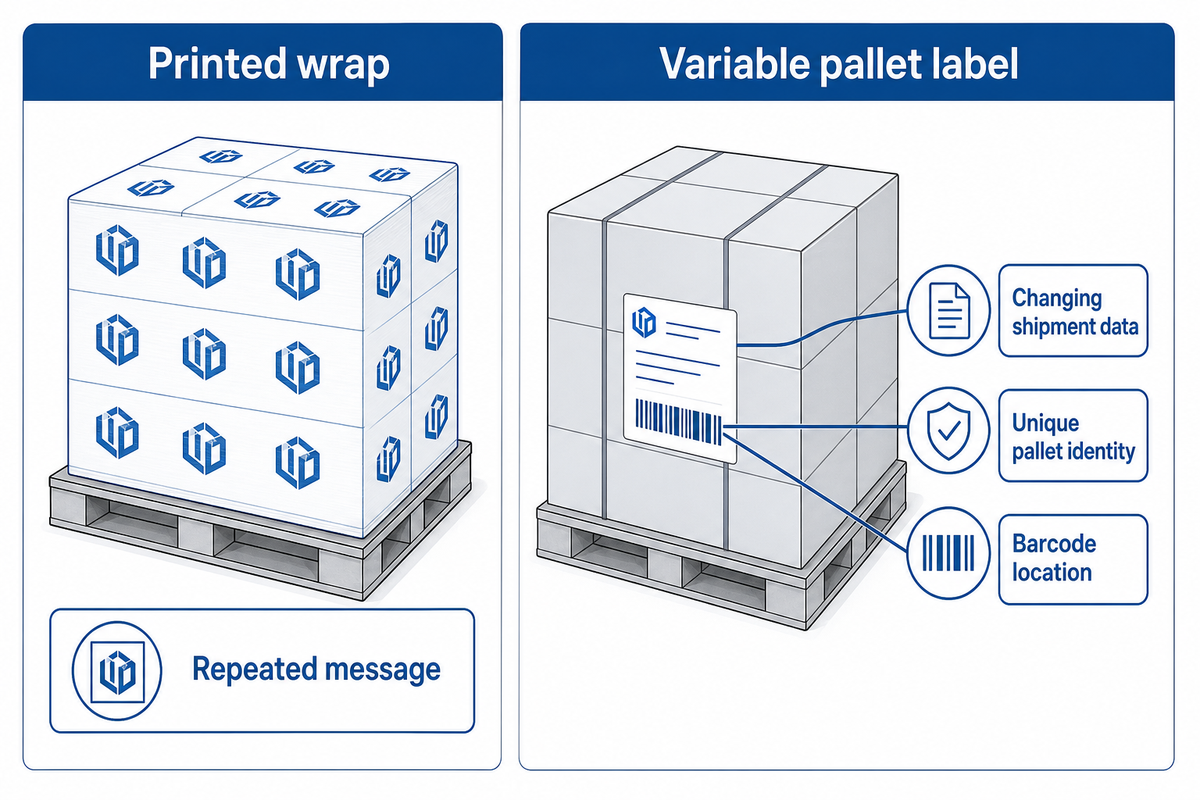
Pick printed wrap when a message needs to be repeatedly and visibly communicated across the wrapped load. Plain film with a separate label provides a place for changing shipment data. Both require appropriate wrapping specification; the choice of branding surface doesn’t settle load restraint.
GS1’s Serial Shipping Container Code identifies a logistic unit. A brand logo doesn’t offer such unique identification. For retail distribution or receipt using GS1 labels, retain the specified barcode and its readable location.
Branding alone doesn’t establish tamper evidence or theft prevention. Ask for separate evidence for the systems required.
| Task | Route to consider | Buyer check | Limitations / Not suitable for |
|---|---|---|---|
| Stable brand message | Printed film | Visibility after wrapping | Frequent artwork changes |
| Unique pallet number | Variable pallet label | Correct identifier and scan | Repeated logo alone |
| Changing destination | Shipment label | Dispatch data match | Preprinted fixed destination |
| Mixed product load | Film plus separate label | Contents and unit identity | Branding as contents proof |
| Visible carton text | Clear film trial | Read through all layers | Obscuring print coverage |
| Opaque branding field | White-film sample | Color and hidden carton data | Required see-through inspection |
| Temporary promotion | Separate removable message | Stock left after campaign | Large obsolete custom inventory |
| Small marking area | Printed tape as marking aid | Attachment and readability | Assuming tape replaces wrapping |
| Separate banner system | Equipment-specific banner | System and film compatibility | Treating banner as printed stretch film |
Hypothetical overlap problem: A hypothetical overlap problem could occur if a warehouse approves branding on a flat sample, then wraps a carton load. The operator adds overlapping turns around an uneven upper layer. Overlapping film covers part of the logo and the dispatch label, which then becomes difficult to scan. Darker ink isn’t the solution to either the overlap or blocking. A quality trial would check the completed load to determine if a branded area is left readable and the shipping label is placed where prescribed. If there are changes to the wrapping procedure, the agreed load-containment performance is also to be maintained.
GS1 Sweden’s pallet-label guidance places barcodes 400–800 mm above the pallet bottom and labels at least 50 mm from a vertical edge. Its stated one-item and layer-pallet arrangements use labels outside the wrap. Follow the applicable receiving specification; extra branding is no reason to hide required data.
Prepare artwork for the film and print process
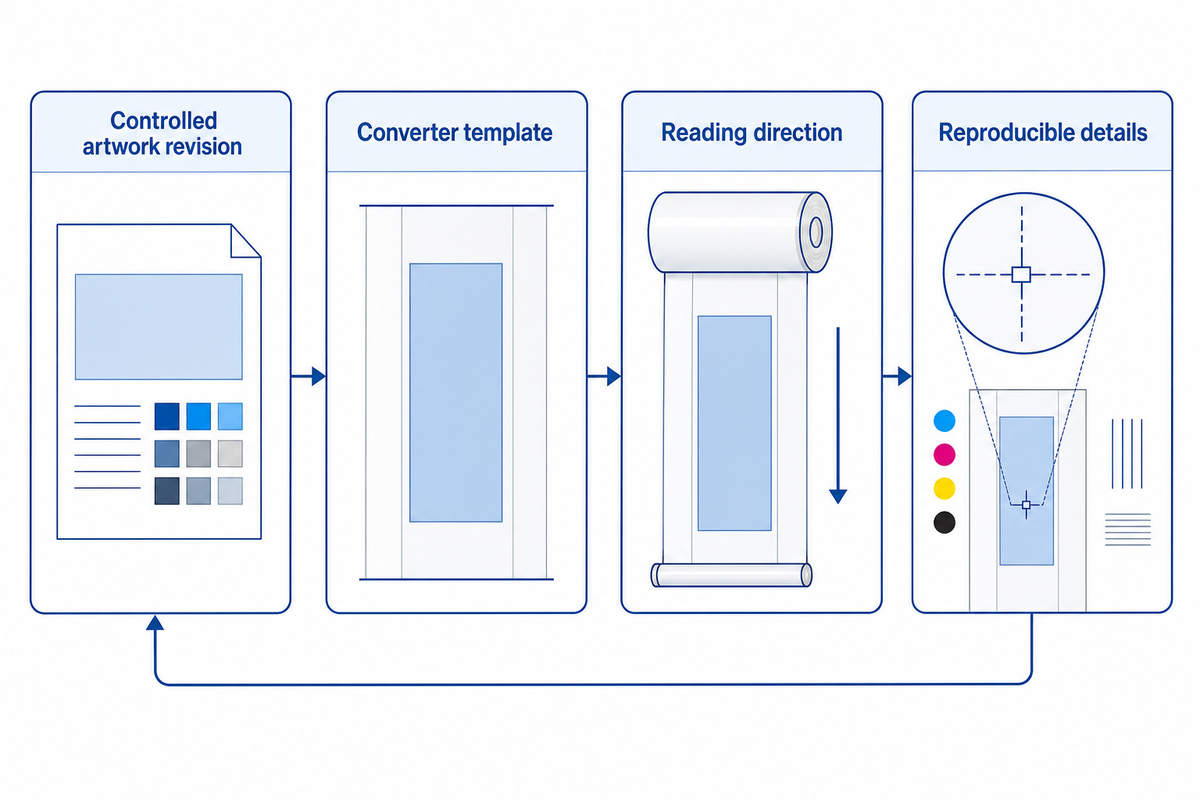
Artwork preparation begins with the converter’s actual printing process and template, and ends with a reproducible drawing. Send a revision-controlled vector file with the intended text, color standard, and drawing showing the reading direction. Ask the converter to confirm the reproducible details before the brand team approves the drawing or procurement pays for tooling.
Evaluate whether the proposal prints the stretch film or if a banner is added. US20060260279A1 describes relatively unstretchable banner film between stretch-wrap layers. That disclosure describes a different construction; it isn’t UD Packaging technology or evidence that all directly printed film distorts beyond use.
Send for confirmation
- Editable artwork and a locked reference PDF
- Revision date, text and color targets
- Print side and reading-direction drawing
Resolve before approval
- Unconfirmed fine lines or small lettering
- A template from another converter
- An unexplained change of film background
A 300 mm repeat should be marked on the converter’s drawing with units and measurement points. The logo width is a different dimension. If the supplier provides a repeat different from what was agreed to, revise the drawing before approval; a familiar filename can’t resolve conflicting manufacturing instructions.
Choose ink colors and the film background
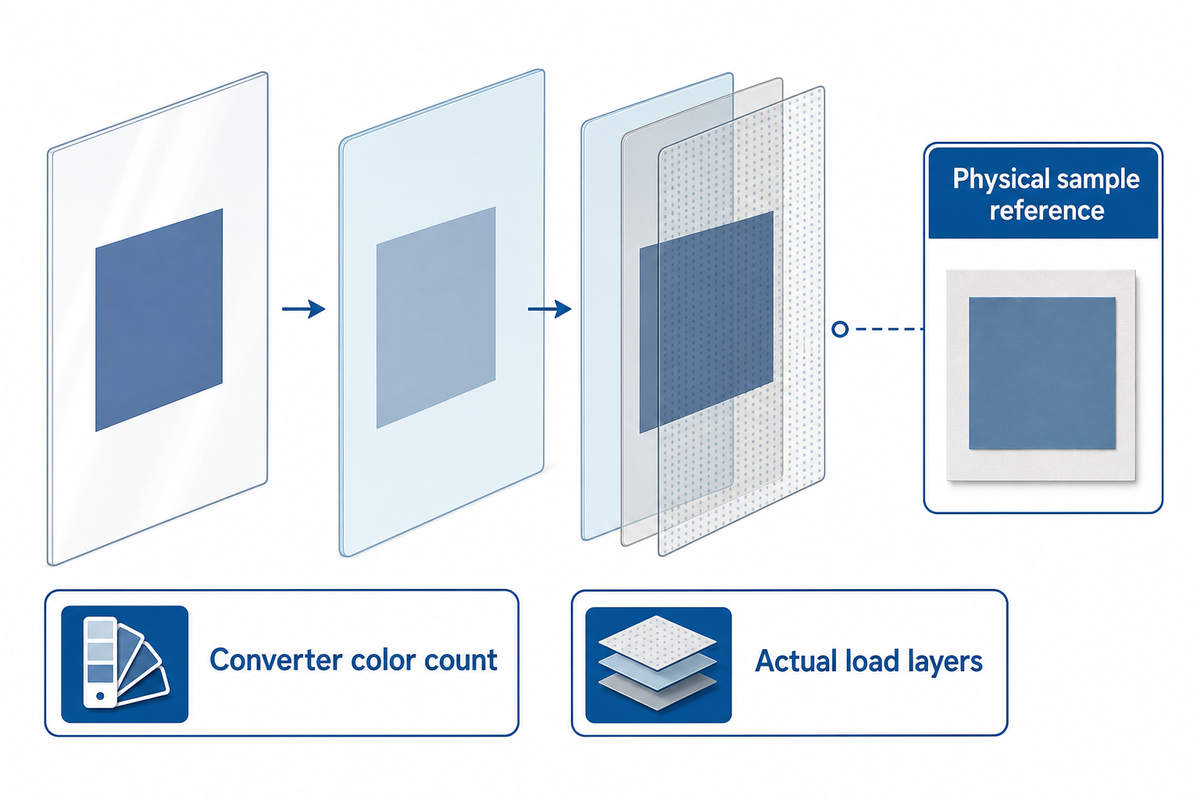
Approve ink colors on the background of the proposed film. Under the agreed upon conditions, check the converter’s color count, and compare a physical sample with the reference. Screen appearance alone doesn’t resolve the visual effect of the substrate and ink deposit.
Is it possible to get stretch wrap in custom colors or with branding?
Some suppliers can create custom colors or print your branding, but the available ink counts and film backgrounds are specific to the quoted process. Brown and Pratt lists one- or two-color printing, while Wrap Tite suggests using a white background. Neither statement specifies a universal limit or confirms UD Packaging’s printed film capability.
In a 2022 gravure-printing study, Eller and D’Amico found that white ink coating weight and film type altered the final color of inks used in printed flexible packaging. The study is about reverse printed flexible packaging, not stretched pallet film. The study suggests comparing the construction of the film offered instead of borrowing a numerical value from a different process to assess its feasibility.
For transparent films, evaluate clarity by the actual number of layers necessary on the load. Maintain the approved physical sample for color consistency on repeat orders. An automatic exposure photograph can be a poor reference compared to the approved physical sample.
For an environmental claim, evidence should be provided for the ink system and the recycling stream. Different recycling behavior is reported for the tested NC-free ink technologies and nitrocellulose-based inks in the RecyClass reports. This summary doesn’t certify a finished roll. A claim for recycled resin also requires evidence, as explained in our recycled stretch film trial guide.
Set roll repeat and unwind orientation before proof approval
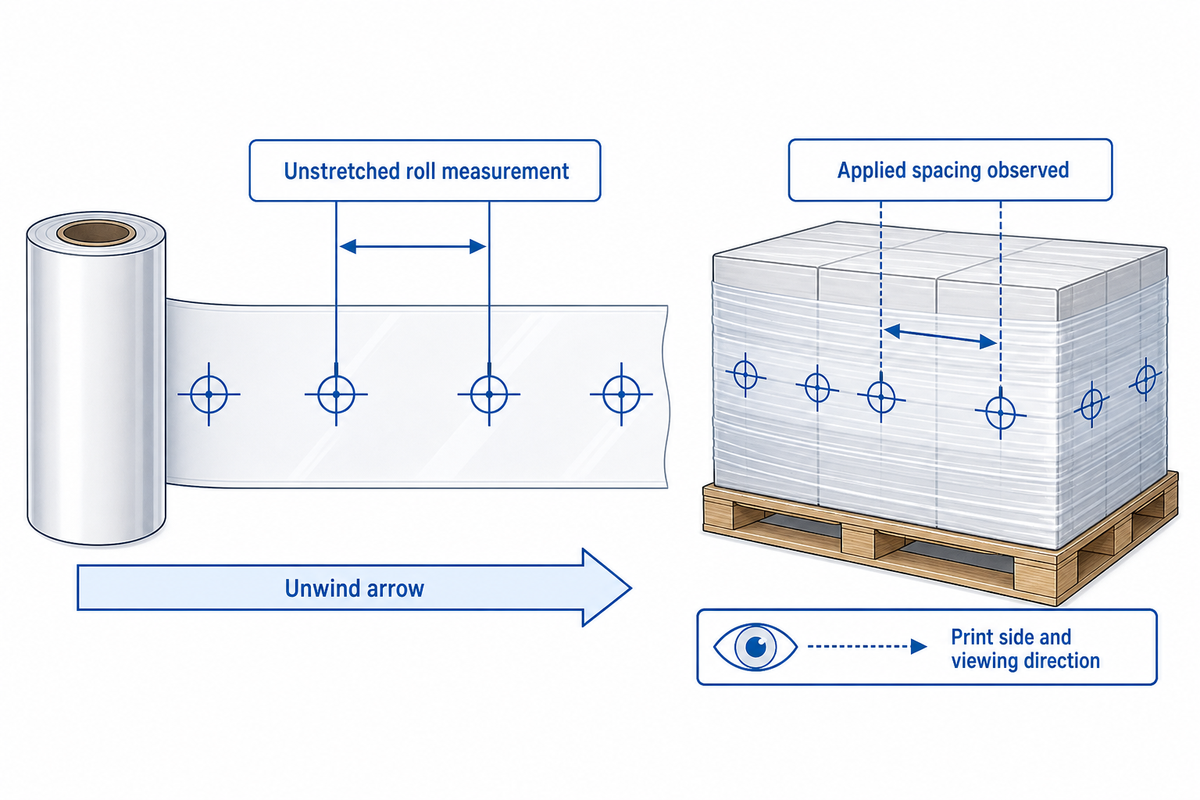
Roll repeat is the distance between equivalent points in successive printed images in the specified film state. Approve the unstretched measurement separately from appearance on the load. Pair an unwind arrow with print side and viewing direction so that converter and operator interpret the drawing the same way.
The Flexographic Technical Association includes checking unwind direction against the print surface in their press training. Request the supplier’s actual drawing rather than assuming a numbered wind code means the same thing everywhere.
Mark the print side on the same operator view photograph used in the Trial record.
Repeat and Orientation Test Card
A repeat and orientation test card links roll drawing, applied measurement and artwork revision to one specific Trial.
| Field | Example entry | Decision it supports | Limitations / Not suitable for |
|---|---|---|---|
| File and sample identity | Artwork rev. 3; trial A | Link sample to drawing | Unidentified roll substitution |
| Unstretched repeat | 300 mm, center to center | Check roll against drawing | Using logo width instead |
| Film and core | 500 mm web; 76 mm core | Confirm equipment fit | Assuming universal availability |
| Unwind viewpoint | Operator-side photo with arrow | Confirm reading orientation | Unexplained wind-code number |
| Applied repeat | 600 mm on photographed flat face | Compare observed spacing | Whole-load inference from one face |
| Overlap | 200 mm, measured on test face | Locate obscured artwork | Changing overlap without load review |
| Elapsed time | 10 min after wrapping | Identify measurement state | Assuming later readings match |
| Temperature | 23 °C at recorded location | Describe trial environment | Claiming hot-route validation |
| Release decision | Appearance observed; handling pending | Prevent premature order release | Calling the load fully approved |
Hypothetical repeat calculation: start with a 300 mm unstretched repeat and assume uniform, measured elongation of 100%. The arithmetic is 300 mm × (1 + 1.00) = 600 mm. At 200% elongation, the same calculation gives 300 mm × (1 + 2.00) = 900 mm. A buyer who interprets “200%” as “twice the original length” would specify the wrong expectation. Those figures describe idealized length change, not a guarantee from a wrapper dial. Actual application includes pre-stretch, further extension toward the load, relaxation, corners and overlap. Measure the visible spacing on the sample and record when and where the measurement was taken.
Wrap Tite warns that overlap can obscure a printed logo. Even a correctly measured 300 mm roll repeat therefore leaves placement unresolved. If procurement wants a readable mark on every face, state that as an observed trial requirement, with agreed viewing distance and faces, rather than calculate approval from pallet circumference alone.
Apply the sample on the actual wrapping setup
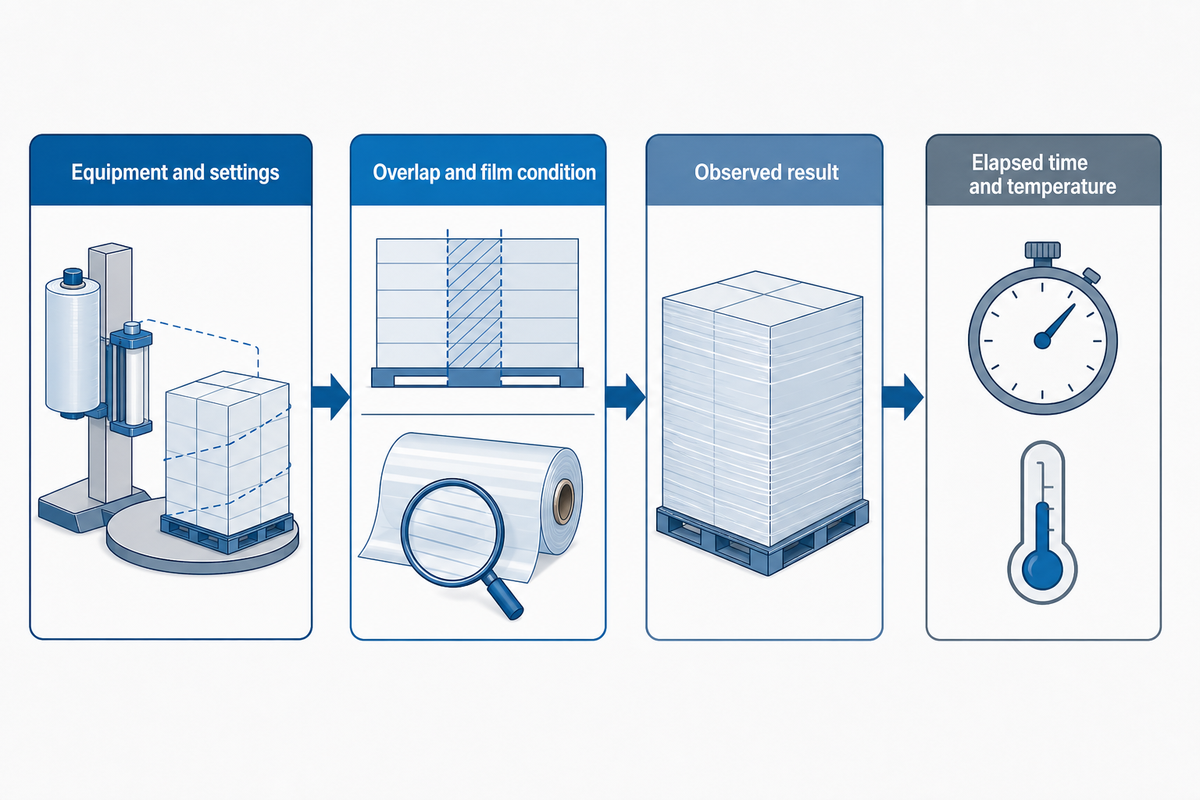
Sample applications must reproduce the roll format and the load and wrapping processes to the extent the trial allows. Record equipment identity and settings, as well as overlap, film condition, and the observed result. Record elapsed time and temperature. An immediate photograph cannot describe the behavior of the film throughout storage and transportation.
Virginia Tech’s stretch-wrap research summary differentiates pre-stretch between machine rollers from post-stretch toward the load. Its time-and-temperature study used uniform rigid loads and didn’t assess printed graphics. Use the findings to describe the conditions encountered, not to estimate percentage losses experienced, for the shipment in question.
What gauges and roll sizes can I order?
Orderable gauges and dimensions vary by supplier and printed-film construction. As one published example, Brown and Pratt offers 18-inch × 1,500-foot hand film at 80 gauge, with four rolls per case. Consider that named vendor format, and request actual converter’s width, length, thickness and core specification.
UD Packaging’s standard hand-film inquiry fields include 450/500 mm widths, 12–25 µm thickness and 50/76 mm cores. Those fields don’t establish a printed offer. Compare hand stretch film and machine stretch film formats against the intended operation. Use the film specification reference when quotations use different units.
Take note of both cast stretch wrap and blown stretch films based on documented facts and final results. Gauge won’t completely resolve strength, puncture and tear resistance or efficient film consumption. Different wrapping machines require their respective setup records. A tight-looking load isn’t a containment measurement. Staff should request test conditions before accepting broad descriptions such as “great cling” or “versatile.”
Approve the product after stretch and handling checks
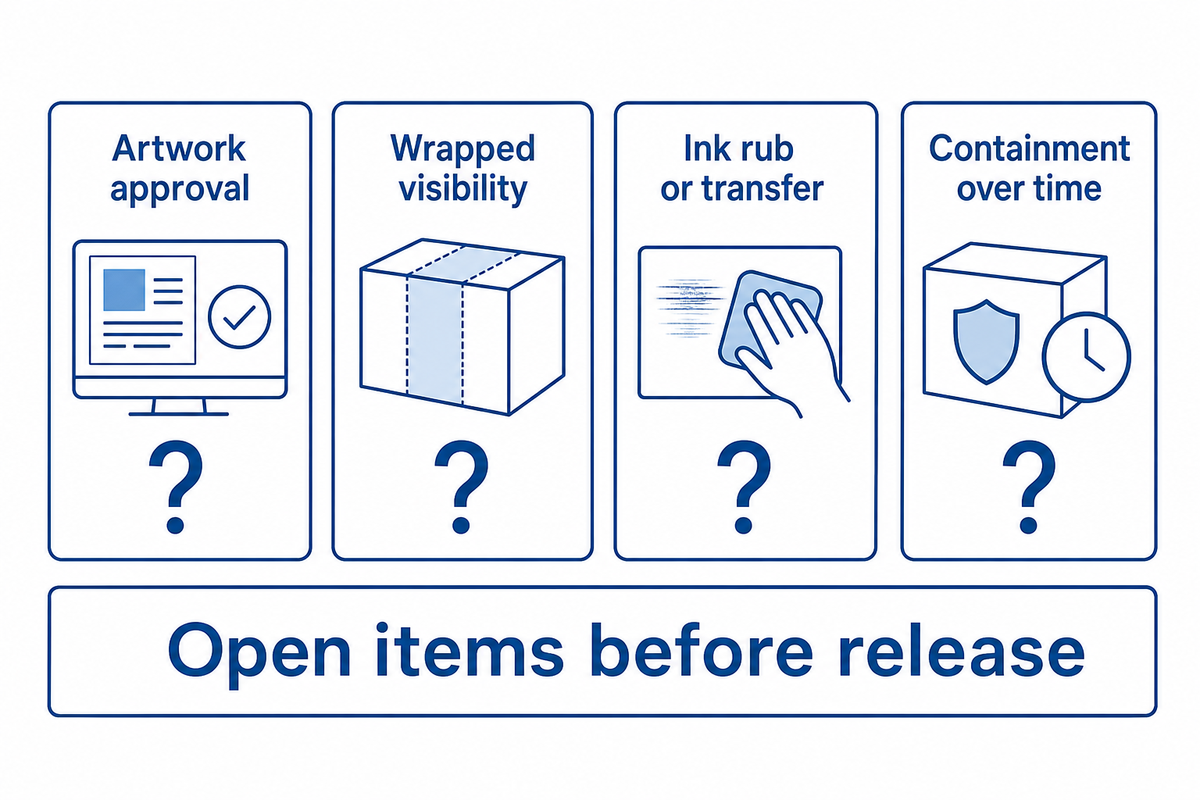
Product approval should indicate which evidence supported the decision and which questions are still open. Artwork, flat print, wrapped visibility and load performance are distinct. Let the brand owner approve design, quality staff examine material evidence, and the operations owner confirm the agreed application trial before the procurement releases the order.
Proof Boundary Record
A proof boundary record pairs each approval with its evidence, accountable owner and explicit exclusion.
| Approval subject | Evidence to retain | Owner | Limitations / Not suitable for |
|---|---|---|---|
| Text and artwork | Signed revision | Brand owner | Load-performance approval |
| Color and background | Agreed physical reference | Brand and QA | Screen-only color acceptance |
| Roll repeat | Unstretched measurement | Converter | Predicting applied spacing |
| Unwind orientation | Viewed-side drawing and sample | Operator | Ambiguous wind codes |
| Wrapped legibility | Face photos and viewing conditions | Operations | Untested loads and settings |
| Ink rub or transfer | Agreed specimen method and result | QA | Inferring containment |
| Containment over time | Measurements with time/temperature | Packaging specialist | Immediate appearance alone |
| Handling route | Applicable trial plan and findings | Logistics and QA | Vibration as every route event |
| Commercial release | Approved records and open-item closure | Procurement | Unapproved material substitution |
ASTM D5264-98(2019) covers comparative abrasion testing of printed materials on flat substrates. Confirm specimen suitability with the lab and agree on the test criteria. Rub tests and applied-load trials, for example, address different questions.
“No direct correlation between these test results and actual field performance has been established.”
D5415 evaluates vibration containment performance; mechanical handling is not discussed explicitly. ASTM D4649-20(2025) describes selection and provides tips for indoor use. It does not address outdoor performance. Neither public scope defines a universal printed-film acceptance threshold.
When not to buy the printed film yet
Hold the production order if the converter is unable to connect the sample roll to the quoted construction and artwork revision. An inexpensive sample with a different ink system or base film leaves the purchaser unable to identify what construction was approved. Ask for the missing identity record before comparing prices again. Likewise unreadable markings, print transfer or tears require an agreed corrective trial rather than being told that a sample from the production batch will look better.
Delay release for proposed approval extending beyond trial. An indoor sample at 23 °C doesn’t support outdoor exposure or a hot transport route. An ink-rub result doesn’t indicate food-contact safety. For a changing brand campaign, finance should also check whether the minimum order can be used before the artwork expires. Plain film with a separate message may reduce obsolete custom stock. It’s a buying decision to evaluate against a real order quantity. It’s not a guaranteed saving from this checklist.
Freeze the purchase order and repeat-order record
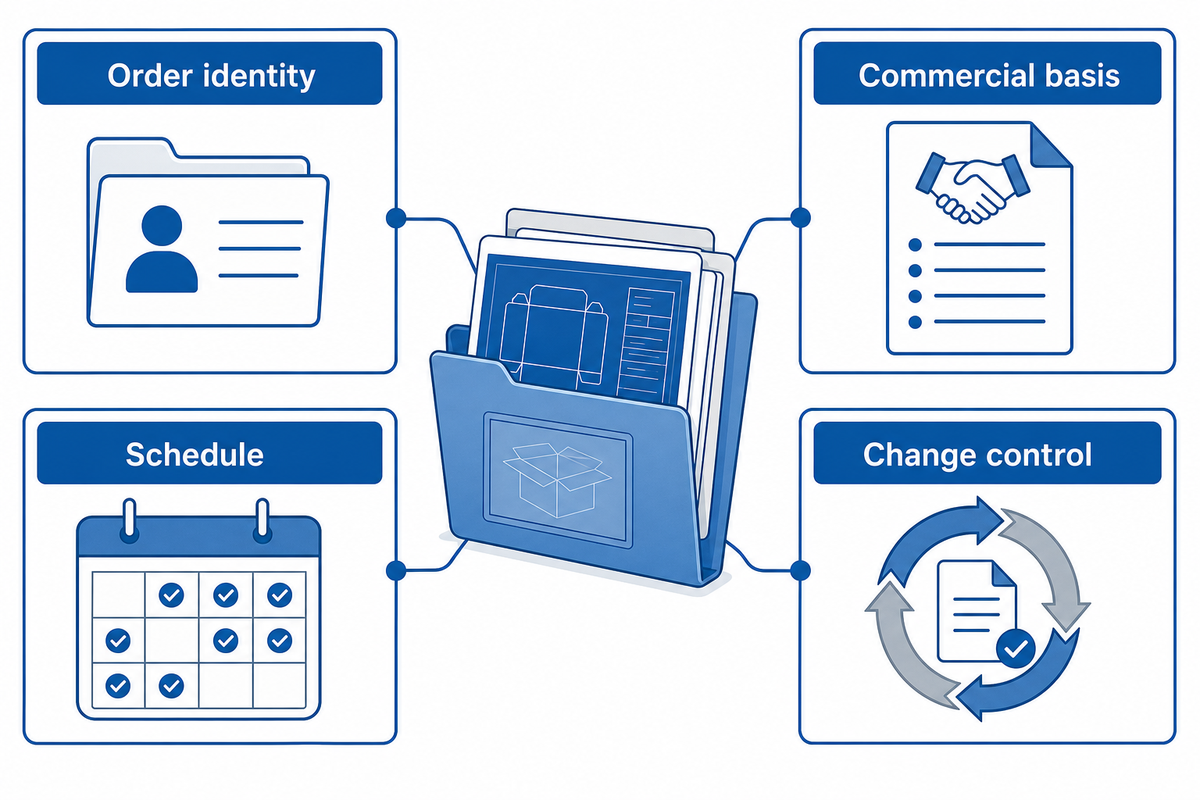
A repeat order should reference the approved film, ink system, artwork revision and application record, quantity and delivery terms. Separate setup charges and recurring roll costs. Name the person who approves changes to prevent a reorder from using a different construction or releasing an obsolete design.
Ask a wholesale supplier the minimum allowable per artwork, rolls per case, net film quantity, plate ownership, storage terms and freight basis. Brown and Pratt states an initial lead time of 5-6 weeks after artwork approval and 3-4 weeks for repeat orders using the same artwork. Those are specific to the supplier, not UD Packaging delivery commitments.
Keep one purchase record attached to the order
- Order identity: supplier and quotation number, linked to the approved artwork revision and trial sample.
- Commercial basis: confirmed minimum per design, quantity units, film price, and separate plate or setup fees.
- Schedule: supplier-confirmed starting event and expected date for both the first order and each repeat order. Don’t assume the repeat clock starts at artwork approval.
- Change control: named revision owner, changes requiring another trial, and the person authorized to release the revised order.
Hypothetical reorder decision:Procurement receives a lower roll price for the next shipment, and the plant manager wants to maintain the previous wrapping speed. The quote names the old artwork but switches to a different film. Finance sees an immediate price benefit; the quality staff is unable to correlate the proposed film with the approved sample. The buyer therefore requests a separate quotation line for unchanged film and a trial option for the alternative. Compare the film used per accepted load, trial waste and any operator time added, prior to making a decision. If the alternative film has different print visibility or load containment, the lower roll price hasn’t proven to be a lower operating cost.
For a 500 mm-wide trial, record the measured overlap in mm and state the roll identity along with the purchase specification. A reorder that varies the width, ink, print side or wrapper setup needs the affected checks repeated. Retaining the original drawing without the application record would keep only part of the approved solution.
Keep the sample and the decision together
Release the order only when the artwork, material, applied result and commercial terms identify the same product. Preserve unresolved items explicitly; a signature should never imply a test that was not performed.
Frequently asked questions
How much does stretch film cost?
Compare the complete order basis.
Compare quotations on the same film specification, roll quantity and delivery basis. Printed film can add artwork, plate and setup charges, so a roll price alone is incomplete. Ask whether those charges recur, when the lead time starts, and what sample approval is included before comparing the cost of an order.
What is the purpose of stretch film?
Film helps hold the load together.
Stretch film helps hold goods together on a pallet during handling, storage and transport. Printing adds a repeated brand mark or handling message, but the film still has to suit the load and wrapping process. Check containment and legibility separately; an attractive logo doesn’t show that a shipment is adequately secured.
Is stretch film the same as shrink wrap?
The application processes differ.
Stretch film is pulled around a load under tension, while shrink film tightens when heat is applied. Printing doesn’t remove that difference. Tell the converter whether your equipment stretches or heat shrinks the film, and approve the correct material and application process before reviewing artwork, samples or a production quotation.
What is another name for stretch film?
Stretch wrap and pallet wrap are common terms.
Stretch wrap and pallet wrap commonly describe stretch film. Hand wrap and machine wrap identify application formats. Include the actual roll specification when ordering, because a familiar trade name alone doesn’t establish dimensions, print capability or suitability for your load.
Which printed stretch film is strongest?
Compare the applied system.
A thickness number or a cast-versus-blown label can’t select the best film for every load. Compare the candidate on the actual pallet being shipped, including corners, load shape, wrapping pattern and handling conditions. Then inspect tears, containment and print readability together. Request the supplier’s test method and conditions for any strength claim, and distinguish laboratory film properties from the performance of a wrapped load. Approve a specific film and application combination rather than buying a generic strongest-film claim.
Can printed film be pre-stretched?
Confirm where pre-stretch occurs.
Ask the converter whether the quoted film is pre-stretched before delivery and whether the print is approved for that construction. Specify the intended hand or machine application. A pre-stretched product and a powered pre-stretch wrapper describe different parts of the process.
Is printed stretch film safe for food contact?
Suitability depends on the intended use.
Do not infer food-contact suitability from use around food shipments. Identify whether film or ink can touch food, then request documentation for the specific construction and conditions of use. Outer pallet wrapping and direct food contact are different applications. The FDA’s food-contact framework addresses intended uses; a generic material description or clean-looking sample is insufficient. Confirm the supplied material and destination requirements before making an approval decision. A document covering unprinted polyethylene does not automatically cover a different ink, contact surface or use.
Establish the standard-film baseline
Review UD Packaging’s load-assessment inputs and send your current roll dimensions, application method and load requirements for assessment. For printed-film sourcing, use the records above to confirm the converter’s capability and trial scope separately.
Basis and limits: This document combines public supplier information, research synopses and public scopes of standards that were checked in October 2026. The tables are sample buying aids. The worked examples are fictitious. They don’t represent UD Packaging test results, certifications or confirmations of a custom printed film offer.
References & Sources
- Serial Shipping Container Code GS1.
- Position the barcode correctly GS1 Sweden, pallet-label guidance.
- US20060260279A1 public patent disclosure, separate banner-film construction.
- White ink coating weight and film type in gravure printed flexible packaging Eller and D’Amico, Journal of Print and Media Technology Research, 2022.
- Ink solutions for surface and reverse printing on flexible plastic packaging RecyClass test-campaign summary.
- Flexographic Narrow Web Employee Development Training Program Flexographic Technical Association, Module 1.
- Effect of Time and Temperature on Stretch Wrap Virginia Tech, Spring 2019 research summary.
- ASTM D5264-98(2019) ASTM International, public scope for printed-material abrasion testing.
- ASTM D5415-95(2025) ASTM International, public scope for vibration containment testing.
- ASTM D4649-20(2025) ASTM International, public stretch-film selection and application scope.
- Food Packaging & Other Substances that Come in Contact with Food U.S. Food and Drug Administration.