Get in touch with UD Packaging Company

Brick Strapping for Cooled Bundles: From Coil to Arrival

By XCX · Updated October 2026
Brick strapping connects a group of bricks with tensioned bands and joints. To select a polyester strap begins with the actual cooled bundle, its corners and the handling route. A roll specification helps select material; the complete pack trial decides if that selection was right. Use the following six checks to connect the delivered coil to the joint and edge condition and arrival record before agreeing to a production change.
Buyer starting point: Identify the load and the exact strap and the approval person. Enter any missing acceptance limits as a hold. This guide provides a purchasing worksheet; qualified plant personnel must describe the handling and test procedure.
What brick strapping must hold
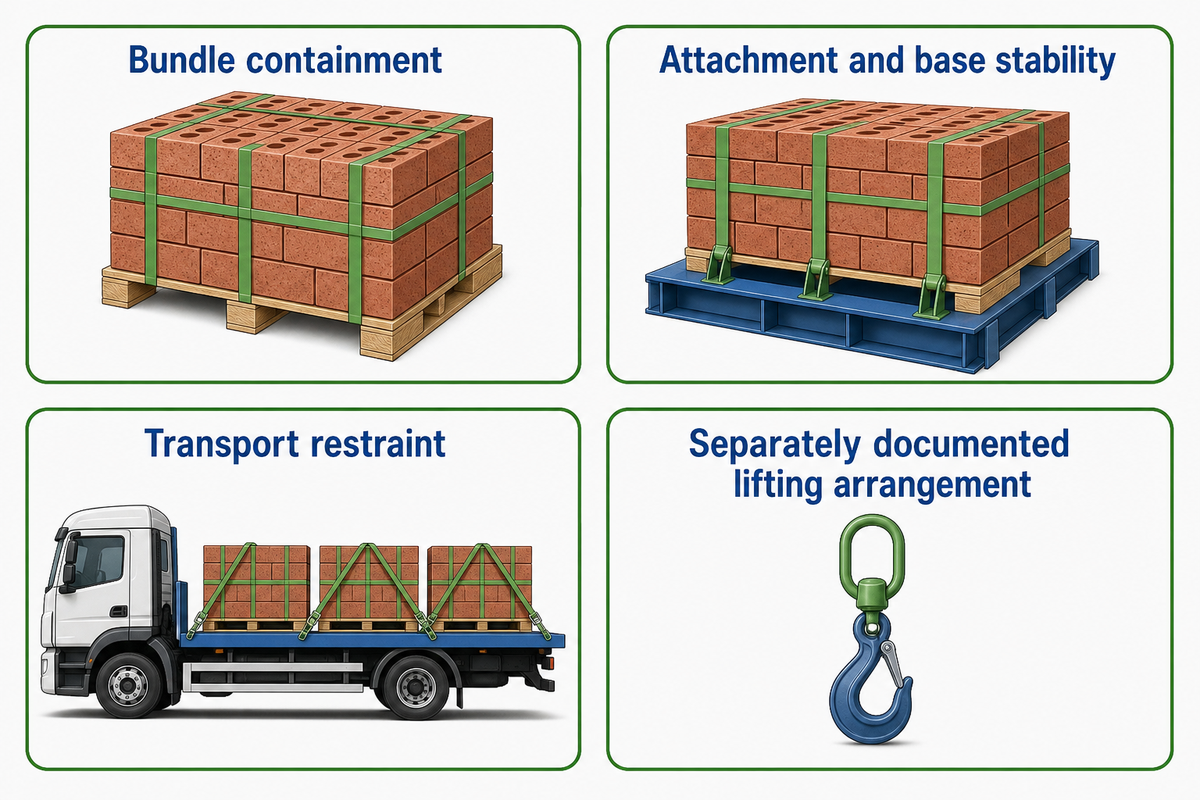
There are different boundaries for a brick bundle and its attachments to a pallet and their respective restraint to a vehicle. Locate which boundary the proposed band crosses. A sound packaging joint may unitize the bricks, but that doesn’t by itself determine the suitability of the pallet, transport restraint or a lifting arrangement.
Read the FMCSA Cargo Securement Rules for the United States vehicle boundary: cargo must be secured adequately to the vehicle using a system that meets the applicable requirements. Packaging strapping is one element of the load description. The arrangement of the vehicle requires its own assessment, even if all the bands are intact.
Mark these boundaries on the pack photograph
Bricks ↔ surrounding band: bundle containment.
Bundle ↔ pallet: attachment and base stability.
Cargo ↔ vehicle: transport restraint.
Pack ↔ lifting equipment: separately documented lifting arrangement.
What is the strapping process?
The general brick strapping sequence is: Present a stable pack, position the specified band, apply tension with compatible equipment, form the approved joint and check the result. The plant procedure and actual tool instructions govern that work. Tight appearance or completion of a machine cycle doesn’t indicate that the entire load has passed its acceptance criteria.
Keep the receiver in that process. OSHA’s 2008 interpretation of stored brick shipping units describes stability as a combination of the arrangement, wrapping and pallet. Removing effective restraint changes those conditions. Agree on a receiver side opening plan before shipment; this isn’t a direction to cut bands from an unsupported stack.
Record the cooled brick bundle before choosing a strap
Record the brick type, gross pack mass, dimensions, stack pattern and base before selecting plastic strap. For recently fired brick, include actual strap contact conditions, rather than relying on cooling time or air temperature. The documented operating envelope of the chosen grade, and the trial representing the actual route the pack takes, are mandatory.
The public scope of ASTM D4675, guidance on strapping selection and use, considers selection as an initial step to testing. The application factors include mode of handling, transit and storage. A smooth sample on the packing bench therefore answers a narrower question than an abrasive, palletized bundle moving through the customer’s transit route.
Illustrative hold: A sample brief is submitted for a 16 mm band. Procurement has photos and a coil quote. Quality has recorded the brick dimensions. The brief states, “cooled overnight.” There are no recorded strap-contact temperatures or recorded time-and-temperature conditions approved for the grade. The team can evaluate the commercial scope, but the material change decision is on hold. Quality adds a measured contact record. The supplier defines the proposed grade and its limits. The plant then establishes representative trial conditions. This sequence is to prevent the team from assuming the absence of a visible hot surface means the application temperature is acceptable.
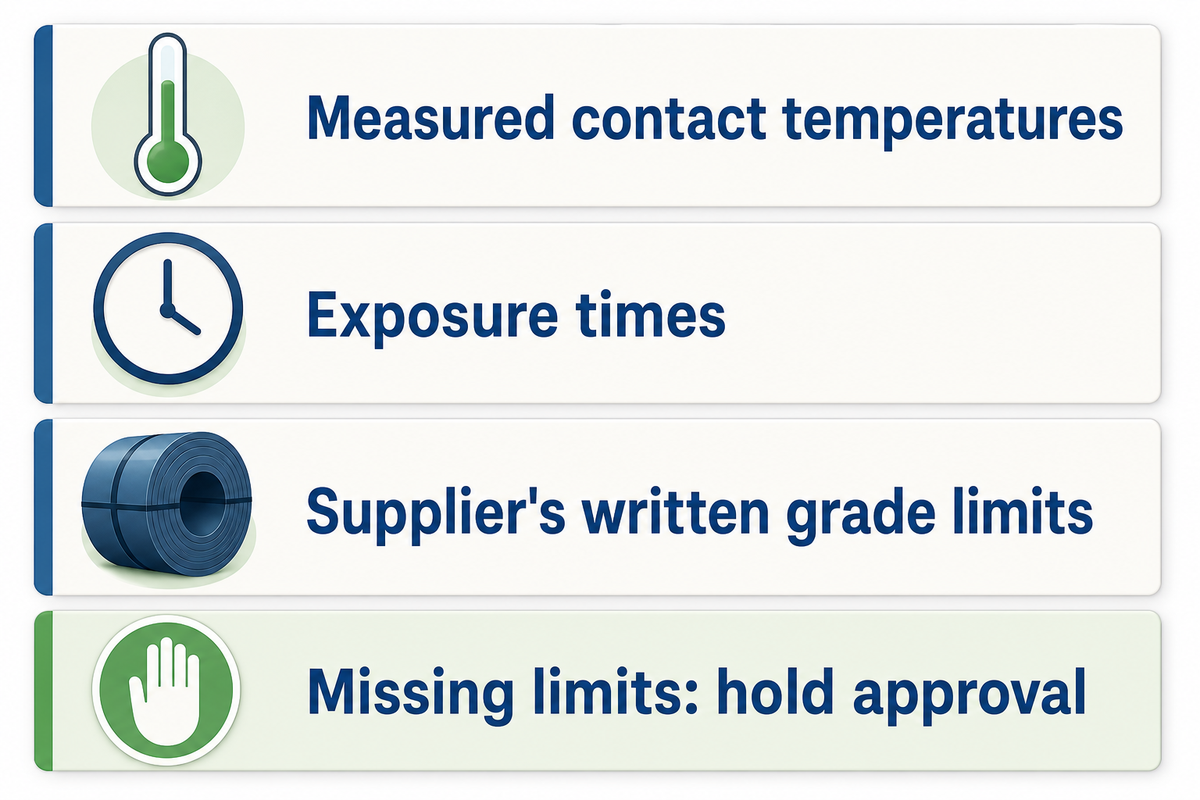
Specification checkpoint: A 16 mm width identifies a nominal band dimension, not a temperature rating. Put measured contact temperatures, exposure times and the supplier’s written grade limits on the same trial sheet. If limits are absent, a hold on approval is warranted.
PET coil specification: six published formats
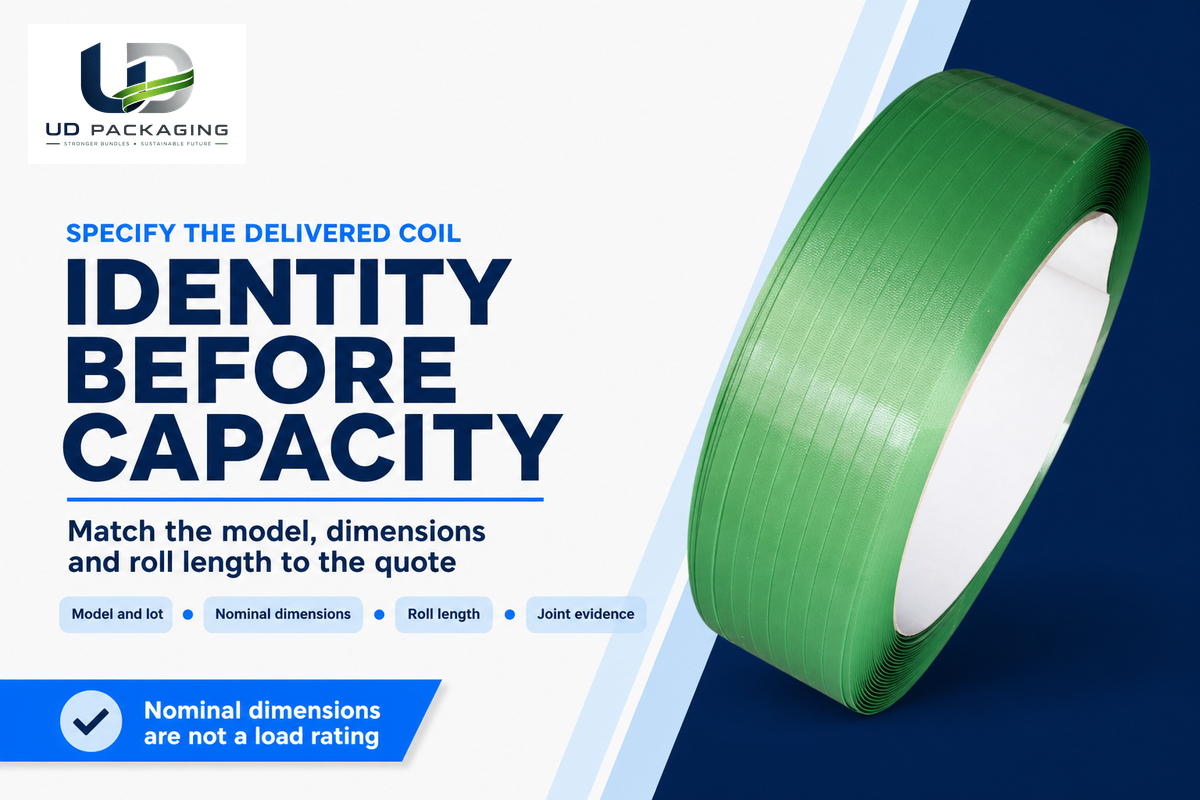
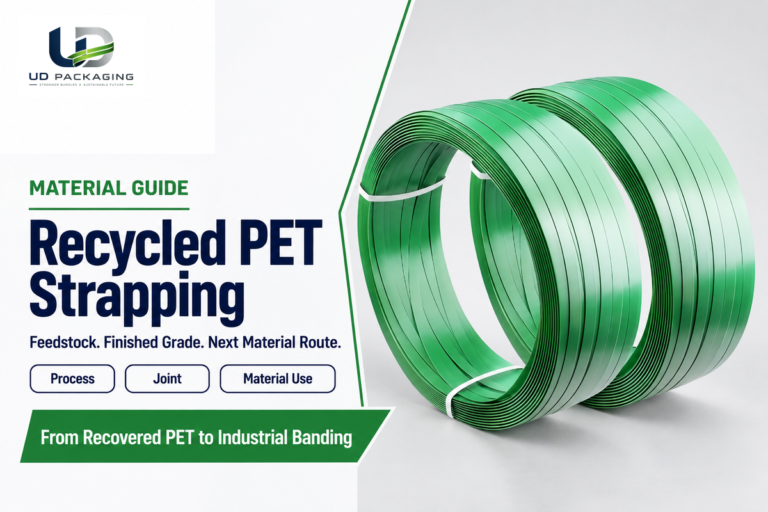
UD Packaging has six PET coil formats for construction materials, spanning three nominal widths and a few thicknesses. Use those to identify a sample or quotation. They don’t assess complete-load performance. They do not rank complete-load performance: a longer roll, thicker band or higher linear mass cannot establish the required strap count, joint result or safe brick-pack load.
| Model | Width | Thickness | Linear mass | Roll length | Net roll mass |
|---|---|---|---|---|---|
| 1206 | 12 mm | 0.6 mm | 9.36 g/m | 2,140 m | 20 kg |
| 1606 | 16 mm | 0.6 mm | 12.5 g/m | 1,600 m | 20 kg |
| 1608 | 16 mm | 0.8 mm | 16.6 g/m | 1,200 m | 20 kg |
| 1610 | 16 mm | 1.0 mm | 20.8 g/m | 960 m | 20 kg |
| 1908 | 19 mm | 0.8 mm | 19.8 g/m | 1,020 m | 20 kg |
| 1910 | 19 mm | 1.0 mm | 24.7 g/m | 800 m | 20 kg |
These nominal entries come from UD’s published construction product data, not calculated tolerances. Request core dimensions, winding direction and dispenser fit separately. Multiplying nominal linear mass by roll length need not reproduce exactly 20 kg; don’t silently edit the supplier’s values.
What is the maximum load capacity of this PET strap?
The table doesn’t set a limit for brick load capacity. Bare-band break strength, the applied joint, strap path and contact conditions of the pack address different questions. Request the actual grade’s test report and a complete applied system test. A pallet weight alone isn’t enough to select one of these models or to define the number of bands.
ASTM D3950’s public abstract distinguishes material and joint properties. A specimen result must stay attached to its test conditions; it cannot be promoted into an all-model rating. A separate guide to joint strength evidence explains the reason for a joint’s evidence record to be separate.
A 19 mm × 1.0 mm model and a 16 mm × 0.8 mm model describe different nominal bands. Keep their coil identities separate during sampling. Neither dimension pair provides a working-load rating, and selecting the thicker option doesn’t relieve the responsibility to assess the joint and corners.
Match the strapping machine, tensioning and joint
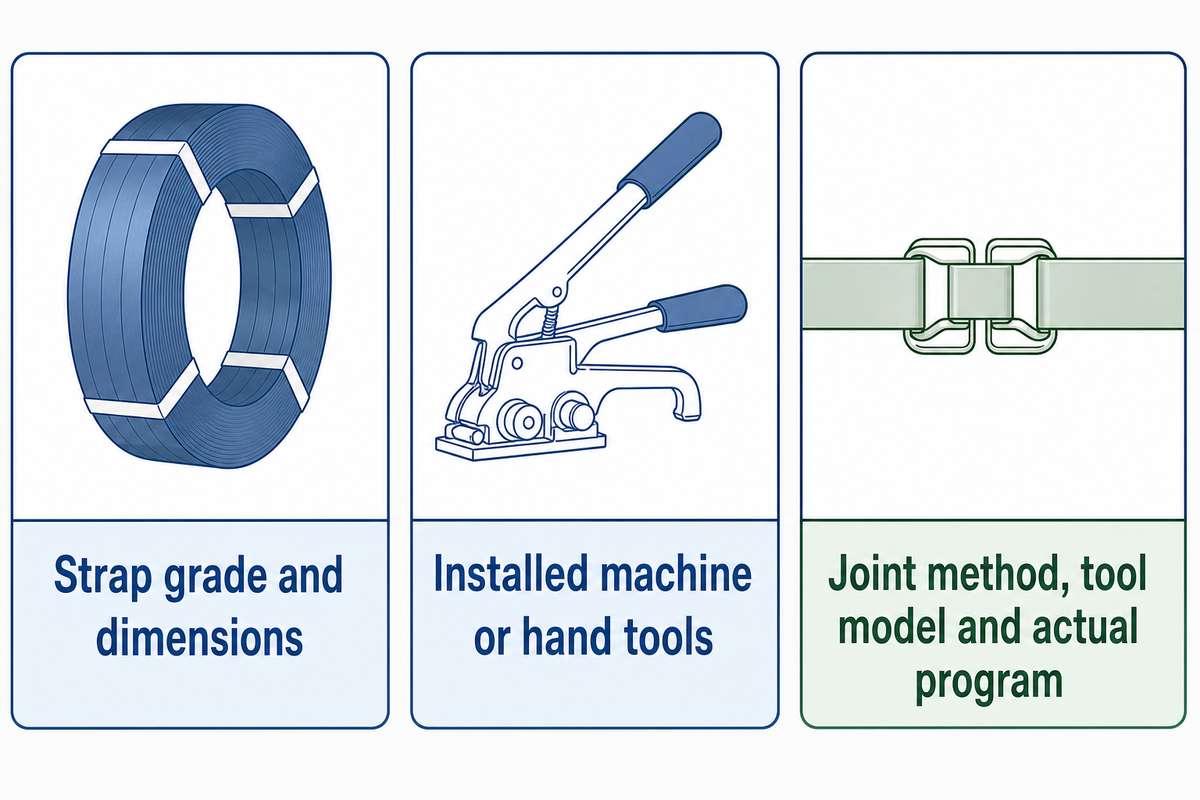
Match the strap grade and dimensions to the installed strapping machine or hand tools before comparing tension settings. Record the joint method, tool model and actual program. A setting on one tensioner isn’t proof for other strapping equipment, and a strapper completing its cycle says nothing by itself about joint performance after handling.
ASTM D3950-23, the nonmetallic strapping specification, publicly lists breaking strength, elongation, transverse strength and applicable joint strength tests. It covers properties that a buyer can request; citing the standard does not verify delivered PET straps.
On Practical Machinist, a historical machinery-shipping discussion differentiated a roller tensioner from a separate seal, and asked for equipment needing no air or electricity. The purchasing lesson is: what joining hardware and utilities does the proposed packaging system require? That discussion isn’t a brick trial.
| Quoted type | Ask for | Limitations / Not suitable for |
|---|---|---|
| Manual strapping | Matched tensioner, sealer and band | A kit label without joint compatibility |
| Separate hand tools | Seal type and joint inspection method | Substituting a similar-looking seal |
| Electric battery tool | Approved grade, gauge and charging provision | Assuming every handheld tool takes every width |
| Pneumatic tool | Specified air supply at the workstation | An unverified plant air connection |
| Semi-automatic station | Operator tasks and pack presentation | Using cycle time as complete-line output |
| Automatic strapping machine | Feed path and actual pack trial | A carton demonstration as brick evidence |
| Fully automatic strapping machines | Conveyor interface and fault recovery | Ignoring upstream palletizing delays |
| Side seal arrangement | Head access and joint location on the pack | An inaccessible joint inspection position |
| Modular strapping head | Exact module and control integration | Treating modules as interchangeable |
When should I choose plain versus embossed finish for strapping?
Use the approved surface for the exact tool or head and the proposed grade. An emboss pattern is a product feature, not proof of better grip or stronger joint. Contact the equipment supplier to confirm feed, tensioning, and joining compatibility of the actual sample, rather than accepting a generic smooth-versus-textured recommendation.
Add guides and the pulley path in the check where the machine uses them. For a semi automatic station with a foot pedal, add the operator sequence as well. Indicate surface finish on the sample sheet so a replacement coil can be checked against the sample. Compare polyester strapping tool options against the installed configuration, not against an unrelated production line.
Run the 6-Check Corner-to-Arrival Trial Card
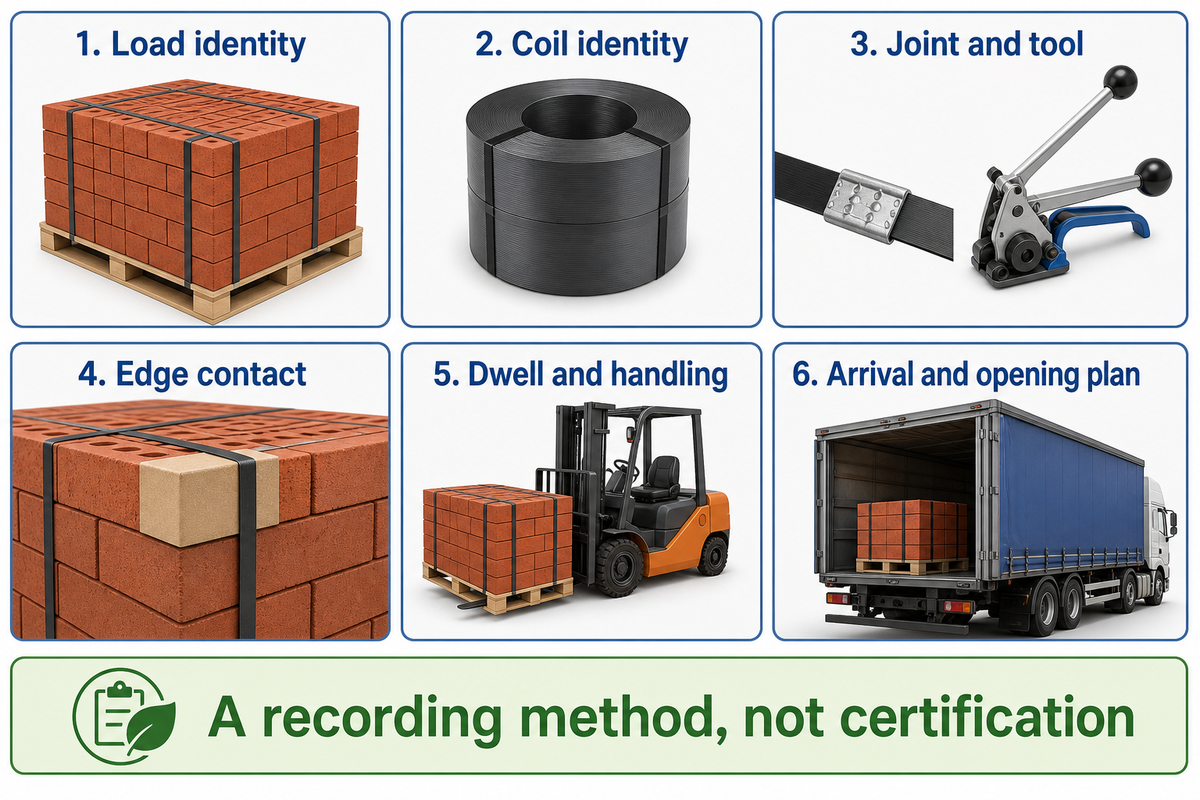
The 6-check corner-to-arrival trial card is an editorial recording method for a buyer’s approved sample trial. It connects the pack identity to six observations and a named decision owner. Acceptance criteria should be defined prior to the sample trial; a completely filled out sheet records evidence but in and of itself, doesn’t validate the packaging system or certify compliance.
| Check | Record on the same sample ID | Decision owner |
|---|---|---|
| 1. Load identity | Brick dimensions, stack, mass, base and contact conditions | Plant and quality |
| 2. Coil identity | Model, grade, lot and nominal dimensions | Procurement and quality |
| 3. Joint and tool | Tool/head, program, join and agreed inspection result | Plant technician |
| 4. Edge contact | Strap path, protector identity and before/after photographs | Quality |
| 5. Dwell and handling | Duration, route, observations and every intervention | Plant and logistics |
| 6. Arrival and opening plan | Original or changed configuration, receiver observations and opening conditions | Receiver and qualified approver |
Record retensioning, rebanding, replacement protectors, or opening as interventions. The public ASTM D4169-23e1 distribution-testing scope distinguishes an unopened performance-test sequence from development inspections that may affect evaluation of closure performance. Apply that distinction to your records, without describing this worksheet as a standard-compliant laboratory test.
Illustrative changed result: A trial sheet identifies model 1608, nominally 16 mm × 0.8 mm, and photographs the original corner protection. At an intermediate stop, the team replaces a protector and applies a new band after damage is observed. The replacement pack later arrives with acceptable visible corners. Logistics records that result, but quality doesn’t mark the original configuration “passed.” The intervention changed the system being observed. The approver retains the original damage record, identifies the replacement configuration and decides what further evaluation is needed. At this point, Procurement can distinguish a successful recovery action from evidence that the first packaging choice was adequate.
“Storage of material shall not create a hazard.”
For the illustrative 16 mm x 0.8 mm trial, a replaced band creates a changed configuration even if its model number stays the same. Keep the first and the replacement records together. An acceptable arrival photograph of the repaired pack can’t erase the earlier failure observation.
Compare PET and steel on the same brick load
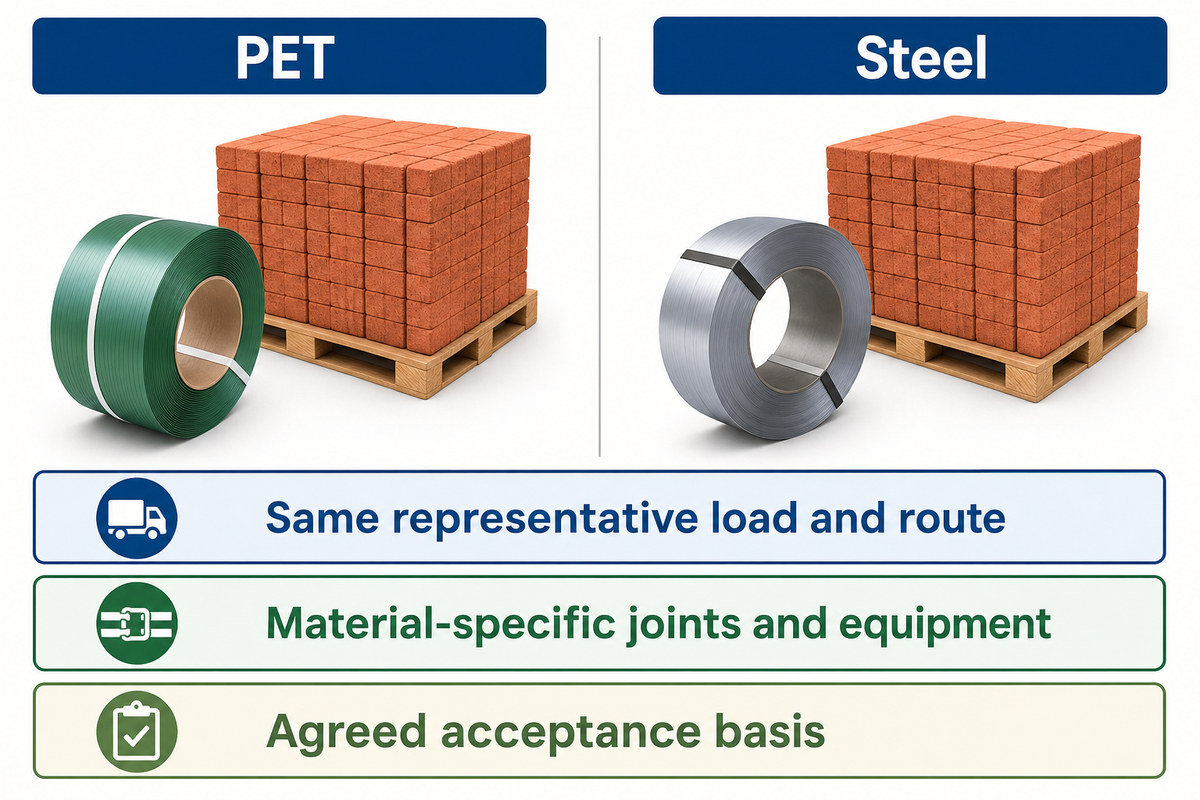
Compare PET and steel strapping as complete applied systems on the same representative load and route. Keep the material-specific joints and equipment requirements evident. Similar tensile strength figures don’t equate to the same performance at an abrasive corner, after pack settlement or after handling. The decision requires the relevant observations and an agreed acceptance basis.
Record the actual steel strapping coil specs used as the baseline. “Heavy duty” and “high strength” are descriptions, not interchangeable test results. The presence of a heavy-duty system on steel coils doesn’t prove acceptability for strapping bricks. Ask what changes: joint, protector, tool settings, strap path and acceptance criteria. Only compare elasticity claims with their stated test conditions; a material data label isn’t sufficient.
When not to approve a material change
Keep a change on hold if the baseline is undefined, there is no applicable evidence for the proposed joint, or the agreed load trial is incomplete. UD’s own guidance states that not all increased force in a bare band results in greater stability. ASTM D4675’s application-specific scope is stronger evidence to test the complete system.
An edge cut or slipped joint requires further investigation against the agreed criteria. Just increasing the tension can change the loading at the same corner; this doesn’t provide the cause for the set up failure. Decide who’s the judge for the observation and what evidence is needed before the next trial. Don’t use a ‘bundle lookin’ good’ outcome where a retained tension result was unmeasured.
Material names won’t work here. Polypropylene strapping, woven polyester and PET have different product constructions and joining requirements. Polyethylene wrapping could also be part of the pack, but it can’t serve as a substitute specification for any band. Use the PET and steel comparison to frame questions, and verify the actual configuration.
A 19 mm candidate also needs its own grade, joint and edge-contact evidence; width doesn’t make it equivalent to a steel band. Compare accepted complete-pack results under the agreed route. Without those results, purchasing has a candidate for evaluation rather than an approved replacement.
Build a comparable brick strapping quotation
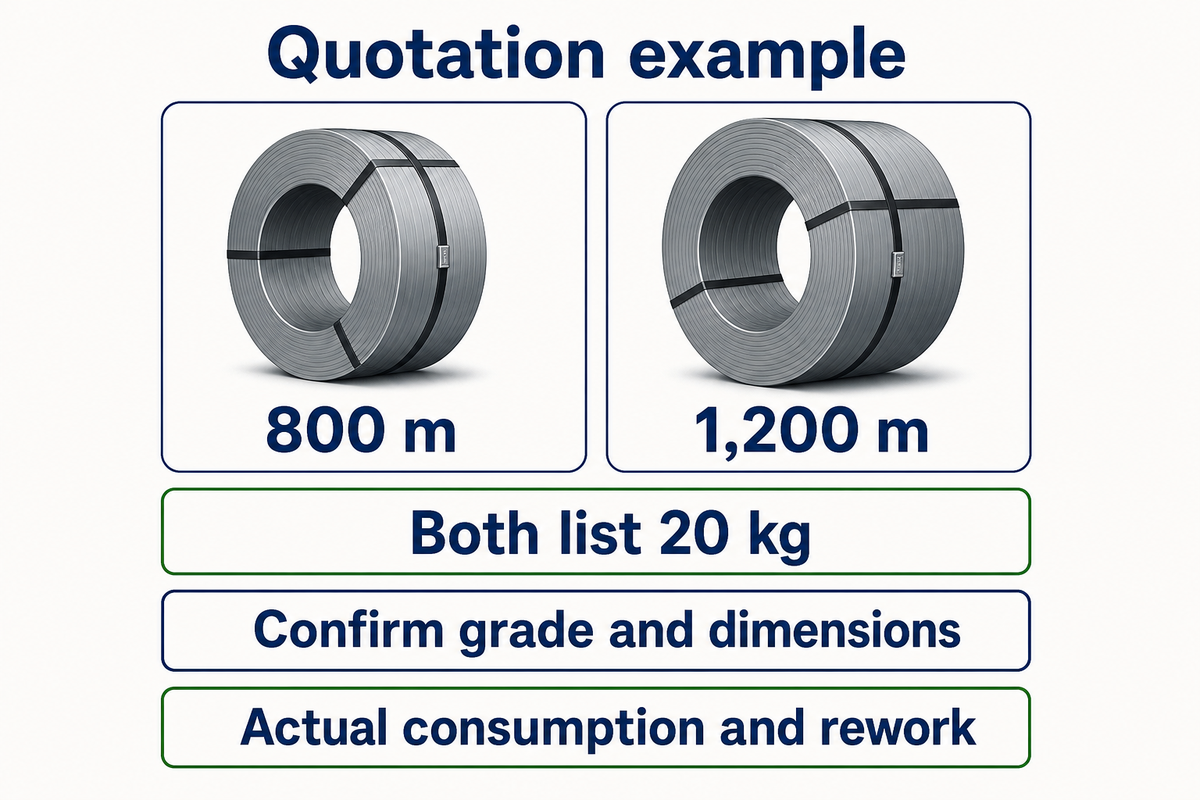
An equivalent quotation describes the same load, delivered material and scope of application. Request roll length as well as price, and then separate equipment, protectors, freight and trial work. Finance needs the cost of an accepted packaging result. Procurement can’t calculate that from a roll price, when consumption, rejection and rework remain unknown.
| Missing item | Who resolves it | Buying decision | Limitations / Not suitable for |
|---|---|---|---|
| Grade and nominal gauge | Supplier | Identify the offered product | Generic “PET band” offers |
| Roll length and core | Procurement | Compare delivered supply and fit | Equal roll counts with unequal lengths |
| Joint consumables | Plant | Include applicable seals or join costs | Unspecified joint method |
| Edge protection | Quality | Price the tested protector | Cheaper untested substitution |
| Tool and utility fit | Plant | Include installation requirements | Unsupported compatibility claims |
| Consumption per pack | Plant | Measure the actual approved pattern | Guessing from gross pack mass |
| Rejects and rework | Finance and quality | Separate observed from assumed costs | Invented savings percentages |
| Carrier configuration | Logistics | Confirm applicable transport requirements | Using unitization as vehicle approval |
| Destination and delivery basis | Procurement | Compare the same delivered scope | Ex-works and delivered prices mixed |
Illustrative quotation decision: A buyer receives one offer for a 1,200 m coil and another for an 800 m coil. Both are described as 20 kg rolls, so the initial comparison uses price per roll. Quality notices that the catalogue entries identify different dimensions: model 1608 is 16 mm × 0.8 mm, while 1910 is 19 mm × 1.0 mm. Procurement asks for separate, fully specified alternatives instead of treating the cheaper roll as the winner. Finance leaves savings uncalculated until the approved pattern, actual consumption and rework are known. No market price or performance advantage can be inferred from those roll labels alone.
Copy those requirements into the sample request. “Recommended range” below means evidence to state, not a universal operating setpoint.
RFQ checklist — send with pack photographs:
| Parameter | Recommended range | Why it matters | How to verify |
|---|---|---|---|
| Pack dimensions and mass | Measured mm and kg | Identifies the trial load | Recorded sample measurements |
| Contact conditions | Measured °C and exposure duration | Defines the thermal question | Grade-specific written limits |
| Coil | Exact model, mm, m and lot | Connects quote to sample | Label and specification match |
| Tool and joint | Exact model and approved program | Controls system compatibility | Supplier confirmation and joint evaluation |
| Route and dwell | Actual handling stages and duration | Defines representative exposure | Agreed trial plan and observations |
| Acceptance | Project-specific written criteria | Prevents retrospective pass decisions | Named qualified approver |
An 800 m quotation and a 1,200 m quotation describe different quantities, even when both list 20 kg. Confirm grade and dimensions prior to comparing commercial terms. Only measured consumption of the approved system connects the offered material price to packaging cost per accepted pack.
What evidence should a brick strapping supplier provide?
Ask the supplier to connect each claim to the offered grade, delivered lot and applicable test. The evidence should identify nominal dimensions, joint compatibility and the conditions and results of any test. A catalog, a single specimen test or a machine-capacity figure can’t establish acceptance of every brick bundle using that product family.
In the case of strapping solutions, request brick strapping machine demonstrations based on the actual pack geometry. Fully automatic strapping and higher work efficiency remain proposals until the plant’s feed, inspection and recovery tasks are included. An automatic strapping demonstration with an easy carton doesn’t reproduce an abrasive construction load.
UD’s published construction data can identify a 12 mm, 16 mm or 19 mm candidate. Send the coil identity along with the completed trial brief so the sales, plant and quality folks discuss the same strapping system. Use the resulting record to specify what may proceed and what still lacks evidence.
Frequently Asked Questions
How much does brick strapping cost?
Price depends on the specified material and delivered scope.
Request a dated quote for the exact grade, dimensions, roll length, quantity and destination. Include the applicable tools, joints, protectors and delivery basis. Compare cost per accepted pack only after actual consumption and rework are known. If one offer excludes protectors or freight, identify that difference before comparing totals. The six-format table provides nominal product inputs, not current market prices.
What is brick strapping?
It is packaging banding used to hold a brick bundle together.
The selected band, joint, edge protection and load arrangement work as a system. A packaging band isn’t automatically a vehicle restraint or lifting device. PET and steel banding describe different material routes; neither name specifies the whole pack. Identify where the band runs, how the ends fasten together and which handling conditions the proposed arrangement must withstand.
Can PET strapping be used on wet bricks?
Wet conditions must be included in the application assessment.
Ask for the exact grade’s limits and evaluate the joint, contact surfaces and complete pack under representative conditions. Don’t infer suitability from a generic claim about polyester or from a dry sample alone. Record the exposure and compare it with the approved trial plan. A change in storage or delivery conditions may require a new assessment even when the product model stays unchanged.
Where is brick strapping used?
Typical applications include packaged brick storage and distribution.
Specific applications differ in pack geometry, temperature, edges and handling. PET pallet strapping and unitizing require an arrangement selected for that actual load. Identify the boundary being restrained and the receiving conditions; a successful trial on one pack doesn’t automatically qualify another.
Is brick strapping safe?
Suitability depends on the complete system and its use conditions.
Qualified personnel must set handling procedures and acceptance criteria, including opening at the receiver. An unbroken band or a supplier’s high-strength description is insufficient evidence of complete-load stability. Keep the approved load, band, joint and route identified. Record any intervention rather than carrying the original approval forward to a changed configuration without assessment. Vehicle restraint and lifting arrangements need their own documented basis.
Why do PET roll prices differ?
Two roll quotations may describe different products and quantities.
Width, thickness, grade, nominal length, order quantity and delivery scope can differ. UD’s six listed formats range from 800 m to 2,140 m per nominal 20 kg roll. Identify those differences before treating two roll prices as comparable offers.
Does recycled PET automatically reduce the packaging impact?
A recycled-content label does not establish the whole packaging outcome.
Compare content, consumption, rejected material and the available recovery route on a stated basis. “Eco-friendly” alone provides none of that evidence, and it doesn’t establish joint or load performance. Ask what product the claim covers and how it was measured. Keep environmental comparisons separate from the acceptance trial, then use both records when selecting a supplier. Procurement can request the declared recycled-content basis, while the plant records actual consumed and rejected material. The receiver can identify whether the used band enters a documented recovery route. If those records are missing, leave the environmental comparison unresolved instead of converting a label into a savings claim. No verified environmental savings are claimed for the illustrative scenarios here.
Send the sample brief
Send UD Packaging pack pictures, measured conditions, proposed coil, installed tool and planned route. Also send the missing information and the trial’s decision owner. The construction packaging specification page has the published baseline. The Corner-to-Arrival record converts the published baseline to a focused sample discussion.
Related Articles
References & Sources
- ASTM D3950-23 public abstract for nonmetallic band and joint properties; full paid text not used.
- ASTM D4675-14a(2022) public selection/application scope, including the need for testing.
- ASTM D4169-23e1 public distribution-testing scope and the distinction between performance testing and development inspection.
- OSHA 29 CFR 1910.176(b) workplace material-storage requirements.
- OSHA brick shipping-unit interpretation, February 6, 2008 construction-site storage conditions; not a PET specification.
- FMCSA Cargo Securement Rules vehicle securement guidance, last updated in 2014 concerning rules effective in 2004.
Product table: UD Packaging’s published construction-page data, accessed October 14, 2026. Illustrative scenarios and the recording worksheet are editorial examples, not customer test results.