Get in touch with UD Packaging Company

(Updated November 2026)
Deploying a photovoltaic PET strapping roll for secure export solar palletizing requires four engineering clearances before bulk procurement. Rigid edge protectors must be in place around aluminum frames and glass, the module manufacturer’s strap path must be followed, coil core and straightness must match the strapping head, and a three-coil line trial must check overnight tension retention and weld strength.
Photovoltaic PET strapping rolls hold 26 to 32 stacked solar modules (including 28 modules on Solarwatt’s Panel vision M 5.0/5.5 pallet) near Solarwatt’s 2,000 N tension benchmark without rusting, provided rigid corner guards block bare glass contact and friction welds exceed Fromm’s 75% efficiency threshold.
Quick Engineering Specifications for Solar Pallet Strapping
| Supply Width & Thickness | 9–25 mm (0.354–0.984 inches) wide; 0.50–1.27 mm (0.020–0.050 inches) thick (common PV range: 12.5–19 mm) |
| Working Tension Window | 40–60% of nominal break strength (PAC guidance); Solarwatt manual cites approx. 2,000 N per strap |
| Joint Efficiency Reference | Friction welds exceed 75–80% (Fromm/PAC guides); manual metal clips under 50%; Solarwatt sets >=90% overlap width |
| Relevant Specifications, Guides & Transport Tests | ASTM D3950-23 (nonmetallic strap); ASTM D4675-14a(2022) (selection guide); ASTM D4169-23e01 (distribution testing); ISTA 3E:2026 (truckload unitized loads); IEC 62759-1:2022 (PV package transport simulation) |
| Trial & Commercial Baseline | Free standard-stock trial rolls in 7–10 days; 500 kg roll MOQ (1,000 kg starting order quantity for broad PET inquiries) |
Key Engineering Facts at a Glance
- Switching from carbon steel to polyester (PET) without wider rigid edge protectors still indents thin aluminum module rails at equal loop tension.
- Dent-free frames and tight straps do not certify cell health: National Renewable Energy Laboratory (NREL) cyclic tests on pre-cracked cells showed that 30 Pa RMS pressure over one million cycles triggered permanent electrical damage.
- Deep surface embossing inflates hand-caliper thickness readings; one published 5/8-inch x 0.035-inch x 4,000 ft. boxed catalog pair lists 52 lb embossed versus 54 lb smooth waxed.
- Export purchase orders referring to Chinese tensile test methods must state if they’re requesting GB/T 1040.3-2006 or GB/T 1040.3-2026, which comes into effect on December 1, 2026.
How a Photovoltaic PET Strapping Roll Secures Solar Panel Pallets Without Frame Damage
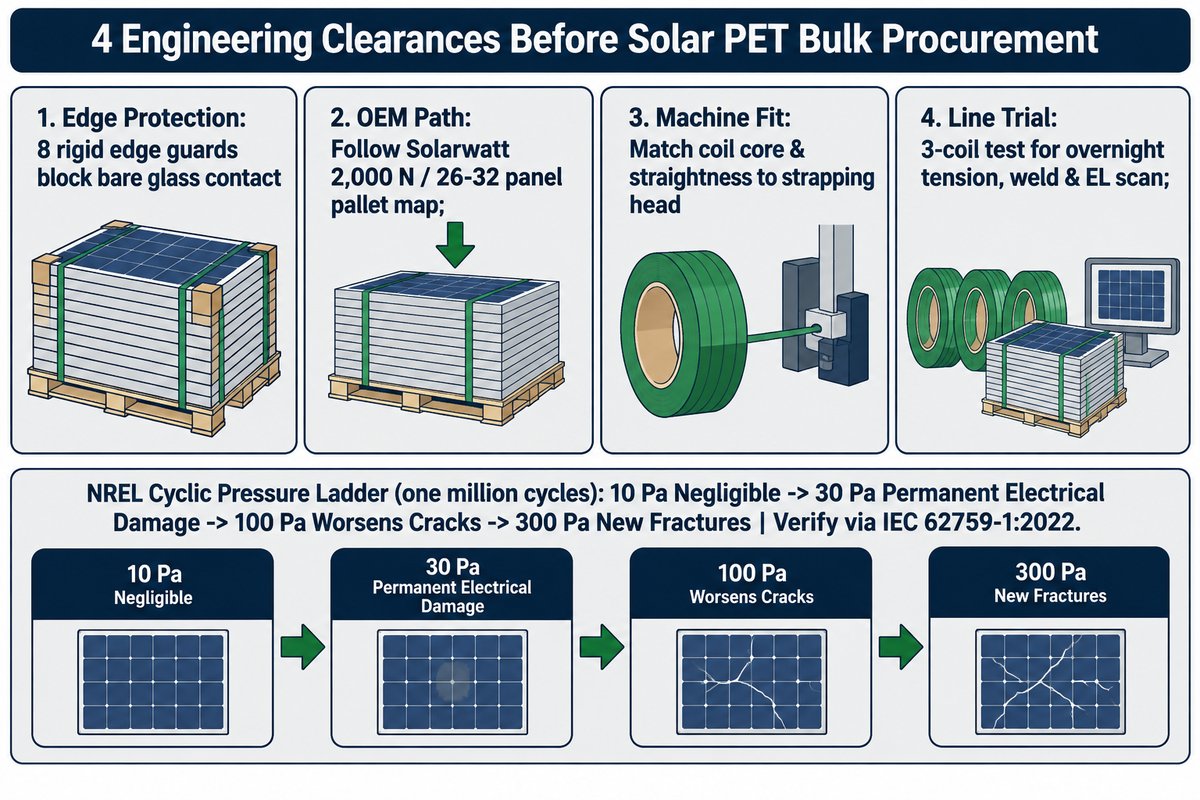
Solar module pallets require zero exposed glass contact, and packaging qualification trials pair mechanical checks with electroluminescence (EL) imaging because rigid stacks of 26 to 32 panels concentrate clamping loads onto thin anodized rails and silicon wafers. Solarwatt’s packaging manual uses four polyester bands near that 2,000 N target only with eight rigid edge protectors.
Think of strapping a stack of solar panels like clamping framed glass windows in a wooden crate. Unlike corrugated cartons or lumber bundles that deform safely under clamping pressure, photovoltaic laminates transfer point bending straight into hairline wafer fractures. Standard warehouse shipping carton poly strap lacks the sustained tension stability needed for a 1,070 x 1,800 mm export pallet, so solar lines pair engineered PET packaging with rigid corner hardware to hold panels securely in transit.
External inspection alone misses internal cell fatigue. A July 2022 National Renewable Energy Laboratory study in the IEEE Journal of Photovoltaics (NREL/JA-5K00-82150) applied low-amplitude air pressure cycles from 10 Pa to 300 Pa RMS for one million cycles each on cracked solar cells. In those tests, 10 Pa caused negligible change, 30 Pa triggered permanent electrical damage, 100 Pa worsened existing cracks, and 300 Pa opened new fractures. Those single-cell fatigue results do not measure freight failure rates, yet they explain why packaging qualification combines external mechanical containment with post-transit module evaluation under IEC 62759-1:2022.
Module manufacturers bind freight liability to their written packing specifications. Solarwatt’s return and shipping manual states that transport damage costs due to violations of packaging instructions are the shipper’s liability. Since solar photovoltaic and new energy unit loads exhibit characteristics of rigid yet fracture-sensitive loads, customers choose a PET strapping roll specification along with tools, joints, corner boards, and stretch-wrap together with the shipment, rather than buying from a coil label alone. No single strap width, thickness, or routing pattern fits every module frame profile or dual-glass stack, so final production settings follow each panel maker’s manual and full-pallet validation.
PET vs. PP vs. Carbon Steel Strapping Under ASTM D3950 and D3953
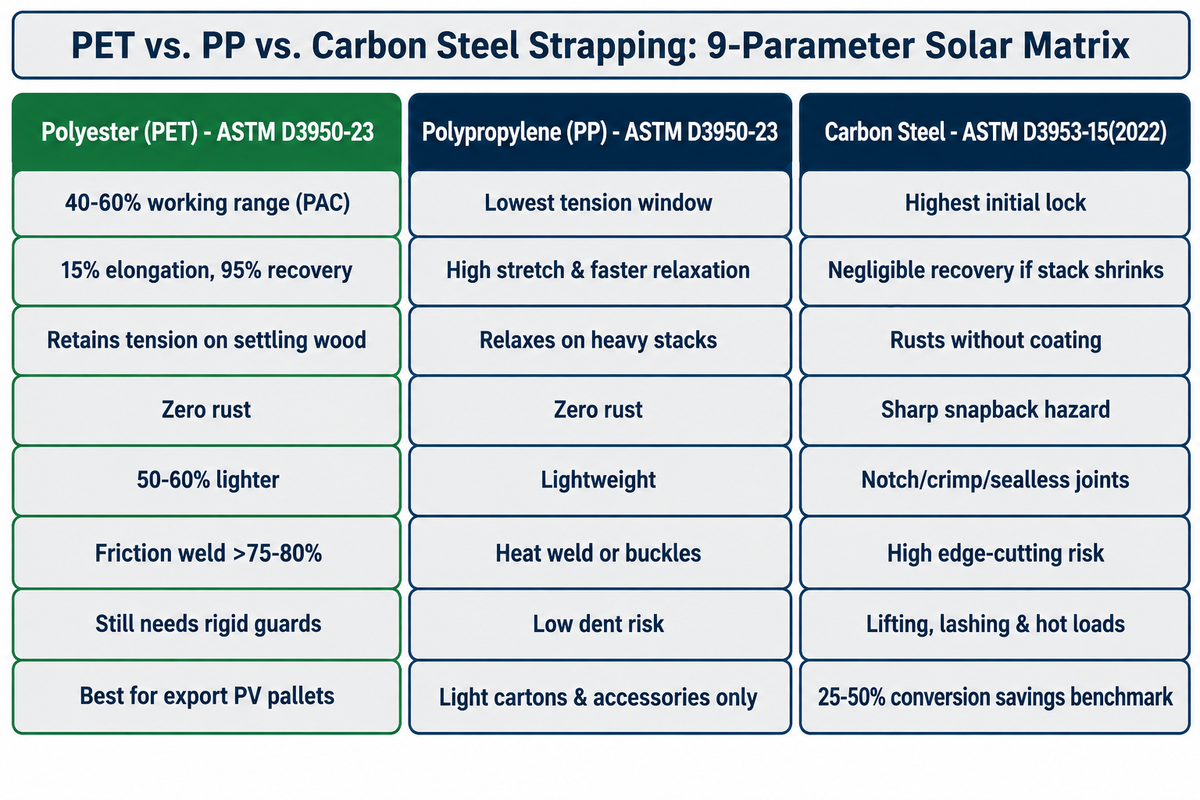
ASTM D3950-23 specifies nonmetallic PET and PP strapping, while ASTM D3953-15(2022) specifies flat carbon-steel strapping and seals. Moving from ASTM D3953-15 carbon steel strapping to PET still dents thin aluminum rails unless rigid corner guards spread local bearing stress.
In industrial freight, poly strapping includes extruded plastic banding from either polypropylene (PP) or polyester (PET) resins. Two active ASTM Committee D10 specifications anchor material comparisons in procurement. ASTM D3950-23 classifies extruded nonmetallic strapping into five material types, covering breaking strength, elongation, transverse strength, and joint strength conformity. Flat cold-rolled carbon steel strapping and seals for carloading, truckloading, lifting, and lashing are covered under ASTM D3953-15(2022). Specialty and alloy steel banding, as well as other types of steel, are excluded. ASTM D4675-14a(2022) provides guidance for the selection of flat strapping and directs buyers to validate the complete packaged unit.
Heavy duty plastic strapping operates best when tensioned into PAC Strapping’s recommended working range of 40% to 60% of nominal break strength. Published North American steel-to-PET conversion catalogs cite 25% to 50% material cost savings and up to 60% lower strap weight, along with moisture-resistant durability and complete rust resistance during humid ocean voyages. Even so, plastic banding is not a universal drop-in for steel when pallet banding crosses unprotected sharp edges, contacts hot surfaces, or serves lifting and cargo-lashing rules. ASTM D3950-23 addresses packaging strapping properties, ASTM D4675-14a(2022) guides selection and use, and the 25% to 50% conversion savings are general industrial benchmarks.
| Engineering Parameter | Polyester (PET) | Polypropylene (PP) | Carbon Steel |
|---|---|---|---|
| Governing ASTM Standard | ASTM D3950-23 (nonmetallic) | ASTM D3950-23 (nonmetallic) | ASTM D3953-15(2022) (flat steel) |
| Recommended Working Range | 40–60% of break strength (PAC guide) | Lowest working tension window | Highest absolute tension capacity |
| Elongation & Recovery | High recovery (Solarwatt manual: 15% elongation, 95% recovery) | High stretch with faster stress relaxation | Negligible recovery after load settlement |
| Retained Tension on Settling Loads | Maintains clamp as wood pallets settle | Fair; relaxes rapidly on heavy stacks | Highest initial lock; goes slack if stack shrinks |
| Moisture & Rust Behavior | Zero rust in marine or outdoor storage | Zero rust in marine or outdoor storage | Rusts without coating; stains cartons |
| Coil Handling & Recoil Safety | ~50% to 60% lighter than steel; reduced whip hazard | Lightweight; safe for manual handling | Heavy coils; sharp edges and snapback risk |
| Typical Joint Method & Efficiency | Friction weld (>75–80%); manual clips (<50%) | Heat weld or plastic/metal buckles | Notch, crimp, or sealless steel joints |
| Aluminum Frame Contact Risk | Still dents thin rails without rigid edge guards | Low dent risk; insufficient clamp for heavy PV | High edge-cutting risk without steel-rated guards |
| Primary Solar Packaging Fit | Export module pallets and rigid multi-panel stacks | Light accessory cartons and bundling boxes | Lifting, lashing, or extreme-heat/sharp loads |
Is polyester (PET) or polypropylene (PP) strapping better for heavy solar module pallets?
Polyester (PET) strapping is the better choice for heavy solar module pallets because it maintains tighter retained tension as wooden pallets settle and supports high-tension export clamping without rusting. Among industrial comparative charts, polypropylene (PP) maintains fair retained tension and a lower working tension window, fitting bundling boxes, light cartons, and inverter accessories. For warehouse parcels, choose PP if clamping would crush the cardboard. Palletizing heavy solar modules using a heavy duty polyester strapping route avoids the post-transit slack of PP and steel corrosion stains.
The Frame-Bevel & Glass-Stand-Off Test: Edge Guards, Corner Boards, and Interleaves
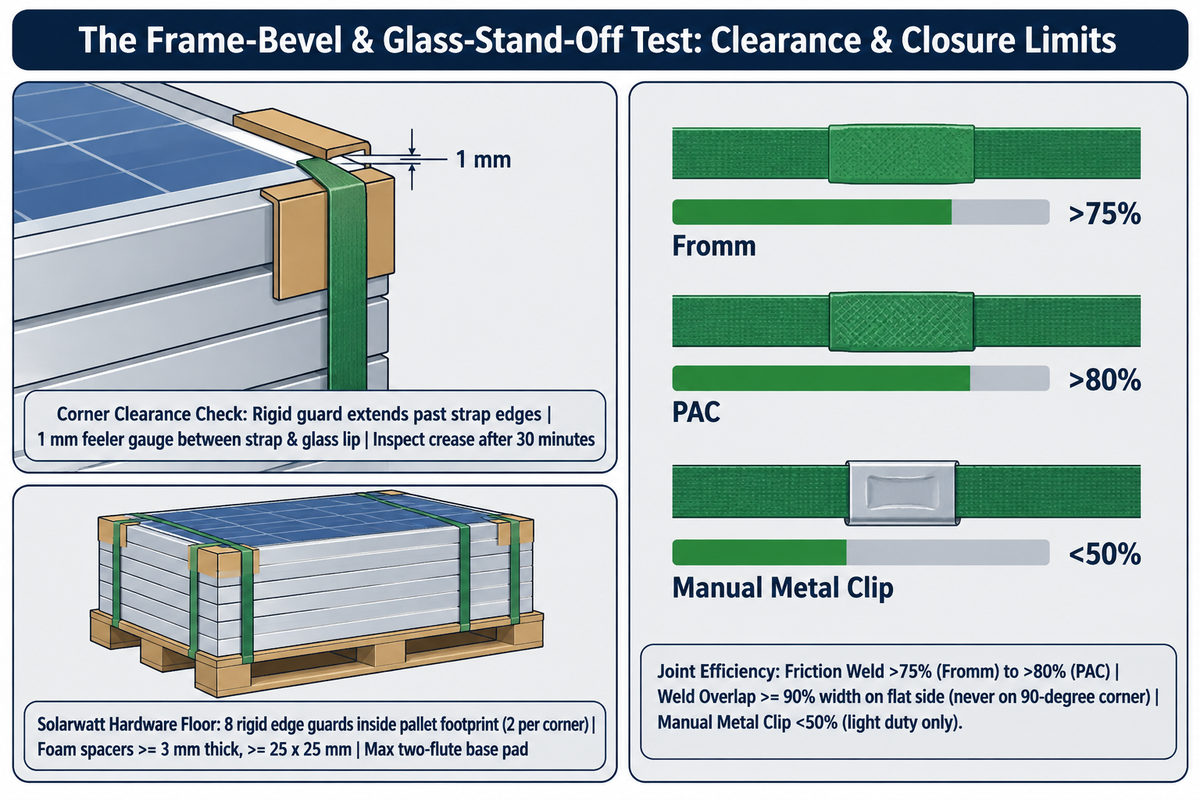
Rigid corner guards at the strap contact points spread pressure across the aluminum frame and separate PET bands from exposed glass. Heat-sealed joints should be on flat, supported surfaces and away from corners. Run the Frame-Bevel & Glass-Stand-Off Test prior to starting production.
The Frame-Bevel & Glass-Stand-Off Test is a benchtop clearance test confirming rigid corner protectors extend past strap edges with zero bare glass contact at target tension. One sacrificial loop should be tensioned over the corner board at your production tension setting. Slide a 1 mm feeler gauge between the strap underside and the glass lip, then inspect the board crease after 30 minutes for flute collapse or rail indentation.
Solarwatt’s packaging instructions show how tightly OEMs control the contact interface on glass-glass stacks. Each Solarwatt package places eight rigid plastic or solid cardboard edge protectors (two per corner) strictly inside the wooden pallet footprint so forklifts cannot shear protruding brackets. Between individual modules, frame-mounted closed-cell foam rubber spacers (six per module, or four on Panel vision GM 3.0) maintain at least 3 mm uncompressed thickness and at least 25 x 25 mm footprint area. A full-surface cardboard pad (maximum two-flute corrugated or solid board) separates the bottom panel from wooden deck splinters.
The tension must be adjusted so that the strap is tight but does not damage the solar panels (approx. 2000 N). When using heat-sealed straps: The area where the two sides of the strap are heat-sealed together must not be less than 90% of the strap’s width.
Closure selection will determine whether the strap loop actually holds its rated load. Fromm Packaging’s polyester closure analysis notes that standard manual metal clip joints usually achieve less than half (under 50%) of the strap’s break strength, though exact joint performance varies with clip geometry, tool calibration, and strap grade. Because of this, serrated strapping seals for polyester banding and manual metal buckles are best suited to low-volume, light-duty warehouse bundling. Per Fromm, automatic and battery-powered friction welds typically exceed 75% of break strength, while PAC reports over 80%. These welds don’t place sharp steel edges in contact with glass. Place every weld flat on a rigid side board or pallet-block face, never across a 90-degree module edge.
Do
- Place 8 rigid plastic or laminated edge protectors directly under all 4 strap lines inside the pallet footprint on Solarwatt-style stacks.
- Align heat or friction welds to at least 90% of strap width (Solarwatt manual) on flat, supported side surfaces.
- Use frame-mounted foam spacers at least 3 mm thick and at least 25 x 25 mm in footprint between stacked glass modules.
- Select battery or automatic friction welding (>75% Fromm / >80% PAC joint efficiency) for full solar export pallets.
Avoid
- Never run bare PET straps, twisted bands, or metal seals directly across exposed laminate glass or bare bevels.
- Avoid placing loose single-wall corrugated cardboard scraps beneath tensioned straps in place of rigid laminated corner boards.
- Keep edge protector brackets inside the pallet base footprint so forklift forks cannot shear them off during handling.
- Reserve manual metal clips for light-duty warehouse bundling rather than heavy ocean export stacks.
Can a photovoltaic PET strapping roll rest directly against solar glass if cardboard sheets are placed underneath?
No, loose single-wall corrugated cardboard sheets compress and crush locally under high pallet-strapping line pressure, thus reducing loop tension and transferring concentrated edge loads directly onto glass bevels and aluminum frame lips. For example, Solarwatt’s packaging instructions permit corrugated pads only as flat full-surface pallet base liners (maximum two-flute or solid board) and specify rigid plastic or solid cardboard edge protectors under every tensioned strap contact point. Always follow your module manufacturer’s approved edge-guard profile rather than improvising with loose carton scraps.
The Dual-Glass vs. Framed Stack Restraint Selector: Strap Paths and Unitization
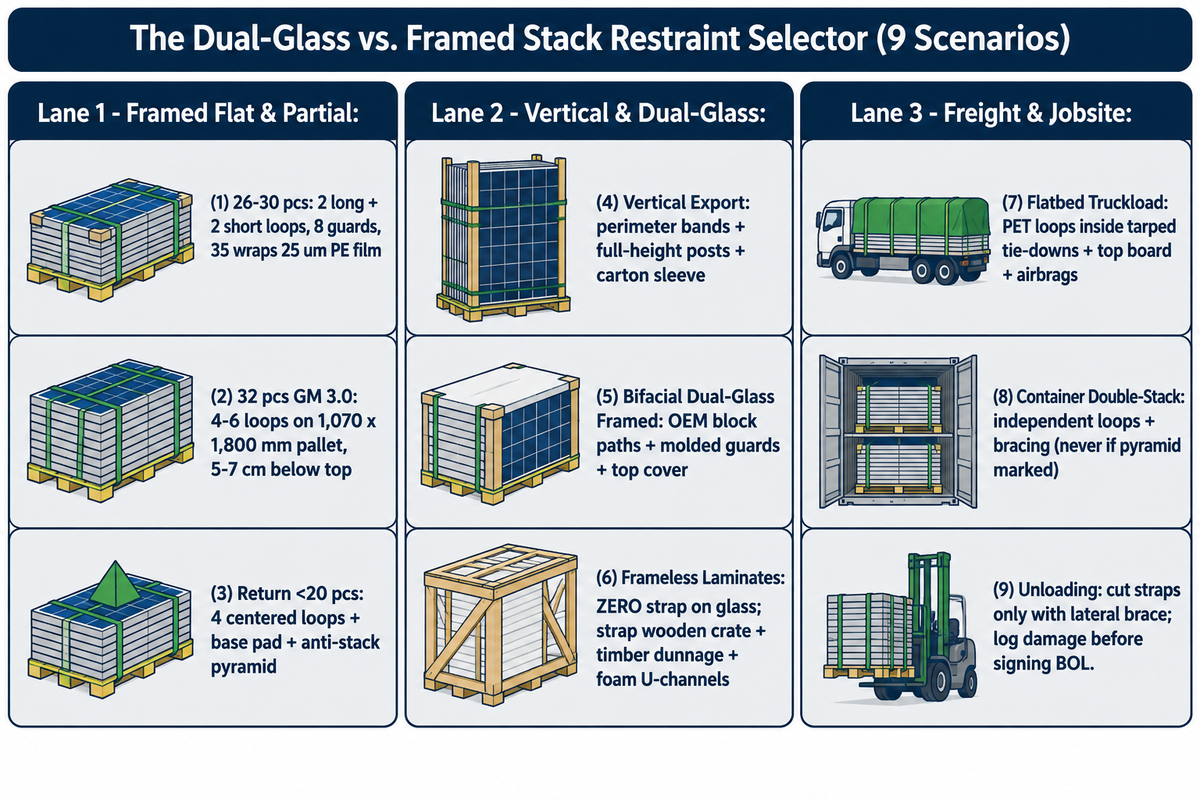
Solar pallet strap paths should follow each module manufacturer’s packing instructions for stacked framed modules, vertical export crates, and frameless dual-glass laminates. Unsupported spans above bare glass edges aren’t allowed. Use The Dual-Glass vs. Framed Stack Restraint Selector to pair band routing with stretch film.
The Dual-Glass vs. Framed Stack Restraint Selector aligns module frame architecture with OEM-defined strap paths, dunnage blocks, and secondary film wrap prior to palletizing. In Solarwatt’s flat-stacked manual (26 to 32 modules, depending on series), two straps are aligned on the long side and two on the short side, and all run vertically upwards, next to the outer pallet blocks, without twisting or drifting off-center. Where lower strength bands are used, Solarwatt increases the strap count from four to six to maintain the total holding force.
Other large-format module exporters also use vertical pallet architectures to increase container packing density. As reported in PV Tech, Trina Solar’s vertical module packing design passed ISTA 3E, and received recognition from leading international ocean carriers. In both vertical and horizontal configurations, polyester bands are used in conjunction with outer film wrap, rather than alone.
Packaging World states that collapsing pallet loads often occur due to inadequate outer unitization between bands. For Solarwatt’s 30-module configuration, installers apply around 35 wraps of 25 µm polyethylene stretch film extending 5 cm to 7 cm below the pallet top edge and 10 cm above the top module. Compare film holding mechanics in this stretch film vs. shrink wrap unitization guide.
Framed Aluminum Module Stack
- Framed aluminum stacks bear clamping load on rigid 30–35 mm anodized perimeter rails.
- Framed flat stacks follow OEM paths such as Solarwatt’s 2 long-side and 2 short-side vertical straps beside outer pallet blocks.
- Framed Solarwatt layouts use 8 rigid corner guards and 4–6 frame-glued foam spacers per panel.
- For Solarwatt’s 30-module configuration, apply roughly 35 wraps of 25 µm PE stretch film and follow anti-stack pyramid markings.
Bifacial Dual-Glass / Frameless Stack
- Bifacial dual-glass and frameless stacks have zero bare aluminum rail buffer, so edge glass chips under point compression.
- Frameless glass stacks prohibit unsupported vertical straps bearing directly onto glass perimeter bevels.
- Dual-glass crates use continuous perimeter frame caps, timber top/bottom dunnage, and foam-lined U-channels.
- Dual-glass unitization isolates all PET loop tension strictly into rigid wooden crates or top-cap beams.
| Stack Architecture | Strap Routing Path (Follow OEM Manual) | Contact Shielding Hardware | Secondary Containment |
|---|---|---|---|
| Flat-Stacked Framed (26–30 pcs) | Solarwatt example: 2 long + 2 short vertical loops beside outer blocks | 8 corner protectors; 6 foam spacers/module | ~35 wraps of 25 µm PE stretch film (at 30 pcs) |
| Flat-Stacked High Count (32 pcs, GM 3.0) | 4 to 6 vertical straps meeting tensile floor | 1,070 x 1,800 mm wood pallet; 4 spacers/module | Full PE wrap 5–7 cm below pallet top |
| Vertical-Standing Framed Export | OEM-specified perimeter bands + boxed pallet lock | Full-height vertical corner posts + top cap | Outer carton sleeve + stretch film |
| Bifacial Dual-Glass Framed | OEM-designated block paths only; zero off-center | High-stiffness molded guards + corner blocks | Top waterproof cover film + 25 µm wrap |
| Frameless Glass-Glass Laminates | No direct strap on glass; strap wooden crate only | Timber dunnage beams + foam U-channels | Rigid crate lid + moisture barrier film |
| Return / Partial Stack (<20 pcs) | 4 centered vertical straps; zero twisted runs | Full-surface cardboard base pad + 8 edge guards | Proportional PE wraps + anti-stack pyramid |
| Flatbed Domestic Truckload | Unitized PET loops inside tarped tie-downs | Heavy top-board distribution under tie-downs | Weatherproof cover film + dunnage airbags |
| Container Double-Stack (OEM-Approved) | Independent per-pallet loops + container bracing | Load-rated corner posts; never stack if pyramid marked | Inter-pallet dunnage + airbags or timber bulkheads |
| Jobsite Receiving & Unloading | Cut outer bands only with lateral stack brace | Inspect intact guards before signing freight BOL | Document visible damage at delivery and submit claims within the carrier’s stated deadline |
Risks associated with jobsite unloading should be taken into consideration at the specification stage. In public solar installer discussions on delivery handling, crews warn that vertically bound panels can tip suddenly or recoil when outer straps are cut without lateral bracing. Receiving crews also note that freight carriers enforce tight damage-notification deadlines after the bill of lading is signed, so clear “Do Not Stack” and “Unpack Safely” pictograms on two pallet faces protect both crews and freight claims.
Roll Width, Gauge, Embossed vs. Smooth Waxed PET, and Breaking Strength
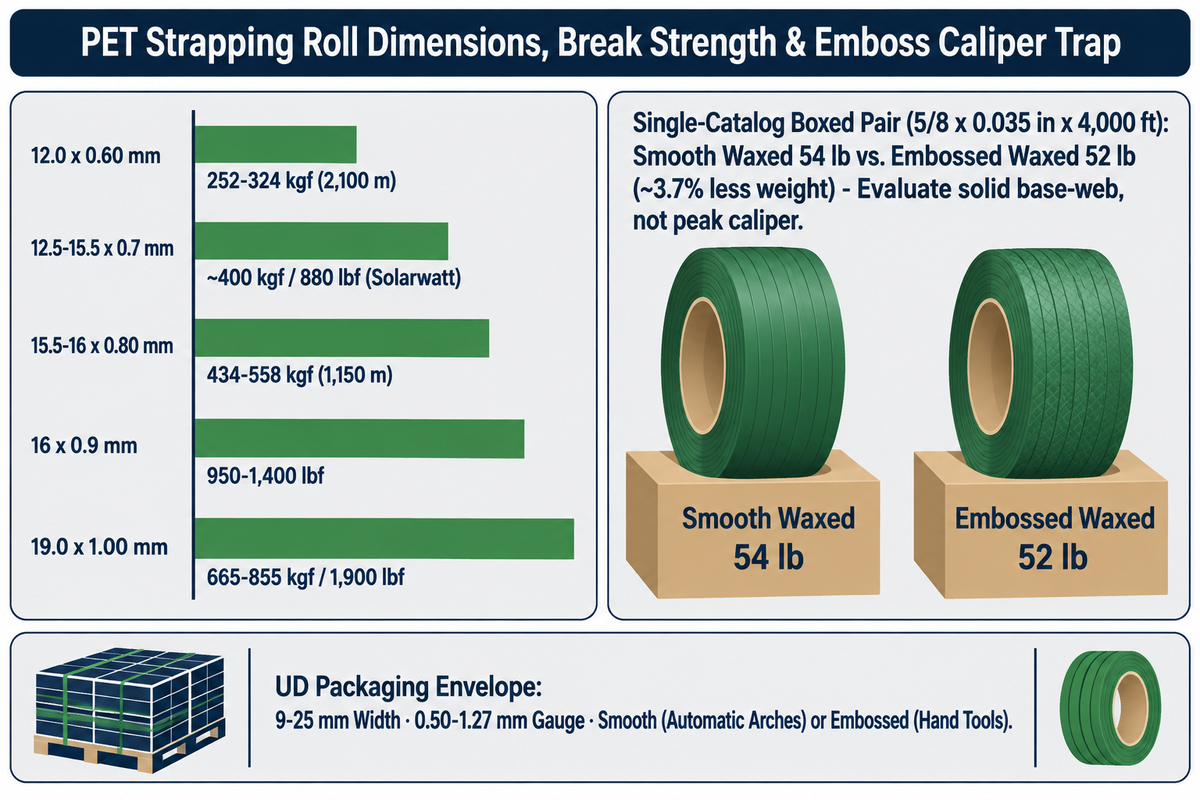
Photovoltaic pallet lines commonly select 15.5-16 mm (5/8-inch) or 19 mm (3/4-inch) polyester strapping rolls in 0.70 mm to 1.00 mm (0.028-0.040-inch) thickness, binding break strength directly to exact width, gauge, and lot test data. Evaluate load-bearing base-web cross-section rather than caliper readings across deep embossment peaks.
9–25 mmUD Packaging PET width range
0.50–1.27 mmUD Packaging PET gauge range
1,400 lbftypical 5/8 x 0.035 inch break
~400 kgfSolarwatt 12.5–15.5 mm strap floor
Industrial packaging strapping catalogs map roll dimensions to breaking-force ranges for heavy duty poly strapping, including packaging strapping roll and packaging strapping banding roll formats. Light-to-medium 12.0 x 0.60 mm rolls have a breaking force of roughly 252–324 kgf at 2,100 m per coil, while Solarwatt’s manual specifies 12.5 x 0.7 mm and 15.5 x 0.7 mm polyester bands near 400 kgf (~880 lbf) with 15% elongation and 95% recovery. Standard 15.5–16 mm (5/8-inch) heavy duty poly strapping spans 434–558 kgf at 0.80 mm (1,150 m/roll) and reaches 950 lbs break strength up to 1400 lbs break strength at 0.9mm (approximately 0.031–0.035 inches). Heavier 19.0 x 1.00 mm (3/4-inch x 0.040-inch) pallet strapping rolls deliver 665–855 kgf at 1,000 m (approximately 3,281 ft) per roll, with imperial 3/4-inch x 0.040-inch catalogs listing 1,900 lbf at 3,000 ft. UD Packaging manufactures across a 9–25 mm (0.354–0.984 inches) width and 0.50–1.27 mm (0.020–0.050 inches) thickness envelope in smooth or embossed polyester PET configurations; see how heavy duty PET strapping roll tolerances behave on rigid industrial bundles in this PET strap specification guide for heavy roll packaging.
Surface finish creates a specification trap when procurement compares quotes by caliper alone. In one published North American industrial polyester catalog, a boxed 5/8-inch x 0.035-inch (0.9mm) x 4,000 ft smooth waxed coil on a 16 x 6 inch core weighs 54 lb versus 52 lb for the matching 1400 lbs embossed waxed coil, approximately 3.7% less coil weight in that specific boxed pair. That weight difference applies only to that single catalog pair and varies with embossment depth and packaging across factories. Multiple strap extruders confirm the underlying mechanical risk: deep surface embossing inflates hand-caliper readings across raised peaks without adding polymer to the load-bearing base web. Similarly, green PET and green polyester are common industrial sorting conventions, never certified strength grades or UV guarantees.
Does embossed photovoltaic PET strapping hold the same tension and weld strength as smooth waxed PET at identical thickness?
Embossed and smooth waxed PET strapping with the same hand-caliper thickness don’t behave the same under tension or friction welding. Embossing reduces the solid base-web cross-section underneath caliper peaks and modifies friction against feed wheels, gripper teeth, and automated chutes. Smooth waxed polyester keeps a constant cross-section and reduces drag on chutes. Embossed strap grips manual tensioners cleanly, so changing finishes requires retesting weld time, cooling dwell and feed tension on your exact strapping head.
Dispenser Cores, Lateral Camber Limits, and Automatic PV Arch Compatibility
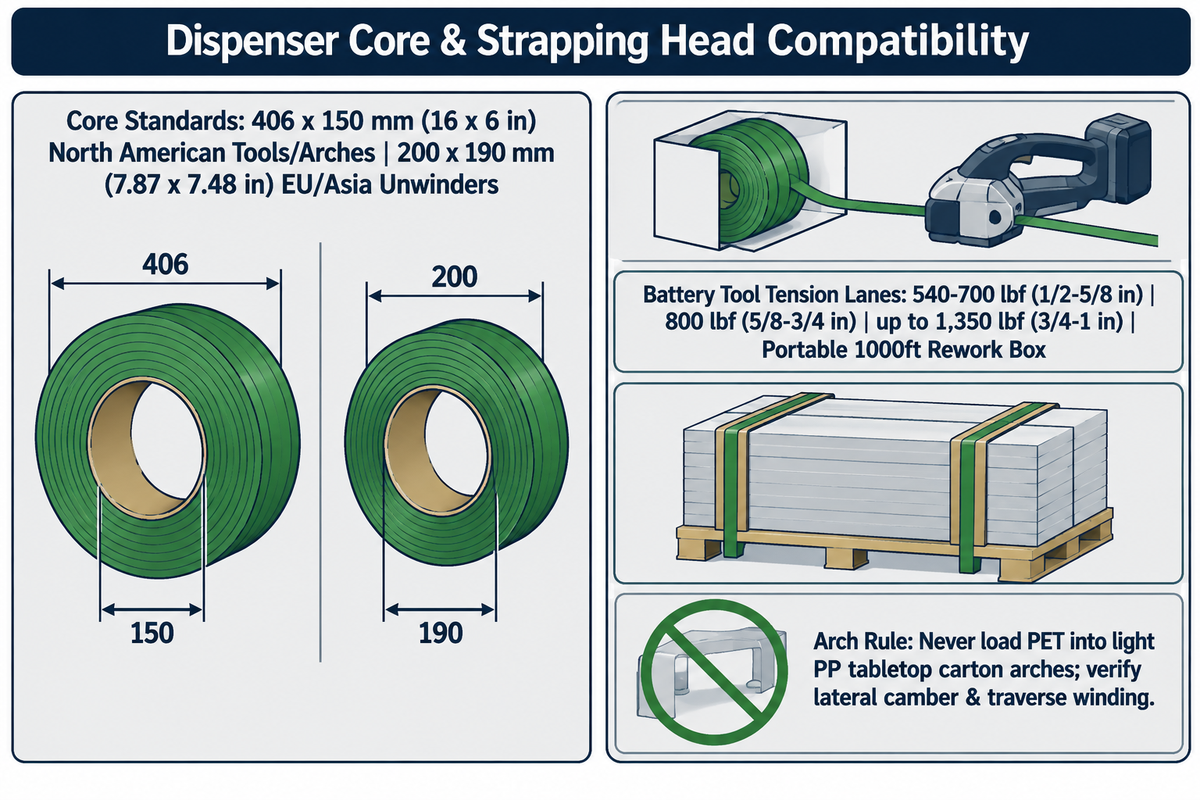
Core size (406 x 150 mm / 16 x 6 inches versus 200 x 190 mm / approximately 7.87 x 7.48 inches), coil weight, and machine-grade straightness determine if a plastic strapping roll feeds jam-free through solar palletizers. Coils that run smoothly in handheld tools can still jam in automatic pallet arches.
Equipment matching separates three operating lanes: portable dispenser boxes (e.g. 1000ft hand coils for jobsite rework), battery-powered combination tools on wheeled coil trolleys, and integrated pallet strapping systems. North American catalogs list 16 x 6 inch (406 x 150 mm) cores on battery hand tools (540-700 lbf on 1/2-5/8 inch models, 800 lbf on 5/8-3/4 inch models, and up to 1,350 lbf on 3/4-1 inch models) and large pallet strapping arches (usually for 3/8-3/4 inch widths and 0.023-0.040 inch thicknesses). European and Asian automatic strapping heads also offer 200 x 190 mm unwinder kits, so check core ID, core face width, maximum outer coil diameter, and unwind direction directly against your machine manual.
Don’t load polyester strapping into light semi-automatic or automatic polypropylene (PP) tabletop arches built solely for corrugated cartons. Major equipment catalogs state that polyester banding requires dedicated pallet strapping systems or heavy-duty hand tools, not light PP carton machines. For manual stations, pair each width polyester coil with the exact strapping tensioner and windlass tool, sealer jaw width, and heavy-duty cutter blade to prevent strap edge nicks. Packaging Digest notes that battery strapping systems, and battery friction-weld tools, in particular, reduce operator fatigue and provide more consistent tension than manual windlass and sealer strapping kits.
Machine-grade polyester strapping rolls require tighter straightness, less lateral camber, and steadier traverse winding than manual coils. Because exact camber ceilings and splice limits vary between arch builders, review the straightness tolerance of your machine manual before placing your order. Provide your strapping head model, current roll label photo, core size, and joint method to your supplier in advance so they test straightness, winding, and surface wax compatibility, and determine if coils are suitable before shipment.
The Thermal-Swing Tension Buffer Method: -20°C to +70°C Transit and UV/Static Control
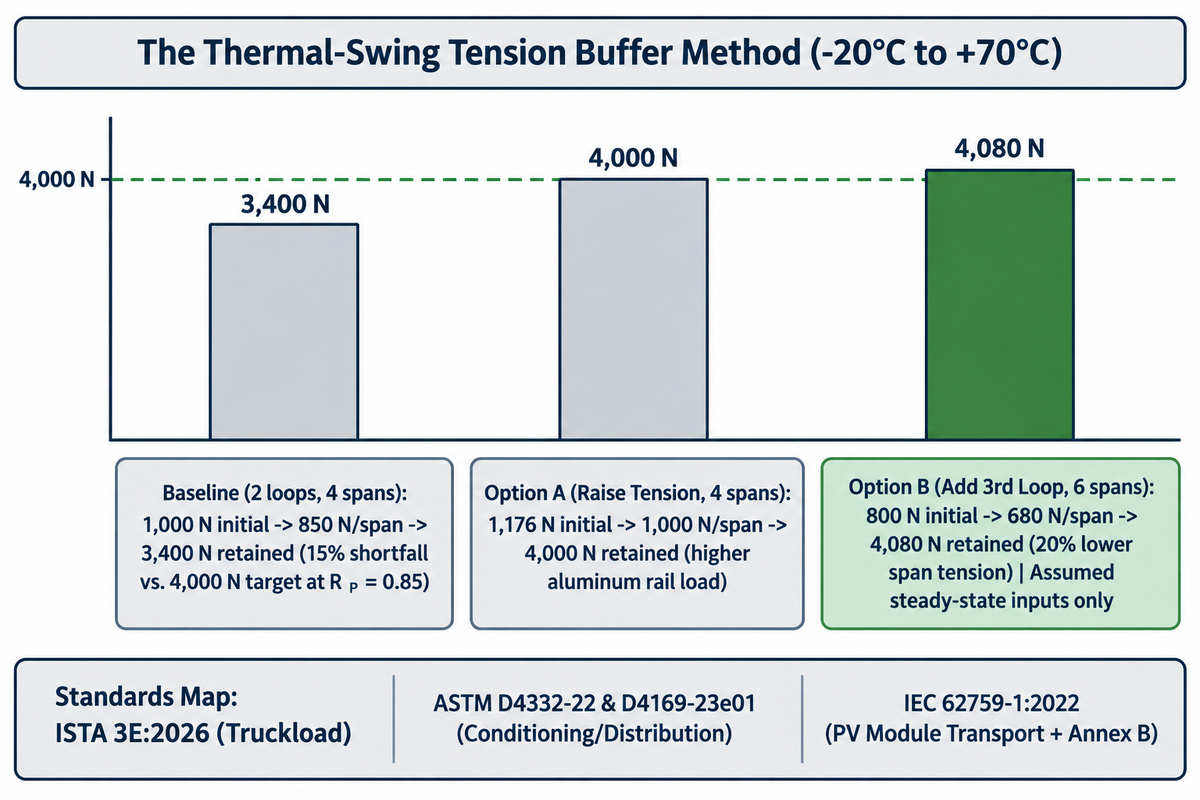
Assess the joints and strap tension retained across the thermal qualification range of -20°C to +70°C, and confirm the actual temperature exposure conditions for the intended shipping route. Joint efficiency, joint strength retention, and loop relaxation are separate measures; IEC 62759-1:2022 assesses the complete PV module package through transportation simulation and subsequent environmental testing.
The Thermal-Swing Tension Buffer Method breaks thermal performance into three separate checks: joint efficiency eta(T,t), joint strength retention R_j(T,t), and retained loop tension R_P(T,t). Treating all three as a single performance number obscures the location of failure. Fromm Packaging documented variability in warehouse air temperatures creating uneven thermal distribution along the outer edges of thermoelectric heat-seal blades resulting in abnormal welds. Friction welding alleviates the problem of ambient plate drift.
Export qualification matches each test standard to its actual logistics segment instead of treating one test standard as a universal proof:
- ISTA 3E:2026 (Truckload Unitized Shipments): Assesses unitized shipments through truckload delivery systems via shock, rotational edge drop, compression aligned with ISTA 3H, and up to 240 minutes of random vibration. It evaluates truckload transport rather than ocean container heat soak alone.
- ASTM D4332-22 & ASTM D4169-23e01: ASTM D4332-22 offers atmospheric conditioning procedures for packaging while ASTM D4169-23e01 offers schedules for testing the performance of shipping containers and systems.
- IEC 62759-1:2022 (Reliability of PV Module Packaging): Simulates the transportation of complete flat-plate PV module package units, followed by environmental stresses, intermediate module stabilization, and retesting criteria in Annex B.
A strap arriving at a port with slack doesn’t automatically mean the initial tension was set too low. Load settlement, crushed corner boards, joint slip, and changes in the path of the strap also result in slack. Increasing weld heat is also not a remedy for a weak friction weld. Excess heat degrades the polyester melt zone. PAC Strapping also warns against oversizing strap gauge: higher residual tension comes from applying PET inside its 40–60% working range rather than switching to a heavier strap at low stretch. For ultra violet light-stabilized or anti-static polyester packaging banding, provide a clear indication in your RFQ.
Worked Tension Buffer Calculation (Assumed inputs for auxiliary horizontal perimeter bands): Assumed inputs for this secondary perimeter-band comparison, distinct from the ~2,000 N primary vertical loops, are a horizontal restraint target of F_req = 4,000 N (899 lbf) across two perimeter straps (k = 4 tensioned spans), an initial installed tension of P_0 = 1,000 N (225 lbf) per span, and an illustrative hot-container retained tension ratio of R_P(+70°C) = 0.85 (steady-state thermal relaxation only, excluding pallet wood shrinkage or joint slip).
| Configuration Option | Spans (k) | Initial Span Tension (P_0) | Retained Per Span (P_0 x 0.85) | Total Retained Clamp vs. 4,000 N |
|---|---|---|---|---|
| Unbuffered Baseline (2 loops) | 4 | 1,000 N (225 lbf) | 850 N (191 lbf) | 3,400 N (764 lbf), 15% shortfall |
| Buffer Option A: Raise Tension | 4 | 1,176 N (264 lbf) | 1,000 N (225 lbf) | 4,000 N (899 lbf), higher rail load |
| Buffer Option B: Add 3rd Loop | 6 | 800 N (180 lbf) | 680 N (153 lbf) | 4,080 N (917 lbf), 20% lower span tension |
On these assumed inputs, Option B (i.e. the addition of a third strap loop) meets the retained clamp load target of 4,000 N while reducing the initial span tension from 1,000 N to 800 N (i.e. a 20% reduction per corner). This calculation depicts the trade-off between strap count versus tension; it isn’t a certified freight limit. This is due to uncertainty in welds (efficiency factor eta(T, t)), pallet wood compression, and container shock (i.e. impact) loads, which must still be validated on the full pallet.
How much weight can PET strapping hold safely across -20°C to +70°C solar ocean freight?
Four 15.5–16 mm polyester bands rated at 400–635 kgf (880–1,400 lbf) break strength can secure a validated solar pallet, but a 2,000 N (~450 lbf) setting represents roughly 51% of a 400 kgf strap and roughly 32% of a 635 kgf strap. Each strap grade must therefore be checked against PAC’s 40–60% working range alongside friction-weld efficiency (>75%). Safe ocean freight capacity depends on retained clamping force after thermal relaxation, loop count, corner-guard bearing area, and inter-panel friction rather than nominal break strength alone.
The 3-Coil Solar Line Run-Off Yardstick: Incoming QC, CoA Verification, and Supplier Trials
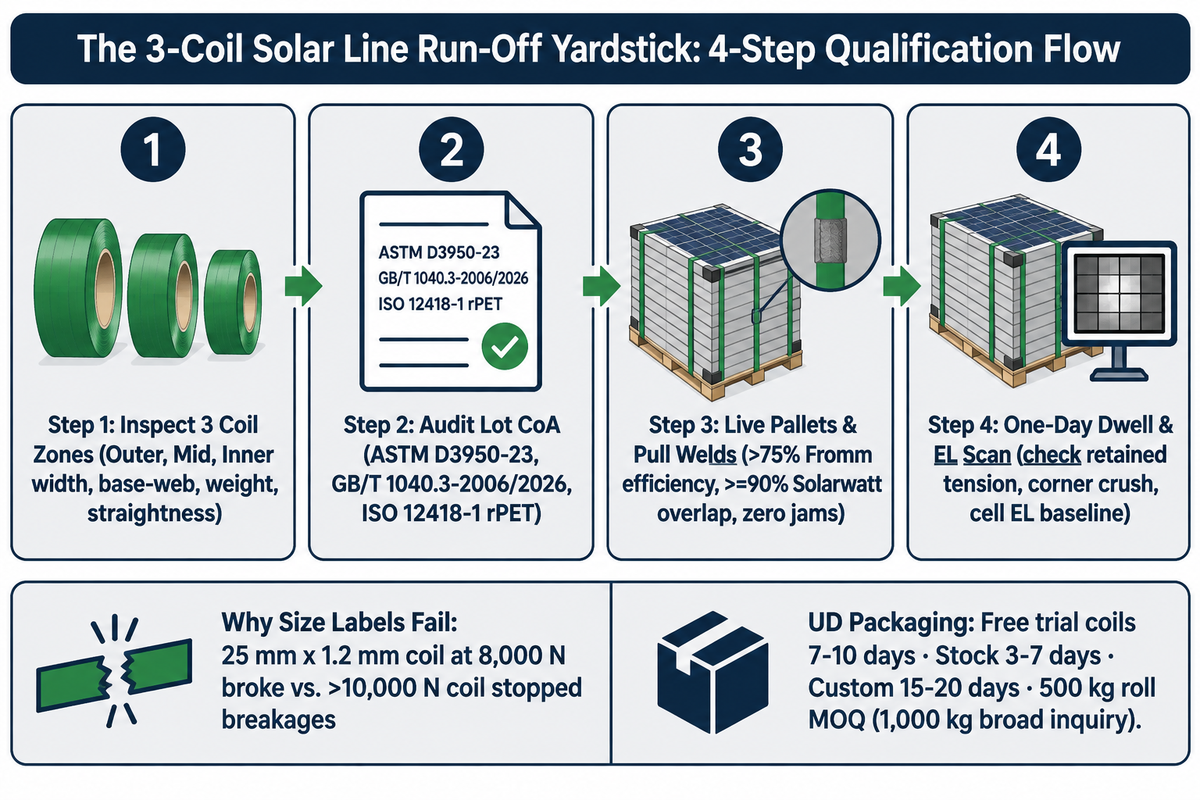
Three full trial coils across live solar pallets, verifying lot-specific Certificates of Analysis under ASTM D3950-23 and the GB/T 1040.3 edition required on the purchase order, and inspecting outer, middle, and inner coil layers are required before a supplier can be approved.
The 3-Coil Solar Line Run-Off Yardstick is a multi-coil receiving and line-qualification protocol testing dimensional uniformity, pulled weld strength, overnight tension retention, and post-strapping module EL comparisons before bulk release. A published factory testing case from a Chinese strapping extruder shows why size labels fail in procurement. A heavy-duty buyer using 25 mm x 1.2 mm PET suffered repeated breakage because its incumbent coil tested near 8,000 N tensile strength. Switching to a tightly controlled 25 mm x 1.2 mm coil exceeding 10,000 N stopped breakages without changing tools or strap size.
- Inspect Three Coil Zones — Measure width, base-web thickness, coil net weight, and straightness at outer, mid, and inner layers across all three sample rolls.
- Audit Lot CoA & Feedstock — Lock ASTM D3950-23 tensile/elongation/split values, name either GB/T 1040.3-2006 or the incoming 2026 edition on the purchase order, and verify ISO 12418-1 intrinsic viscosity, contamination, water content, and bulk density for rPET batches.
- Run Live Pallets & Pull Welds — Strap sample loaded pallets per coil on your production head, pull welded loops to verify >75% joint efficiency (Fromm benchmark) and >=90% overlap (Solarwatt benchmark), and check for dust or feed jams.
- Re-Check After Dwell & EL Scan — Measure retained loop tension after a one-day dwell, inspect corner boards for crush marks, and compare module EL images with pre-strapping baseline images for newly visible cell damage before releasing production.
Purchase orders for recycled polyester feedstock should specify written traceability rather than assume equivalence to virgin material. Recycled PET strapping procurement controls link batch records to ISO 12418-1 recyclate checks because moisture or viscosity drift shifts melt behavior inside friction-weld heads. When evaluating supplier quotes, total cost per accepted pallet should be analyzed as opposed to price per roll. Price is dependent on seven quote inputs (width, thickness, coil length, resin grade, surface finish, order quantity, and Incoterms).
Do not approve a PET strap from the roll label alone; approve the strap, tool, joint, and load as one package during the machine trial.
UD Packaging manufactures PET strapping from granulation to finished coils in Jiangyin, China, supplying 9–25 mm wide and 0.50–1.27 mm thick polyester strapping rolls, serrated seals, buckles, and strapping equipment for solar photovoltaic and industrial export loads. Written quotations return within 24 hours on business days against ASTM D3950-23, ASTM D4675-14a(2022), ISO 12418-1 rPET specifications, and GB/T 1040.3-2006 or GB/T 1040.3-2026 as named on the purchase order. Free standard-stock sample rolls ship in 7–10 days for line trials, stock and small-batch orders ship in 3–7 business days, and custom coil lengths, cores, colors, or printed marks ship in 15–20 business days. Roll production starts at a 500 kg MOQ split by size, color, and print (with 1,000 kg as the standard starting order quantity for broad PET inquiries), under a 30–50% deposit against proforma invoice on FOB, CIF, DDP, FCA, or CIP terms. Product-level SGS test reports and RoHS declarations accompany orders within the written scope, with Certificate of Origin, REACH, and SDS available on request; product quality testing is distinct from factory certification.
Frequently Asked Questions
What ASTM and IEC standards apply to photovoltaic PET strapping rolls and solar pallets?
ASTM D3950-23 covers extruded nonmetallic strapping (polyester and polypropylene) across breaking strength, elongation, transverse strength, and joint testing. ASTM D4675-14a(2022) describes flat strapping system selection, while ASTM D3953-15 (2022) describes flat carbon-steel strapping for comparison. For the complete shipping unit of a solar module, IEC 62759-1:2022 describes photovoltaic transport simulation and subsequent environmental tests.
How wide should edge protectors be beneath 16 mm or 19 mm solar PET straps?
Use rigid edge protectors wider than the 16 mm or 19 mm strap to provide full clearance past both strap edges while keeping them flush inside the wooden pallet base footprint. According to Solarwatt’s manual, eight rigid edge protectors (two per corner) must stay inside the pallet footprint without overhang. Frame-mounted foam spacers should be used alongside those guards to maintain the inter-module distance specified by the module manufacturer for stacked solar modules.
Should solar module warehouses choose green embossed or smooth black PET strapping rolls?
Choose smooth waxed PET for high-speed automatic pallet strappers and embossed PET for hand tensioners. Strap color such as green polyester is an industrial sorting convention and is never indicative of UV durability or strength. Compare load-bearing base-web cross sections, rather than peak caliper thickness, state UV-stabilizer requirements explicitly for outdoor yards, and test weld energy on your exact strapping head.
Why does loose corrugated cardboard fail under tensioned PET straps?
A loose single-wall corrugated sheet can be crushed by a tensioned strap, reducing protection at aluminum frame lips and glass bevels and allowing the strap to lose tension.
What causes PET strapping weld joints to fail after ocean container shipping?
Ocean freight exposes solar pallets to thermal stresses between cold staging yards and hot container roofs. These ocean-freight thermal swings can reveal weak welds caused by overlap below Solarwatt’s 90% width floor, ambient temperature drift on thermoelectric heat blades, incompatible surface wax, shortened cooling timers, or unmonitored rPET viscosity shifts. Pulling sample welds right after strapping and re-checking tension after a one-day dwell catches marginal closures before container loading.
How long do UD Packaging trial sample rolls and bulk orders take?
UD Packaging supplies free standard-stock trial sample rolls in 7 to 10 days, dispatches stock and small-batch orders in 3-7 business days, and completes custom production runs in 15 to 20 business days with a 500 kg roll MOQ.
Can photovoltaic PET strapping rolls replace steel strapping on framed dual-stack exports?
High-tensile ASTM D3950-23 polyester strapping replaces carbon steel on many framed solar exports when paired with rigid corner boards, balanced loop counts, and container blocking that keep the frames within working compression limits. Dual-stack transitions must follow the solar panel manufacturer’s stacking limit, including Solarwatt’s anti-stack pyramid on specified return pallets. For transport validation, ASTM D4169-23e01 covers distribution simulation, ISTA 3E:2026 covers unitized shipments by truckload, and IEC 62759-1:2022 assesses complete PV module package units.
Request Trial Coils Matched to Your Solar Strapping Line
Share your current strap width, gauge, core size, strapping head model and pallet layout. UD Packaging returns a specification-matched quotation on the next business day and arranges free standard-stock sample rolls in 7 to 10 days for your three-coil line run-off.
Application Scope: Final pallet strapping patterns, tension targets, edge-protector profiles, and stacking limits must follow each solar module manufacturer’s current packing manual and full-pallet transport qualification.
References & Sources
- ASTM D3950-23: Standard Specification for Strapping, Nonmetallic (and Joining Methods) ASTM International
- ASTM D3953-15(2022): Standard Specification for Strapping, Flat Steel and Seals ASTM International
- ASTM D4675-14a(2022): Standard Guide for Selection and Use of Flat Strapping Materials ASTM International
- IEC 62759-1:2022: Photovoltaic (PV) Modules, Transportation Testing, Part 1: Transportation and Shipping of Module Package Units International Electrotechnical Commission
- Millions of Small Pressure Cycles Drive Damage in Cracked Solar Cells (NREL/JA-5K00-82150) National Renewable Energy Laboratory / IEEE Journal of Photovoltaics
- ISTA 3E Overview: Similar Packaged Products in Unitized Loads for Truckload Shipment International Safe Transit Association
- ASTM D4332-22: Standard Practice for Conditioning Containers, Packages, or Packaging Components for Testing ASTM International
- ASTM D4169-23e01: Standard Practice for Performance Testing of Shipping Containers and Systems ASTM International
- Trina Solar’s Innovative Packing of Modules Receives Recognition From International Shipping Companies PV Tech
- Reducing the Occurrence of Collapsing Pallet Loads, Part II Packaging World
- New Battery-Powered Strapping Tool Offers Ergonomic, Sustainable Option Packaging Digest