Get in touch with UD Packaging Company

Stretch film vs shrink wrap comes down to how the film tightens. Pulled around the load, stretch film holds it by elastic recovery. Heat isn’t involved. Shrink wrap goes on loose and tightens when heat is applied. For pallets, stretch is the default and shrink earns its spot where the pack needs to be sealed, tamper-evident or weather-tight.
A quote that calls both films “shrink wrap” hides the key differences. The machine to own (a stretch wrapper or a heat source), the temperature the goods must take and the weather the pallet will meet all vary with the process. Three tools follow. The 4-Rung Heat-First Ladder settles the choice in order, the 9-Job Wrap Matrix assigns nine jobs to a process, and a cost-per-pallet formula comes with a break-even test.
Difference Between Shrink Wrap and Stretch Film: Tension Against Heat
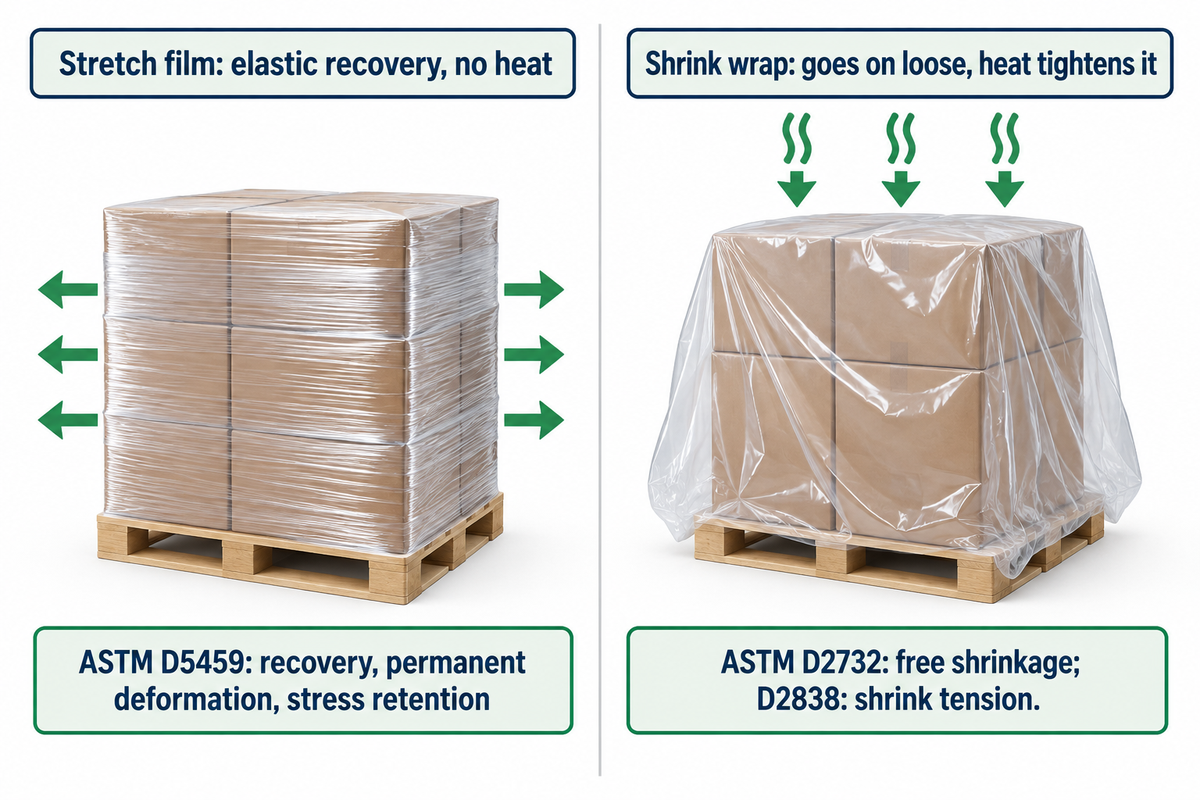
Stretch film holds a load by elastic recovery, and no heat is involved. Powered stretch wrappers pre-stretch it 60 to 400 percent depending on equipment type (per a 2013 MH&L article by a hood-machine maker). Shrink wrap is used oversize and contracts when heat is applied to it.
“This test method covers the measurement of recovery from extension, permanent deformation, and stress retention of stretch wrap film.”
The difference between stretch film and shrink wrap runs through the standards: clause 5.2 of ASTM D5459 links elastic recovery to the tightness or snugness of a package. On the shrink side, ASTM D2732-14(2025), clause 4.1, says internal stresses may be locked into the film during manufacture and released by heating. ASTM D2838-18(2026), clause 5.2, adds that shrink tension affects the appearance and performance of a film in a shrink-packaging application.
Stretch film
- Holds a pallet or bundle layer by layer
- Suits goods and labels that cannot take heat
- Runs on a hand dispenser or stretch wrap machine
- Leaves an unsealed skin for indoor storage and transit
Shrink wrap
- Gives a tight skin that follows the product’s shape
- Suits tamper evidence and weather-tight covers
- Runs on a heat gun, sealer with tunnel or hood system
- Needs goods and labels that tolerate the shrink range
| Check | Stretch film | Shrink wrap |
|---|---|---|
| Source of tightness | Elastic recovery of the stretched film | Contraction of film heated to its shrink range |
| What holds the load | Layers that cling to each other under tension | A contracted skin that can be sealed closed |
| Machine a quote implies | Hand dispenser, turntable or rotary-arm wrapper | Heat gun, L-bar sealer plus tunnel, or hood system |
| Figure to check on a quote | Pre-stretch in percent, set on the wrapper | Shrink air temperature in °C for the film family (rung 1 below) |
| Film family on the quote | LLDPE, cast or blown | PVC, polyethylene or polyolefin |
| ASTM method for the property | D5459: recovery, permanent deformation, stress retention | D2732: free shrinkage at set temperatures; D2838: shrink tension |
Is stretch film the same as shrink wrap?
Stretch film and shrink wrap differ, although both are polymer film. Stretch film is a stretchable film that tightens by tension alone, while shrink wrap needs a heat source. Different equipment is needed for each, a hand dispenser or stretch wrap machine for stretch film, and a sealer with a tunnel, a hood system or a heat gun for shrink wrap.
The names are often confused because shrink wrap and stretch wrap are both clear plastic film wound around a load. On a purchase order, write the process (stretch or shrink), the resin and the gauge, and the line tells the supplier which machine you run. The setting of a wrapper determines the holding force on the stretch side. A guide on force to load and wrapper settings provides more detail on this.
Stretch Wrap Film and Shrink Film Types: Which Resin and Gauge Fit Which Process
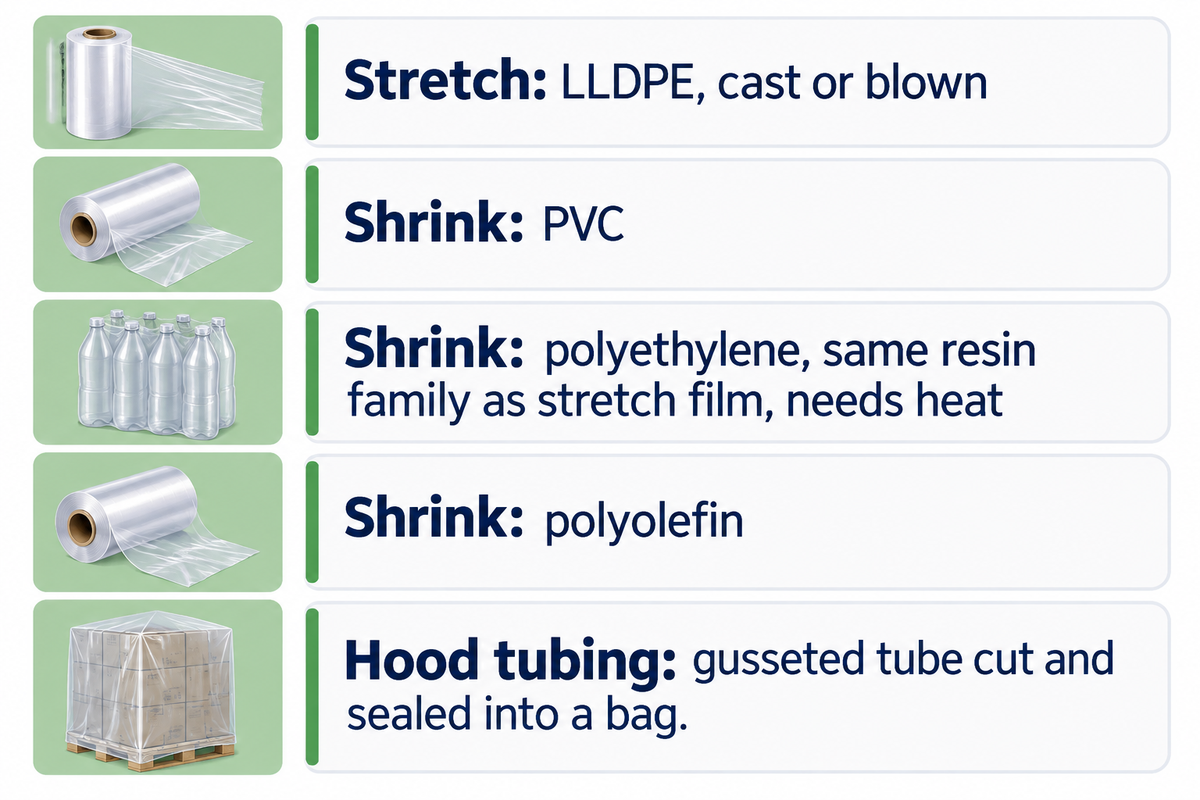
LLDPE is the resin of stretch film, while shrink film is PVC, polyethylene or polyolefin. The 2025 Sensors Study put LLDPE stretch film at 15, 17 and 23 microns, while ASTM D2732 tests shrink film and sheeting up to 0.76 mm thick. Resin alone does not separate them, so a quote line needs process and gauge as well.
| Film family | Process | Resin | Equipment match | Note for the quote line |
|---|---|---|---|---|
| Cast or blown stretch film, hand and machine rolls | Stretch | LLDPE | Hand dispenser or stretch wrap machine | Quote thickness in micron or gauge and width in mm |
| Polyolefin shrink film | Shrink | Polyolefin | Heat source with sealer, tunnel or hood | Highest shrink range of the three |
| PVC shrink wrap film | Shrink | PVC | Heat source with sealer, tunnel or hood | Lowest shrink range of the three |
| Polyethylene shrink film | Shrink | Polyethylene | Heat source with sealer, tunnel or hood | Same resin family as stretch film but needs heat; confirm the process |
| Gusseted shrink tubing for hoods | Shrink | Not applicable | Hood system | Cut and sealed into a bag, then shrunk; quote tube width and thickness |
Stretch wrap is commonly made as cast stretch wrap or blown stretch film, both LLDPE, and the spiral wrappers in the MH&L article run either. On the roll, shrink film and stretch film look alike, so confirm the wrapping process on the line before ordering; the differences between stretch film and shrink film show up in the heat step.
What is thicker, 60 gauge or 80 gauge stretch wrap?
80 gauge stretch wrap is thicker than 60 gauge. Dividing the gauge number by 4 gives micron, so 80 gauge is 0.80 mil, about 20 micron, and 60 gauge is 0.60 mil, about 15 micron. One mil equals 25.4 micron, which gives 20.3 and 15.2 micron when the gauge is first read as mil.
Quote processes in microns so gauges and mils are compared directly. Film mass follows thickness, because a thicker film weighs more per wrap, which the cost section prices out. The mils to microns chart converts any other figure on a quote, and export buyers can find the customs heading for stretch, shrink and cling film in a separate guide.
Shrink Wrap vs Stretch Wrap by Job: The 9-Job Wrap Matrix
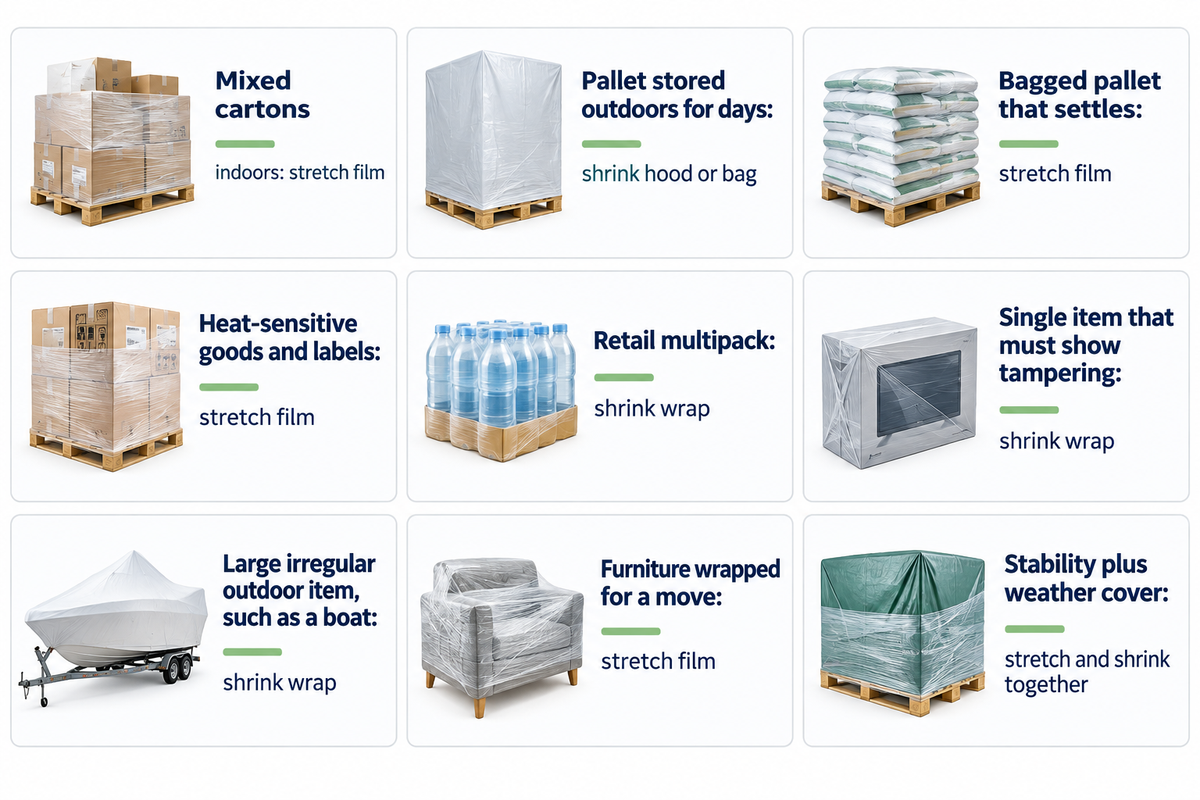
Pallet loads are unitized with stretch film, and shrink wrap takes the jobs that need a closed skin: a sealed pack, visible tampering or a weather barrier. The 9-Job Wrap Matrix below gives each of nine common jobs one default process, the reason, the equipment and the limit that flips the choice.
| Job | Default process | Why | Equipment | Limit |
|---|---|---|---|---|
| Mixed cartons on a pallet, indoors | Stretch film | Tension from elastic recovery holds the layers together with no heat step | Hand dispenser, turntable or rotary-arm wrapper | Little vertical holding force next to a hood |
| Same pallet stored outdoors for several days | Shrink hood or bag | Film shrinks tightly around load and pallet contours; a top sheet on stretch film gives only nominal protection | Hood system | Goods must pass the heat check (rung 1) |
| Bagged pallet that settles after wrapping | Stretch film | A settling load loosens the wrap, so stress retention, a property ASTM D5459 measures, matters | Wrapper with pre-stretch | Stretch-hood film is particularly well-suited to products that tend to settle |
| Heat-sensitive goods and thermal-print labels | Stretch film | Applied without heat, so goods and labels never meet the shrink temperature | Hand dispenser or wrapper | No sealed skin: no tamper evidence, no weather barrier |
| Retail multipack | Shrink wrap | Film tightens around the products and holds the pack as one unit | L-bar sealer plus tunnel, or heat gun for small runs | Goods must tolerate the film’s shrink range (rung 1) |
| Single item that must show tampering | Shrink wrap | A tight, sealed skin must be cut to open, so entry shows | L-bar sealer plus tunnel, or heat gun | Goods and labels must tolerate the shrink range; otherwise use stretch film |
| Large irregular outdoor item such as a boat | Shrink wrap | Large-format film shrinks over contours that a stretch roll does not follow, and the sealed skin sheds weather | Heat gun or gas heater | Gas heaters add fire risk and need ventilation |
| Furniture wrapped for a move | Stretch film | Cling holds layers to each other, not to the finish, and the wrap comes off by hand | Hand dispenser | Layers trap moisture and the cling additive attracts dirt and dust; the guide to wrapping furniture covers wood, leather and upholstery finishes |
| Pallet that needs stability and a weather cover | Stretch wrap and shrink wrap together | Stretch film holds the stack in transit; a shrink hood or cover seals it against weather | Stretch wrapper plus a heat source | Two film purchases and a heat step; the stretch layers underneath must tolerate the shrink range |
What is shrink wrap good for?
Shrink wrap is good for jobs that need a skin that follows the product’s shape. Examples are retail multipacks, single items that must show tampering, boats and equipment stored outdoors, and pallets that wait in the weather. Use shrink wrap when the goods pass the heat check because heat does the tightening.
A pallet shrink hood is a bag cut and sealed from gusseted tubing, applied oversize over the load and shrunk with heat. According to MH&L, hooding provides very good pallet load stability and protection.
Large outdoor covers for boats and equipment apply the same idea at a bigger scale, with a heat gun or gas heater tightening large-format film over shapes that stretch film does not follow.
Wrap Equipment, Heat Tolerance and Changeover: The 4-Rung Heat-First Ladder
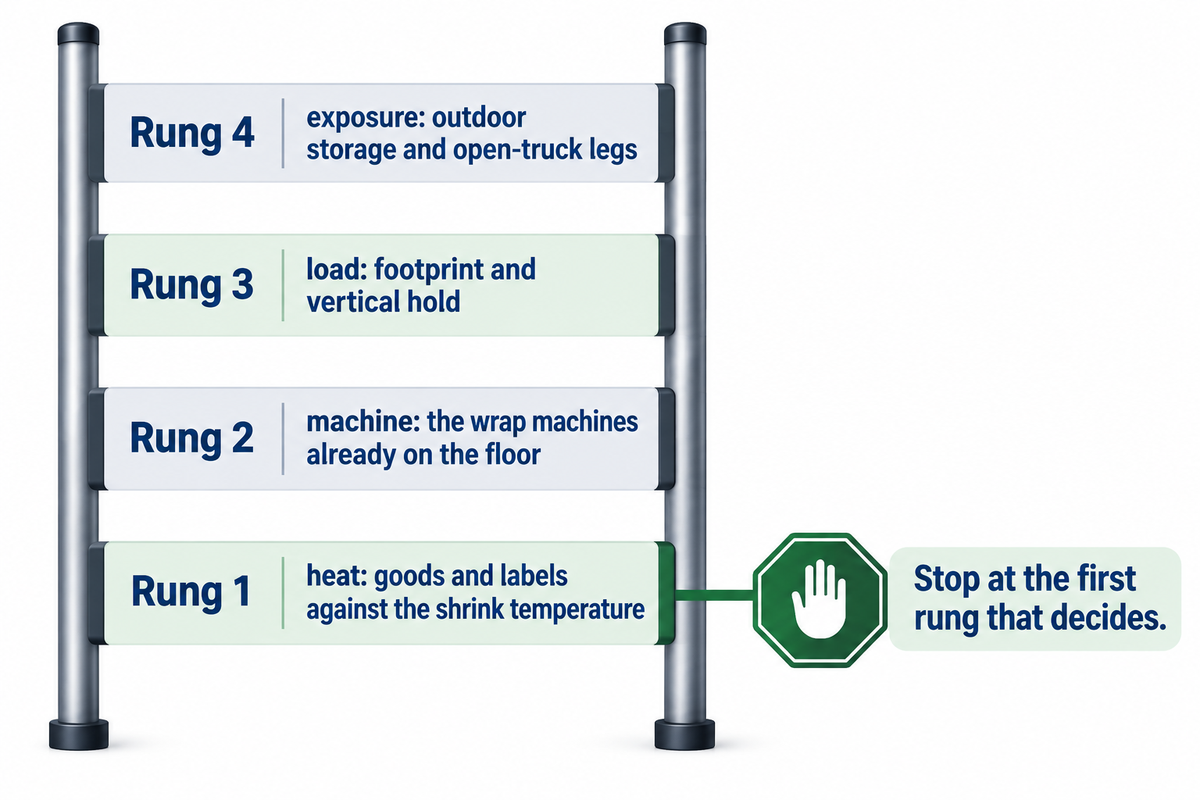
Heat comes first. The 4-Rung Heat-First Ladder runs four checks in order (heat, machine, load, exposure) and stops at the first rung that decides. If the goods or labels cannot take the shrink temperature, stretch film settles the question before equipment or cost does.
- Rung 1, heat. Compare the highest temperature the goods and labels tolerate, in °C, with the typical shrink air temperature of the film: about 90–110 °C for PVC, about 105–160 °C for polyethylene film and about 135–175 °C for polyolefin. If the heat limit sits below that range, stop and use stretch film. Maker guides disagree (two polyethylene guides read 105–115 °C and 135–160 °C), film thickness, tunnel design and line speed move the setting, and ASTM D2732 measures shrinkage at several specified temperatures without setting an operating value.
- Rung 2, machine. Name the wrap machines already on the floor (table below): a stretch wrap machine pulls the film around the load, and a shrink wrap machine heats it. Pair hand stretch film with a dispenser and machine stretch film with a powered wrapper. The guide on how to specify machine stretch film covers the roll side. With only a stretch wrapper on site, the load stays on stretch film unless rung 4 calls for a seal, because a tunnel or hood heater is a capital expense.
- Rung 3, load. Check footprint and vertical hold. Spiral stretch wrapping gives little vertical hold, while heat shrink hoods work particularly well when the load footprint is substantially smaller than the pallet. Use stretch film for full-footprint stacks and test a hood when the load is narrower than the pallet.
- Rung 4, exposure. Count outdoor storage and open-truck legs. As a packaging solution for outdoor loads, a stretch-wrapped pallet with a top sheet provides nominal protection, which MH&L calls practically insufficient for outdoor storage and for open flatbed trucks in inclement weather. Outdoor storage or an open-truck leg in inclement weather moves the load to a shrink hood, bag or cover over the stretch layers; a tamper-evident requirement on single items moves them to shrink wrap.
| Equipment | Process | Heat source | Where it fits |
|---|---|---|---|
| Hand dispenser | Stretch | None | Pallets wrapped one at a time on the dock floor |
| Turntable wrapper | Stretch | None | Stable loads that can turn on a base |
| Rotary-arm wrapper | Stretch | None | Loads that must stay still while the arm circles |
| Heat gun | Shrink | Electric or gas-fired hand tool | Hand shrink wrappers working single items, small runs and large covers |
| L-bar sealer plus tunnel | Shrink | Tunnel heater | Single items and multipacks |
| Hood system | Shrink | Natural or liquid propane gas; infrared or electric heaters | Full pallet loads that the film can shrink tightly around |
Shrink-hooding uses significant energy and carries a risk of fire, so keep open-flame tools away from cartons and ventilate the work area. The fume reports cited here come from supermarket meat wrapping, not from a pallet shrink line. Three meat wrappers developed respiratory symptoms from fumes of PVC film cut with a hot wire (JAMA, 1973). The fume reports were published in JAMA, 1973 and Inhalation tests in Clinical Allergy, 1980. Inhalation tests in Clinical Allergy, 1980, on one patient pointed to phthalic anhydride from heated price labels as the principal agent and to epoxidized soybean oil, a PVC film additive, as a suspected secondary agent.
How do I choose between stretch film and shrink wrap for a palletized load?
Choose stretch film for a palletized load unless the goods pass the heat check and the load then needs a seal or weather cover. Outdoor storage or an open-truck leg in inclement weather, or a footprint much narrower than the pallet, points to a shrink hood, bag or cover; indoor full-footprint loads stay on stretch film.
Suppose a pallet of sealed cartons ships by truck after several days of outdoor storage. Rung 1 is passed if the cartons and labels can tolerate the film’s shrink range, and rung 2 is passed if a stretch wrapper and a hood system are both accessible; both are assumptions. The stack is flush with the pallet edge, so rung 3 does not decide. Rung 4 settles it: several days outdoors outweigh a top sheet over stretch film, therefore the pallet goes under a shrink hood or bag or gets a shrink cover over the stretch layers. Kept indoors, the same pallet stops at rung 3 on stretch film.
Stretch Wrap vs Shrink Wrap Cost per Pallet: The Formula and a Worked Example
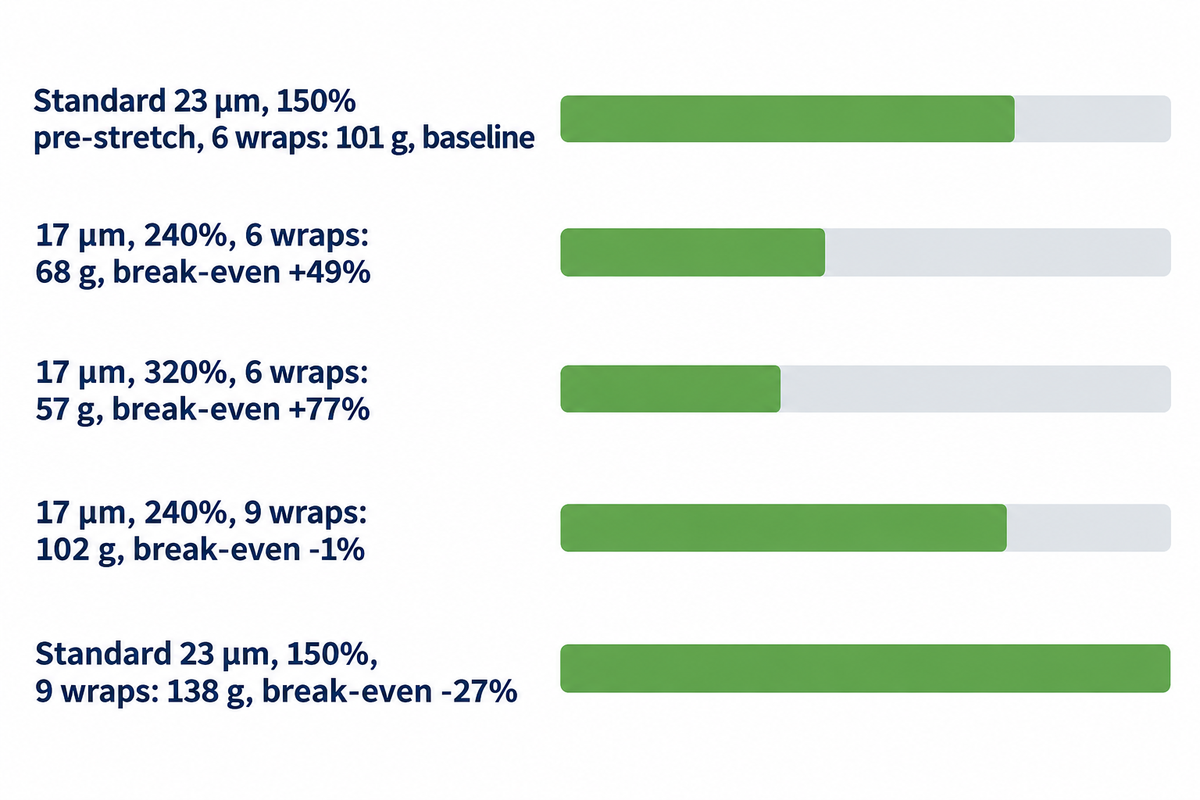
In a 2025 laboratory study, film gauge and pre-stretch together decreased the film on one load by about a third for the same wrap count, even though the thinner film costs more per kilogram.
The cost per pallet is film mass (in kilograms) times the price per kilogram, plus energy, labor and equipment write-off per pallet. Film mass moves stretch film cost most.
The Sensors study weighed the film on one pallet load for five recipes and quoted 8.50 PLN/kg for the 17 µm film and 5.50 PLN/kg for the 23 µm standard film. That’s a premium of about 55% (8.50 ÷ 5.50 = 1.55) on the quoted prices, which are for the study, so replace them with your own. The break-even premium is the most a lighter film may cost per kilogram before it stops saving money: divide the baseline film mass by the new film mass and subtract 1.
| Recipe | Wraps | Film mass per pallet | Film value per pallet (study prices) | Break-even price premium |
|---|---|---|---|---|
| Standard 23 µm film, 150% pre-stretch | 6 | 101 g | 0.56 PLN | 0% (baseline) |
| 17 µm pre-stretch film, 240% | 6 | 68 g | 0.58 PLN | +49% (101 ÷ 68 = 1.49) |
| 17 µm pre-stretch film, 320% | 6 | 57 g | 0.48 PLN | +77% (101 ÷ 57 = 1.77) |
| 17 µm pre-stretch film, 240% | 9 | 102 g | 0.87 PLN | −1% (101 ÷ 102 = 0.99) |
| Standard 23 µm film, 150% pre-stretch | 9 | 138 g | 0.76 PLN | −27% (101 ÷ 138 = 0.73) |
At these prices the 17 µm film at 240% pre-stretch lands almost level with the baseline (0.58 PLN against 0.56 PLN), because its 55% premium sits just above its 49% break-even. Only the 320% recipe wins clearly, at 0.48 PLN, and it sits above the 300% point beyond which, the authors write, neck-in and thinning limit further gains. Nine wraps of the same 17 µm film weigh 102 g, so that pallet is no lighter than the six-wrap standard pallet and costs more at any price premium, although the study measured a higher holding force for it.
The authors settle on about eight turns at 200–250% pre-stretch as the best balance of safety, cost and environmental performance. They also state price per kilogram alone is a flawed negotiation metric, which is why a quote needs film mass per pallet next to it.
To perform the test on your own pallets, weigh the film on a sample of loaded pallets for each recipe. Multiply the average mass by the quoted price per kilogram, then add the terms below.
| Cost term | Stretch film | Shrink hood or bag |
|---|---|---|
| Energy per pallet | Wrapper power, read from your own meter | Gas or electric heating per load |
| Labor per pallet | Minutes at the wrapping station | Minutes including the heat step |
| Equipment write-off per pallet | Wrapper price ÷ pallets wrapped over its life (low volume raises it) | Sealer, tunnel or hood machine price ÷ pallets over its life |
| Insurance and fire precautions | Not applicable | Heat source near cartons: ask the insurer |
These masses are from one crate (1200 × 800 × 1500 mm, 182 kg including a 22 kg pallet) wrapped on one Robopac 705 automatic wrapper at about 25 °C without vibration, so replace them with film weighed from your own pallets. Comparing roll prices instead of price per kilogram and film mass per pallet hides the wrap-count effect.
A published shrink comparison is available in the 2013 MH&L article by a hood-machine manufacturer. It reports that film cost per pallet for shrink-hooding can easily exceed stretch-hooding by 40 percent or more. It compares two hood systems, not a stretch roll against a hood. The same article says fire risk can mean higher insurance premiums, which adds an insurance line to the shrink inputs.
Packaging Waste: What Happens to Stretch Film and Shrink Wrap Afterwards
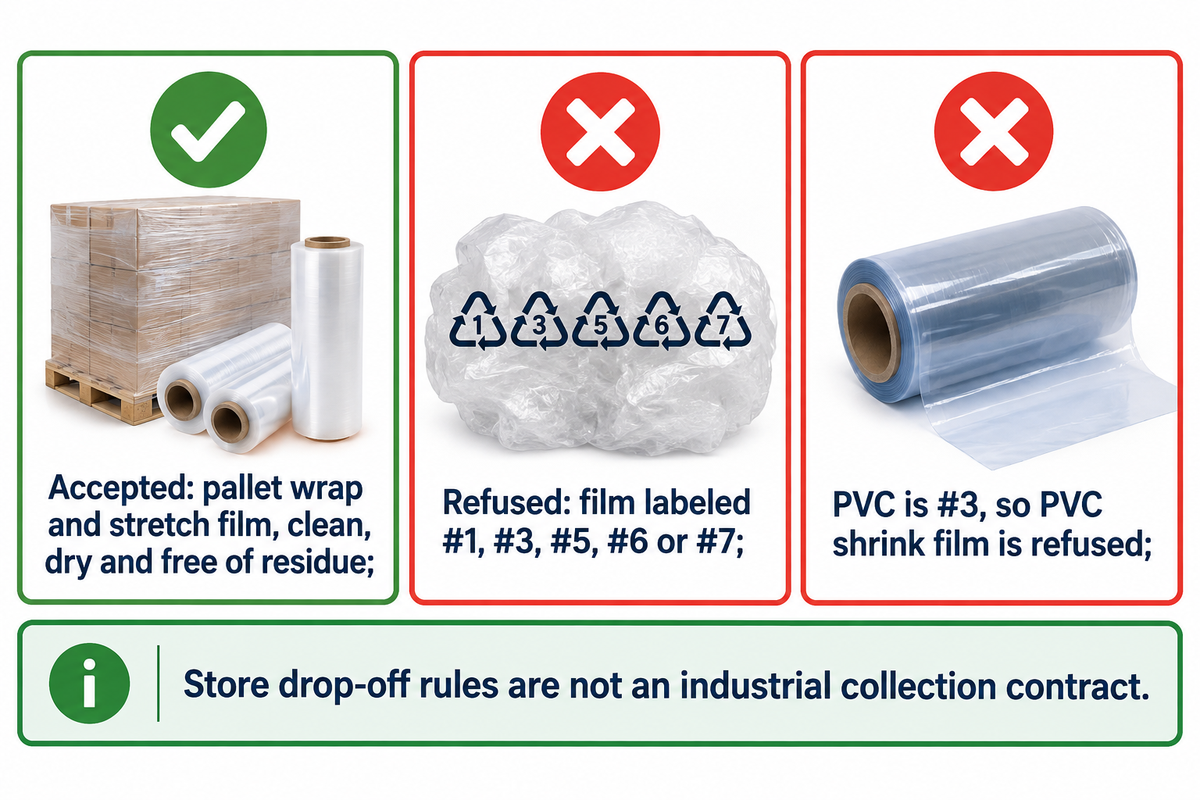
New York State’s film-plastic drop-off list accepts pallet wrap and stretch film when it’s clean, dry and free of residue, and refuses film labeled #1, #3, #5, #6 or #7. PVC is #3, so PVC shrink film is refused at those collection points.
| Film | Status at retail drop-off | Condition |
|---|---|---|
| LLDPE stretch film and pallet wrap | Accepted | Clean, dry and free of residue |
| Polyethylene shrink film | Shrink-wrap is named in the state’s film-plastic definition; refused only with a refused resin code | Clean, dry and free of residue; check the printed resin code |
| PVC shrink film | Not accepted | PVC is labeled #3 |
The state’s Plastic Bag Reduction, Reuse and Recycling Act defines film plastics as uncontaminated non-rigid film plastic packaging products, including newspaper bags, dry cleaning bags and shrink-wrap. This definition took effect on March 1, 2015, as explained by the New York State Department of Environmental Conservation. Rules for store drop-off programs don’t constitute an industrial collection contract, and so a warehouse’s own hauler may set different terms.
The warehouse collection steps are in the guide to collecting and recycling stretch wrap, and the options that avoid film altogether are in the guide to paper, reusable and band alternatives.
Supplier Brief: What to Send Before You Request a Quote
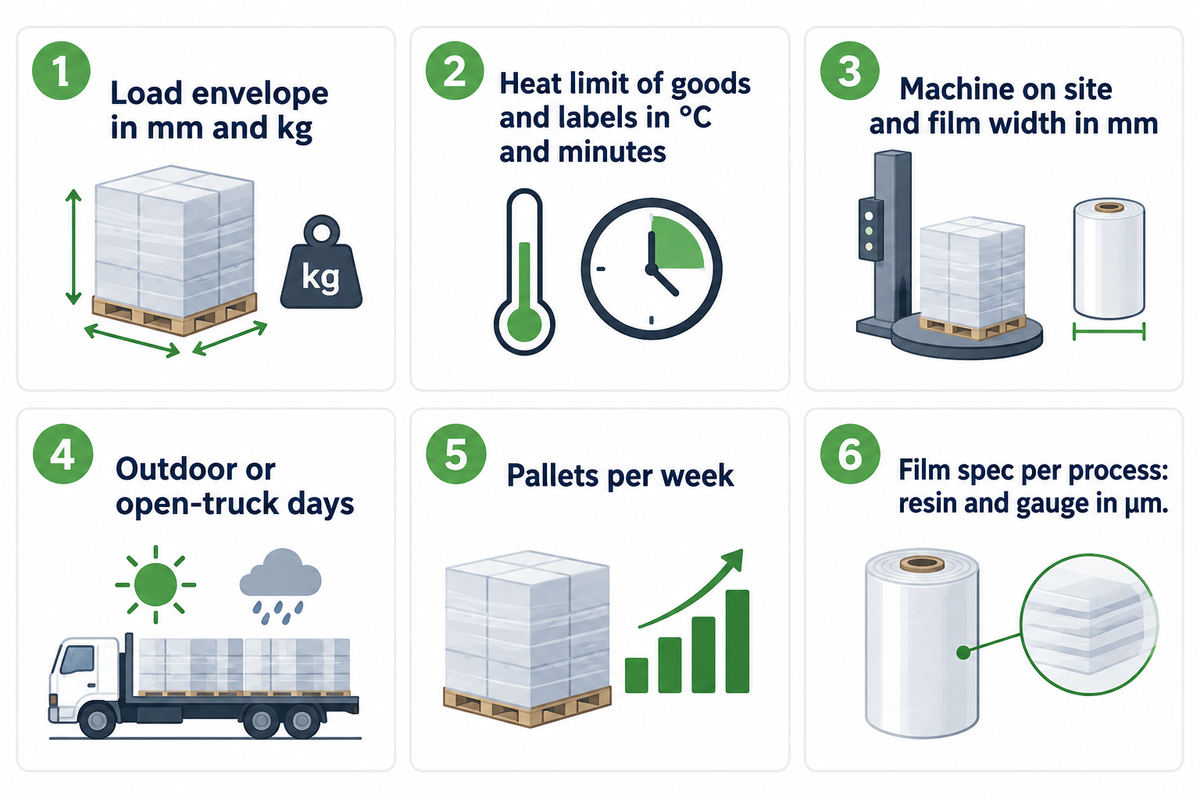
UD Packaging advertises a range of hand and machine stretch film and strapping, and lists no shrink film or shrink equipment. A supplier brief for comparison, therefore, has six elements: load envelope, goods heat limit, machine on site, outdoor days, pallets per week, and film spec per process.
Where can I buy stretch wrap film for industrial pallets?
Buy stretch wrap film from a film manufacturer or packaging distributor that quotes by resin, gauge in micron and width in mm and send the same six-row brief to each. Compare stretch film manufacturers to find out who caters for what application.
Quotes compare only when every supplier prices the same load, the same wrapper and the same film spec. Ask each for price per kilogram next to price per roll, because a lower roll price can hide a heavier pallet, as the cost section shows. For shrink wrap, ask separately for the film, the heat source and the sealer or tunnel, since each is its own line on the quote.
RFQ checklist: six rows to send with every quote request
Copy the six rows below into the quote request for either process.
RFQ checklist: copy these rows into your quote request
| Parameter | Recommended range | Why it matters | How to verify |
|---|---|---|---|
| Load envelope in mm and kg | Length × width × height in mm and gross mass in kg, pallet included | Footprint and mass decide rung 3 and the wrapper settings | Measure and weigh one loaded pallet |
| Heat limit of goods and labels in °C and minutes | Highest °C and minutes the goods and labels tolerate, written beside the film’s shrink range | Rung 1 stops the shrink route when the limit sits below the range | Heat test one pallet’s goods and labels before any shrink order |
| Machine on site and film width in mm | Wrapper type (hand, turntable, rotary arm), pre-stretch setting in % and film width in mm | The wrapper sets which stretch film runs; a tunnel or hood is a new purchase | Read the wrapper nameplate and the roll label |
| Outdoor or open-truck days | Count of outdoor storage days and open-truck legs in inclement weather per load; any count above 0 points to rung 4 | A top sheet over stretch film gives only nominal protection outdoors | Check the storage plan and the carrier’s trailer type |
| Pallets per week | Pallets wrapped per week, listed for each process | Volume sets the equipment write-off per pallet | Count from dispatch records |
| Film spec per process (resin and gauge in µm) | Stretch: LLDPE with gauge in µm. Shrink: PVC, polyethylene or polyolefin with thickness in µm | Resin and thickness fix the machine fit and the cost per pallet | Compare each quote’s resin, µm and price per kg line by line |
UD Packaging answers this brief for stretch film only. The hand and machine stretch film range covers both application routes. Send the six rows above with a photo or sketch of the loaded pallet, and the film can be matched to your wrapper and load.
Frequently asked questions
Is stretch film the same as cling wrap or saran wrap?
No. Stretch film is an industrial LLDPE film that wrappers pre-stretch around loads, while cling wrap is a thin household film for covering food.
Both cling to themselves, and in stretch film that cling comes from an additive that, according to MH&L, also attracts dirt and dust. A pallet roll is specified in micron and width for load holding, not for wrapping food.
What is another name for stretch film?
Other names for stretch film are stretch wrap, pallet wrap and stretch wrapping film.
Hand stretch film and machine stretch film name how it’s applied; cast and blown name how it’s made. Shrink wrap, also called heat shrink wrap or plastic shrink wrap, is a different product, so quotes need a line naming the machine.
What is stretch film used for?
Stretch film is used to wrap pallets so the cartons and bags on them move as one load.
It also bundles narrow items and wraps furniture for a move. A hand dispenser or stretch wrap machine applies it with no heat, so it’s the film used when goods or labels can’t take heat.
What are the downsides of using shrink wrapping?
Shrink wrapping needs heat, so goods and labels must tolerate the film’s shrink range.
The heat source adds energy cost and fire risk, and a tunnel or hood machine is a capital purchase that a hand dispenser avoids.
Can shrink wrap be used on pallets instead of stretch film?
Yes, as a shrink hood or bag placed over the load and shrunk with heat.
A hood suits pallets that sit outdoors, ride in open trucks or need a sealed top, and it needs a hood machine, a heat source and goods that pass rung 1 of the ladder. Indoor mixed cartons stay on stretch film, applied cold. A load that needs both shrink and stretch can take stretch layers first and a shrink cover second.
Is shrink wrap recyclable?
Polyethylene shrink film can be, when it’s clean and dry; PVC shrink film labeled #3 is refused at New York State retail drop-offs.
The state’s law names shrink-wrap among film plastics, and its list names pallet wrap and stretch film.
Updated November 2026.
References & Sources
- ASTM D5459-95(2025), recovery of stretch wrap film, ASTM International
- ASTM D2732-14(2025), thermal shrinkage of plastic film, ASTM International
- ASTM D2838-18(2026), shrink tension of plastic film, ASTM International
- Tkaczyk et al., Pilot Study of Stretch Film for Securing Palletized Loads, Sensors 25(22):6883, 2025, MDPI
- Shrink vs. Stretch: How They Stack Up for Your Pallet Loads, 2013, MH&L (author: Uffe Steen Kristiansen, BEUMER Corporation, a hood-machine maker)
- Plastic Bag and Film Plastic Recycling, New York State Department of Environmental Conservation
- Sokol, Aelony and Beall, Meat-wrapper’s asthma. A new syndrome?, 1973, JAMA
- Pauli et al., Meat wrapper’s asthma: identification of the causal agent, 1980, Clinical Allergy
About This Comparison
This comparison of stretch film and shrink wrap applies ASTM scope text, a 2025 peer-reviewed pallet study and a New York State recycling page to the choice of process. UD Packaging’s published range is hand and machine stretch film. It lists no shrink film or shrink equipment, so the shrink-side figures come from standards, studies, trade press and maker guides, rather than from its own product data. Reviewed by the UD Packaging technical team