Get in touch with UD Packaging Company
Color Stretch Film: How to Code Pallet Loads Without Losing Label and Barcode Visibility

PACKAGING MATERIALS · WAREHOUSE OPTICAL & LOAD-CODING GUIDE
Color stretch film is pigmented linear low-density polyethylene (LLDPE) packaging material; Packaging and Wrapping Machines reports about 60% to 75% visible-light transmission through 1 to 2 overlapping layers of its translucent tinted film for visual load coding, and up to 100% cargo concealment with its 80-gauge (20.3 µm) opaque black or white film applied in 3 to 4 overlapping wraps. Selecting the right grade lets distribution centers color code palletized shipments without causing barcode scanner no-reads or automated wrapper photoeye overruns.
The biggest causes of delays in dock scanning and warehouse mis-shipments are (a) treatment of every colored stretch wrap film as if they were clear wraps and (b) the lack of consideration to how the choice of pigments affect the material usage, in both manual and automated lanes. Below, we compare 650 nm red-laser readings of linear barcodes, whose print quality is graded under ISO/IEC 15416:2025, with white-LED 2D imaging through colored film; we also examine outdoor heat buildup, hand and machine wrapping, and dock-level qualification.
Key Takeaways for Packaging & Warehouse Engineers
- Translucent tint versus opaque concealment: Packaging and Wrapping Machines reports label readability through 1 to 2 overlapping layers of translucent tinted film and up to 100% visual concealment with 80-gauge (20.3 µm) opaque film applied in 3 to 4 overlapping wraps, while ASTM D4649-20 provides indoor selection guidelines.
- Red laser wavelength contrast (Church Offset Printing): under 650 nm red-laser scanning, cool-tinted film can darken a white label background after 2 to 3 wraps, while barcode bars printed in red or orange ink can lose contrast against white label stock.
- Outdoor yard heat and UV limits: Packaging and Wrapping Machines reports 15°F to 30°F (8.3°C to 16.7°C) lower pallet core temperatures under white TiO2 wrap than black wrap in open-yard or tarmac conditions (depending on solar irradiance, dwell time, and load thermal mass), while AAA Polymer reports that unstabilized film can begin degrading within 30 days outdoors.
- Pre-stretch and wrapper photoeyes: Packaging and Wrapping Machines reports a common 200% to 250% pre-stretch range for opaque film; black wrap can interfere with infrared photoeyes, while polarized retro-reflective or ultrasonic sensors can detect dark loads.
Translucent Tinted vs. Opaque Color Stretch Film: Where Load Coding Ends and Concealment Begins
Across the translucent tint formulations listed in the table below, organic pigment masterbatch loading commonly ranges from 1% to 3% with about 60% to 75% visible-light transmission across 1 to 2 layers (as reported by Packaging and Wrapping Machines for through-film barcode scanning). By contrast, opaque black stretch wrap film uses carbon-black pigment and the co-extruded multilayer opaque white polyolefin film in US Patent US10576718B2 incorporates 6 wt% to 14 wt% titanium dioxide in its intermediate layers (with 0.050 wt% to 0.15 wt% secondary pigment) to block light transmission and obscure carton contents after 3 to 4 revolutions. Unlike standard stretch film, which makes all loads look identical, the use of a specific colour grade allows operators to see at a glance which loads are which, based on the warehouse goal of either fast aisle visual identification or tamper-evident cargo concealment; the benchmarks for light transmission and concealment layers depend on pigment masterbatch loading, initial gauge, and pre-stretch ratio.
For this guide, stretch film products are grouped by practical visibility into clear, translucent tinted, and opaque grades, while ASTM D4649-20 (Standard Guide for Selection and Use of Stretch Wrap Films, Section 1.1) covers indoor unitizing and palletizing guidelines where 80 gauge is a nominal thickness of 0.0008 in (20.3 µm). When assessing a color stretch film specification for a translucent pe stretch film, engineers evaluate optical clarity using ASTM D1003, in which haze is diffuse transmitted light scattered beyond 2.5° divided by total transmitted light, and expressed as a percentage: Haze = (Td / Tt) × 100%.
Conversely, down gauging opaque black stretch film to less than 70 gauge (17.8 µm) on a high-tension carriage can result in corner “windowing.” Based on warehouse standards set by Packaging and Wrapping Machines, 100% visual concealment of pilferage requires a minimum of 80 gauge (20.3 µm) of opaque film applied with 3 to 4 overlapping carriage revolutions. To see how ASTM optical and mechanical test methods appear on mill certificates, consult our stretch film technical data sheet guide.
| Film Grade & Hue Class | Masterbatch Loading & Pigment Type | Reference Gauges (µm / mil) | Transmittance & Haze (ASTM D1003; test layer count stated in each row) | Max Readable Layers (650 nm Red Laser) | Max Readable Layers (White-LED 2D Imager) | Primary Warehouse Application |
|---|---|---|---|---|---|---|
| Standard Clear Cast LLDPE | Unpigmented (virgin LLDPE resin) | 60, 67, and 90 ga (15, 17, and 23 µm in PMC12656129); 80 ga (20.3 µm / 0.80 mil) nominal | Clear unpigmented baseline at 1 layer; low haze | 3–4 layers (flat, wrinkle-free) | 4–5 layers (flat, wrinkle-free) | General stock unitization with excellent clarity |
| Translucent Yellow / Orange Tint | Common 1%–3% warm organic masterbatch | 43 and 63 ga high-performance grades (Packaging Digest); 80 ga (20.3 µm) standard | About 60%–75% transmittance at 1–2 layers; moderate haze | 1–2 layers (black ink bars; red or orange ink can lose contrast) | 2–3 layers (broadband white LED) | FIFO month coding, priority staging, cross-dock lanes |
| Translucent Red Tint | Common 1%–3% warm organic masterbatch | 43 and 63 ga high-performance grades (Packaging Digest); 80 ga (20.3 µm) standard | About 60%–75% transmittance at 1–2 layers; moderate haze | 1–2 layers (black carbon bars on white label) | 2–3 layers (broadband white LED) | Quality-control quarantine hold and damaged load coding |
| Translucent Blue Tint | Common 1%–3% cool phthalocyanine pigment | 43 and 63 ga high-performance grades (Packaging Digest); 80 ga (20.3 µm) standard | About 60%–75% transmittance at 1–2 layers; moderate haze | 1 layer max (absorbs 650 nm background light at ≥2 wraps) | 2–3 layers (white-light CMOS imager) | Food/allergen separation, cold-chain, and shift A coding |
| Translucent Green Tint | Common 1%–3% cool organic pigment | 43 and 63 ga high-performance grades (Packaging Digest); 80 ga (20.3 µm) standard | About 60%–75% transmittance at 1–2 layers; moderate haze | 1 layer max (darkens white label spaces under red laser) | 2–3 layers (white-light CMOS imager) | QC-released stock, eco/recycled zone, and shift B coding |
| Translucent Purple / Violet Tint | Common 1%–3% deep cool masterbatch | 60, 67, and 90 ga reference range (15, 17, and 23 µm); 80 ga (20.3 µm) standard | About 60%–75% transmittance for translucent tints; verify dark violet by trial | Trial scan required (high 650 nm absorption; cap at 1 layer or use pouch) | 1–2 layers (white-light CMOS imager) | Reverse logistics, RMA returns, and seasonal quarantine |
| Opaque Black Film | Carbon-black masterbatch (opaque grade) | Minimum 80 ga (20.3 µm / 0.80 mil) for opaque concealment | Up to 100% opaque concealment at 3–4 wraps; haze not applicable | 0 layers (requires external pouch or unwrapped window) | 0 layers (requires external pouch or unwrapped window) | High-value theft deterrence and indoor tamper evidence |
| Opaque White Film | TiO2 masterbatch (6–14 wt% in intermediate layers of multilayer film in US10576718B2) | Minimum 80 ga (20.3 µm / 0.80 mil) for opaque concealment | Up to 100% opaque concealment at 3–4 wraps; haze not applicable | 0 layers (requires external pouch or unwrapped window) | 0 layers (requires external pouch or unwrapped window) | Heat-sensitive outdoor yard storage (with UVI package) |
| Custom Printed Stretch Film | Clear or tinted base + surface flexo ink | 60, 67, and 90 ga reference range (15, 17, and 23 µm); 80 ga (20.3 µm) standard | Clear or tinted base transmittance (about 60%–75% for tinted base) in unprinted zones; opaque under ink | 1–2 layers in clear unprinted window zones | 2–3 layers in clear unprinted window zones | Brand identity and printed tamper-evident security tape |
Barcode and Label Readability Through Colored Film: Layer Count, Hue Contrast, and Scanner Optics
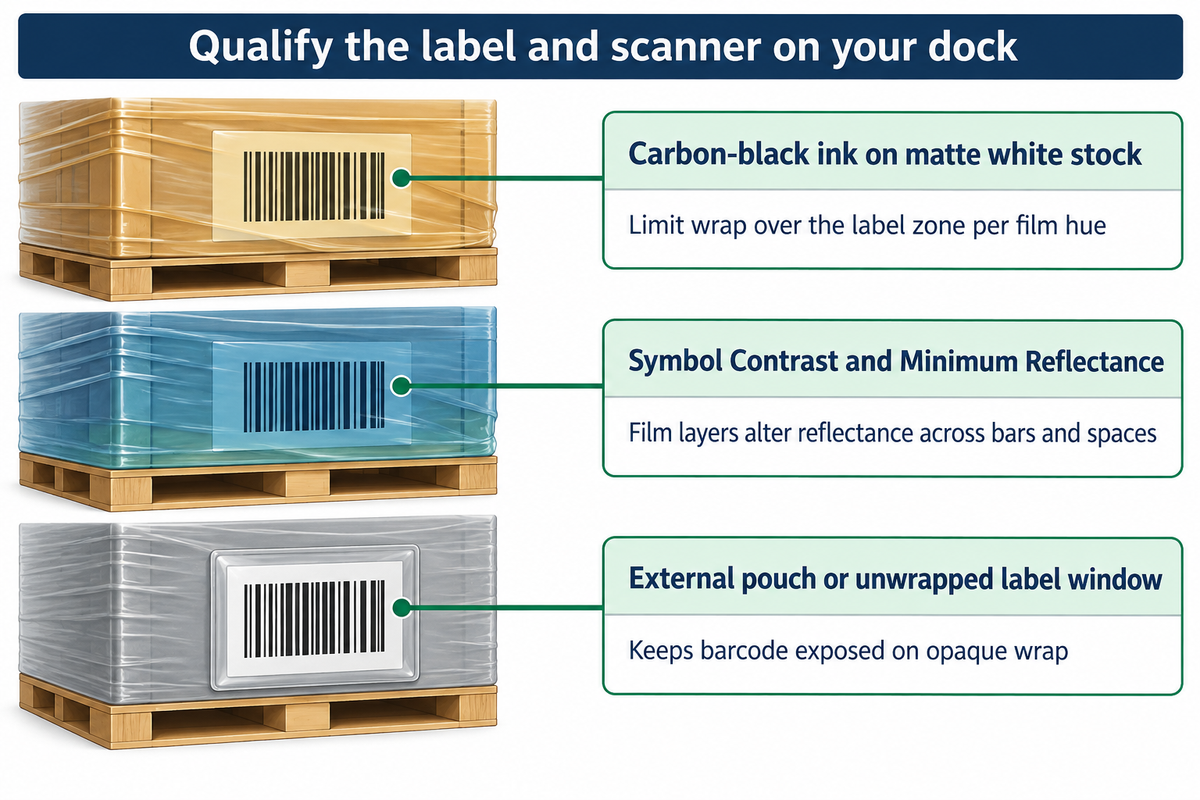
Limit wrap over the label zone per film hue and scanner: the table allows up to 1 to 2 layers for warm tints under a red laser, at most 1 layer for blue or green, and requires dock trial scans or an external pouch for dark violet, while printing barcode bars in carbon-black ink on matte white stock; qualify the actual label and scanner on your dock. When opaque film or 3 or more overlapping layers cover the label, an external self-adhesive label pouch or an unwrapped label window keeps the barcode exposed.
Under ISO/IEC 15416 for 1D linear barcode verification, all 10 scan lines are graded based on reflectance parameters. The average of those scores determines the grade of the barcode. The details are provided by Cognex. There are two reflectance relationships in which plastic film affects linear barcode contrast: Symbol Contrast (SC = Rmax − Rmin, reflectance difference between light spaces and dark bars) and Minimum Reflectance (which fails when minimum reflectance of the bars Rmin exceeds ½ maximum space reflectance Rmax). If an unwrapped GS1-128 label has typical white-space reflectance of about 80% and black-bar reflectance of about 10%, its baseline Symbol Contrast is 80% − 10% = 70%; the label is graded for symbol evaluation only after its other grading parameters are measured. Colored plastic film can reduce Symbol contrast and increase minimum reflectance. However, a decrease in Symbol contrast doesn’t mean a failure. The grade should be evaluated considering the minimum-reflectance requirement, which fails when minimum reflectance of the bars exceeds ½ of maximum space reflectance. Barcode readability with colored stretch film depends on multiple parameters such as the wavelength of illumination of the scanner, reflectance of the label, and overlapping film layers, instead of a single contrast figure.
Why do cool-tinted and warm-tinted films behave differently under a 650 nm red laser?
Under a monochromatic 630–660 nm red laser scanner, cool-tinted stretch films (blue, green, violet) absorb red light and turn the white label background dark after 2 to 3 layers, whereas warm-tinted stretch films (red, orange, yellow) transmit red light and remain readable up to 2 layers provided the barcode bars are printed in black carbon ink rather than red or orange ink. As reported in the monochromatic barcode contrast guide by Church Offset Printing, red light identifies warm colors (red, orange, yellow, white) as “white” (high reflectance Rmax) and identifies cool colors (blue, green, violet, black) as “black” (high absorption).
In the stated 2-to-3-layer dark blue or green film setup, typical white-space reflectance of about 25% and bar reflectance of about 15% produce 25% − 15% = 10% Symbol Contrast under ISO/IEC 15416; that low contrast does not establish that every scan will fail. With 1 to 2 layers of red or yellow tint in the stated setup, a 650 nm red laser measuring white spaces at about 70% reflectance and black bars at about 10% yields 70% − 10% = 60% Symbol Contrast; red-ink or orange-ink bars can lose contrast against the background, while the barcode’s overall grade requires its other measured parameters.
A 2D area imager (Signal Processing StackExchange) can read a suitably printed 2D symbol where a 1D linear laser cannot; the symbol’s Reed-Solomon correction is built into the symbol and is separate from ISO/IEC 15415 print-quality grading, and film lap seams or specular gloss measured under ASTM D2457 can still impede decoding. Moreover, as GS1 2D barcode guidance emphasizes, many industrial 2D scanners still use a red reading light; to read reliably through 2 to 3 layers of cool blue or green colour stretch film, the 2D CMOS imager must be equipped with broadband white-LED illumination and tested on your actual label stock. CGP Coating notes that extra wrap revolutions do not always improve pallet stability when film tension or friction is miscalibrated; overlapping layers can also reduce barcode readability.
Warehouse Load-Coding Architecture: Mapping Standard Film Colors to FIFO, QC Hold, and Zone Routing
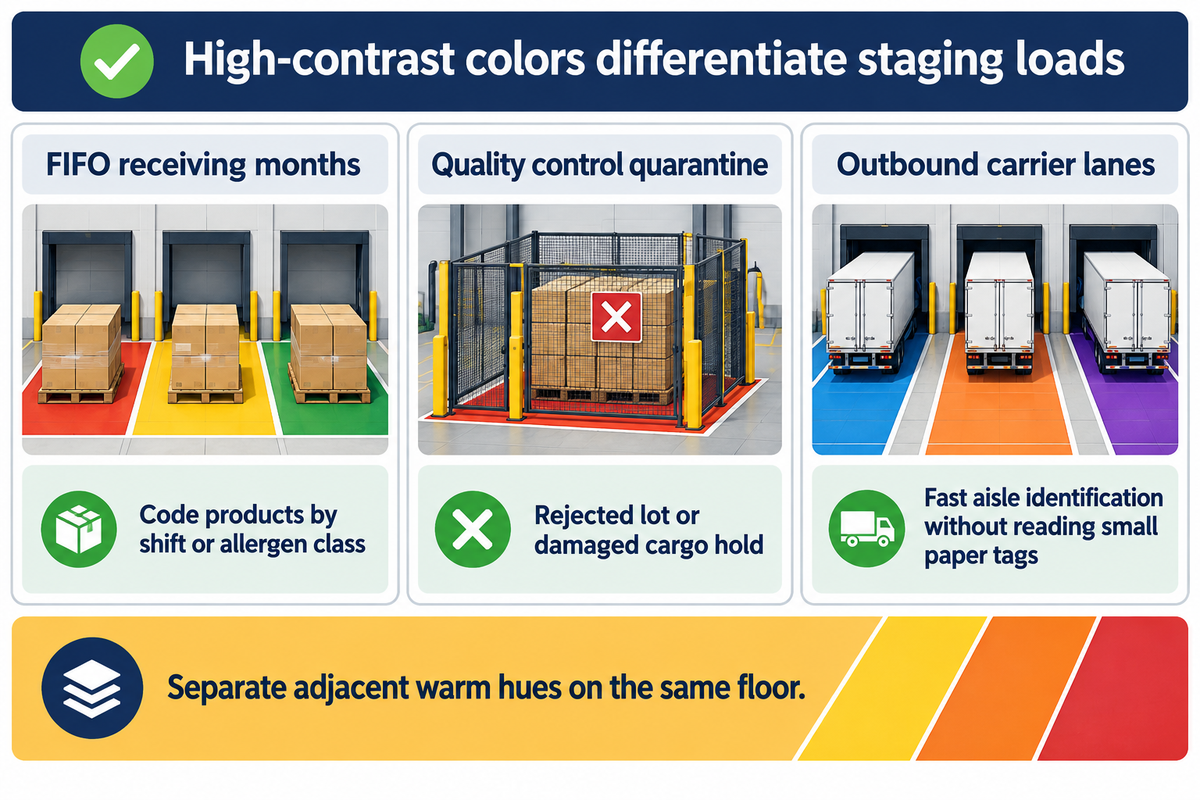
According to Tuosheng Pack, differentiating high contrast stretch film colors for various warehouse functions (e.g., FIFO receiving months, quality control quarantine, allergen separation, outbound carrier lanes, etc.) can help differentiate loads during staging. Using distinct floor colors can help prevent operator confusion when dealing with adjacent warm colors (e.g. red vs. orange) under high bay lighting.
Because colored stretch wrap is available in multiple colors for shipping and packaging, operations teams achieve easy identification from 15 to 25 meters (50 to 80 feet) down an aisle without dismounting a forklift to read small paper tags. An eye-catching colour wrap improves product identification and allows receiving clerks to code products by shift, allergen class, or carrier lane. On heavy export loads that combine color films with rigid unitization, pair your color code with our industrial strapping for shipping guide to keep colour-coded pallet loads structurally locked during intermodal transit.
| Film Color | Standard Warehouse Coding Assignment | High-Bay LED Aisle Visibility (20 m) | 650 nm Red Laser Compatibility | White-LED 2D CMOS Compatibility | Shop-Floor Label Window Rule |
|---|---|---|---|---|---|
| Red Tint | Quality-control quarantine, rejected lot, or damaged cargo hold | High (keep separate from orange on same floor) | Good up to 1–2 layers on carbon-black ink; erases red or orange ink | Good up to 2–3 layers (flat application) | Keep mid-pallet label zone ≤2 layers; never use red text on labels |
| Green Tint | QC-released stock, approved outbound staging, or eco/recycled line | High contrast against racking and concrete | Low at ≥2 layers (absorbs 650 nm red light) | Good up to 2–3 layers | Cap label zone at 1 layer for red lasers or use white-LED 2D imagers |
| Blue Tint | Food-grade / allergen-free zone, cold-chain, or FIFO Month A | High (universal food & pharma visual cue) | Low at ≥2 layers (darkens white background under red light) | Good up to 2–3 layers | Use single-pass mid-belly wrap recipe or white-light 2D scanner |
| Yellow Tint | Hazmat buffer, priority cross-dock staging, or FIFO Month B | Highest brightness under dim warehouse lighting | High up to 2 layers (transmits 650 nm red wavelength) | High up to 3 layers | Avoid yellow highlighters or orange/red ink on shipping placards |
| Orange Tint | Rush / expedite freight, seasonal promotional stock, or Shift C | High (do not pair simultaneously with red tint) | Good up to 2 layers on black-on-white labels | Good up to 2–3 layers | Maintain ≤2 layers over GS1-128 barcode zone |
| Purple / Violet Tint | Customer RMA returns, rework staging, or bonded customs hold | Moderate-High (distinct from standard primary hues) | Poor (high absorption across 630–660 nm) | Moderate up to 1–2 layers | Apply external label pouch or cap label zone at 1 stretched layer |
| Opaque Black | High-value electronics/apparel theft deterrence & transit security | Some infrared diffuse pallet-height photoeyes can miss dark film | 0 layers (up to 100% opaque at 3–4 wraps) | 0 layers (up to 100% opaque at 3–4 wraps) | Mandatory external self-adhesive pouch outside the final wrap for labels that must be scanned |
| Opaque White | Outdoor yard storage, solar heat reflection, and clean export appearance | Very High (bright white titanium dioxide surface) | 0 layers (opaque at 3–4 wraps) | 0 layers (opaque at 3–4 wraps) | Mandatory external self-adhesive pouch or top-sheet placard |
| Standard Clear | General unrestricted inventory requiring full carton graphics visibility | Neutral (no color-code signal) | High up to 3–4 flat layers | High up to 4–5 flat layers | Avoid overlapping rope seams directly across barcode bars |
Black vs. White Opaque Stretch Film: Theft Concealment, Solar Heat Buildup, and Outdoor UV Stability
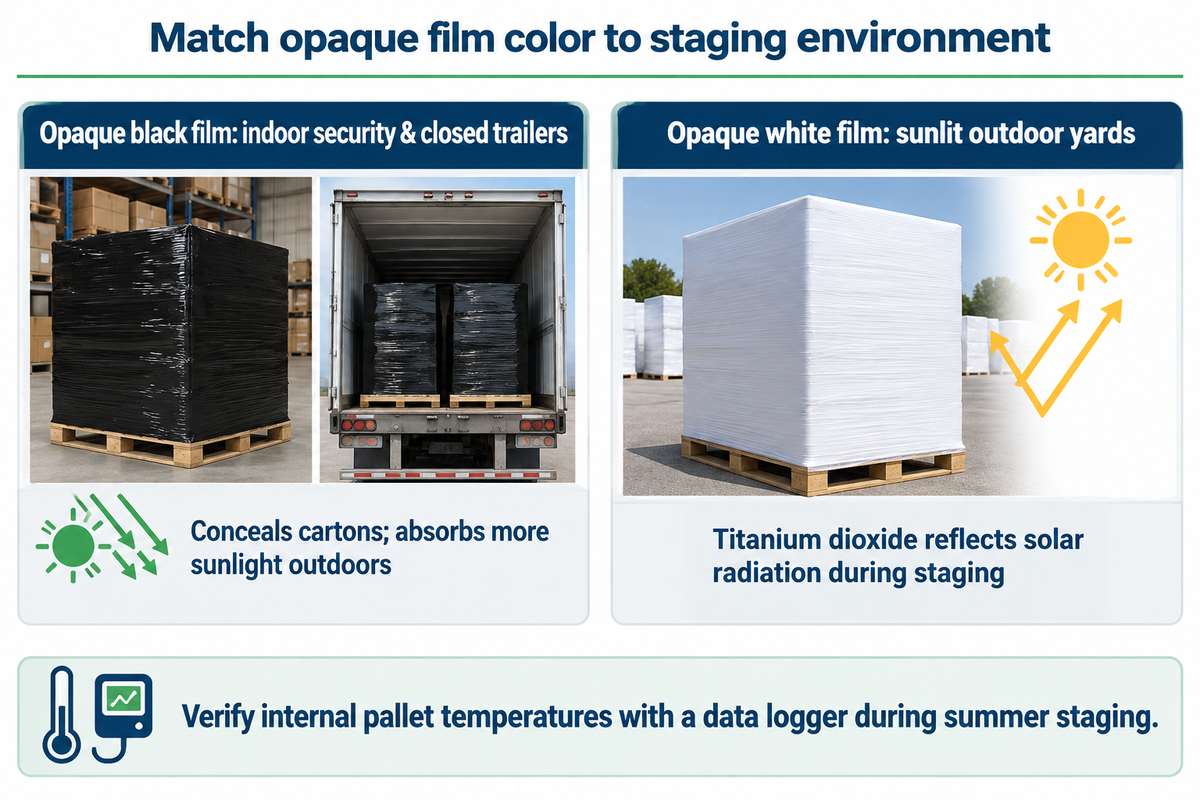
Select opaque black stretch film for indoor security and closed-trailer transit where concealing high-value cartons prevents pilferage, and specify opaque white stretch film when heat-sensitive pallet loads sit in sunlit outdoor yards: Packaging and Wrapping Machines reports pallet core temperatures 15°F to 30°F (8.3°C to 16.7°C) lower with opaque white film than with clear or black film in open-yard or tarmac logistics; sun exposure and load mass affect the result.
In the presence of solar radiation, the surface color (albedo) of stored sensitive items can create thermally stressful conditions within the load. Films that absorb solar radiation, such as black films, can increase the heat build up during staging. The use of White opaque films containing TiO2 can reflect solar radiation and help reduce the heat build up during staging. Black film absorbs more sunlight, while white opaque film containing titanium dioxide reflects more of it and can reduce heat buildup during outdoor staging; humid air can still condense on a cooler carton, and heat can still affect its case seal. Outdoor pallet core temperature differences and UV service life vary with solar irradiance, ambient humidity, dwell duration, and load thermal mass, so facilities storing temperature-sensitive palletized products outdoors should verify internal temperatures with a data logger during summer staging.
Does opaque color automatically protect stretch film from outdoor sun exposure?
No: AAA Polymer says most unstabilized stretch films start degrading and losing elongation within 30 days outdoors, while UV inhibitors (HALS / UVI) may protect film for 9 to 12 months of outdoor uv protection. Macroscopic polyethylene weathering studies published by the National Institute of Standards and Technology (NIST) confirm that ultraviolet photo-oxidation cleaves polyethylene polymer chains faster as UV irradiance and ambient temperature rise, causing unstabilized plastic wrap to chalk, yellow, and split under tension. While ASTM D4649-20 Section 1.1 covers indoor environments, buyers staging full pallet loads outdoors for extended periods should specify UVI-stabilized film rather than relying on pigment color alone.
How Pigment Masterbatch Changes Film Mechanics and Automated Wrapper Photoeye Detection
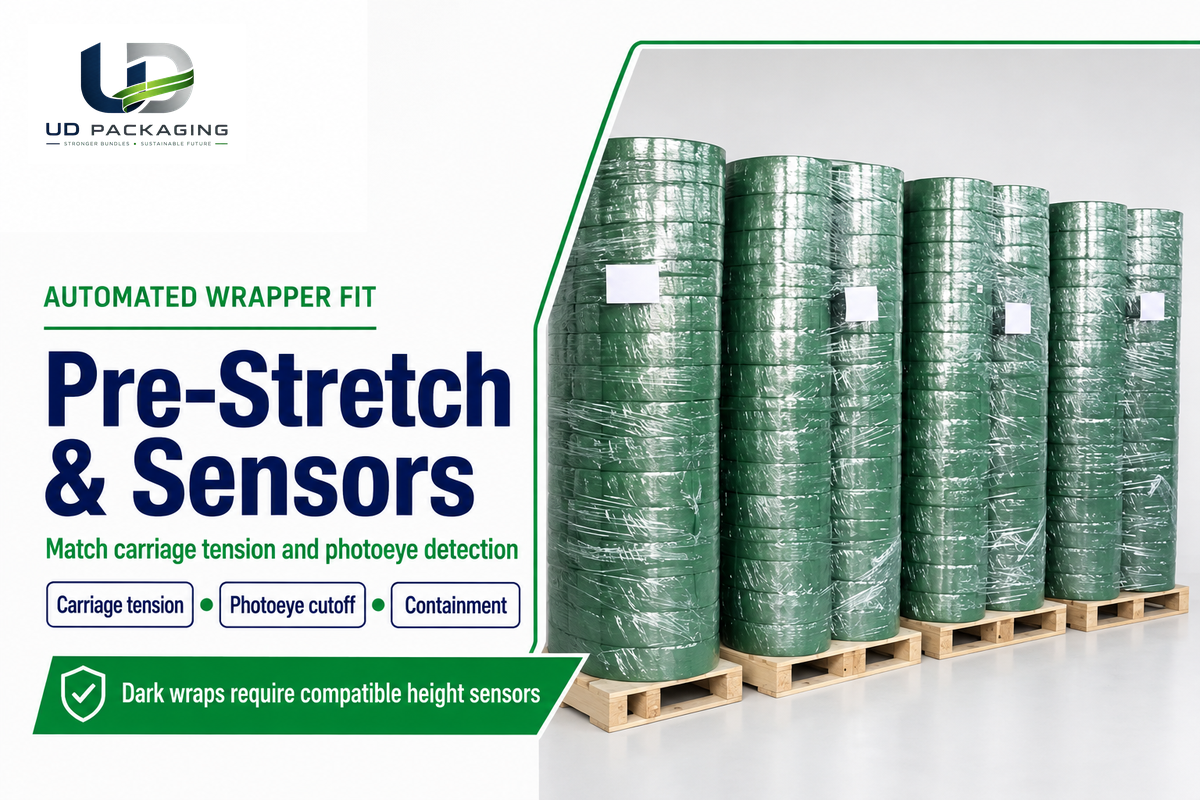
Packaging and Wrapping Machines reports 200% to 250% pre-stretch for the opaque films it describes, compared with 200% to 300% for translucent tinted cast film; MPS Pack describes cases in which infrared diffuse photoeyes miss black-wrapped loads. Because stretch wrap functions as an elastic packaging membrane around unitized cartons, matching pre-stretch carriage tension to the film formulation helps reduce web breaks, and using compatible pallet-height sensors prevents top-of-pallet overruns.
In a November 2025 empirical study published in Sensors (Tkaczyk et al., PMC12656129), researchers tested 15 µm (60 gauge), 17 µm (67 gauge), and 23 µm (90 gauge) LLDPE cast films at 150%, 200%, and 250% pre-stretch on a Robopac 705 wrapper. Within the 150% to 250% quasi-elastic region, molecular chains align to increase tensile modulus; beyond 300% pre-stretch, neck-in and thinning trigger film failure. For the 23 µm film at 250% pre-stretch, localized static stabilizing force (Fs, measured at one-third pallet height on the long side) scaled linearly with wrap revolutions (n): 2.35 N at 1 wrap, 5.88 N at 3 wraps, 7.64 N at 4 wraps, 11.76 N at 6 wraps (11.76 − 5.88 = 5.88 N added by doubling from 3 to 6 wraps), 18.23 N at 9 wraps, and 29.99 N at 15 wraps. Note two critical engineering boundaries from the study and companion standards:
- Local Force vs. Whole-Pallet Certification: Localized mid-pallet force measurements and analytical temperature estimates don’t by themselves certify whole-pallet dynamic transit compliance under EUMOS 40509 (0.8 G longitudinal, 0.5 G lateral), and the ±8% force variation across 5°C to 35°C in Tkaczyk et al. is an analytical estimate rather than multi-temperature sled testing.
- Viscoelastic Stress Relaxation: Stretch film relaxes after application; Virginia Tech Center for Unit Load Design research reports containment force can drop by up to 55% over 12 hours when over-stretched, which is why buyers verify elastic recovery and stress retention under ASTM D5459-95(2025), peel cling under ASTM D5458-95(2025), and protrusion puncture resistance under ASTM D5748-26.
At 200% machine stretch film pre-stretch on a machine stretch wrap carriage, an 80-gauge (20.3 µm) film lengthens by a factor of 3.0; volume conservation gives its final thickness from that length change together with the stretched web width, so post-stretch thickness, corner puncture resistance, and pigment coverage over a label can’t be derived from the draw ratio alone and must be qualified on the wrapper. For manual dock operations using 18 inches wide hand stretch film rolls (with quiet unwind and quiet release), hand stretching by a typical 50% to 100% increases film length by a factor of 1.5 to 2.0; post-wrap thickness also requires the stretched web width and starting gauge.
Colored Stretch Film vs. Custom Printed Film, Dock Trial Protocol, and 2026 Warehouse Adoption Trends
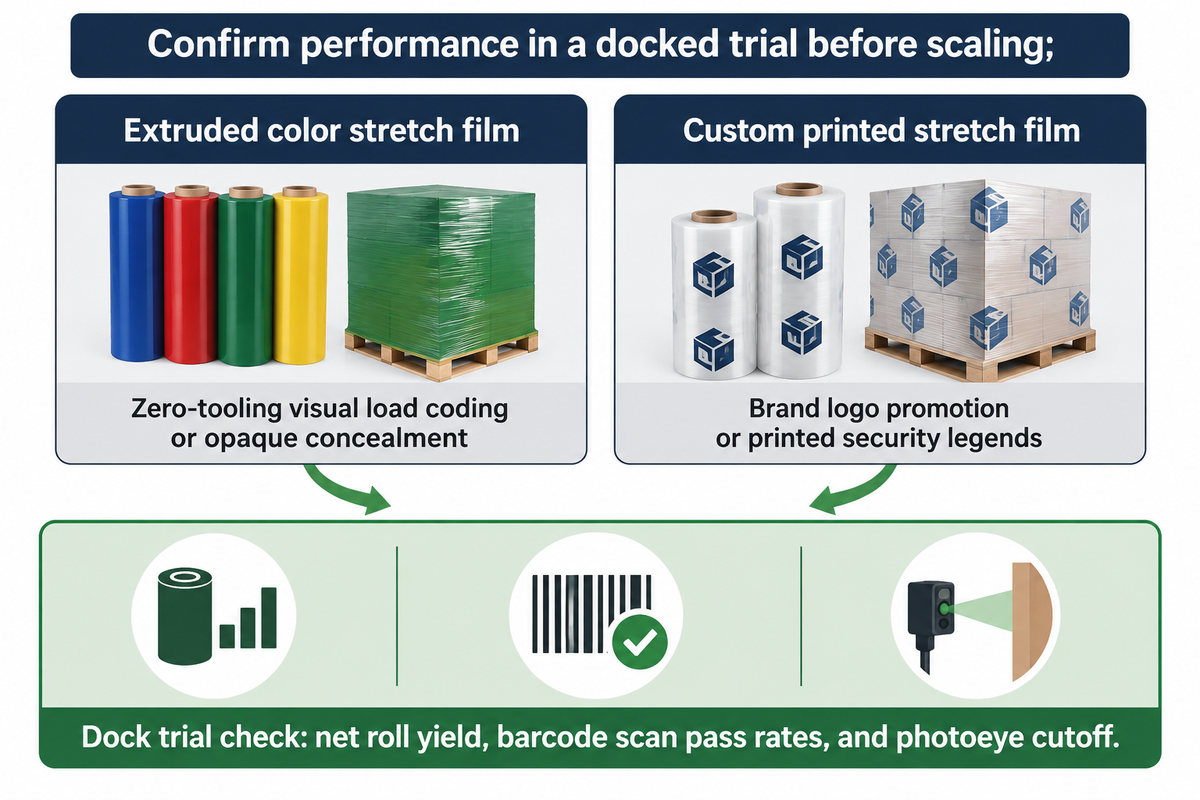
Choose extruded color stretch film for zero-tooling 360-degree visual load coding or opaque concealment across flexible packaging roll quantities, and use custom printed stretch film for brand logo promotion or printed security legends when roll volume justifies printing plate setup and artwork approval lead times. Before scaling any colored roll across automated wrappers, run a docked trial to confirm net roll yield, barcode scan pass rates, and photoeye cutoff.
According to Persistence Market Research, the global stretch wrap machines market reaches US$ 927.3 million in 2026 and is projected to grow at a 5.3% CAGR to US$ 1,331.1 million by 2033, with turntable wrappers representing 52.9% of installations and automatic systems holding 43.5%. As Packaging Digest highlights (noting commercial high-performance films supplied in 43 and 63 gauge, 20-in and 30-in widths, and 7,500 ft and 10,500 ft lengths), modern automated lines increasingly pair metered pre-stretch carriages with vision scanning portals, making optical consistency and roll-to-roll gauge uniformity mandatory across the supply chain.
The Dock-Level Colored Film Sample Trial & Wrapper Photoeye Protocol
Follow this 5-step qualification sequence on your shipping dock before approving a new colored or opaque packaging film lot.
- Verify net roll weight and agreed yield tolerance: Weigh 5 sample rolls and subtract paperboard core weight. Using the nominal LLDPE roll weight calculation Width (in) × Length (ft) × Gauge × 0.000004, a 20 in × 5,000 ft × 80-gauge machine roll has a theoretical net film mass of 20 × 5,000 × 80 × 0.000004 = 32.0 lb. For a 32.0 lb nominal roll, an agreed ±7% single roll weight tolerance gives an acceptance range of 32.0 × 0.93 = 29.76 lb to 32.0 × 1.07 = 34.24 lb; acceptance of the lot follows the separately agreed to sampling and tolerance.
- Audit scanner wavelength versus film hue at 1, 2, and 3 stretched layers: wrap a test pallet bearing your standard GS1-128 and 2D DataMatrix labels. For each layer count, 10 trial scans at a 15° to 30° skew with the actual dock scanners, including a 650 nm red laser and a white-LED 2D imager, measure progress toward a typical 100% first-pass read target; separately, ISO/IEC 15416:2025 grades linear GS1-128 against the Grade C (1.5) target, while ISO/IEC 15415 grades DataMatrix.
- Program a mid-belly single-pass wrapper recipe and calibrate photoeyes for dark film: on turntable or rotary-arm wrappers, maintain 3 to 4 bottom wraps and 3 top wraps for containment while limiting the 36-to-48-inch (90-to-120-cm) label zone to 1 to 2 translucent layers. Because MPS Pack states that carbon blacks and dark tints can absorb infrared beams and cause carriage over runs in some instances, test a polarized retro reflective photo eye, a laser time of flight sensor or an ultrasonic load height sensor before running black stretch film.
- Inspect corner windowing and puncture resistance at target pre-stretch: run opaque 80-gauge film at a typical 200% to 250% pre-stretch over 90° pallet corners. Confirm zero translucent corner windowing and zero web breaks or corner tears; if corners thin to translucence, lower the pre-stretch setting or evaluate a heavier gauge on your load profile for excellent puncture resistance.
- Check 24-hour post-wrap cling and banding retention: inspect wrapped product loads after 24 hours of warehouse staging to confirm film tails stay laminated without flagging, narrow banding zones retain tension without crushing top-layer cartons, and product coding for inventory identification and organization remains clear across every variety of applications.
Scope & Supply Confirmation Note: UD Packaging supplies LLDPE stretch film products (including hand wrap, machine film, and narrow rolls to bundle cartons in industrial packaging) and strapping consumables. UD Packaging doesn’t manufacture barcode verification meters, pallet netting, and wrapper sensor hardware. Because available color shades, nominal gauges, roll dimensions, and UVI additive packages depend on production specifications, always request sample rolls and confirm exact hand or machine roll availability against your labels, scanners, and wrapping equipment before bulk ordering. Because available color shades, nominal gauges, roll dimensions, and UVI additive packages depend on production specifications, always request sample rolls and confirm exact hand or machine roll availability against your labels, scanners, and wrapping equipment before bulk ordering.
Frequently Asked Questions
How many layers of translucent tinted stretch film can a warehouse barcode scanner read through?
A warehouse 2D CMOS imager using broadband white LED illumination commonly reads black-on-white barcodes through 1 to 2 stretched layers of translucent blue, green, yellow, or red stretch film (about 60% to 75% light transmission). Some translucent films may remain readable through 3 flat layers; verify the maximum number of layers with your actual scanner.
When can red or orange tinted stretch film make a label unreadable to a red laser scanner?
A 650 nm red laser can’t distinguish red or orange barcode bars or priority stamps under red film from the background because it treats warm colors (red, orange, yellow) as reflective white background. Consequently, red or orange markings beneath red film can lose contrast, while cool blue or green film darkens white spaces.
Does adding color pigment masterbatch reduce the stretchability or puncture strength of LLDPE stretch film?
Translucent tinted cast film with a common 1% to 3% organic pigment loading commonly supports 200% to 300% machine pre-stretch. However, opaque black film uses carbon-black pigment and multilayer white film incorporates 6% to 14% titanium dioxide in intermediate layers (US10576718B2, about 200% to 250% pre-stretch); qualify puncture resistance on your wrapper.
How do you stop an automatic pallet wrapper photoeye from missing black stretch film?
Replace standard diffuse infrared photoeyes—which can miss dark loads because carbon black absorbs infrared light—with a polarized retro-reflective photoeye paired with a corner-cube reflector, a laser time-of-flight sensor, or an ultrasonic load-height sensor calibrated for dark non-reflective pallet loads.
Should outdoor pallets be wrapped in black opaque stretch film or white opaque stretch film?
To protect heat-sensitive pallets from the outdoors, cover them with UV-stabilized white opaque stretch film. Use UV-stabilized black film on thermally stable, concealment-needed cargo. According to Packaging and Wrapping Machines, reflective white film can decrease pallet core temperatures by 15°F to 30°F (8.3°C to 16.7°C) in an open-yard storage scenario when compared with black film, dependent on the intensity of the sun, dwell time, and mass of the load.
What is the difference between colored stretch film and custom printed stretch film?
Colored stretch film blends pigment masterbatch directly into the extruded LLDPE melt for uniform 360-degree tinting or concealment with zero tooling fees, whereas custom printed stretch film applies surface ink logos onto film and requires printing plates and artwork approval.
How should operators apply opaque stretch film when the shipping label must remain scannable on the dock?
Operators keep shipping labels scannable on opaque-wrapped pallets using three proven warehouse dock methods: attaching the GS1-128 barcode inside a self-adhesive clear packing-list pouch on the exterior of the final opaque film layer, roping the opaque film web narrow to bypass a mid-pallet label band that’s then covered with 1 flat layer of clear wrap, or applying a hanging placard inside the top pallet deck board where forklift tines won’t tear it during loading.
Need Sample Rolls to Test on Your Dock Scanners and Pallet Wrappers? Share your target film hue (translucent tint or opaque black/white), required gauge and roll width for hand wrap or machine stretch film, and outdoor UV requirements with UD Packaging. Visit our Industrial stretch film Range or request a custom sample & specification quote for warehouse trial.
References & Sources
- From ASTM International (via iTeh Standards). ASTM D4649-20: Standard Guide for Selection and Use of Stretch Wrap Films (Section 1.1 indoor scope; companion references ASTM D5458-95(2025), ASTM D5459-95(2025), and ASTM D5748-26).
- International Organization for Standardization (ISO). ISO/IEC 15416: Information technology, Automatic identification and data capture techniques, Bar code print quality test specification, Linear symbols (2016 edition withdrawn 2025-01-08; superseded by ISO/IEC 15416:2025).
- Cognex Corporation 3 Essential ISO Standards for Barcode Verification (ISO/IEC 15416, ISO/IEC 15415, ISO/IEC TR 29158)
- Church Offset Printing. Barcode Dos and Don’ts: Color and Contrast under Red Laser Scanners.
- Qualtech Products Industry. (ASTM D1003: Standard Test Method for Haze and Luminous Transmittance of Transparent Plastics)
- Packaging AND Wrapping MACHINES.
- AAA Polymer. UV Stabilized Stretch Wrap Film: Outdoor Degradation Timelines and UVI Additive Protection.
- Tkaczyk, S. et al. (2025). Empirical Evaluation of Stretch Film Mechanics Display in Optimizing Wrapping Parameters for Pallet Stability. Sensors , 25(22):6883 (PubMed Central PMC12656129).
- Google Patents / USPTO. US Patent US10576718B2: Multilayer Opaque Polyolefin Film (6–14 wt% TiO2 and 0.050–0.15 wt% secondary pigment co-extrusion).
- MPS Packaging Australia. Read Black Pallet Wrap: When to Use It, Photoeye Sensor Limitations, and Label Visibility.
- Persistence Market Research (2026). Stretch Wrap Machines Market Size, Share, and Growth Analysis (2026–2033).
- Packaging Digital. Stretch Wrap Film Packaging Design & Specification Benchmarks.
- CGP Coating Innovation (2026) Why is Stretch Film Not Always Effective for Stabilizing a Pallet?
- Tuosheng Pack. Colored Stretch Film Applications & Warehouse Error Reduction Benchmarks
- Signal Processing StackExchange. Most Reliably and Rapidly Readable 2D Barcode Under Optical Distortion
- GS1 Finland. Creating a GS1 2D Code and Placing It on Packaging (Red vs. White Illumination Guidance).
- National Institute of Standards and Technology (NIST)
- Virginia Tech Center for Unit Load Design. Effects of Temperature and Post-Wrap Relaxation on Stretch Wrap Containment Force.