Get in touch with UD Packaging Company

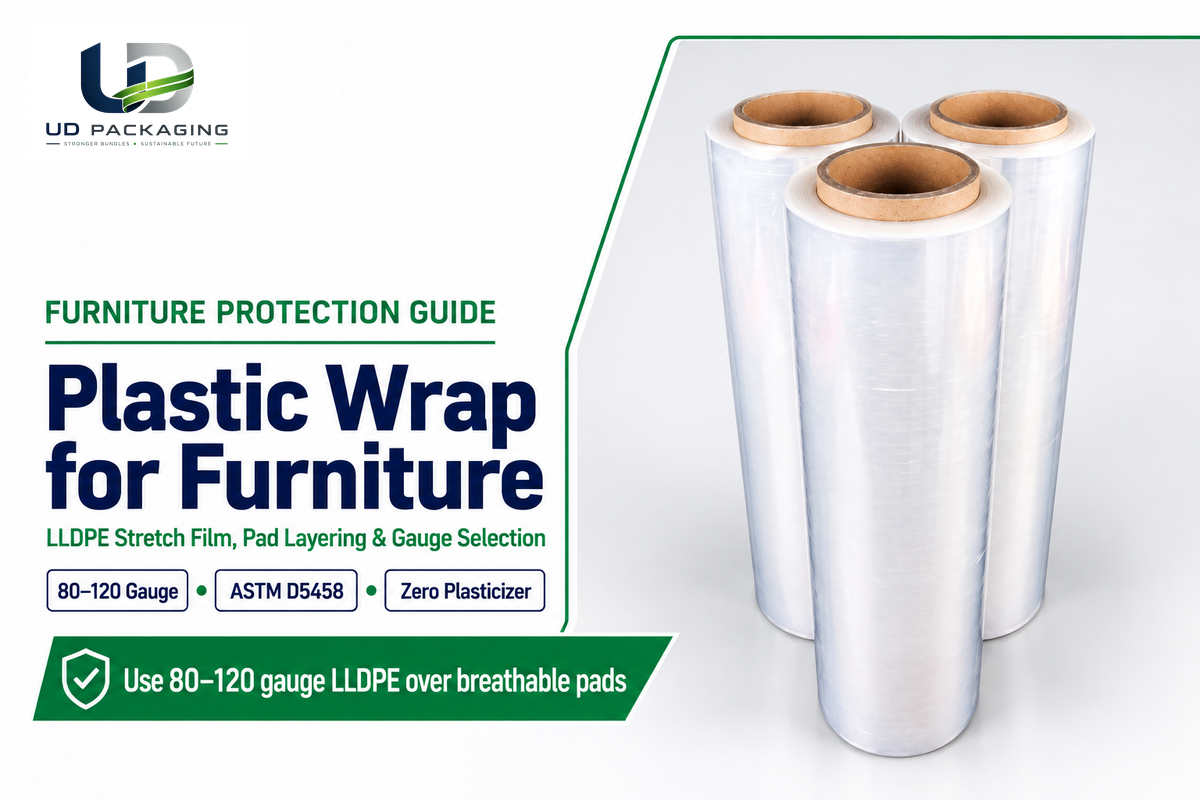
Distinguishing the best plastic wrap for furniture means separating industrial linear low-density polyethylene (LLDPE) stretch film from household polyvinyl chloride (PVC) kitchen wrap and heat-gun shrink film. When homeowners and commercial crews use plastic wrap for moving , an 80 to 120 gauge (0.80 to 1.20 mil / 20.3 to 30.5 microns) LLDPE plastic stretch film secures breathable moving blankets, dresser drawers, and upholstery cushions via elastic tension and self-clinging tack tested under ASTM D5458 without leaving sticky tape adhesive behind. It is tested under ASTM D5458 and does not leave sticky tape adhesive behind. Using industrial LLDPE stretch film along with a breathable underlay pad prevents condensation blushing, veneer peeling and corner punctures during transit and storage.
Updated November 2026 · By karry, UD Packaging
Use 80 to 120 gauge (20.3 to 30.5 µm) LLDPE stretch wrap as your primary plastic wrap for furniture, and always place a breathable quilted moving blanket or 1 to 2 mm polyethylene foam sheet against wood, leather, or painted finishes first. Never apply household PVC cling film directly to finished wood or leather, and remove full-coverage plastic wrap before placing furniture into long-term non-climate-controlled storage.
Quick Specs: Furniture Plastic Wrap Engineering Baseline
- Linear Low-Density Polyethylene (LLDPE, ASTM D7611 Code #4, 0.917 g/cc density) uses 0.5–6 wt.% polyisobutylene (PIB) or metallocene self-clinging tackifier and zero ester plasticizers.
- Under industry thickness standards, 100 gauge equals 1.0 mil (25.4 microns), while an 80 gauge thick (0.80 mil / 20.3 µm) roll serves moving furniture and medium-duty loads up to 2,000–2,200 lbs.
- Standard moving roll sizes include 5 in × 1,000 ft mini bundling rolls with a spinning plastic handle for drawers and 15 in, 18 in, and 20 in × 1,000 to 1,500 ft hand rolls for sofas and dressers.
- Preventive conservation guidelines recommend maintaining stable indoor storage temperatures below 68 °F (20 °C) with controlled moderate relative humidity, and removing outer plastic wrap after 24–72 hours of transit.
What Plastic Wrap to Use for Furniture: LLDPE Stretch Film vs. PVC Cling Wrap and Heat-Shrink Film
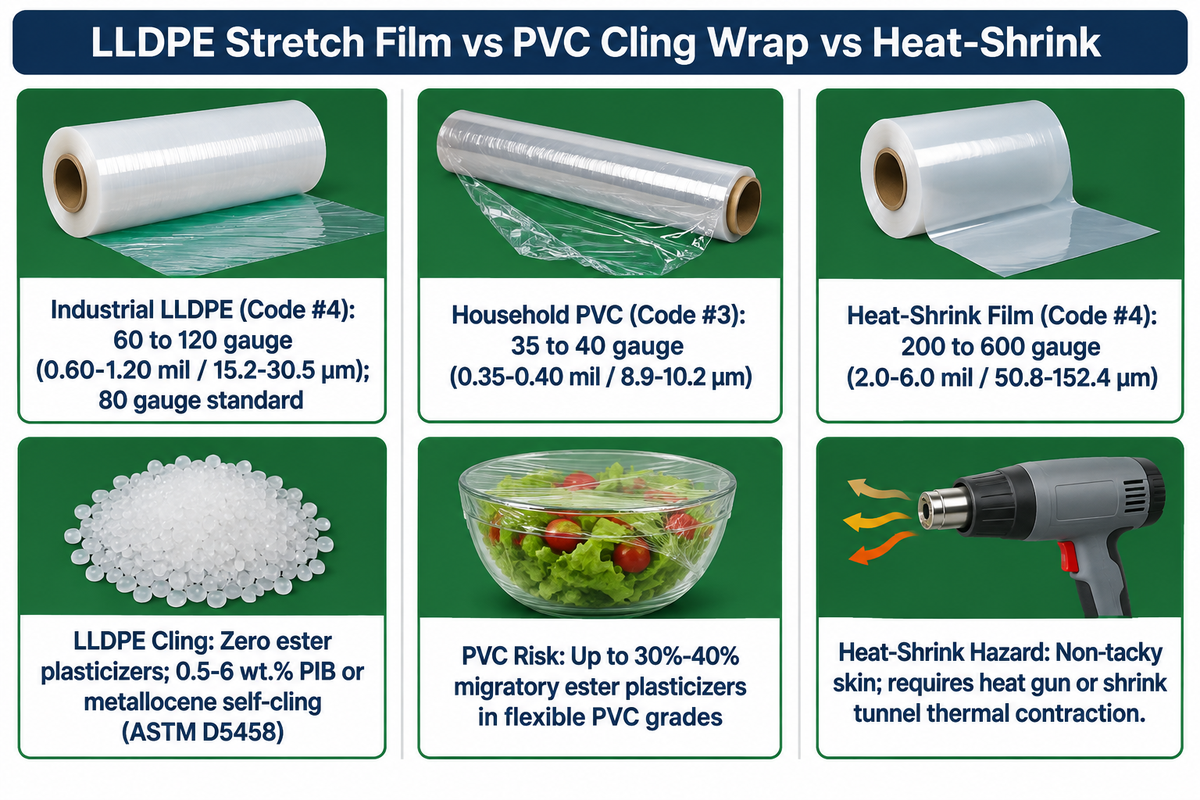
80-120 GAUGE (20.3-30.5 µm / 0.80-1.20 mil ) Linear Low-Density Polyethylene (LLDPE) stretch film is plastic wrap for furniture, keeping moving blankets and drawers in place by elastic recovery and self-clinging tack (ASTM D5458) without adhesive residue, unlike thin 35-40 GAUGE (8.9-10.2 µm) household PVC cling wrap or heat-shrink film.
Shoppers browsing moving supplies frequently use the phrases plastic wrap, stretch wrap for moving, shrink wrap roll, and furniture saran wrap interchangeably, yet the underlying polymers behave very differently when pressed against furniture varnish or leather. When you use plastic wrap on household goods, choosing an industrial strength polyethylene roll for moving rather than a kitchen food wrap protects delicate surfaces. According to Canadian Conservation Institute (CCI) Technical Bulletin 32, polyethylene (PE) contains no plasticizers, whereas flexible polyvinyl chloride (PVC) contains as much as 30% plasticizer that migrates out of the sheet and stains or softens adjacent finishes. A peer-reviewed conservation study in Heritage Science (Nature) also documents that ester plasticizers—including phthalates, sebacates, adipates, and trimellitates—reach concentrations up to 40% in flexible PVC, with surface sweating or sticky deposits observed in 23% of surveyed PVC objects.
By contrast, commercial furniture protection relies on pure polyethylene classified under ASTM D7611 Resin Identification Code #4 (LDPE/LLDPE). As described in US Patent US5085927A LLDPE (at 0.917 g/cc base density) achieves self-adhering cling by means of 0.5 to 6 wt.% low-molecular-weight polyisobutylene (PIB) or polybutene migrated to the skin of the film, or by means of ultra-low density polyethylene (ULDPE) and metallocene cling layers. Since the plastic film sticks and only adheres to itself when wrapping furniture, a self-adhering plastic wrap for moving locks pads in place cleanly. Zero-plasticizer LLDPE chemistry eliminates ester plasticizer leaching, though high temperature truck interiors above 120 °F (49 °C) can cause low-molecular-weight PIB tackifier bloom or pressure imprint, especially if the film is stretched during application to uncured shellac or nitrocellulose lacquer.
LLDPE Stretch Wrap vs. PVC Kitchen Cling Film vs. Polyolefin Shrink Film
Heated heat-shrink film (also called “packaging heavy-duty shrink film for boat winterizing or export skids”) starts out as a loose web of LDPE or polyolefin that shrinks when heated with a heat gun. Pointing a heat gun at a sofa, upholstered headboard, or lacquered dresser scorches fabric and blisters wood finishes. When a residential mover, or a video reviewer on CCLI Reviews, tests a roll for moving supplies from a roll of moving supplies, it is actually cold-applied polyethylene instead of thermal film. Even if an online office products listing calls a product Heavy-Duty Shrink wrap for moving, the roll inside the carton is actually hand shrink wrap that is self-adhering LLDPE, and stretches considerably with manual tension. In warehouse unitizing, buyers use the names shrink pallet wrap or shrink wrap for pallet wrap interchangeably to refer to cold-stretched pallet shrink film. When you purchase a heavy-duty stretch wrap for residential moving or a wrap for moving furniture and wrap for moving for furniture across state lines, make sure the specification sheet states cold-applied LLDPE stretch industrial strength film.
| Film Property / Parameter | Industrial LLDPE Stretch Wrap (Mover’s Wrap) | Household PVC Food Cling Wrap | LDPE / Polyolefin Heat-Shrink Film |
|---|---|---|---|
| Base Polymer & ASTM D7611 Code | Linear Low-Density Polyethylene (LLDPE, Code #4) | Plasticized Polyvinyl Chloride (PVC, Code #3) or thin PE | Low-Density Polyethylene (LDPE, Code #4) or polyolefin |
| Typical Thickness (Gauge / Mil / µm) | 60 to 120 gauge (0.60–1.20 mil / 15.2–30.5 µm); 80 gauge standard | 35 to 40 gauge (0.35–0.40 mil / 8.9–10.2 µm) | 200 to 600 gauge (2.0–6.0 mil / 50.8–152.4 µm) |
| Plasticizer & Cling Mechanism | Zero ester plasticizers; 0.5–6 wt.% PIB or metallocene self-cling (ASTM D5458) | Up to 30%–40% migratory ester plasticizers in flexible PVC grades | Non-tacky skin; requires heat gun or shrink tunnel thermal contraction |
| Elastic Recovery & Load Retention | High elastic memory under hand or machine pre-stretch locks moving pads and drawers | Negligible tear resistance; rips immediately on furniture corners | Rigid biaxial shrink tension; heat source hazards on wood and upholstery |
| Recommended Furniture Application | Securing moving blankets, bundling drawers, wrapping dry synthetic upholstery | Not recommended for furniture (costly and high finish-staining risk) | Outdoor industrial machinery or boat storage with protective heat shielding |
Which Furniture Surfaces Cannot Touch Plastic Wrap Directly: Wood Finishes, Leather, and Upholstery
Wood, whether lacquered, varnished, shellacked, painted, or oil-rubbed, should not be in direct contact with clear plastic wrap; the same goes for aniline or top-grain leather. In the case of bonded (PU/PVC) leather, it should never be in contact with clear plastic wrap directly; only clean, dry, synthetic microfiber upholstery will tolerate short-term (24 to 48 hours) direct contact with LLDPE during a local move.
Many consumer moving guides fall victim to the myth that polyethylene plastic wrap melts wood varnish with chemical plasticizer leaching. While museum conservation bulletins from the National Park Service (Conserve O Gram 08/04) confirm that polyethylene (PE) is chemically inert and free of the weeping plasticizers that make flexible PVC sticky, wrapping impermeable PE film directly against wood or leather causes two physical failure modes instead: micro-climate vapor trapping and tacky skin delamination. As the IPS Packaging & Automation furniture stretch wrap guide explains, plastic wrap film, when placed directly against wood or leather, will cause numerous failures including warped wood and delaminated tacky skin, and damaged leather, unless the item is first covered with moving blankets or breathable furniture pads.
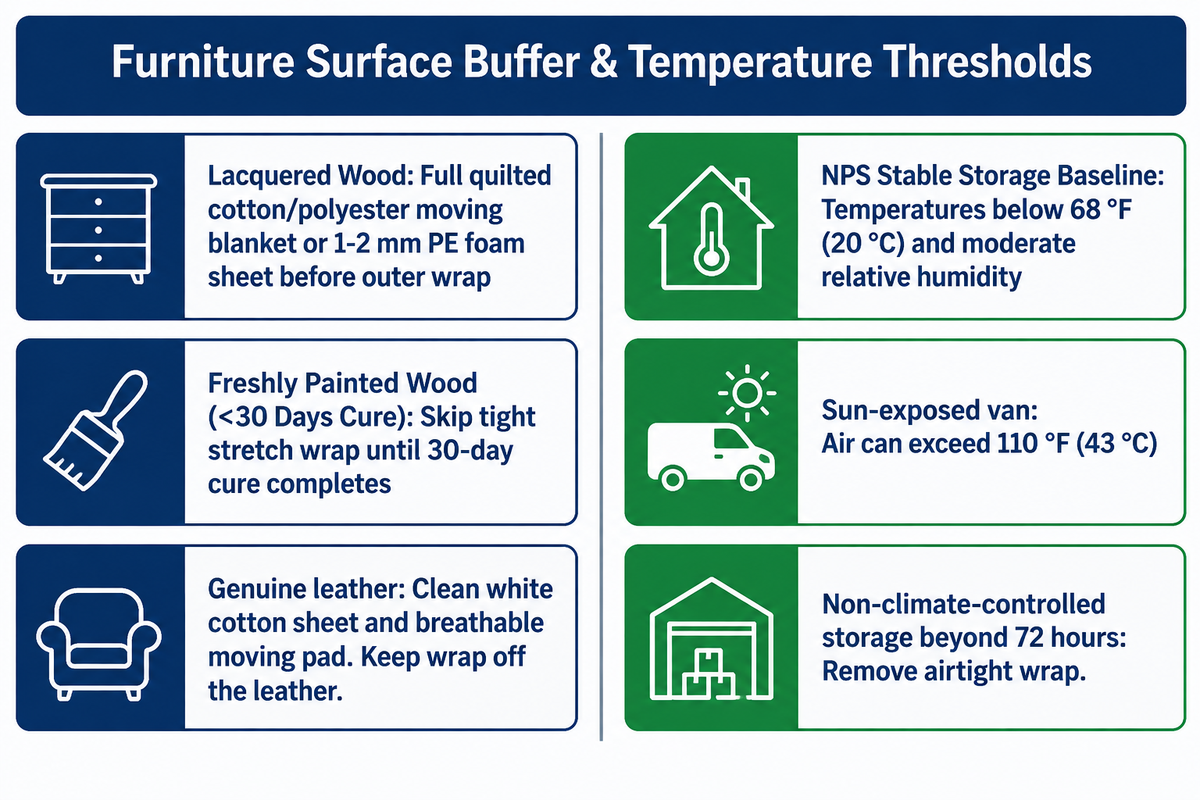
Even when a breathable cotton or non-woven moving blanket is placed under LLDPE stretch wrap, full 6-sided hermetic sealing traps ambient humidity inside wood and leather pores if the furniture is stored for more than 72 hours across diurnal temperature swings. If upholstered furniture is stored for more than 72 hours across diurnal temperature fluctuations, trapped moisture will accelerate damage to the finish and increase the risk of mold infestation. The National Park Service preventive conservation standards state that storage of stable furniture should occur at temperatures below 68 °F (20 °C) and moderate relative humidity. When a moving or portable storage van is left in the sun, the air inside the van, and by extension the air in contact with the furniture, can increase to well above 110 °F (43 °C). The moisture trapped in the air comes out and gets absorbed into the furniture, and will damage the lacquer and other topcoats and trim.
The 7-Surface Furniture Finish & Underlay Buffer Matrix
The 7-Surface Furniture Finish & Underlay Buffer Matrix (with 9 surface types) will tell you the required buffer layer and the maximum wrapping time before the outer stretch wrap film is applied.
| Furniture Surface Category / Finish Type | Direct Plastic Contact Allowed? | Primary Damage Mechanism Without Buffer | Mandatory Underlay Buffer & Wrapping Rule |
|---|---|---|---|
| 1. Nitrocellulose, Pre-Catalyzed & Acrylic Lacquered Wood | No (Zero Direct Contact) | Milky white moisture blush in lacquer; stretch-ridge pressure imprinting | Full quilted cotton/polyester moving blanket or 1–2 mm PE foam sheet before outer wrap |
| 2. Oil-Rubbed, Shellac & Paste-Wax Wood Finishes | No (Zero Direct Contact) | PIB tackifier interaction and uneven sheen clouding across wood grain | Acid-free kraft paper or soft cotton sheet under a quilted furniture pad |
| 3. Freshly Painted or Refinished Wood (<30 Days Cure) | No (Do Not Enclose in Plastic) | Trapped solvent off-gassing re-softens paint and permanently embosses film creases | Breathable cotton drop cloth only; skip tight stretch wrap until 30-day cure completes |
| 4. Genuine Leather (Aniline, Semi-Aniline, Pigmented) | No (Zero Direct Contact) | Condensation sweating, mildew growth, and topcoat sticking in warm trucks | Clean white cotton sheet plus breathable moving pad secured with moderate wrap tension |
| 5. Bonded Leather & Faux Leather (PU / Vinyl Backing) | No (Zero Direct Contact) | Self-adhering film tack peels delaminating polyurethane skin off fabric backing | Non-woven breathable dust cover under quilted moving pad; never press tacky side to PU |
| 6. Velvet, Chenille & Natural Linen Upholstery | No (Requires Pad Buffer) | Permanent pile crushing on corners and water-ring staining from trapped humidity | Drape clean cotton sheet and corner pads first; apply light-tension 80-gauge wrap |
| 7. Bone-Dry Synthetic Woven Microfiber / Polyester | Yes (Local Transit ≤48 Hours Only) | Condensation if wrapped damp or left sealed in non-climate storage >72 hours | Direct 80-gauge clear stretch wrap allowed for 24–48 hr move; remove immediately at destination |
| 8. Framed Mirrors, Glass Tabletops & Pictures in Your Home | No (Requires Foam/Cardboard First) | Direct bubble marks on gilded frames and point-impact glass breakage | Wrap in PE foam and telescopic mirror carton first; secure outer carton with stretch wrap |
| 9. Powder-Coated Metal, Laminate & Wrought-Iron Frames | Yes (With Corner Foam Guards) | Sharp metal feet puncture thin film unless cushioned at corners | Cap sharp feet with foam blocks, then wrap with 100–120 gauge blown stretch film |
How to Layer Breathable Moving Pads, PE Foam, and Stretch Wrap Without Trapping Moisture
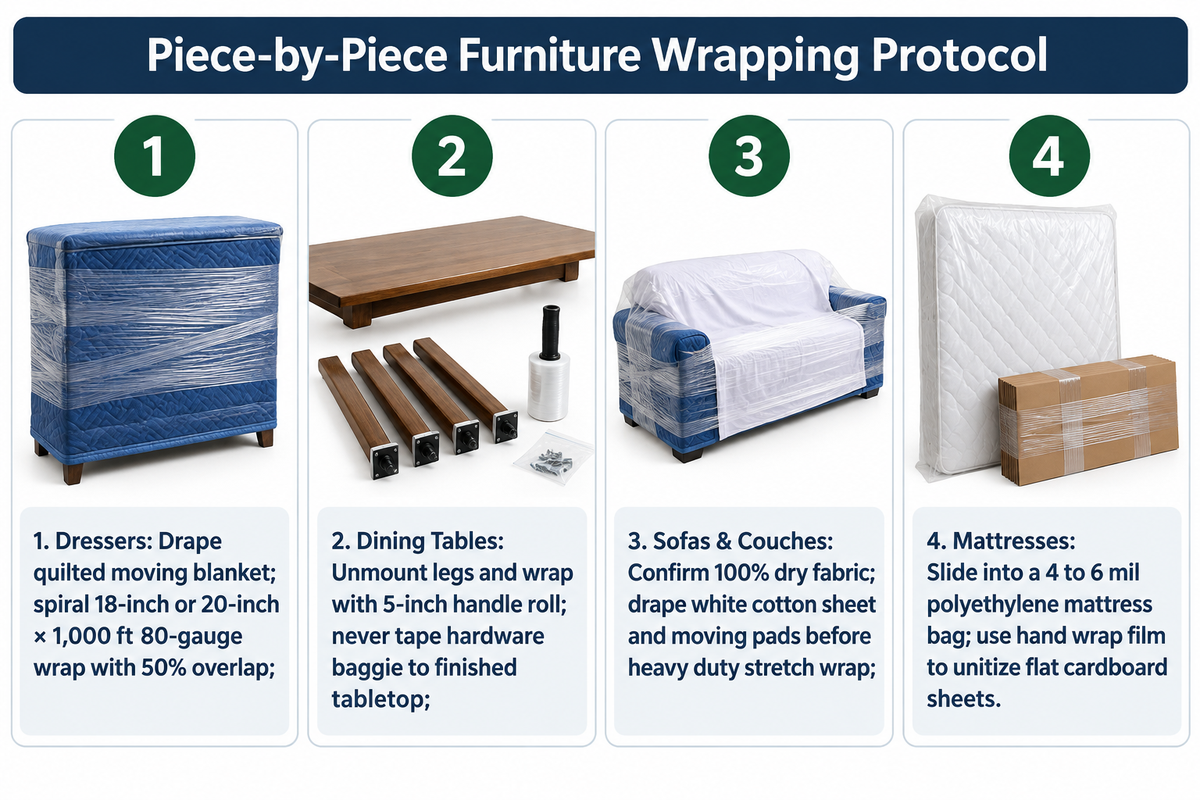
Apply the two-layer professional moving system by draping the entire furniture piece in a dry breathable moving blanket or 1.0 to 2.0 mm closed-cell polyethylene foam sheet, positioning cardboard corner protectors over sharp edges, and spiraling LLDPE stretch wrap with a 50% overlap strictly over the outside of the pad.
Field reports from container movers in Reddit’s r/moving community consistently highlight what happens when homeowners reverse this order or skip the blanket: wood dressers wrapped directly in stretch film sweat during portable container temperature swings and ruin the finish, while leather and vinyl chairs trap heat and stick together when double-stacked. It’s also very important not to put cellular bubble wrap directly up against finished wood or glass-top lacquer. Tight elastic wrap leaves “bubble print” on the wood which can only be removed through mechanical means, like stripping.
It is also important to keep packing tape off of wood and leather. While it is essential to have packing tape for sealing corrugated boxes, sticking packing tape across dresser drawers strips the wood veneer and leaves a sticky residue. A cling durable plastic stretch wrap tape sticks to itself, locking moving pads in place, and is perfect for securing moving pads around wood or leather.
Piece-by-Piece Wrapping Protocol: Dressers, Dining Tables, Sofas, and Mattresses
- For casegoods and dressers with drawers kept inside, leave lightweight clothing in sturdy drawers, drape a full-size quilted moving blanket over the top, front, and sides, and wrap an 18-inch or 20-inch × 1,000 ft 80-gauge hand stretch film roll from the base upward with a 50% band overlap, applying extra pull tension as you round the four corners so the pad cannot slip during stair carries.
- For hardwood dining tables and office desks, unmount the table legs, and cover each with a 5-inch stretch wrap with handle (or a compact pack with handle) and put the bolts in a baggie taped to the underside of the desk or table. Never put the bolts in a baggie taped to the finished surface. Cover the tabletop with a breathable moving pad and edge guards (corrugated) and secure with clear stretch wrap film.
- For upholstered sofas and couches, vacuum cushions thoroughly and confirm the fabric is 100% dry; on leather, velvet, or linen couches, drape a clean white cotton sheet and moving pads over the arms and backrest before applying heavy duty plastic stretch wrap so the film shields against truck grease and rain without crushing the upholstery pile.
- For mattresses and box springs, slide the mattress and box spring into a 4 to 6 mil polyethylene mattress bag instead of using hand wrap film. Also use a clear hand wrap film to unitize protective cardboard sheets on the flat faces.
Choosing Gauge Thickness (80 vs. 90 vs. 120 Gauge) and Roll Width: Cast vs. Blown Stretch Wrap
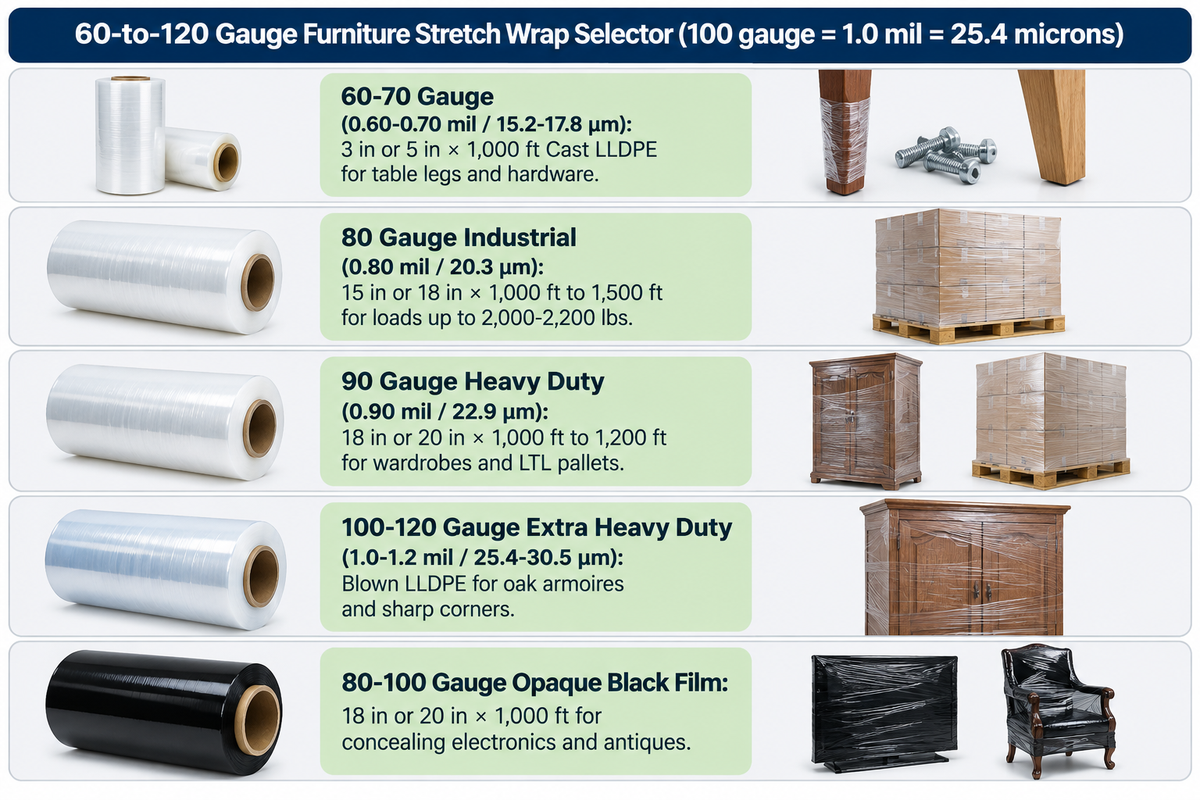
80 gauge (0.80 mil / 20.3 µm) cast LLDPE is the industry-standard plastic wrap for furniture for securing moving blankets and dresser drawers, 90 gauge (0.90 mil / 22.9 µm) handles heavier mixed casegoods, and 100 to 120 gauge (1.00 to 1.20 mil / 25.4 to 30.5 µm) blown LLDPE resists corner punctures on heavy hardwood armoires and metal frames.
MH-USA stretch film gauge guide, states that 100 gauge equals 1.0 mil (25.4 microns) exactly. In commercial moving and warehouse operations, 60 to 70 gauge (15.2 to 17.8 µm) film is light dust bundling, 80 gauge (0.80 mil / 20.3 µm) is the standard for furniture and lighter to medium-duty pallet loads up to approximately 2,000 to 2,200 lbs, and 90 to 120 gauge (22.9 to 30.5 µm) stretch film protects heavier irregular loads with sharp protrusions. Upgrading from 80 gauge (20.3 µm) to 120 gauge (30.5 µm) offers more dart puncture resistance on corners. However, thicker film requires more manual pre-stretch and can crush rattan frames.
Aside from thickness, buyers also need to choose between cast and blown extrusion processes evaluated in ASTM D4649-20(2025) (which references ASTM D882, ASTM D1922, ASTM D1709, and ASTM D5458). As IPS Packaging and Packaging Digest write, cast LLDPE clear industrial stretch wrap film has a quiet unwind with high optical clarity and is suitable for indoor moves (and reading labels). Blown LLDPE film has a higher biaxial tear and puncture resistance and is better suited for sharp-edged, heavy loads. For more information on laboratory coupon testing in MD and TD, see our companion document on reading a stretch film technical data sheet.
The 80-to-120 Gauge Furniture Stretch Wrap & Roll-Width Selector
Select your Furniture Category, Edge Geometry, and Dispenser Style using the 80-to-120 Gauge Furniture Stretch Wrap & Roll-Width Selector below:
| Gauge / Mil / Micron Thickness | Preferred Extrusion & Cling | Standard Roll Width & Length | Best Furniture & Moving Application |
|---|---|---|---|
| 60–70 Gauge (0.60–0.70 mil / 15.2–17.8 µm) | Cast LLDPE, Clear Self-Adhering | 3 in or 5 in × 1,000 ft (mini handheld roll) | Bundling detached table legs, curtain rods, hardware bags, and light dining chairs |
| 80 Gauge Industrial (0.80 mil / 20.3 µm) | Cast LLDPE, One-Sided or Quiet Cling | 15 in or 18 in × 1,000 ft to 1,500 ft (1 roll or 4-pack) | Securing moving blankets on sofas, couches, dressers, and residential loads up to 2,000–2,200 lbs |
| 90 Gauge Heavy Duty (0.90 mil / 22.9 µm) | Cast or Coextruded LLDPE | 18 in or 20 in × 1,000 ft to 1,200 ft | Tall wardrobes, modular office workstations, commercial LTL furniture pallet packing |
| 100–120 Gauge Extra Heavy Duty (1.0–1.2 mil / 25.4–30.5 µm) | Blown LLDPE, High Puncture / Tear | 18 in or 20 in × 500 ft to 1,000 ft (hand or machine) | Heavy oak armoires, wrought-iron patio furniture, sharp casegoods corners, and bulk disposal |
| 80–100 Gauge Opaque Black / Colored Film | Cast or Blown LLDPE (Black Stretch Wrap / Black Shrink Wrap) | 18 in or 20 in × 1,000 ft | Concealing high-value electronics, antique shipments, and color-coding rooms by floor |
There are several styles of dispensers available at retail hardware stores for apartment moves. You can purchase a multipack of clear stretch wrap rolls or pack clear stretch wrap rolls that are ideal for furniture to do a whole-house move, or pick up a single stretch wrap roll with handles to move a studio apartment. Consumer comparison tests often evaluate 1000 ft clear rolls against 1500 ft stretch rolls, offered by Pratt Retail Specialties (Pratt) at the Home Depot. Other rolls, like Jarlink stretch film, Ticonn, Modern Innovations 15 inch rolls, and International Plastics Co., are available on Amazon, best sellers among Amazon best sellers. When comparing a retail strength heavy duty plastic stretch roll against commercial fleet rolls, look to see if the roll uses an extended cardboard core or if it has reusable brake handles. Using an industrial stretch handle dispenser or an industrial strength with plastic handle dispenser, or inserting two ergonomic handles into a standard 3-inch core, allows a single packer to apply even stretch with handles and stretch to a roll with handles, without it friction-burning their palms, around a tall dresser.
Safe Wrapping Timelines for Moving vs. Storage and How to Vent Long-Term Furniture Covers
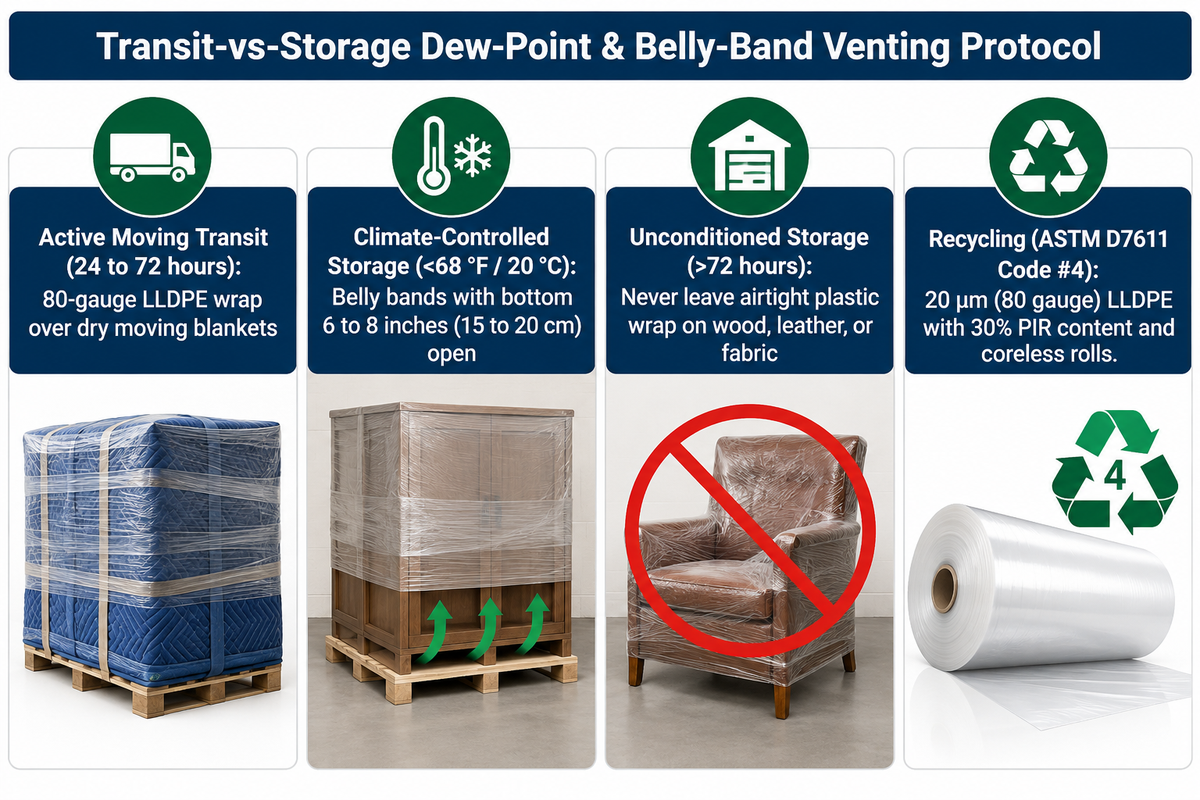
Full-coverage plastic stretch wrap should stay on padded furniture for 24 to 72 hours during active moving or shipping transit and must be removed or vented before entering non-climate-controlled storage, where daily temperature swings drive trapped moisture into wood and upholstery.
As Movers.com’s storage protection guide emphasizes, leaving wood, leather, or upholstered furniture tightly sealed in plastic wrap for long-term furniture and storage setups is a widespread mistake that causes condensation failure, mold, mildew, and finish damage. While breathable pads secured with vented bands are great for storage and long-term shipping and storing, air sealed beneath an impermeable 6-sided polyethylene cocoon cools below its dew point overnight, depositing microscopic water droplets onto cold lacquer, metal hardware, and leather seams.
The Transit-vs-Storage Dew-Point & Belly-Band Venting Protocol
The Transit-vs-Storage Dew-Point & Belly-Band Venting Protocol explains how to modify wrap coverage for transit, climate-controlled rooms, and unconditioned containers:
- When furniture is being transported on a moving truck for 24 to 72 hours, the recommendation is to use a 80 gauge LLDPE wrap over dry moving blankets to protect the wood and upholstered furniture from road dust and rain. Also, if you are transporting furniture from a freezing truck and delivering it to a heated house, then you need to remove the plastic wrap as soon as it arrives so condensation doesn’t build up on the wood.
- In climate-controlled storage maintained below 68 °F (20 °C) with stable indoor humidity, strip off full 6-sided airtight plastic wrap upon arrival, drape breathable cotton moving blankets loosely over the piece, and secure the pads using one or two horizontal 5-inch or 15-inch stretch-wrap “belly bands” around the midsection while leaving the top canopy and bottom 6 to 8 inches (15 to 20 cm) completely open for vertical airflow. The storage should be kept at a temperature of 68 degrees Fahrenheit (20 degrees Celsius) or less.
- In non-climate-controlled storage and portable containers held beyond 72 hours, never leave airtight plastic wrap on wood, leather, or fabric furniture; raise furniture legs off concrete floors on wooden pallets, cover pieces with breathable cotton or non-woven dust sheets, and hang calcium chloride desiccant bags inside enclosed shipping containers.
- LLDPE film is used for shrink wrap. During prolonged exposure to the sun’s UV rays, the film breaks down and fails to provide adequate protection. When staging crated patio furniture outdoors, request UV-resistant stretch wrap and vent the bottom perimeter, or replace the high-static film with anti-static stretch film for office moves involving servers and ESD workbenches.
Municipal Bulk Furniture Disposal and #4 LDPE/LLDPE Film Recycling
One situation that requires “100% hermetic sealing” is furniture disposal using municipal curbside pickup. Some cities have strict Bedbug, sanitation, or other ordinances that require sofas, upholstered chairs and mattresses to be completely sealed in heavy duty plastic wrap or a sealed disposal bag before the collection crews will be able to lift them.
Where film recovery is available, clean polyethylene furniture wrap should not go to a landfill after a move. This is described in ASTM D7611 Code #4 and in the Plastics Recycling Glossary of the Association of Plastics Recyclers (APR). Under ASTM D7611 Code #4 and the Association of Plastic Recyclers (APR) Plastics Recycling Glossary , clean polyethylene stretch wrap is recovered through commercial Furniture Mix PE Film Bales and Clear PE Film Bales . Also, a 2026 peer-reviewed article in Sustainability (MDPI) stated that 20 µm (80 gauge) LLDPE stretch film manufactured with 30% post-industrial recycled (PIR) content and coreless roll designs showed no loss in load stability during transport, compared to virgin film. It is important to note that coreless and 30% PIR LLDPE stretch film are qualified for ASTM D7611 Code #4 store drop-off or commercial Furniture Mix PE Film Bales only if the packing (acrylic or rubber adhesive) and paper labels are completely stripped before baling.
How Moving Crews and Furniture Factories Specify Bulk Stretch Film Rolls
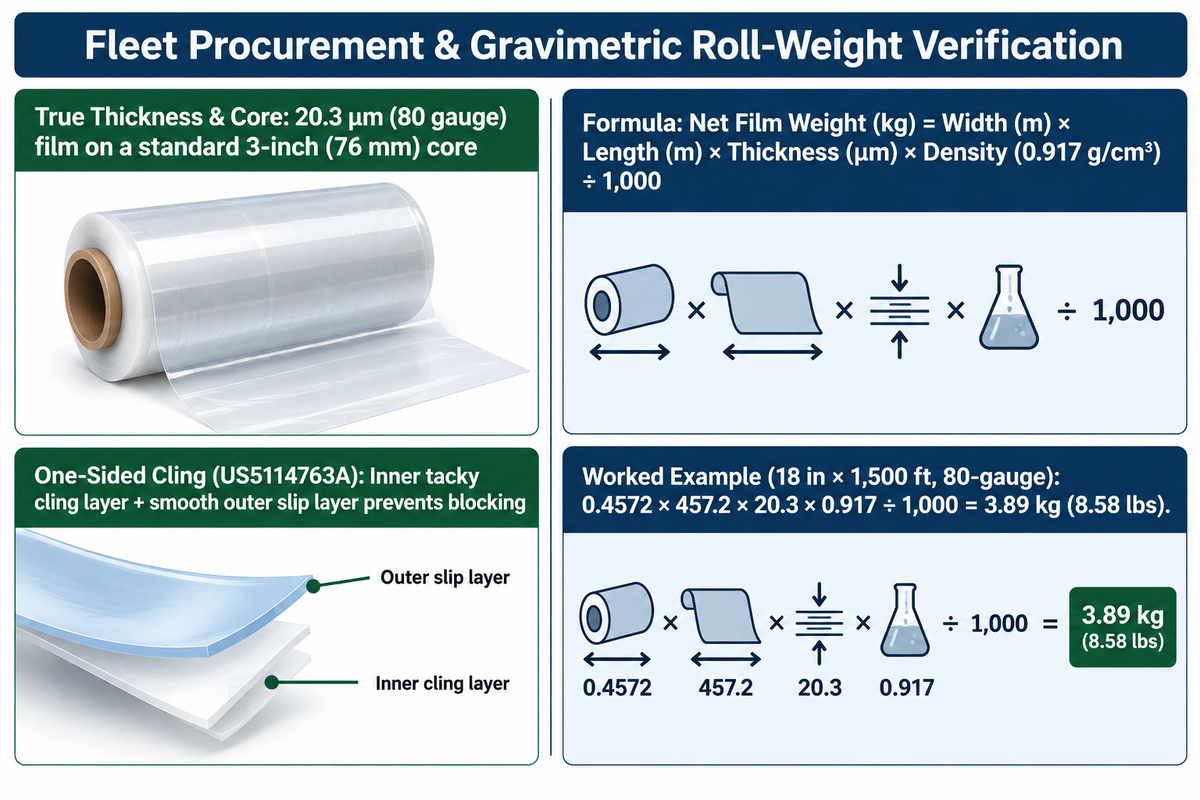
Bulk stretch film moving and furniture manufacturing fleets should request true micrometer thickness (20.3 µm (80 gauge) rather than pre-stretched “equivalent gauge”) films, a standard 3-inch (76 mm) core, and verified net roll weight when shipping orders. Also, request slip-cling (one-sided cling) so items do not stick together and tear when transported in a loaded, tight-fitting, trailer.
Why do professional van lines use one-sided cling while most retail hardware stores carry only two-sided cling? According to U.S. Packaging & Wrapping’s Stretch Wrap 101, and supported by US Patent US5114763A, a coextruded one-sided cling pairing would have a tackified polyethylene inner cling layer and a smooth polyolefin outer slip layer. When a truck is loaded tightly, the inner tacky layer would cling to the underlying wrap layer, and the outer slip layer would allow wrapped objects to be loaded next to each other without sticking together and tearing the film apart (blocking). Blown LLDPE film does have a higher Elmendorf tear resistance than cast film, but clearer cast film makes barcodes easier to read. Noise from blown film unwinding makes it harder to read barcodes during inventory, especially in apartments where films are loaded on trucks through a window.
Gravimetric Roll-Weight Verification Formula: Net Film Weight (kg) = Width (m) × Length (m) × Thickness (µm) × Density (0.917 g/cm³) ÷ 1,000. Worked Example: For a standard 18 in × 1,500 ft (0.4572 m × 457.2 m) hand roll of 80-gauge (20.3 µm) LLDPE furniture wrap at 0.917 g/cm³ density: 0.4572 × 457.2 × 20.3 × 0.917 ÷ 1,000 = 3.89 kg (8.58 lbs) of net polyethylene film prior to adding the 0.3 to 0.7 kg paper core tare.
Whether your crews are manually or automatically wrapping, UD Packaging can provide verifiable thickness and weight rolls of both cast and blown LLDPE one-sided cling. Their film is always made to order, and your engineering team can provide samples of various widths (3 in, 5 in, 15 in, 18 in, or 20 in), gauges (60 to 120 gauge) and cling preferences. UD can also provide two-sided cling film as well.
Frequently Asked Questions
Can you use household kitchen Saran Wrap instead of moving plastic wrap for furniture?
Household kitchen wrap is only 35 to 40 gauge (8.9 to 10.2 microns) thick, tears easily on sharp furniture corners, and costs three to four times more per square foot than commercial moving wrap. Worse, flexible PVC kitchen cling films contain up to 30% to 40% migratory plasticizers that leach into wood lacquer or leather and leave permanent surface stains.
Should you wrap furniture in moving blankets or plastic stretch wrap first?
Always drape a clean, breathable moving blanket, cotton sheet, or closed-cell polyethylene foam pad against the furniture surface first, then spiral LLDPE stretch film tightly over the outside of the pad. Wrapping impermeable plastic directly onto wood, leather, or damp upholstery traps ambient humidity and causes condensation blushing, mildew growth, or finish imprinting during transit.
What gauge plastic wrap is best for moving couches, dressers, and heavy wood furniture?
Standard 80 gauge (0.80 mil or 20.3 microns) cast LLDPE stretch wrap handles most residential couches, upholstered chairs, and padded dressers for medium-duty loads rated up to 2,000 to 2,200 lbs. For heavy oak armoires, wrought-iron frames, or uncrated casegoods with sharp corners, upgrade to 90 to 120 gauge (22.9 to 30.5 microns) blown LLDPE stretch film.
How many rolls of plastic wrap do you need to move a house or apartment?
One 15-inch or 18-inch by 1,000-foot roll covers a one-to-two-bedroom apartment, while a three-to-four-bedroom house requires two to three 1,500-foot rolls.
Why did plastic wrap leave cloudy white marks on my wooden dining table, and how do I prevent it?
Cloudy white marks—known in woodworking as moisture blush—happen when impermeable plastic wrap traps microscopic humidity evaporated from the wood during daytime heat and condenses it back into the lacquer or shellac topcoat as overnight temperatures drop below the dew point. On freshly refinished wood cured for less than 30 days, trapped solvent vapors also soften the finish and emboss the film texture. Prevent blushing by letting new finishes cure for 30 days, keeping storage below 68 °F in a dry room, and always placing a breathable moving pad under the plastic wrap.
Sourcing wholesale furniture stretch wrap rolls for a moving fleet, warehouse, or casegoods factory? Contact UD Packaging to specify custom gauges (60–120 gauge), roll widths (3 in to 20 in), and one-sided cling formulations or request trial rolls via our UD Packaging contact page.
References & Sources
- Canadian Conservation Institute (CCI Technical Bulletin 32) — Products Used in Preventive Conservation: Polyethylene vs. Plasticized PVC
- National Park Service (Conserve O Gram 08/04) — Care of Objects Made from Rubber and Plastic (PE vs. PVC Stability and Storage Thresholds)
- Heritage Science (Nature, s40494-020-00466-0) — Plasticiser Migration and Surface Sweating in Flexible Polyvinyl Chloride
- ASTM International — ASTM D4649-20(2025) Standard Guide for Selection and Use of Stretch Wrap Films
- ANSI / ASTM D7611 — Standard Practice for Coding Plastic Manufactured Articles for Resin Identification (Code #4 LDPE/LLDPE)
- Association of Plastic Recyclers (APR) — Plastics Recycling Glossary: Furniture Mix PE Film Bales and Clear PE Film Bales
- MDPI Sustainability (2026, 18(12), 5960) — Performance and Life-Cycle Assessment of 20 µm Coreless and 30% PIR LLDPE Stretch Films
- US Patent US5085927A — Linear Low-Density Polyethylene (0.917 g/cc) Stretch Wrap Film with Polyisobutylene Cling Tackifier
- US Patent US5114763A — Coextruded One-Sided Cling (Slip-Cling) Polyethylene Stretch Film Structure
- MH-USA — Stretch Film Gauge to Mil and Micron Conversion Guide and Load Capacity Ratings (60 to 120 Gauge)
- IPS Packaging & Automation — How to Stretch Wrap Furniture for Moving: Cast vs. Blown Film and Breathable Moving Pad Rules
- Movers.com — Can You Keep Plastic Wrap on Furniture in Long-Term Storage? Condensation and Mold Prevention
- U.S. Packaging & Wrapping — Stretch Wrap 101: Differential One-Sided Cling vs. Two-Sided Cling
- Packaging Digest — Multilayer Cast LLDPE Stretch-Wrap Film Engineering and Containment Performance