Get in touch with UD Packaging Company

PACKAGING QUALITY CONTROL · DOCK AUDIT & ASTM METHOD GUIDE
A stretch film test is performed to assess properties of applied film usage such as wrapper pre-stretch elongation, start thickness, local pull plate force on a pallet load, and flat strip mechanics in a laboratory setting. Warehouse teams perform multi-zone force readings and roll tare checks to balance per-pallet film cost and reduce product damage.
Procurement and warehouse engineers run film testing for two distinct reasons: confirming that incoming packaging materials match purchase specifications and verifying consistent wrapper holding force when operators test stretch film on the dock. Below, we compare applied field procedures under ASTM D8314-20 (such as pulling a 152 mm ventilated plate 102 mm outward 5 minutes after wrapping) against flat-sheet coupon tests and transport simulations under ISTA 3-Series procedures. UD Packaging manufactures and supplies industrial LLDPE stretch film and strapping consumables for warehouse trials; we do not sell, calibrate, or certify testing instruments or wrapping machinery.
Key Takeaways for Packaging & Warehouse Operations
- Mill laboratory standards (ASTM D882-26a, D1709-22, D5458-95(2025)) evaluate flat specimen mechanics and laboratory peel cling. Dock field methods (ASTM D8314-20) measure applied grams, pre-stretch ratio, and local pull-plate force, while ISTA 3E, 3B, 3N, and EUMOS 40509 evaluate dynamic unit-load survival.
- Subtracting bare paperboard core tare from gross roll weight to compute film cost per acceptable pallet stops heavy cores from disguising high resin prices during a weigh test.
- At the Virginia Tech Center for Unit Load Design, containment force dropped by as much as 55% after 12 hours when greater starting containment force was used in experimental tests on a uniform rigid unit load. Comparing 5-minute and 12-to-24-hour readings shows how much initial tension a candidate wrap retains on your load.
- During material reduction trials, UD Packaging supports end users with batch Certificates of Analysis and sample rolls of hand and machine wrapping, while third-party laboratories perform formal transit certification.
Stretch Film Test Kits vs. Lab Coupon Tests: What Portable Gauges Measure and What Requires a Pallet Trial
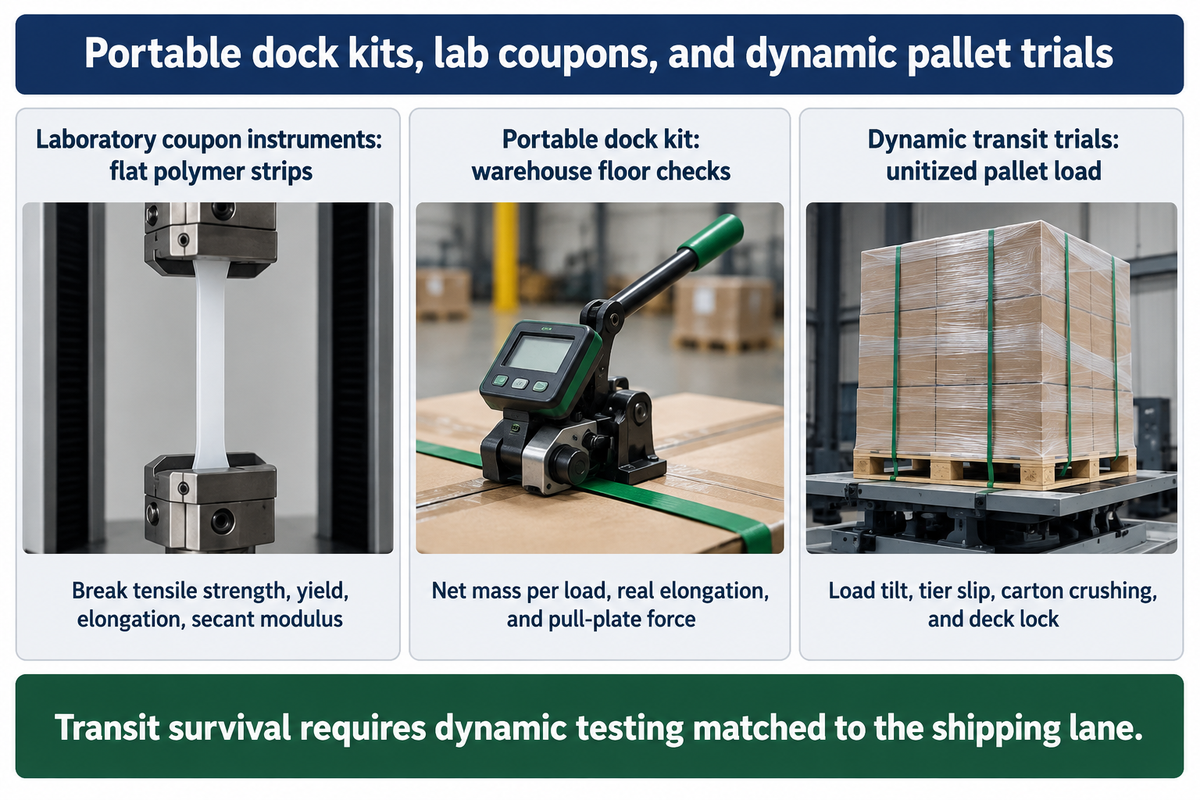
A stretch film test kit gives a quantitative value of film applied to the load during a weigh test. This test kit measures net mass of film per load, real elongation of the wrap, starting film thickness and local pull-plate force. By contrast, laboratory coupon instruments test flat polymer strips and dynamic pallet trials evaluate load survival under braking and vibration.
A field kit in a daily warehouse quality control process combines four handheld devices. Operators pair a hanging digital gram scale for stripped wrap weight with a 10-inch marker wheel or dual wheel tachometer, a flat anvil micrometer for starting thickness and a pull-plate force scale. ASTM D8314-20 sets applied stretch wrap film checks on a 1219 × 1016 × 1270 mm (48 × 40 × 50 inch) test stand or pallet load, including pulling a 152 mm (6-inch) ventilated plate 102 mm (4 inches) outward after a 5-minute rest. Meanwhile, ASTM D4649-20(2025) guides stretch wrap film selection and use across hand and machine wrapping lines. Unlike heat-tunnel checks for pcr shrink film that inspect heat seal integrity and bag seal strength, stretch wrap audits focus on elastic recovery and interlayer tack.
| Verification Tier & Method | Reference Standard | Test Specimen | Primary Measurable Output | What This Test Cannot Prove |
|---|---|---|---|---|
| Tier 1 Lab: Strip Tensile & Modulus | ASTM D882-26a | Unstretched flat film strip (<1.0 mm / 0.04 in. thick) | Break tensile strength, yield, elongation, secant modulus | Post-stretch holding force or pallet corner survival |
| Tier 1 Lab: Dart & Probe Puncture | ASTM D1709-22 / D5748-95(2019) | Clamped unstretched circular or flat specimen | Dart failure mass (g); peak probe force & energy | Biaxial corner puncture after carriage pre-stretch |
| Tier 1 Lab: Pendulum Elmendorf Tear | ASTM D1922 | Pre-slit MD and TD coupon specimens | Grams of force to propagate slit tear | Linear cross-gauge comparison on extensible wrap |
| Tier 1 Lab: Inclined-Plane Peel Cling | ASTM D5458-95(2025) | Film strip peeled from inclined film-covered flat surface | Peel cling force (g) to separate adhered wrap layers | Inward radial squeeze or dusty cold-dock tail retention |
| Tier 1 Lab: Stress Retention & Recovery | Lab MD Stress Retention | Machine-direction film strip held at fixed extension | Elastic recovery %, permanent deformation, stress retention | Corrugated carton compression or deck-lock geometry |
| Tier 2 Dock Kit: Cut-and-Weigh Mass | ASTM D8314-20 (Cut & Weigh) | Film stripped from wrapped loads (five to ten loads in a buyer audit), plus gross roll and bare core weights | Average applied grams per pallet; gross roll weight minus bare-core tare gives net film mass per roll | Applied film quantity only, not inward holding force |
| Tier 2 Dock Kit: 10-Inch Line / Star Wheel | ASTM D8314-20 (Marking Wheel) | Indexed roll web before and after wrapper application | Real pre-stretch % and stretched web neck-down width | Long-term creep resistance or transit deck locking |
| Tier 2 Dock Kit: Pull-Plate Force Gauge | ASTM D8314-20 Sec. 15.3.1 | 152 mm ventilated plate pulled 102 mm at top/mid/base | Localized inward holding force (lbf / N / kgf) at dwell time | Cross-device equivalence or multi-axis vibration survival |
| Tier 3 Transit: Channel Sled & Vibration | ISTA 3E / 3B / 3N & EUMOS 40509 | Full unitized pallet load on vibration table or deceleration sled | Load tilt, tier slip, carton crushing, and deck lock under G-loads | Trailer blocking/bracing compliance outside tested channel |
Can a portable stretch film test kit certify that a wrapped pallet will survive truckload transit?
No: a portable dock kit checks applied film mass, elongation, starting thickness, and local pull-plate force on the warehouse floor; however, transit survival requires dynamic testing matched to the shipping lane. Under ISTA 3-Series procedures, ISTA 3E covers full-truckload shipments of similar packaged products, ISTA 3B covers less-than-truckload mixed freight, and ISTA 3N models European full-truckload road vibration spectra.
Doing a transport trial or shipping a controlled batch of pallets validates the recipe and establishes a baseline for future operations. Once a specific SKU has been proven to survive transit at recorded top, middle, and base pull-plate readings after 24 hours, operators have the basis to audit daily production against that internal baseline.
Cut-and-Weigh Mass Audits: Verifying Net Roll Weight, Core Tare, and True Film Cost Per Pallet
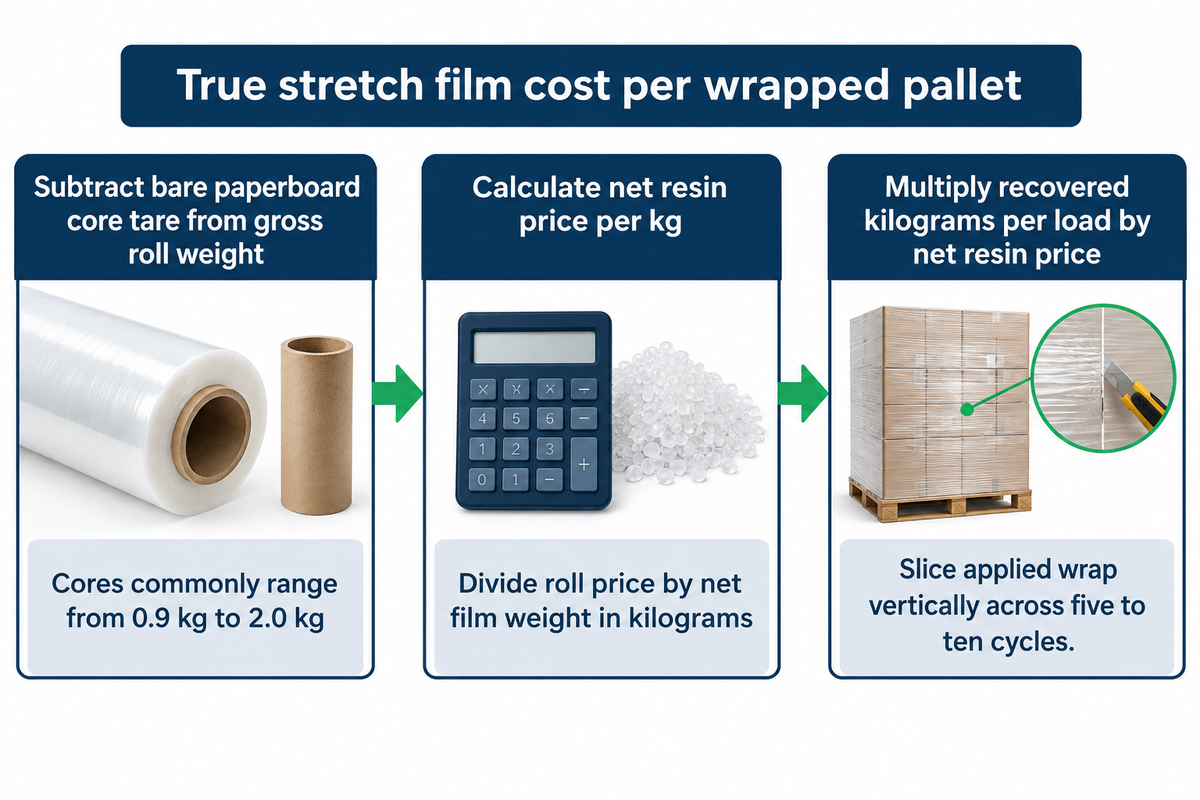
To accurately determine the true stretch film cost per wrapped pallet, subtract the bare cardboard core weight from the gross roll weight to determine the net polyethylene weight in kilograms. Divide the roll price by the net film weight in kilograms and multiply it by the average weight in kilograms of stripped film (grams divided by 1,000) across loads that are properly contained.
The ASTM D8314-20 procedure requires technicians to slice the applied wrap vertically and weigh the recovered film ball on a calibrated gram scale. For a buyer wrapper-consistency audit, repeating five to ten identical wrap cycles smooths out cycle-to-cycle variation, while standard LLDPE density sits around 0.918 to 0.920 g/cm³ (0.0332 lb/in³). The receiving teams weigh empty 3” inner-diameter stretch film cores as part of their procedures. Before computing cost per load, receiving teams also weigh empty 3-inch inner-diameter stretch film cores, which commonly range from 0.9 kg to 2.0 kg (2.0 lb to 4.4 lb) depending on wall thickness. Heavy cores inflate gross shipping weight on quotes billed by gross poundage.
There are three steps to approving a gauge film switch.
- Isolate net roll polyethylene mass by subtracting bare paperboard core tare from gross roll weight: Net Film Mass (kg) = Gross Roll Mass (kg) − Bare Core Tare (kg). At 0.920 g/cm³ density, a 20-inch-wide, 5,000-foot, 80 gauge stretch roll (0.80 mil / 20.32 microns) contains roughly 31.84 to 31.90 lb (14.47 kg) of net polyethylene excluding the core.
- Quoted roll prices and verified net film mass are used to calculate net resin price per kg. In a documented benchmark setup using a 20-inch, 5,000-foot, 80 gauge machine roll bought at $72 net per roll, isolating net resin weight establishes an objective per-kilogram baseline across competing quotes.
- Calculate true film cost per acceptable pallet as (Average Stripped Film Mass in grams ÷ 1,000) × Net Price per kilogram. In that same 200% pre-stretch cut-and-weigh audit averaging 340 grams (0.750 pound) of film per pallet, buyers compare candidate rolls by multiplying recovered kilograms per load by net resin price per kilogram.
When evaluating a thinner packaging film roll, lower gram usage per pallet only delivers real savings if 24-hour relaxed containment force and corner puncture survival remain equal on the wrapped pallet roll. Track scrap separately as well: automated lines often see 3% to 5% process waste, whereas manual hand wrapping can reach 10% to 15%.
10-Inch Line Marks vs. Star-Wheel Tachometers: Checking Pre-Stretch Ratio and Film Neck-Down
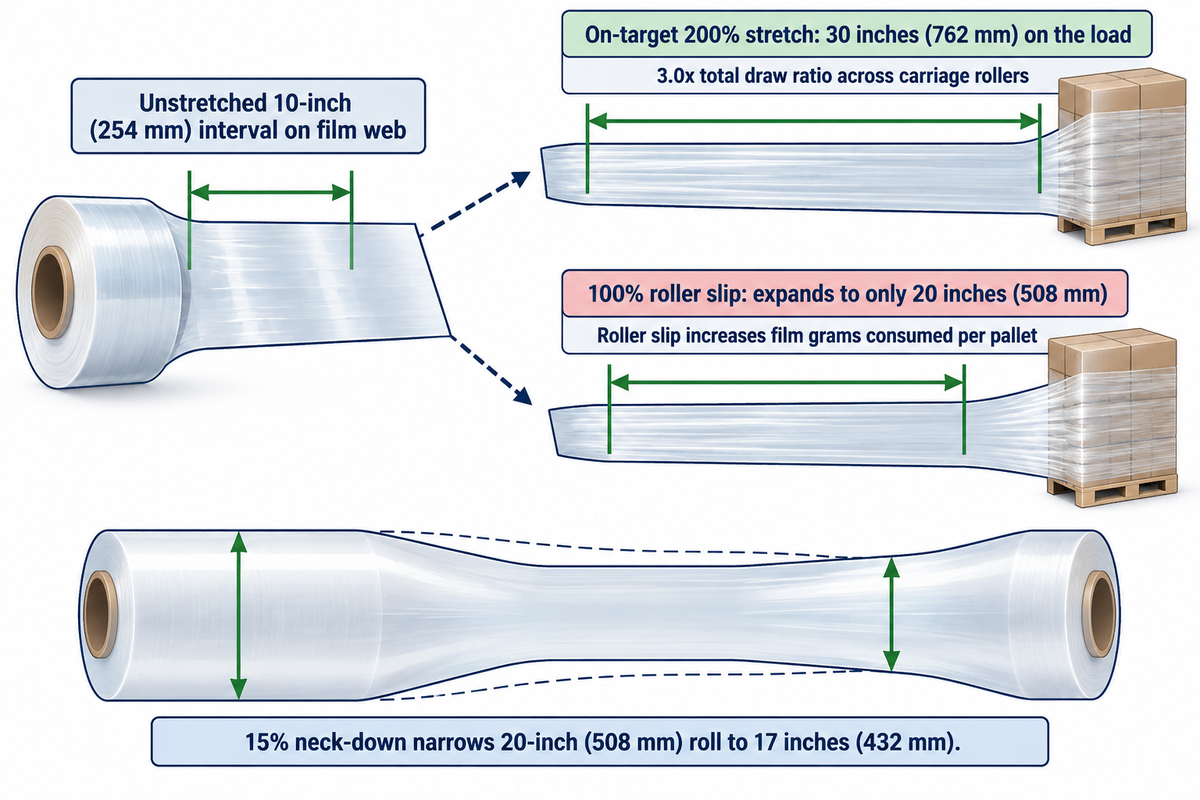
On each pallet roll, operators verify real wrapper elongation by marking an unstretched 10-inch (254 mm) interval, running a normal wrap cycle, and measuring expanded mark spacing and web width on the load. Dual-wheel star tachometers isolate primary roller draw inside the carriage, while line marks capture total applied stretch.
If you want an easy way to test stretch without stopping automation lanes, ASTM D8314-20 outlines Marking Wheel and Tapeless speed-ratio methods. The Marking Wheel procedure uses 2 to 4 evenly distributed marks around the wheel circumference and compares marked distances before and after wrapping, while the Tapeless procedure compares film speed on the load to feed-roll speed. With a manual 10-inch mark, calculate the amount of stretch as Applied Stretch (%) = ((Final Length − Initial Length) ÷ Initial Length) × 100:
- At an on-target 200% stretch level, a 10-inch (254 mm) mark on machine stretch film becomes 30 inches (762 mm) long on the load, yielding (30 – 10) ÷ 10 × 100 = 200% elongation (a 3.0x total draw ratio).
- When glazed polyurethane pre-stretch rollers, paraffin buildup, or misthreaded nip rollers cause hidden roller slip inside a 200% carriage, that 10-inch mark may expand to only 20 inches (508 mm, or 100% actual stretch). Roller slip causes a quiet increase in film grams consumed per pallet.
Measuring length expansion alone still misses transverse neck-down and thickness thinning. In a November 2025 empirical study in Sensors (Tkaczyk et al., PMC12656129), researchers tested 15 microns (15 µm), 17 µm, and 23 µm LLDPE stretch films across 150% to 250% pre-stretch on a 1200 × 800 × 1500 mm, 182 kg crate (including a 22 kg pallet). In that study, 23 µm film stretched at 150% thinned to 9–10 µm on the load, while high-performance 15 µm film rated for 150%–300% pre-stretch thinned to 5–6 µm at high draw. Always record post-wrap web width alongside mark spacing. Under tension, effective web width can drop 10% to 25%: a 20-inch (508 mm) roll with 15% neck-down covers only 17 inches (432 mm), requiring overlap checks.
Pull-Plate Containment Force Mapping: ASTM D8314 Field Checks Across Top, Middle, and Base Zones
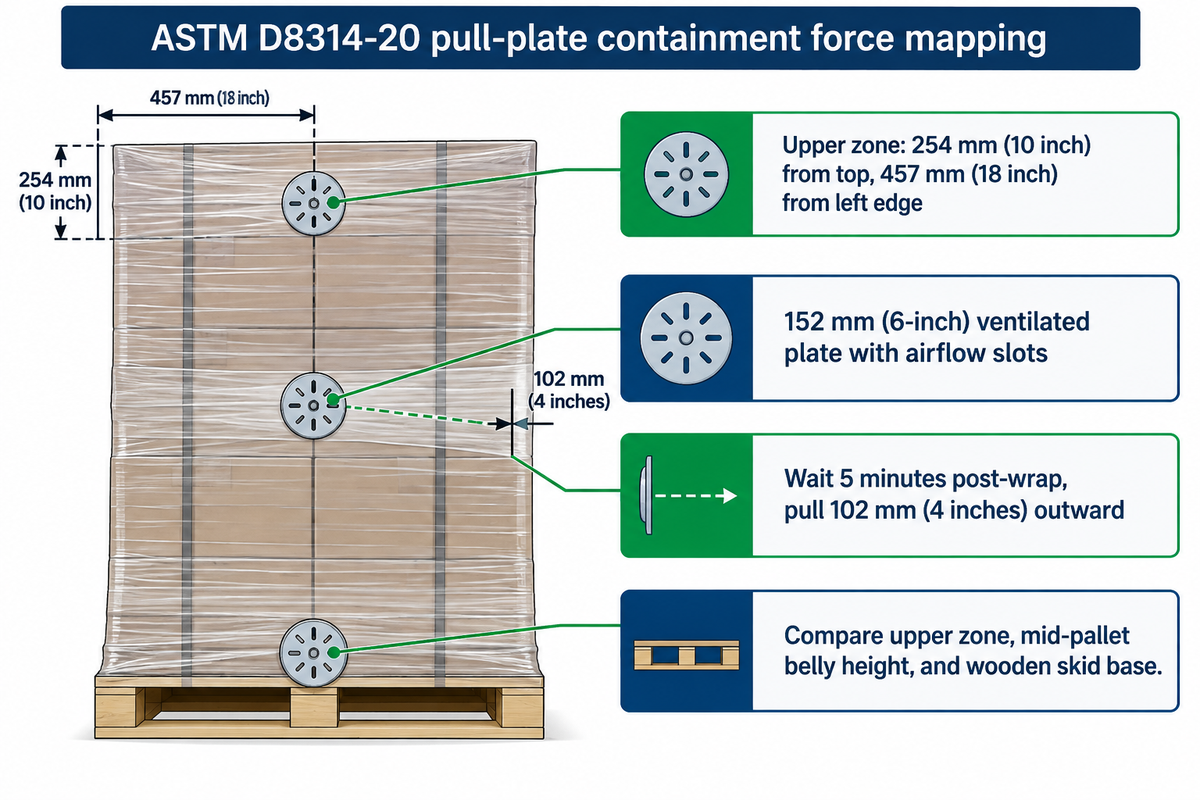
Pull-plate containment mapping measures the inward holding force of applied wrap by inserting a ventilated rigid disc behind the film stack at top, middle, and pallet-base zones. Operators then measure the force needed to pull the web outward a fixed distance after a timed rest.
(Review ASTM D8314-20 Section 15.3.1 for reference pull-plate fixture). Under ASTM D8314-20 Section 15.3.1 , the reference pull-plate fixture uses a 152 mm (6-inch) diameter non-yielding plate machined with airflow slots (comparable to the 150 mm flush sensor disk in instrumented crate studies). Note 1 specifies those slots so pulling film away from flat cartons does not create partial vacuum suction behind the disc that inflates load cell or spring scale readings. The standard defines an upper zone geometry in which the plate is placed 254 mm (10 inch) from the top of the load and 457 mm (18 inch) from the left vertical edge. After waiting 5 minutes post-wrap, they pull perpendicular to the load face until the film deflects 102 mm (4 inches) from its resting tangent line.
Warehouse audits compare pull-plate force across three elevations: the upper zone (254 mm below the top edge), mid-pallet belly height, and the base zone where bottom wraps capture the wooden skid deck. Film engagement with the pallet helps tie the load to the skid, while braking performance requires a unit-load transport trial. Powered carriages commonly operate in the 150% to 300% pre-stretch range whereas manual hand wrapping reaches only 10% to 30%, so non-destructive piston gauges must always use consistent dwell timers and offsets.
Is there an ASTM-certified containment force tool with a universal pass-or-fail poundage?
No: ASTM International publishes standard test methods and guides rather than certifying commercial tool brands, and ASTM D8314-20 Sections 1.2 through 1.2.1 establish neither a universal pass-or-fail poundage nor a cross-device precision and bias statement. Safe holding force varies widely between fragile light cartons and heavy rigid drums.
Therefore, poundage figures noted on a 6-inch ventilated pull plate, a narrow hook scale, and a spring-piston deflection gauge aren’t directly interchangeable across vendors. Treat your chosen gauge as an internal repeatability instrument: lock the pull distance, corner offset, and post-wrap dwell time in your quality control procedure, and validate the forces against shipping data.
ASTM Laboratory Coupon Tests: What D882 Tensile, D1709 Dart, and D1922 Tear Actually Prove
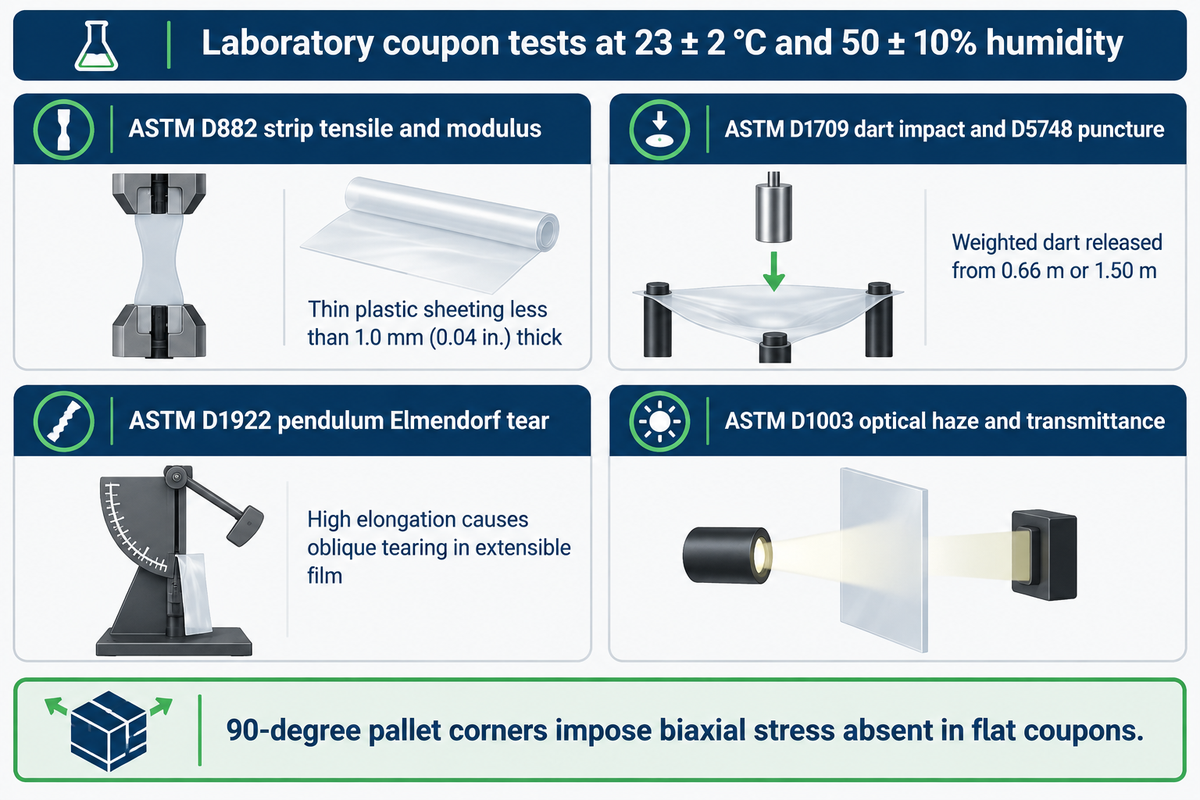
Unlike those daily dock gauges, ASTM D882, D1709, D5748, and D1922 laboratory coupon tests verify whether an unstretched roll lot meets specified flat-specimen properties. Technicians run these tensile, dart impact, probe puncture, and tear tests under 23 ± 2 °C and 50 ± 10% relative humidity.
When reviewing a stretch film technical data sheet from film manufacturers, buyers encounter three mechanical coupon metrics run on a universal testing machine or impact stand, plus one optical clarity check:
- Strip Tensile and Modulus (ASTM D882-26a, revising D882-18 and D882-26) applies to thin plastic sheeting less than 1.0 mm (0.04 in.) thick, while ASTM D638-22 covers thicker plastics. D882 pulls flat machine-direction (MD) and transverse-direction (TD) strips at a set test speed (500 mm/min in patent protocols) to record yield, break tensile strength, elongation, and secant modulus.
- Free-Falling Dart Impact (ASTM D1709-22) employs a weighted hemispherical dart, which is released from 0.66 m (Method A) or 1.50 m (Method B), and strikes clamped flat film to measure the gram weight associated with specimen failure. Protrusion Puncture (ASTM D5748-95(2019)) uses a rounded probe to penetrate taut film at a speed of 250 mm/min to determine the peak penetration force and energy.
- The Pendulum Elmendorf Tear (ASTM D1922) test measures the gram-force required to extend a pre-cut slit. High elongation and oblique tearing in extensible stretch film prevent the use of ASTM D1922 as a precise acceptance tool unless repeatability is proven first. Tear resistance also does not vary linearly with thickness, restricting cross-gage comparability.
- Optical Haze and Transmittance (ASTM D1003) reports laboratory film haze and luminous transmittance, while barcode readability through applied clear or translucent color stretch film is verified by a separate on-pallet scanner trial.
Why can a roll pass every coupon spec and still snap on your wrapper? Laboratory coupon jaws pull a narrow, unstretched specimen along one axis at a time. Once a power carriage draws a 17 microns or 23 microns web across a 100% to 300% or 150% to 300% pre-stretch window, film thickness drops sharply. Wrapping the leading stretch web around 90-degree pallet corners then imposes biaxial puncture stress that unstretched flat coupons don’t replicate.
ASTM D5458 Peel Cling vs. Holding Force: Diagnosing Film Tailing and Cold-Storage Unwrap
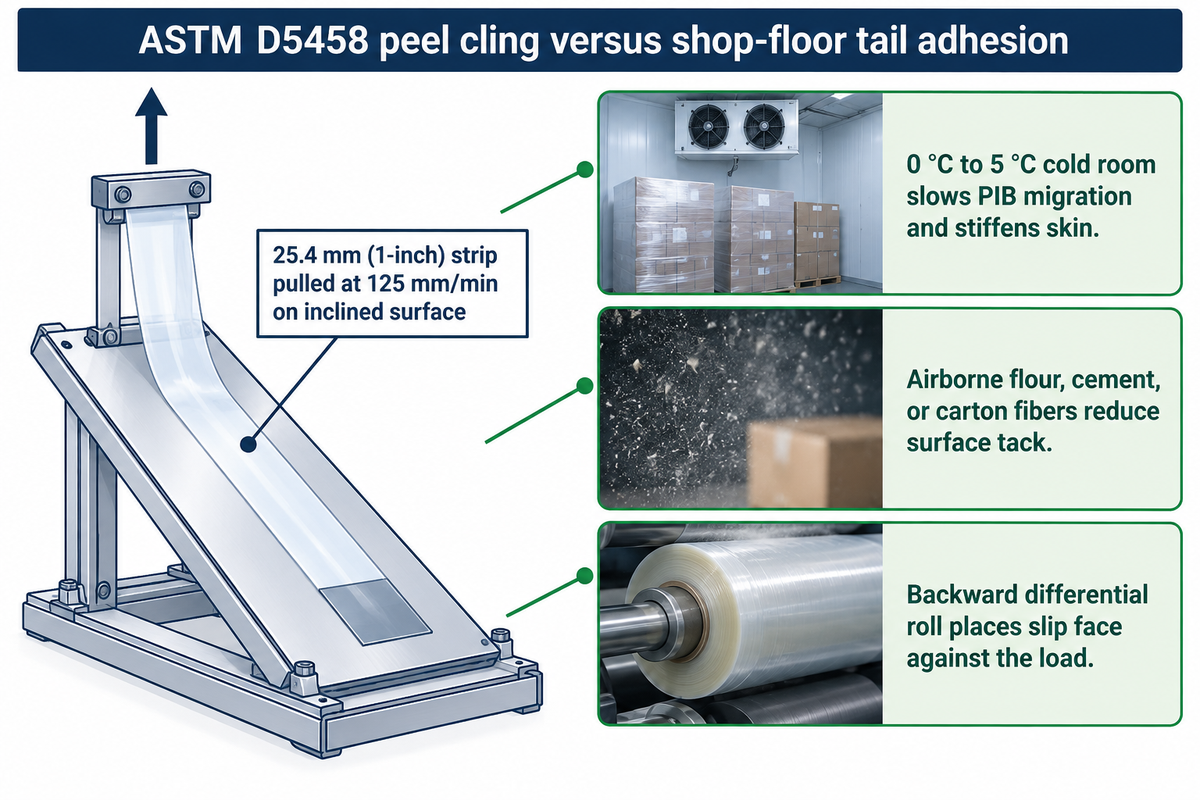
ASTM D5458 peel cling measures the surface tack force required to separate two layers of stretch wrap along an inclined plane, whereas inward holding force comes from elastic tension stored in stretched polyethylene chains. Inward holding force is due to elastic tension stored in stretched polyethylene chains. Insufficient cling lets film tails unravel and shed wrap tightness.
Under the active reapproved ASTM D5458-95(2025) test method, a technician attaches a 25.4 mm (1-inch) wide film strip to a flat film-covered inclined surface. A constant-speed crosshead pulls the strip at 125 mm/min (5 inches/min) to measure peel cling force in grams. Unlike pressure-sensitive packaging tapes, coated with a permanent acrylic or hot-melt adhesive, stretch wrap acquires tack from a migratory polyisobutylene additive or a co-extruded metallocene plastomer cling skin.
As ASTM D5458 notes, interlayer cling helps maintain tight wrap integrity after the wipe-down arm cuts the web. In distribution centers, three shop-floor and roll-mounting variables cause dock tail adhesion to deviate from conditioned laboratory cling measurements.
- Cold room condensation and resin stiffening at 0 °C to 5 °C help slow PIB migration and stiffen the plastomer skin, causing the cut tail to flag loose unless the film grade is formulated for cold storage pallet wrapping.
- Airborne flour, cement, or corrugated carton fibers coat exposed film surfaces and reduce tack, which is why ASTM D8314-20 pairs lab peel checks with a 5-minute cling inspection right on the wrapped test stand.
- Mounting a differential one-sided cling (differential cof) coextruded machine roll backward places its low-friction outer slip face (low outer coefficient of friction) against the load instead of its high-cling inner face. Cut tails then release while adjacent pallets stick together during side-by-side trailer loading.
Why Identical Gauge and Pre-Stretch Fail After 30 Days: Stress Relaxation and Corner Puncture
Two films with the same initial thickness and pre-stretch percentage can diverge during multi-week storage because polyethylene is viscoelastic. Lower-retention film constructions shed a larger share of the initial tension in the first 12 to 24 hours, creating less hoop force as cartons settle.
Polymer resin selection and layer design influence how well a stretched web retains tension and resists corner splitting. For example, Trioworld’s granted multilayer stretch film patent US12296563B2 (published as US20220388285A1) describes a 5 to 40 µm coextruded stretch film. Its structural core uses 50 to 90 wt% octene-1 metallocene LLDPE (around 0.918 g/cm³ density) separated from thin outer cling skins. That construction selects the metallocene LLDPE for stress retention and puncture resistance, while pallet dock trials demonstrate performance across sharp pallet corners.
| Structural or Process Factor | High-Retention Film Profile | High-Decay / Failure-Prone Profile | Verification Test or Audit Check |
|---|---|---|---|
| LLDPE Comonomer & Resin Grade | Octene (C8) or hexene (C6) metallocene LLDPE core resin | Unverified general-purpose blend pushed above its rated draw | Supplier resin grade declaration for comonomer; ASTM D5459-95(2025) for film stress retention |
| Coextrusion Layer Split | 5-to-7+ layers isolating elastic core from cling/slip skins | Monolayer or heavy PIB blend softening core modulus | Supplier product development spec + 24-hr pull-plate retention |
| Extrusion Orientation (Cast vs. Blown) | Cast: quiet unwind, uniform gauge; Blown: high biaxial toughness | Unmatched grade pulled over sharp unguarded metal corners | 127 mm (5-inch) vertical slit tear propagation observed for 10 min under ASTM D8314-20 |
| Cross-Web Thickness Variability | Tight die-bolt profile control (low point-to-point fluctuation) | Thin gauge lanes splitting first at high carriage draw | Digital micrometer multi-point cross-web thickness scan |
| Applied Pre-Stretch vs. Film Rating | Matched to film rating (e.g., 150%–250% on 15–23 µm LLDPE in Tkaczyk et al., 2025) | Stretching past the film’s rated draw limit into severe neck-in | 10-inch line mark elongation + stretched web width check |
| Initial Force-to-Load Tension | Controlled carriage-to-load tension preserving elastic recovery | Excessive wipe tension causing carton corner crush & rapid creep | Compare 5-min vs. 12–24 hr pull-plate readings |
| Interlayer Cling Stability | Consistent inner tack locking overlapping wraps without tail slip | Cold or dusty tail release allowing outer revolutions to slacken | ASTM D5458-95(2025) lab cling + dock 24-hr tail inspection |
| Warehouse Thermal Swing | Qualified at worst-case ambient warehouse/trailer temperature | Tested at 23 °C lab baseline, deployed in hot trailers or cold docks | Conditioned trial staging (±8% analytical shift across 5–35 °C) |
| Roll Edge Condition | Recessed core protection with nick-free wound film edges | Dropped roll edge nicks propagating full web breaks under tension | Receiving visual roll-edge audit before mounting on carriage |
How much containment force does stretch film lose during the first 24 hours of pallet storage?
Empirical unit-load research at the Virginia Tech Center for Unit Load Design (Reynolds & Lumley) found that containment force decreased as much as 55% after 12 hours when greater containment force was used at wrap time. Primary viscoelastic relaxation occurs steepest during the first 12 to 24 hours.
Over a 30-day storage and shipping cycle, that early viscoelastic film relaxation combines with corrugated box humidity creep and ambient temperature shifts (modeled analytically at roughly ±8% across 5 °C to 35 °C in Tkaczyk et al., 2025). When applied film is measured only 5 minutes after wrapping, a single pull-plate reading can overstate the static holding force remaining later in storage, refuting claims of superior load containment based solely on zero-minute readings.
ASTM D4649, D8314, ISTA 3E, and EUMOS 40509: Sample Roll Trial Protocol and Buyer Checklist
There are certain specifications that the new film roll must meet for it to be qualified by an industrial buyer. Industrial buyers qualify a new film roll by checking the batch Certificate of Analysis values for nominal gauge, resin density, MD/TD tensile and elongation (ASTM D882-26a), dart impact, and peel cling. Teams follow ASTM D4649-20(2025) selection guidelines and run an ASTM D8314-20 dock audit before scheduling ISTA 3E, 3B, 3N, or EUMOS 40509 transit tests.
Apply transport validation to your shipping mode and load rigidity boundaries. In the European road-safety framework discussed in Sensors 25(22):6883 (PMC12656129), EUMOS 40509 evaluates unit-load horizontal acceleration rigidity against 0.8 G longitudinal and 0.5 G lateral and rearward benchmarks. Researchers also planned follow-up thermal staging at 5 °C, 25 °C, and 35 °C. When a heavy load can’t resist target G-forces with stretch wrap alone, shippers combine wrap with pallet strapping for shipping and trailer blocking or bracing. Under ISTA unitized load standards, specify Procedure 3E (revised as ISTA 3E-2026) for full-truckload shipments of similar packaged products, ISTA 3B for less-than-truckload palletized freight, or ISTA 3N for European full-truckload vibration profiles.
The 2-Stage Stretch Film Sample Roll & Unit-Load Qualification Protocol
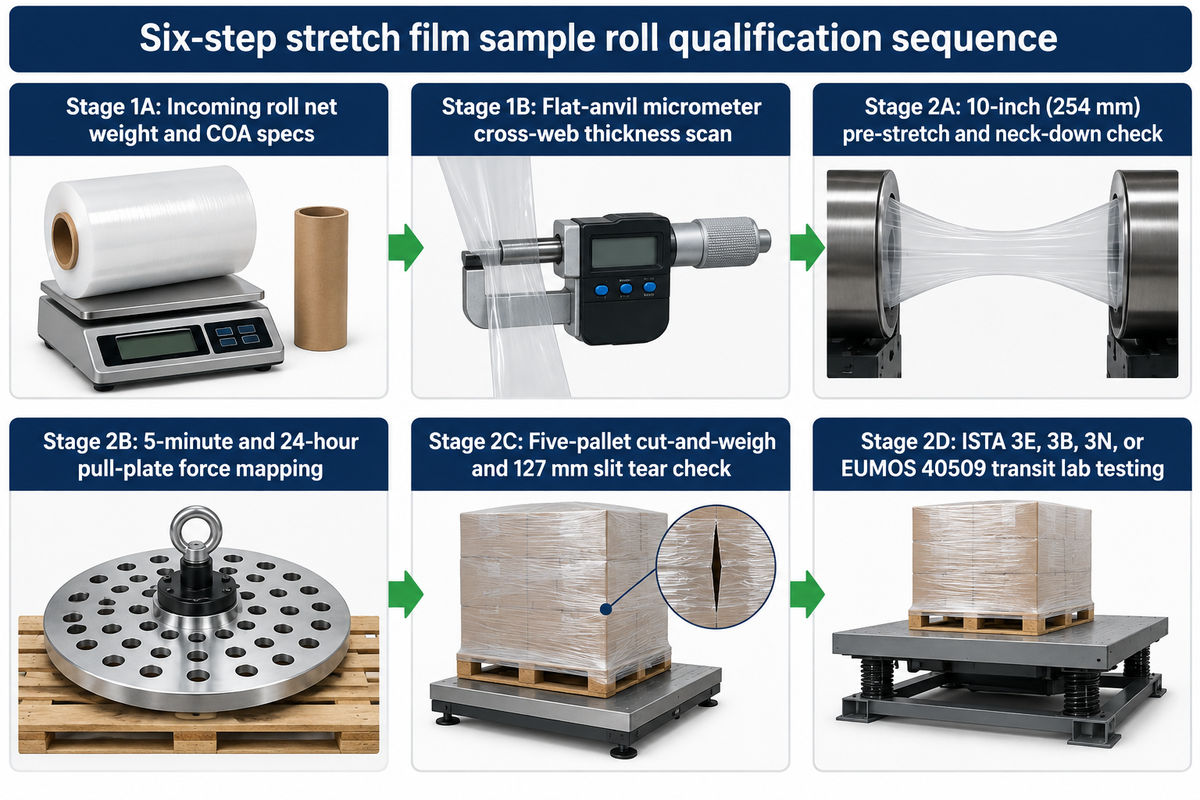
Before changing roll specifications or downgauging to the thinnest candidate grade, run this six-step audit sequence:
- Stage 1A checks incoming roll net weight and Certificate of Analysis specs. Calculate expected net film mass as width × length × nominal thickness × film density in consistent units, then compare it with gross roll weight minus bare-core tare under agreed purchase tolerances.
- Stage 1B scans cross-web thickness uniformity across edge-to-edge cross-web lanes on the unstretched film web with a calibrated flat-anvil digital micrometer before mounting the roll on the carriage.
- Stage 2A audits real wrapper pre-stretch and neck-down. Mark a 10-inch (254 mm) interval on the unstretched roll, wrap your sharpest-corner SKU at the given stretch setting, and measure both mark spacing and stretched web width on the load. When trialing custom printed stretch film, assess print legibility at the same draw ratio.
- Stage 2B maps the difference between 5-minute and 24-hour pull-plate force across the top, middle, and pallet-base zones under ASTM D8314-20 (noting that immediate post-wrap relaxation alone sheds roughly 10% to 20% of the force in crate tests). Stage five test pallets in your warehouse or cold-dock environment and re-measure at 12 to 24 hours to verify relaxed holding force.
- Stage 2C performs a five-pallet buyer cut-and-weigh audit to calculate net film cost per acceptable pallet. Technicians also monitor tear propagation from a 127 mm (5-inch) vertical slit for 10 minutes under ASTM D8314-20 and conduct separate trials to evaluate forklift impact survival.
- Stage 2D raises high-risk export lanes, tall unstable loads, or contract-required SKUs to a third-party accredited transit lab for ISTA 3E, 3B, 3N, or EUMOS 40509 sled and vibration testing.
Buyer Sample-Roll Trial & Scope Verification Checklist (UD Packaging)
- Include key wrapper details in your trial inquiry: hand roll or automatic turntable/rotary-arm wrapper type, target pre-stretch ratio (such as 150%–250%), current nominal gauge, and 3-inch core requirements. Also note pallet weight, corner profile, and warehouse or cold-room temperature.
- UD Packaging provides industrial cast and blown LLDPE stretch wrap rolls (clear/tinted, opaque, and printed) and PET/PP strapping consumables. All trial orders get batch COA, physical data, core tare weights, and sample rolls for dock evaluation.
- UD Packaging’s scope boundary: UD Packaging does not manufacture, sell, or calibrate stretch film test kits, pull-plate meters, laboratory tensile/dart machines, pallet netting, or wrapper maintenance services, and does not issue third-party ISTA or EUMOS certificates. UD Packaging does not issue third-party ISTA or EUMOS certificates. Confirm available gauges, roll lengths, and lead times with our team prior to placing bulk orders.
Frequently Asked Questions
How many sample pallets should you wrap and strip for a reliable cut-and-weigh film audit?
For a practical buyer consistency audit using the ASTM D8314-20 cut-and-weigh procedure, wrap and strip five to ten consecutive, identical pallet loads for each film candidate. Averaging multiple loads smooths out turntable home-position overlap differences and tail cutoff variations across cycles. For the test, select only pallets that satisfy your baseline containment force post relaxation, with no corner punctures or web breaks.
Where on a wrapped pallet should operators measure pull-plate containment force?
Measure three vertical elevations on the long pallet face using a 6-inch (152 mm) ventilated pull plate placed 18 inches (457 mm) inward from a vertical corner. Check the upper zone which is 10 inches (254 mm) down from the top of the pallet, the belly midway, and the lower zone which engages the wood deck of the pallet.
Why does a 250% wrapper pre-stretch setting often measure below 200% on a 10-inch wheel test?
Film slip on the pre-stretch rollers reduces actual web elongation, which leads to a potential wrap of less than 200% at a setting of 250%. The reasons for this include a buildup of paraffin on the rollers, a worn nip-roller spring, glaze on the rollers, or a backward S-wrap threading.
What scale accuracy is needed to check stretch film gram weight per pallet?
Use a calibrated bench or hanging digital gram scale with 1 g resolution for stripped pallet film balls (commonly 200 to 600 g) and 10 g resolution for full rolls and bare cores. Zero the scale with any bag attached first.
What is the difference between ASTM D1709 dart drop impact and ASTM D5748 protrusion puncture on a film datasheet?
ASTM D1709 drops a free-falling hemispherical dart from 0.66 m or 1.50 m onto clamped unstretched film to determine the dart mass in grams associated with specimen failure under sudden impact. ASTM D5748 drives a rounded probe into taut film at 250 mm/min to record peak slow-push force and energy before penetration, which closer reflects sustained carton or pallet-board pressure against stretched wrap.
Does higher peel cling increase pallet containment force?
No. Peel cling provides interlayer surface tack that holds the cut film tail and stops adjacent wrap layers from slipping apart. The inward containment force comes from stretched polymer elastic recovery and wraps around the pallet.
How should buyers handle cardboard core weight when comparing stretch film roll quotes?
Require every supplier quote and packing list to separate net polyethylene film weight from bare paperboard core tare weight, then verify both on a calibrated receiving scale before auditing pallet cost. Then assess the pallet cost. Naked 3-inch machine cores generally weigh 0.9 to 2.0 kg (2.0 to 4.4 lb). For rolls of equal gross weight, a heavier core leaves less usable film, and the core tare weight should be considered.
Ready to Run a Controlled Sample-Roll Audit on Your Wrapper? Share your current roll width, nominal gauge, carriage pre-stretch setting, and pallet weight profile with UD Packaging to request matched hand or machine stretch film trial rolls and batch COA data. Check out our LLDPE stretch film to align your next packaging solution.
References & Sources
- ASTM International (via iTeh Standards). ASTM D8314-20: Standard Test Methods for Performance Testing of Applied Stretch Films (sections 1.2, 7-15, and section 15.3.1 ventilated pull-plate procedure).
- ASTM International. ASTM D4649-20(2025): Standard Guide for Selection and Use of Stretch Wrap Films.
- American National Standards Institute (ANSI). ASTM D882-26a: Standard Test Method for Tensile Properties of Thin Plastic Sheeting.
- ASTM International. ASTM D1709-22: Standard Test Methods for Impact Resistance of Plastic Film by the Free-Falling Dart Method.
- ASTM International. ASTM D5748-95(2019): Standard Test Method for Protrusion Puncture Resistance of Stretch Wrap Film.
- ASTM International. ASTM D5458: Standard Test Method for Peel Cling of Stretch Wrap Film (reapproved 2025 as ASTM D5458-95(2025)).
- Virginia Tech, Center for Unit Load Design (Reynolds & Lumley; advisors Horvath & Bouldin). Effects of Temperature and Post-Wrap Relaxation on Stretch Wrap Containment Force.
- Tkaczyk, S. et al. (2025). Empirical Evaluation of Stretch Film Mechanics in Optimizing Wrapping Parameters for Pallet Stability. Sensors, 25(22):6883 (MDPI Publisher Record).
- Google Patents/USPTO. US20220388285A1 (Granted US12296563B2): Multilayer Coextruded Stretch Film with Metallocene Octene LLDPE Core.
- International Safe Transit Association (ISTA). ISTA 3-Series General Simulation Performance Test Procedures (ISTA 3E, ISTA 3B, ISTA 3N).