Get in touch with UD Packaging Company

Force to Load in Stretch Film: Wrapper Settings, Measurement Protocols, and Pallet Containment Force Limits

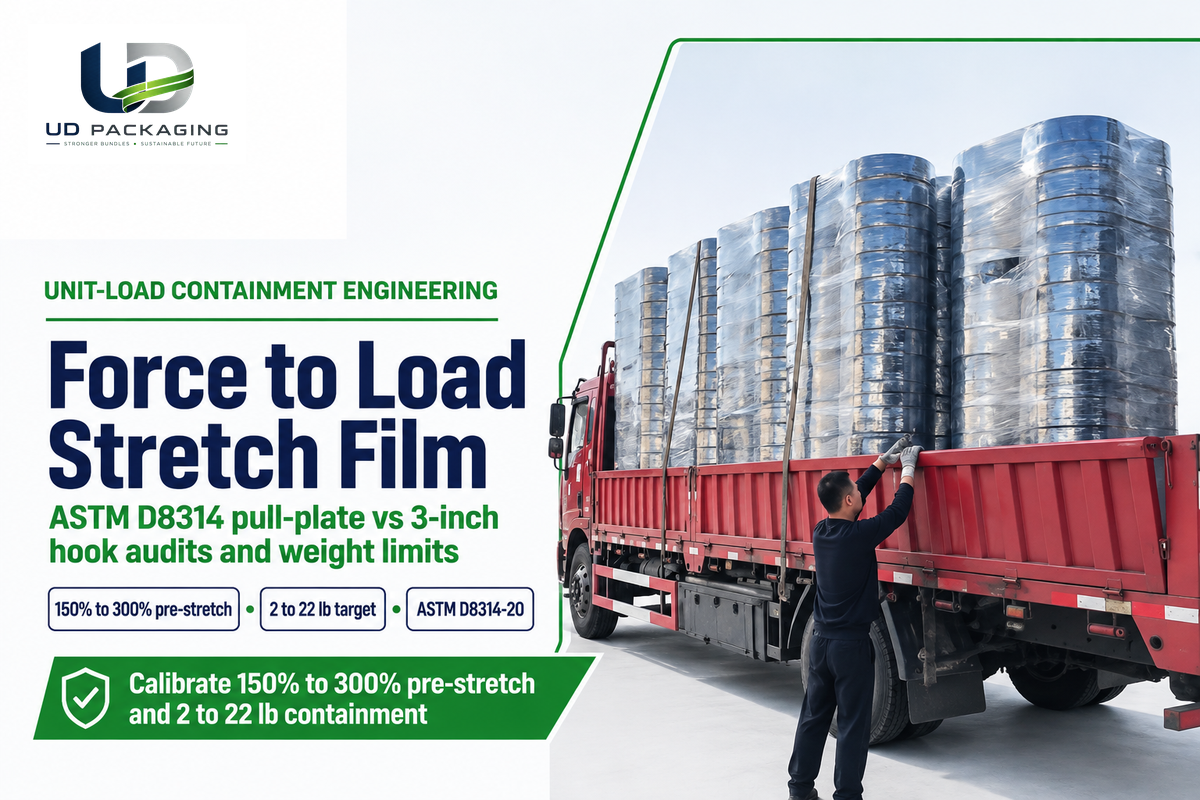
Force to load stretch film, commonly referred to as containment force in unit-load engineering, is the inward holding force created by adjacent stretched polyethylene layers around a unitized pallet load that keeps the load from shifting during transit. Per Robopac USA’s pallet containment guide, containment force is the total inward squeezing force determined as single-layer wrap force multiplied by the number of overlapping film layers. Powered carriages elongate film across a 150% to 300% pre-stretch range; however, the target holding force would range from 2 to 6 pounds for light loads (0 to 500 pounds), to 15 to 22 pounds for extreme loads (1,700 to 2,200 pounds).

Pre-Stretch Ratio vs. Force to Load: Why Wrapper HMI Settings Diverge from Actual Pallet Containment
Containment force is the single most important variable that governs whether shipping pallets arrive intact or collapse inside a highway trailer. Because total force applied to the unitized stack is a key specification in reducing damage and ensuring load safety, operators cannot depend on wrapper panel dials solely to control shipping pallets. Under ASTM D8314-20 (Section 11.1.2), the pallet is subjected to stretch testing, as there is often a difference between settings on the stretching machine and the actual stretch applied.
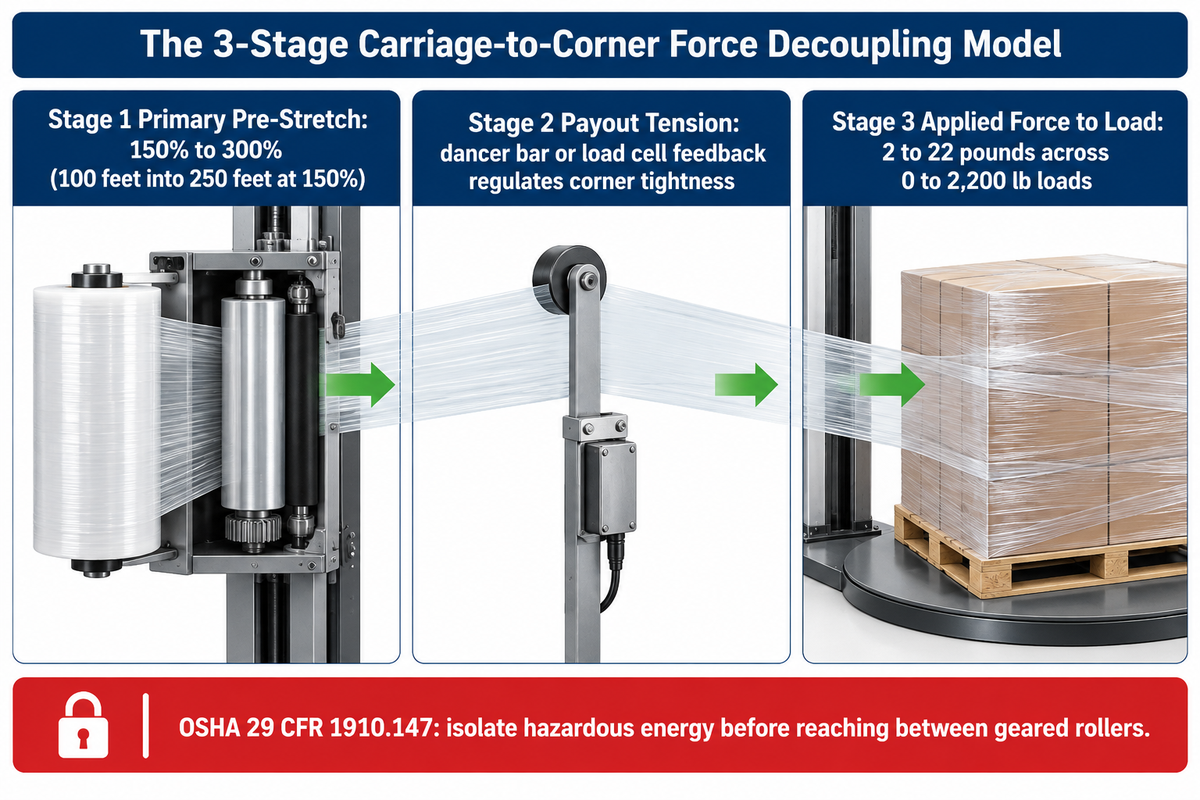
To use stretch film correctly on semi-automatic or automatic stretch wrappers, engineers separate three mechanical zones between the film roll and the load corner. First, primary pre-stretch occurs between two geared rubber nip rollers inside the carriage, before the web exits toward the pallet. It has been shown in peer-reviewed unit-load stabilizing force research (Sensors 2025, PMC12656129) that commercial 15-micron and 23-micron LLDPE machine films operate across a 150% to 300% pre-stretch range. On Lantech Q-300 turntable stretch wrappers and in Morrisette Packaging’s field wrapper benchmarks, a carriage set at 150% pre-stretch turns 100 feet of film into 250 feet, preventing crews from using more film than necessary.
Second, carriage-to-load payout tension—labeled wrap force or tightness on the operator screen and treated as a key specification in reducing damage—controls how fast the elongated web pays out as the pallet rotates. A dancer bar, magnetic brake, or load cell feedback system, regulates this tension between the exit roller and the pallet corner. Third, once the film is stretched around the cargo, single-layer restoring tension multiplied by overlapping film layers generates the inward force that holds your load together.
From a supply-scope viewpoint, UD Packaging manufactures bulk LLDPE stretch wrap supply consumables, including high-pre-stretch machine stretch film rolls, hand wrap rolls and pallet strapping. Because worn carriage rollers or variations in film modulus affect pallet containment, our team provides batch-traceable datasheets to customers to assist in calibrating hand versus machine stretch wrapping setups.
How do inside-carriage pre-stretch rollers and dancer-bar payout tension interact?
Rollers geared to the inside of the carriage extend the film web past its yield point to provide more roll footage and further stiffen polymer chains before exit. After that, the tension in the dancer bar controls the payout of the film web which, in turn, controls how tightly the web wraps around the pallet corners.
When rubber pre-stretch rollers glaze over or dancer-bar potentiometers drift across shifts, actual force to load diverges from the percentage shown on the human-machine interface (HMI). In addition, when technicians open a powered carriage to clean rollers or clear film breaks, OSHA’s lockout/tagout standard (29 CFR 1910.147), which classifies unjamming as servicing, requires isolating hazardous energy before anyone reaches between geared rollers.
| Mechanical Stage | Physical Location on Wrapping Machine | Primary Control Variable & Cited Benchmark | Effect on Film Web & Pallet Load | Field Verification Method (ASTM D8314-20) |
|---|---|---|---|---|
| Stage 1: Primary Pre-Stretch | Between fast and slow geared rubber nip rollers inside carriage | 150% to 300% machine pre-stretch (10%–20% in manual hand wrap) | Elongates 15 µm to 23 µm LLDPE past yield point; increases roll yield and stiffens film modulus | Section 11.2.1 Marking Wheel or Section 11.2.3 Cut and Weigh applied stretch check |
| Stage 2: Secondary Payout Tension | Free span between carriage exit roller and rotating pallet corner | HMI wrap force / dancer-bar or load-cell feedback setting | Sets single-layer tightness and neck-down; excessive tension crushes light carton corners | Verify dancer-bar travel and absence of corner flute crushing or film breaks |
| Stage 3: Applied Force to Load | Multi-layer film envelope pressing inward across Top, Middle, and Bottom zones | 2 to 22 pounds of containment force across 0 to 2,200 lb loads | Cumulative inward force (single-layer wrap force × overlapping film layers) preventing load shift | Section 15.3.1 Pull-Plate evaluation or 3-point handheld containment scale audit |
Where Applied Force Concentrates: Pallet Corners vs. Flat Faces and 12-Hour Stress Relaxation
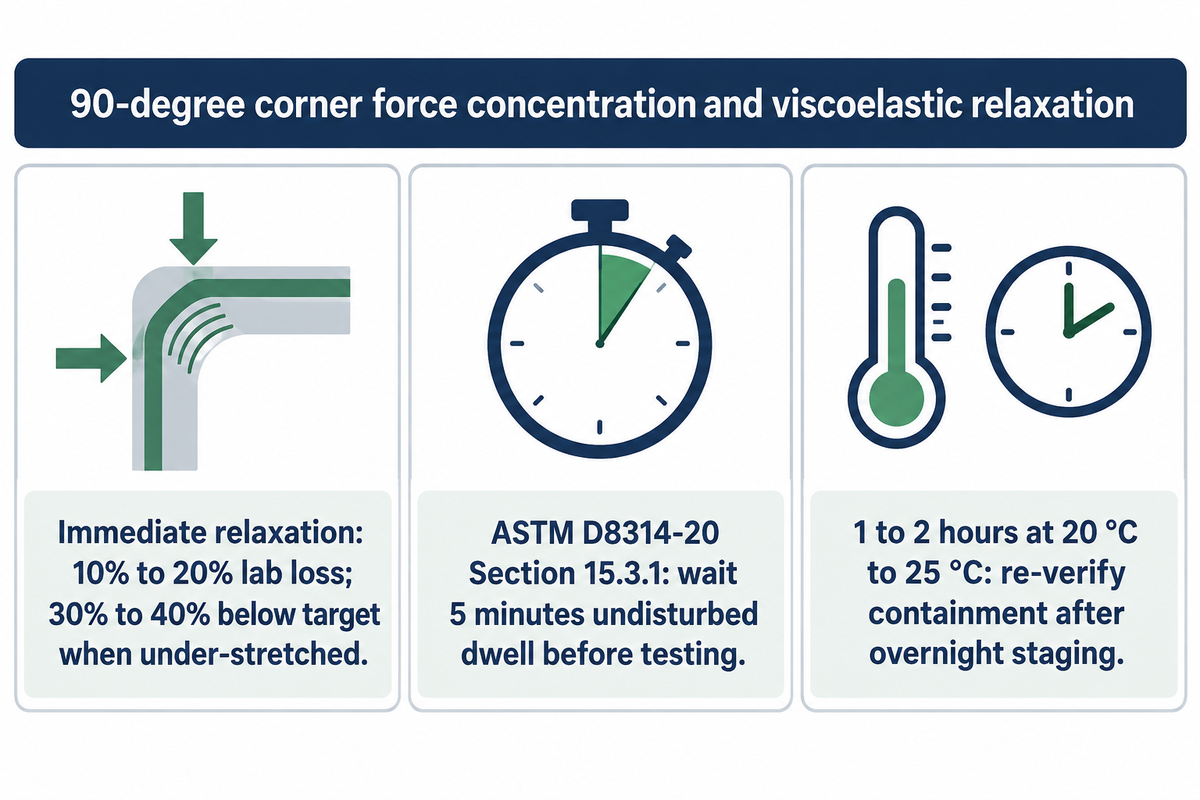
The amount of force delivered to a rectangular pallet is never uniform around its perimeter or constant after the turntable stops. At the 90-degree vertical corners, taut film adjacent to it pulls inward at an angle. Compressive force concentrates at the edge of a carton while the rest of the side of the carton resists the inward force. In addition, stretched polyethylene chains relax after wrapping, reducing initial holding force before the shipment leaves the staging floor.
As GenPac’s analysis of transit pallet containment failures notes, two tight layers and four loose layers can produce a similar total amount of holding force, which is why wrap count or film thickness alone does not tell you whether a load is secure. You can wrap a pallet six times with uncalibrated settings and still suffer product damage, or achieve reliable stability with fewer wraps when pre-stretch and payout tension are balanced. Wrapping with two overly tight passes concentrates peak stress on vertical box corners, whereas applying four moderate-tension passes distributes proper containment across the composite film wall.
What happens to stretch film holding force immediately after the wrapping cycle ends?
Stretched polyethylene relaxes immediately after wrapping, reducing retained stabilizing force by approximately 10% to 20% in instrumented laboratory testing (PMC12656129), while first-time plant audits reported by Morrisette Packaging find mid-load containment force 30% to 40% below target when under-pre-stretched film relaxes on the pallet.
Three viscoelastic behaviors govern how much holding force survives into transit:
- If carriage pre-stretch is set too low, polymer chains aren’t pulled completely into the quasi-elastic region ( 150% to 250% pre-stretch per PMC12656129). As Morrisette Packaging states, un-stretched or under-stretched film relaxes after application, leaving mid-load containment force 30% to 40% below where it should be.
- Because stress relaxation is steepest in the first minutes after the turntable stops, ASTM D8314-20 Section 15.3.1 recommends a consistent, undisturbed dwell time of 5 minutes between the end of the wrap cycle and the start of any containment force test.
- As Tkaczyk et al. (PMC12656129) conclude, specific force-per-turn assumptions hold within the first 1 to 2 hours at 20 °C to 25 °C, whereas longer overnight staging requires re-verifying containment readings so the relaxed equilibrium force keeps the pallet safe to ship.
How to Measure Force to Load Repeatably: ASTM D8314 Pull-Plate vs. 3-Inch Hook Scale Protocols
You cannot verify load stability by pushing the side of a wrapped pallet with your palm. Repeatable quality control requires a calibrated containment force tool or portable film force system from suppliers like Highlight Industries to pull the film out to a fixed distance at a standardized location. Packaging engineers depend on two distinct evaluation protocols described in ASTM D8314-20 (2025) Standard Guide for Performance Testing of Applied Stretch Films and Stretch Wrapping and field kits.
Under ASTM D8314-20 Section 10.2 and Section 15.3.1, laboratory qualification typically uses a pallet load frame measuring 1219 mm (48 in.) long by 1016 mm (40 in.) wide by 1270 mm (50 in.) tall, while field testing applies the Pull-Plate Evaluation Method directly to the wrapped unit load:
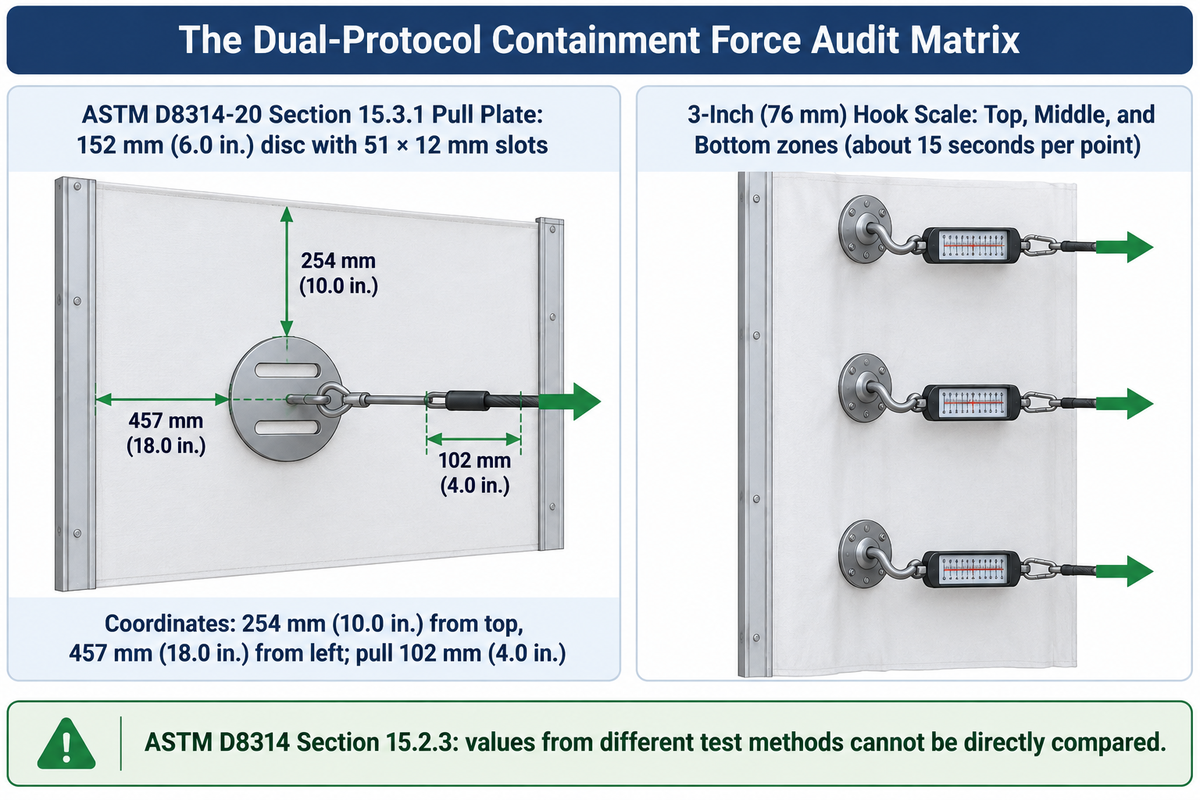
- The pull plate is a non-yielding metal disc 152 mm (6.0 in.) in diameter equipped with a central eyelet for the scale hook and non-slip polymer tape. Two slots near the center measuring 51 mm (2.0 in.) long by 12 mm (0.50 in.) wide allow a tape measure to pass through and prevent a vacuum behind the film.
- After wrapping the load and waiting the recommended undisturbed dwell interval, the operator inserts the pull plate between the film and the product on the longer side of the load. The plate is positioned 254 mm (10.0 in.) down from the top of the product and 457 mm (18.0 in.) from the left vertical edge.
- The operator makes a 25 mm (1.0 in.) horizontal slit for the eyelet and makes two slot-width slits for the tape measure and air flow port. Using a scale hooked to the eyelet, the operator pulls the plate 102 mm (4.0 in.) outward from the resting tangent line to measure the force.
On high-volume shipping docks where crews audit pallets once per shift without slitting film around a metal disc, plants use a handheld hook scale (such as Lantech’s CFT-6 containment force tool) or an electronic portable film force system from suppliers like Highlight Industries. Following Morrisette Packaging’s 3-point field test procedure, the operator takes readings at three areas of the load, base (bottom third), mid-load (center), and top (top third), taking about 15 seconds per point, by pulling the film web outward 3 inches (76 mm) to record the pounds of force.
How do pull-plate contact geometry and 3-inch hook deflection affect measured values?
Differences in contact geometry and the distance pulled in the two methods explain the differences in the readings. Under ASTM D8314-20 Section 15.2.3, containment force test methods are calibrated differently and their values cannot be directly compared across methods.
The ASTM 6.0-inch circular pull plate distributes outward deflection across a wide multi-layer film area to 4.0 inches of pull, while a handheld hook or finger tool engages a multi-layer web at a localized point and pulls 3.0 inches. In a separate context, do not translate containment force in pounds of force (lbf) or Newtons (N) to web tensile strength in pounds per linear inch (PLI). ASTM D8314-20 Section 15.3.1 describes containment force in Newtons or pounds of force, while containment guidance from Robopac USA specifies weight-class targets in pounds. For a complete overview of all applied film test methods, see our guide on ASTM D8314 unit-load containment testing.
| Audit Parameter | ASTM D8314-20(2025) Section 15.3.1 Pull-Plate Protocol | Plant-Floor 3-Inch Hook / Finger Scale Protocol (CFT-6 Style) | Repeatability & Calibration Rule |
|---|---|---|---|
| Contact Hardware Geometry | Non-yielding 152 mm (6.0 in.) diameter metal disc with two 51 × 12 mm (2.0 × 0.50 in.) airflow/ruler slots | Hook scale or piston-guided finger cradle engaging the multi-layer film web at a localized point | ASTM D8314 Section 15.2.3 states that values from different containment force test methods cannot be directly compared |
| Horizontal & Vertical Sensor Coordinates | Longer pallet side, 254 mm (10.0 in.) from top and 457 mm (18.0 in.) from left vertical edge; optional Top/Middle/Bottom | Longer pallet side across Top (top third), Middle (center), and Bottom (bottom third) zones | A variation of even a few millimeters in location or pull distance creates significant deviation |
| Outward Pull Displacement | 102 mm (4.0 in.) perpendicular from resting tangent line | 76 mm (3.0 in.) outward deflection from load face | Insert ruler to product surface; stop pull at exact target displacement mark |
| Post-Wrap Dwell Time & Cycle Time | 5 minutes recommended undisturbed dwell; requires three small horizontal slits (25 mm and 51 mm) | Consistent post-wrap dwell; non-destructive pull taking about 15 seconds per reading once per shift | Conduct all comparisons at the exact same post-wrap time interval and ambient temperature |
Target Force to Load Benchmarks by Pallet Weight Class and How to Prevent Carton Corner Crushing
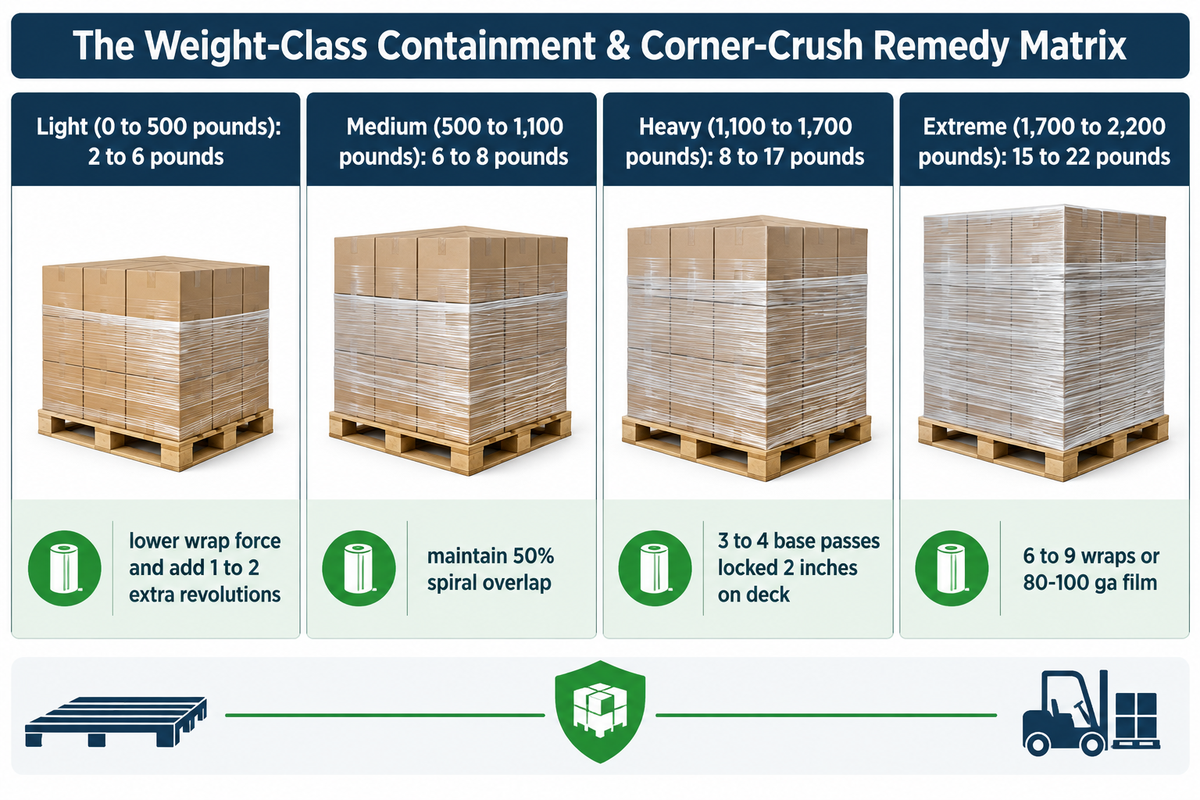
Once your team establishes a repeatable way to measure containment force across the top, middle and bottom of a pallet load, the next step is matching the amount of containment force to your cargo’s weight and load design. Selecting the optimal wrap pattern is an important factor in balancing the amount of film consumed per skid against transit stability: Selecting the optimal wrap pattern is an important factor in balancing the amount of film consumed per skid against transit stability: light loads (0 to 500 pounds) require 2 to 6 pounds of containment force, whereas extreme loads (1,700 to 2,200 pounds) require 15 to 22 pounds . light loads (0 to 500 pounds) require 2 to 6 pounds of containment force, whereas extreme loads (1,700 to 2,200 pounds) require 15 to 22 pounds.
Published by Robopac USA and IPS Packaging & Automation’s Load containment Recommendations, industrial pallet loads are classified into four weight tiers along with A, B and C pallet load profiles:
- A Load Profile: pallet decks with uniform edges both horizontally and vertically, with no sharp protrusions.
- B Load Profile: Irregular case patterns or slight pallet overhangs resulting in exposed steps requiring higher puncture resistance.
- C Load Profile: Highly irregular mixed-SKU loads with sharp protruding edges that require premium tear resistance and careful tension control.
Combining the four weight tiers from Robopac USA and the A, B, and C load profiles from IPS Packaging yields a 9-tier lookup matrix for shipping pallets:
| Load Weight Tier & Profile Class | Pallet Weight Range (lb) | Recommended Containment Force (Robopac USA) | Primary Containment Issues & Failure Mode | Wrapper Recipe & Corner-Crush Remedy |
|---|---|---|---|---|
| Tier 1: Ultra-Light Uniform Class A | 0 to 500 pounds | 2 to 6 pounds | Crushed box corners and top-layer case deformation from excessive wrap force | Lower carriage wrap-force tension; add 1 to 2 extra moderate-tension revolutions |
| Tier 2: Light Fragile Carton Class A | 0 to 500 pounds | 2 to 6 pounds | Flute buckling on empty PET bottles, paper towels, or thin chipboard cases | Reduce payout tightness; rely on 150%–250% pre-stretch elastic recovery |
| Tier 3: Light Stepped-Edge Class B | 0 to 500 pounds | 2 to 6 pounds | Local corner tearing on overhanging light trays when tension is set too high | Use soft high-stretchability film at low carriage payout tension with 50% overlap |
| Tier 4: Medium Stable Carton Class A | 500 to 1,100 pounds | 6 to 8 pounds | Mid-load leaning if top-to-bottom tension varies across operator shifts | Post laminated settings card; maintain 50% spiral overlap up and down |
| Tier 5: Medium Mixed-Case Class B | 500 to 1,100 pounds | 6 to 8 pounds | Weak horizontal seams between layers when vertical carriage speed is too fast | Slow carriage ascent speed; lock film at least 2 inches onto pallet base |
| Tier 6: Heavy Uniform Case Class A | 1,100 to 1,700 pounds | 8 to 17 pounds | Load sliding off pallet deck during forklift braking or highway vibration | Apply 3 to 4 reinforced base passes; lock at least 2 inches onto deck |
| Tier 7: Heavy Irregular Bag/Case Class B | 1,100 to 1,700 pounds | 8 to 17 pounds | Forklift blade punctures at pallet base unzipping bottom containment band | Roll bottom film edge into a tight cable just below top pallet deck boards |
| Tier 8: Extreme Tall/Unstable Class B | 1,700 to 2,200 pounds | 15 to 22 pounds | Upper-tier swaying on unstable loads during intermodal or highway braking | Use double-wrap spiral pattern (6 to 9 wraps) with roped top/bottom bands |
| Tier 9: Extreme Sharp-Edged Class C | 1,700 to 2,200 pounds | 15 to 22 pounds | Corner punctures, film breaks, and multi-tier collapse on sharp protrusions | Combine 80–100 ga puncture-resistant film with corner boards or strapping |
When a warehouse experiences crushed corners on light loads, the instinctive mistake is blaming the type of film or dropping containment force below safe transit levels. Carton crushing occurs when Stage-2 carriage payout wrap force is set too high. The first pass of the film is a compressing force against the box corners even before the support of a flat wall is created. The engineering fix is simple: lower HMI wrap-force tension and add 1 to 2 extra overlapping revolutions so the right amount of containment force accumulates through layer multiplication rather than single-pass corner squeezing.
Also important is IPS Packaging’s analysis of common loading issues with containment and GenPac’s dock failure checklist regarding base locking. If the film isn’t rolled down over the pallet at least 2 inches, the unitized stack can slide off the wooden deck during sudden stopping of the truck. Rolling the bottom few inches of film into a tight roped cable just below the top deck boards locks the load to the pallet. This also provides forklift tines clearance.
Wrap Revolutions, Overlap, and Ambient Temperature: Linear Scaling Rules for Applied Holding Force
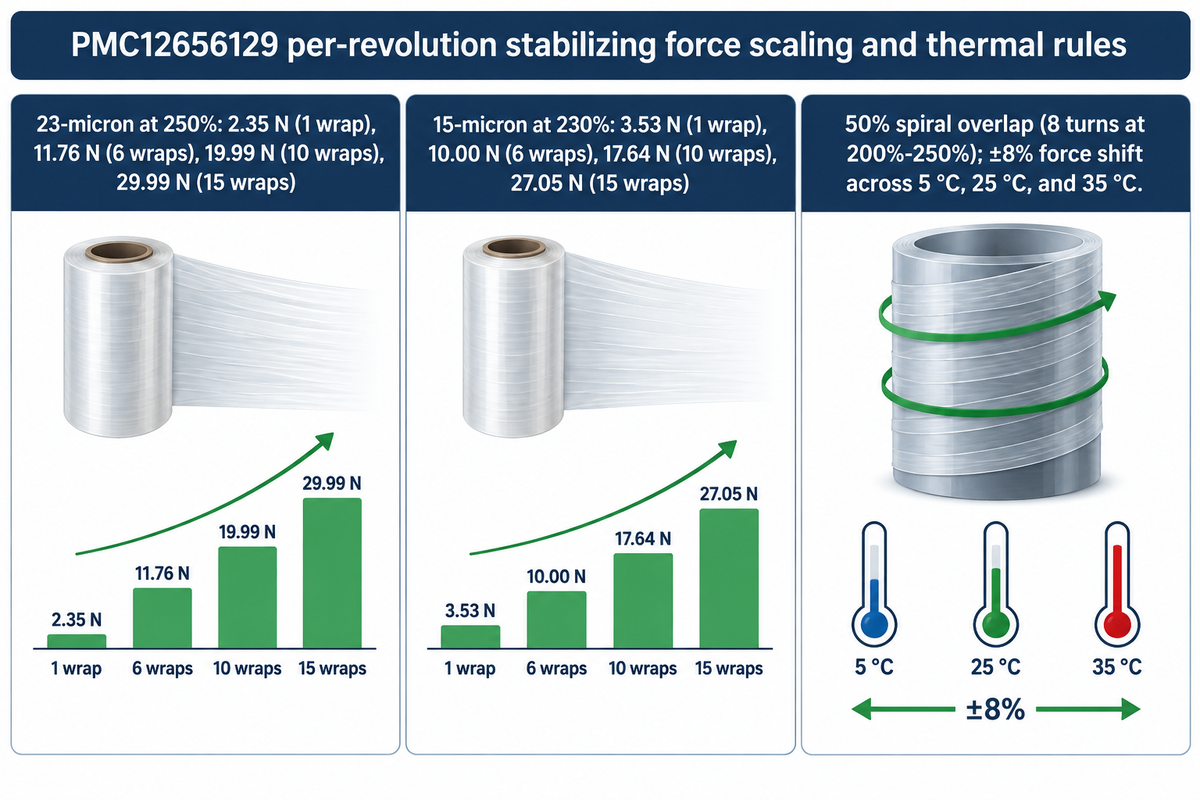
How does each additional turntable revolution add to the stabilizing force on a pallet? In a 2025 peer-reviewed study published in Sensors (Tkaczyk et al., PMC12656129), researchers used a Robopac 705 automatic wrapper and a 150 mm sensor disk flush-mounted to a 1200 × 800 × 1500 mm crate wall to measure static ($F_s$) and dynamic ($F_d$) stabilizing forces across 15-micron, 17-micron, and 23-micron LLDPE stretch films.
Their data showed a direct correlation between the number of turns, the degree of pre-stretching, and the forces that stabilize the cargo. Note that the flush-mounted crate-wall sensor in PMC12656129 Table 1 and Table 2 measures local inward static force ($F_s$) at one-third load height, which is a different physical metric from outward pull-plate or hook-scale containment force and can’t be converted 1-to-1 into pull-scale poundage:
- For the 23-micron film at 250% pre-stretch (PMC12656129 Table 2), local static stabilizing force rises from 2.35 N at 1 wrap to 4.12 N at 2 wraps, 5.88 N at 3 wraps, and 7.64 N at 4 wraps.
- At 6 wraps, local static force reaches 11.76 N; at 10 wraps, it reaches 19.99 N; and at 15 wraps, it reaches 29.99 N, with per-turn increments ($dF_s$) of 1.76 N to 2.36 N per wrap.
- For the 15-micron high-quality film at 230% pre-stretch (PMC12656129 Table 1), local static force starts at 3.53 N at 1 wrap, reaches 10.00 N at 6 wraps, 17.64 N at 10 wraps, and 27.05 N at 15 wraps (31.16 N at 17 wraps).
To translate per-revolution gains into uniform top to bottom restraint on a full pallet, operators must pair wrap counts with proper spiral overlap. As Benchmark Industrial’s complete stretch film guide explains, for upward and downward spirals, a continuous double layer must be formed by overlapping the previous pass by around 50%. Tkaczyk et al. (PMC12656129 Section 4) state that wrapping occurring around 8 turns at 200% to 250% pre-stretch provides an effective balance of safety and cost while still using material efficiently.
Ambient warehouse temperature also shifts holding force after wrapping. Tkaczyk et al. (PMC12656129 Section 3.1) note that temperature variation across 5 °C, 25 °C, and 35 °C alters stabilizing force by approximately ±8% due to changes in LLDPE modulus and relaxation rate, while Morrisette Packaging’s cold-chain notes warn that film mechanical properties shift meaningfully below 35 °F. When pallets are wrapped in a warm staging area and moved into cold storage, or staged in 35 °C summer trailers, test containment force in the actual thermal condition and add 1 compensatory wrap revolution if readings drop below your weight-class target.
How Film Formulation and Extrusion Method Govern Force-to-Load Retention When Down-Gauging
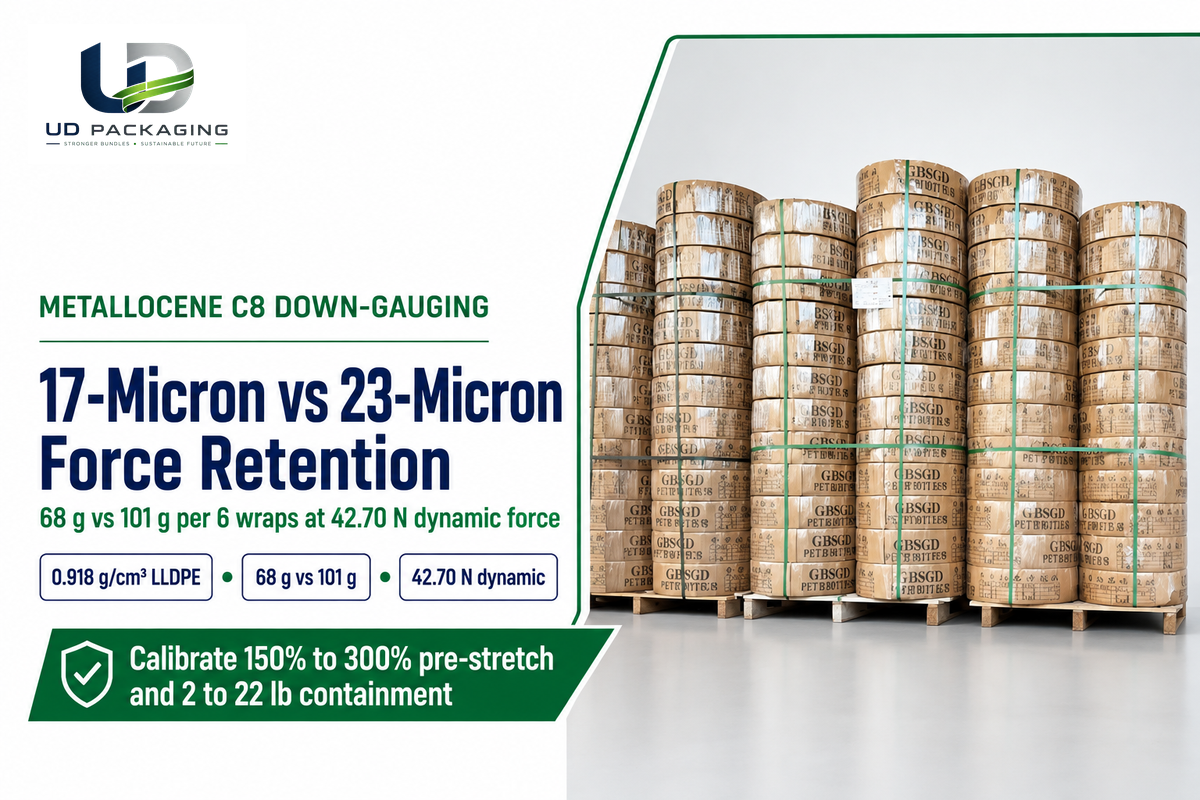
A common misconception in warehouse procurement is that the thicker the gauge, the stronger the film on the pallet. While nominal thickness may determine the raw cross-sectional area of basic commodity wraps, resin chemistry and the method of extrusion may result in thinner engineered films delivering higher stabilizing force per gram of polyethylene.
Commercially available LLDPE stretch films span the gamut from conventional Ziegler-Natta butene or hexene copolymers to metallocene C8 (Octene) based formulations. As described in U.S. Patent Application US20220388285A1 and U.S. Patent Application US20120219814A1, multilayer LLDPE stretch films have a nominal density of about 0.918 g/cm³ and can have metallocene Octene based outer or core layers with cling skins. Dense inter-lamellar tie molecules formed by side branches of Octene create elastic energy storage in 150% to 250% pre-stretch, and beyond 300% neck-in (width reduction) and web thinning occur which limits further force increase (PMC12656129 Section 4).
Extrusion method also governs how the web behaves under tension. As noted in Doverco’s Stretch Film 101 guide and in Benchmark Industrial’s cast vs. blown comparison cast stretch film is extruded over chilled rollers to supply clarity for barcode scanning and to unwind more quietly with thinner, down-gauged profiles (e.g., 40 to 60 gauge). Among industrial types of stretch film, blown stretch film has high biaxial puncture resistance and lower neck-down in stretching, which results in better cling performance and optimizes the amount of stretch film and total amount of wrap in cold-storage applications.
| Film Type Class & Resin Category | Thickness & Pre-Stretch (PMC12656129 / Benchmark) | Applied Mass & Force Benchmark | Neck-In, Cling & Puncture Profile | Best-Fit Pallet Load Application |
|---|---|---|---|---|
| Class 1: High-Quality 15 µm Machine Film | 15 µm (60 ga) at 230% pre-stretch (150%–300% range) | 10.00 N static force at 6 wraps; 27.05 N at 15 wraps; EI(M) = 0.308 N/g | Highest normalized force-per-gram efficiency; requires calibrated power carriage | High-volume uniform A-profile loads on automatic stretch wrappers |
| Class 2: High-Quality 17 µm Machine Film (v1) | 17 µm (67 ga) at 240% pre-stretch (6 wraps) | 68 g foil mass; 42.70 N dynamic force Fd at 123 mm deflection (0.628 N/g) | Matches 23 µm standard film dynamic force (42.80 N) while cutting film mass from 101 g to 68 g | Standard A- and B-profile pallets down-gauging from 23 µm commodity wrap |
| Class 3: High-Quality 17 µm Max-Stretch (v2) | 17 µm (67 ga) at 320% pre-stretch (6 wraps) | 57 g foil mass; 53.60 N dynamic force Fd at 123 mm deflection (0.940 N/g) | Highest specific force efficiency; requires next-generation carriage to avoid neck-in breaks | Short-distance high-throughput A-profile distribution lanes |
| Class 4: High-Quality 17 µm Multi-Wrap (v3) | 17 µm (67 ga) at 240% pre-stretch (9 wraps) | 102 g foil mass; 65.95 N Series 1 to 71.10 N Series 3 dynamic force | High multi-layer restraint at the same ~101–102 g pallet mass as 6 wraps of 23 µm film | Long-distance highway freight requiring high post-relaxation stability |
| Class 5: Down-Gauged 60-Gauge Nano Cast Film | 60 ga (15.2 µm) at 250% to 300% pre-stretch | Replaces 80-gauge (20.3 µm) cast film after wrapper pre-stretch recalibration | Quiet cast unwind, high clarity, and roughly 17% cost savings via right-gauging | Plants upgrading from 80-gauge film on semi-automatic or automatic lines |
| Class 6: Standard 80-Gauge Cast Machine Film | 80 ga (20.3 µm) at 200% to 250% pre-stretch | Industry baseline for standard loads (1,500 to 2,400 lb) | Balanced modulus, clear barcode scanning, and low warehouse unwind noise | General warehouse medium and heavy pallet loads across mixed shifts |
| Class 7: Standard 23 µm Machine Film (v4) | 23 µm (90 ga) at 150% pre-stretch (6 wraps) | 101 g foil mass; 42.80 N dynamic force Fd at 123 mm deflection (0.424 N/g) | Effective on-load thickness of 9–10 µm; higher mass per pallet than 17 µm film | Older turntable wrappers limited to 150% pre-stretch gears |
| Class 8: Heavy-Duty 100-Gauge Blown Film | 100 ga (25.4 µm) blown construction | Rated for heavy loads over 2,400 lb and sharp corners | Superior biaxial puncture resistance and cold-temperature cling; louder unwind | Irregular B- and C-profile loads, cold storage, and sharp-edged cartons |
| Class 9: Pre-Stretched Hand Wrap Film | 35 to 47 ga pre-oriented film | Requires 10 to 15 times less manual pull for excellent containment pressure | Reduced neck-down and reinforced edges for manual ergonomic wrapping | Low-volume bays wrapping under 20 light-to-medium pallets per day |
As noted by Morrisette Packaging and IPS Packaging, evaluating various types of stretch film, including cast pre-stretch film and lower gauge film, allows plants to reduce the amount of stretch film, and thus the total amount of wrap, applied per skid. As shown in PMC12656129 Table 6, a 17-micron high-quality film at 240% pre-stretch (68 g per 6 wraps) showed the dynamic stabilizing force of a 23-micron standard film at 150% pre-stretch (101 g per 6 wraps), reducing potential film mass by 33 g per pallet, while keeping containment and product protection. When requesting industrial packaging supplies, be sure to review our articles on blown versus cast stretch film properties and converting stretch film gauge to microns and mils. For extreme or unstable C-profile loads at or above 2,200 pounds where film alone is insufficient, combine corner board reinforcement with reinforcing heavy pallets with PET or PP strapping.
How to Verify Stretch Film Datasheets, Cut-and-Weigh Mass, and Same-Load Wrapping Trials
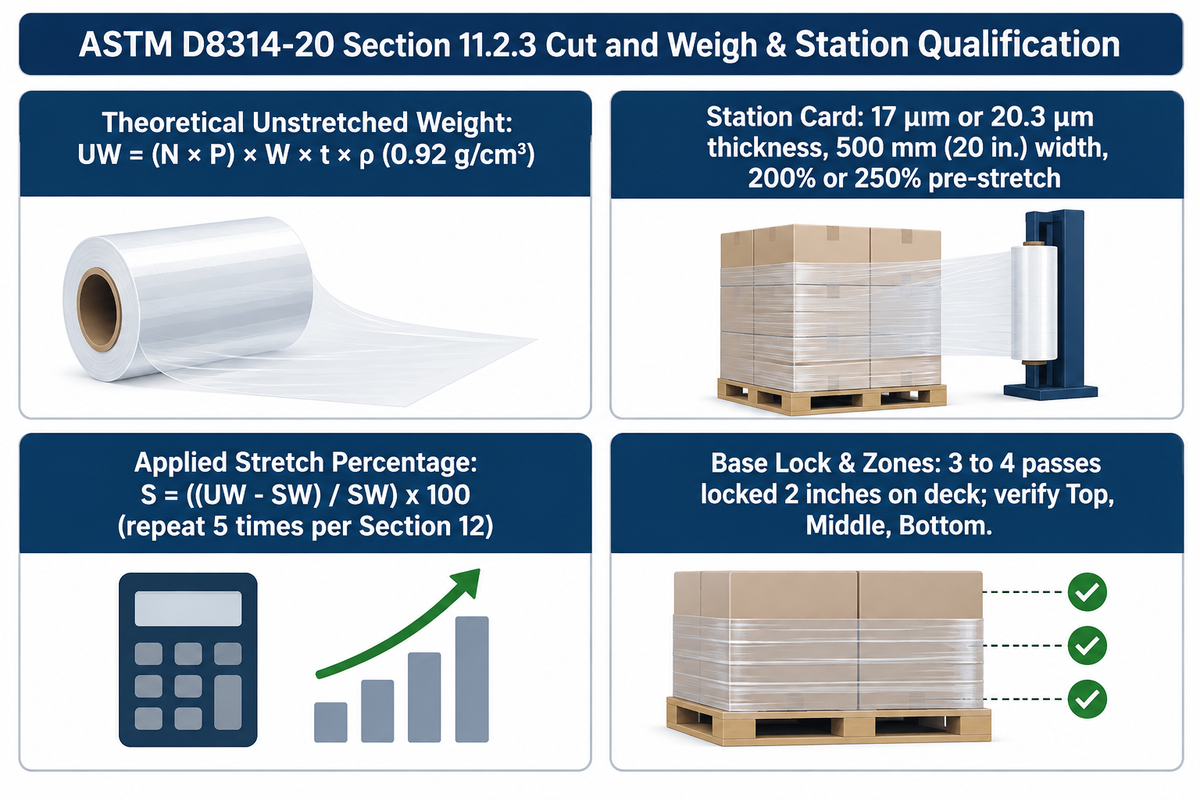
When qualifying change films or introducing new loads or suppliers on your packaging automation line, you’ll need three linked records to verify unapplied roll specification, film mass on the pallet and the containment recipe.
First, inspect incoming roll specs in ASTM D4649-20(2025) Table 3. A lot-traceable certificate of analysis should include nominal thickness, single-roll net weight, 0.918 g/cm³ nominal LLDPE resin density, ASTM D882 tensile modulus, and ASTM D5459 elastic recovery. Buyers can cross-check our guides on reading a stretch film technical data sheet and standard machine and hand stretch film roll dimensions when inspecting inbound pallets of film.
Second, differentiate incoming roll weight checks from Cut and Weigh Method defined in ASTM D8314-20 Section 11.2.3. Unlike incoming roll weighing, Section 11.2.3 measures how much film actually ends up on a wrapped pallet and calculates real applied stretch percentage using Equations 3 and 4: Equations 3 and 4 in that section can be used to determine the actual applied stretch percentage.
Theoretical Unstretched Weight: UW = (N × P) × W × t × ρ
Applied Stretch Percentage on Load: S = ((UW – SW) / SW) x 100
- The variable t is unstretched thickness (cm = micron / 10,000), and ρ is average LLDPE density (0.92 g/cm³ or 0.0332 lb/in³).
- After wrapping the pallet and recording top, middle and bottom containment force, the operator cuts all film from the load, rolls it into a tight ball and measures its stretched weight SW, using a tared scale. For removing film on receiving docks, crews can use ergonomic concealed-blade film cutters for receiving docks after verifying load stability (OLFA safety guidance).
- Under ASTM D8314-20 Section 12 (Stretch Wrapper Consistency Test), repeating this wrap-and-weigh cycle at least five times on the same load frame measures the average and standard deviation of applied film weight to flag inconsistent wrapper-and-film performance.
Same-Load Wrapping Station Qualification Checklist
Before endorsing a new stretch wrap recipe or requesting sample rolls from UD Packaging’s bulk LLDPE stretch wrap supply, staff must record the six following parameters on a laminated station card:
- Film Identification & Lot COA: Record resin construction (cast vs. blown, metallocene octene vs. conventional LLDPE), nominal thickness (e.g., 17 µm or 20.3 µm), unstretched width (500 mm or 20 in.), and net roll weight per ASTM D4649-20(2025).
- Carriage Pre-Stretch & Payout Settings: Log both the geared roller pre-stretch ratio (e.g., 200% or 250%) and the HMI dancer-bar or load-cell wrap-force percentage.
- Wrap Pattern & Base Lock: Record top wraps, bottom anchor wraps (3 to 4 passes locking at least 2 inches onto the pallet deck), vertical carriage speed, and spiral overlap (about 50%).
- Measurement Protocol & Dwell Timestamp: Specify whether force to load was tested via ASTM D8314-20 Section 15.3.1 (pull-plate method after undisturbed dwell) or a 3-inch hook scale.
- Three-Zone Force Readings (Top / Middle / Bottom): Verify that all three vertical zones meet the Robopac USA weight-class target (2–6 lb light, 6–8 lb medium, 8–17 lb heavy, or 15–22 lb extreme) without crushing corners.
- Cut-and-Weigh Applied Mass (SW): Record total grams of applied film per pallet (e.g., 57–68 g for 17 µm film vs. 101 g for 23 µm film) and calculated percent stretch on load per ASTM D8314-20 Section 11.2.3.
Frequently Asked Questions
What is the difference between pre-stretch percentage and force to load on a stretch wrapper?
Pre-stretch percentage is the geared roller speed differential inside the film carriage that elongates the web (typically 150% to 300%) before it leaves the carriage, governing film yield and chain stiffening. Force to load, also called containment force, is the cumulative inward holding force (measured in pounds of force or Newtons) exerted by all overlapping film layers on the pallet after wrapping, governed by carriage payout tension and wrap revolutions.
Why do ASTM D8314 pull-plate tests and 3-inch hook scales give different poundage readings on the same pallet?
The readings vary because the two methods are calibrated differently and engage different film areas (ASTM D8314-20 Section 15.2.3). The ASTM Section 15.3.1 pull-plate test pulls a rigid 6.0-inch diameter disc outward 4.0 inches perpendicular to the load face after a 5-minute dwell time, whereas a plant-floor hook scale pulls a localized point on the film web outward 3.0 inches, yielding non-interchangeable numbers that must be logged separately. The resulting measurements are not interchangeable and must be recorded independently.
How much containment force does a wrapped pallet lose after wrapping?
Wrapped pallets lose approximately 10% to 20% of retained stabilizing force immediately after wrapping (PMC12656129), and Morrisette Packaging reports mid-load containment force 30% to 40% below target when under-pre-stretched film relaxes on the pallet. Because linear low-density polyethylene (LLDPE) is a viscoelastic polymer whose stretched chains relax over time, operators must apply adequate pre-stretch and verify post-dwell force so the relaxed plateau still secures the load during transit.
Can you increase force to load without crushing lightweight corrugated cartons at the corners?
Yes. Reduce the HMI carriage payout tension to lower the peak corner-squeezing forces, and add an additional 1-2 overlapping carriage revolutions to build a total containment force that’s evenly distributed over a number of low-tension layers.
Where on the pallet should operators place sensors or pull scales to log repeatable containment force?
To validate process improvements on the shop floor, measure at three vertical elevations along the longest side of the pallet and a fixed horizontal distance from the corner. For pull-plate testing described in ASTM D8314-20 Section 15.3.1, position a ventilated pull plate at a 10.0 inch vertical elevation from the top of the product, 18.0 inches from the left edge, and dwell for a fixed time, then pull 4.0 inches outward.
Does switching from 23-micron (90-gauge) or 80-gauge film to thinner metallocene film reduce force to load?
Not in the case of modification of resin and pre-stretch calibration. In PMC12656129 Table 6, a 17-micron LLDPE machine film pre-stretched at 240% to 320% delivered 42.70 N to 53.60 N of dynamic stabilizing force at 57 to 68 g per pallet, which compares favorably to a 23-micron film (42.80 N at 101 g).
Does UD Packaging sell containment-force pull scales or only stretch film consumables?
No, UD Packaging sells only consumables: LLDPE hand stretch film, high-pre-stretch machine stretch film rolls in cast and blown constructions, and industrial PET/PP pallet strapping. We don’t make or sell mechanical pull-plate assemblies, electronic hook scales (such as the Lantech CFT-6), or turntable wrapping machinery. We provide batch-traceable COA datasheets and sample rolls so your packaging specialists can validate force-to-load recipes directly on your wrapping line.
References & Sources
- ASTM International/iTeh Standards – ASTM D8314-20 Standard Guide for Performance Testing of Applied Stretch Films and Stretch Wrapping (Sections 10.2, 11.1.2, 11.2.3, 15.2.3 & 15.3.1)
- ASTM International – ASTM D8314-20(2025) Active Reapproval Overview (Subcommittee D10.25 on Palletizing and Unitizing of Loads)
- ASTM International ASTM D4649-20(2025) Standard Guide for Selection and Use of Stretch Wrap Films (Table 3 Thickness & Roll Weight Limits)
- National Library of Medicine/PMC (Tkaczyk et al., Sensors 2025) – Pilot Study of Stretch Film for Securing Palletized Loads (PMC12656129)
- U.S. Occupational Safety and Health Administration (OSHA) 29 CFR 1910.147 The Control of Hazardous Energy (Lockout/Tagout for Machine Servicing and Unjamming)
- United States Patent and Trademark Office – US20220388285A1 Multilayer Stretch Film (0.918 g/cm³ Metallocene Octene LLDPE Formulations)
- United States Patent and Trademark Office – US20120219814A1 Methods of Improving Polyethylene Stretch Films (Multilayer Co-Extrusion Cling & Release Control)
- Robopac USA – Containment Force Is the Key to Safely Shipping Pallets: Weight-Class Benchmarks (2-22 lbf)
- IPS Packaging & Automation
Stretch Film Containment Force: A, B, and C Pallet Load Profiles and Right-Gauging
- Morrisette Packaging Stretch Wrap Containment Force Explained: Field Mis-Settings, Relaxation, and Cold-Chain Effects
- GenPac (General Packaging, Inc.) Stretch Wrap Containment Force: How to Stop Pallet Loads From Failing in Transit
- Benchmark Industrial The Complete Guide to Stretch Film: Cast vs. Blown, Spiral Overlap, and Cost Per Pallet
- Lantech Q-300 Semi-Automatic Turntable Stretch Wrapper Power Roller-Stretch Specifications
- Doverco — Stretch Film 101: Elastic Recovery Memory and Powered Pre-Stretch Mechanics
- SourceBySpec –Stretch Film Technical Encyclopedia: Gauge to Micron Conversion and Polymer Properties
- OLFA Industrial Safety Eliminate Cardboard and Stretch Film Handling Hazards on Receiving Docks
- r/IndustrialMaintenance Field Reports Calibration of Sensor & Dancer-Bar in Stretch Wrapper Carriage