Get in touch with UD Packaging Company
Black Stretch Film Wrap: Concealment Thresholds, Barcode Scanning Workarounds, and Outdoor Storage Limits

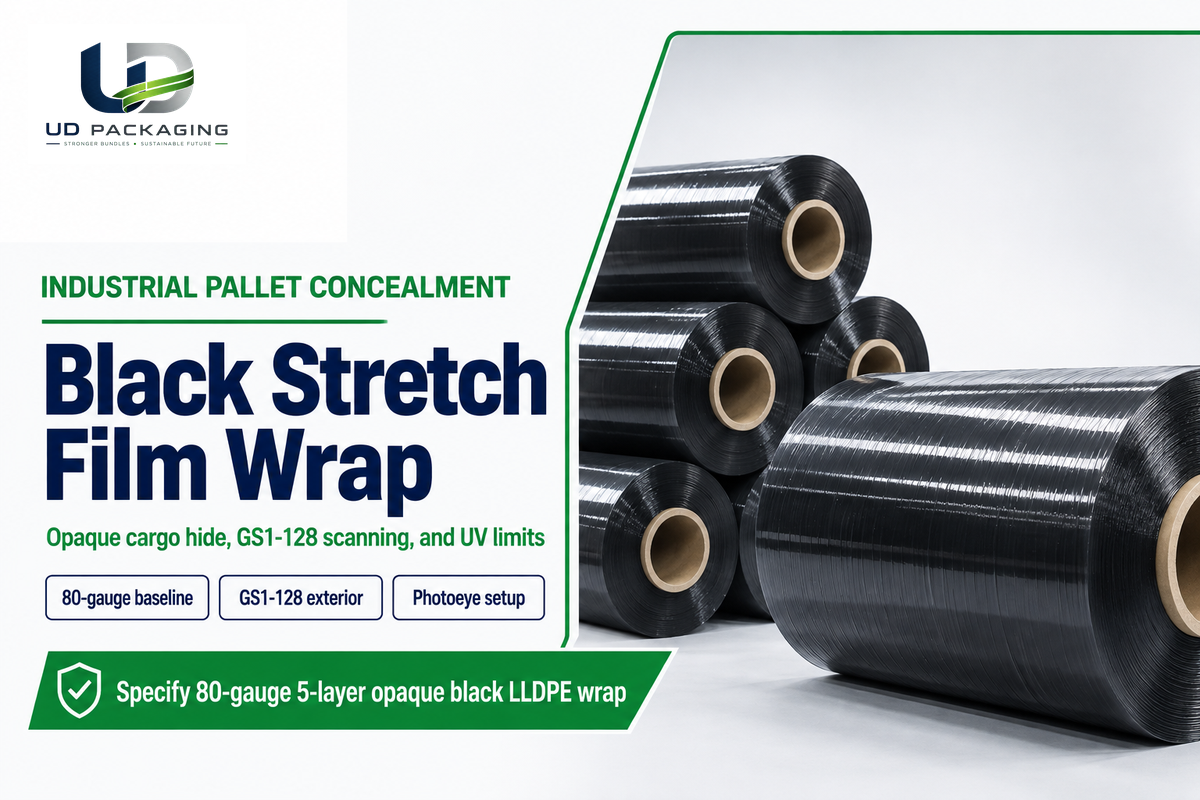
Black stretch film wrap is a linear low-density polyethylene (LLDPE) unitizing web compounded with carbon-black masterbatch to hide palletized cargo and block optical barcode scanners from reading interior carton labels. Unlike translucent colored stretch wrap used for warehouse lane coding, an opaque wrap for pallet security requires an 80 gauge stretch (20.3-micron) or 100-gauge (25.4-micron) starting thickness. Applying 3 to 4 overlapping layers ensures powered pre-stretch elongation doesn’t create translucent corner windows. Standard black pigment in the film absorbs heat, and doesn’t provide UV stabilization for long-term storage outdoors.

What Black Stretch Film Wrap Does: Opaque Concealment vs. Tinted and Zone-Coding Films
In industrial shipping and warehouse operations, opaque black stretch wrap film and translucent colored films must be distinguished by buyers. In ASTM D4649-20(2025) stretch film selection guidelines (Section 4.1), films are classified as clear films for visual inspection, translucent tinted films for inventory coding, and opaque films for concealing cargo. In a warehouse, a translucent blue or green color-coded stretch film may be used to lane code dock staging while still allowing carton label scanning. By contrast, opaque black plastic stretch wrap blocks visible light transmission after multi-layer application. When procurement teams source plastic wrap for shipping high-value freight or plastic wrap for packing mixed cartons, specifying an opaque cling plastic wrap keeps internal contents hidden from dock cameras.
While reviewing distributor catalogs, procurement engineers also observe phrases like ‘stretch wrap industrial strength’ or ‘plastic wrap industrial strength’ that have no defined thickness values. When assessing a black stretch wrap industrial strength listing vs. a clear plastic wrap industrial strength roll, buyers should verify if the supplier is able to provide a certified micron thickness as opposed to marketing adjectives. Distribution centers often pack clear stretch wrap rolls for domestic staging lanes and pack black stretch wrap industrial cases for high-theft export lanes. These facilities must audit the actual web recovery and industrial strength plastic wrap stretch holding force on the wrapper carriage.
From a supply-scope standpoint, UD Packaging manufactures and supplies LLDPE stretch film product line consumables, including hand stretch wrap, machine stretch film rolls, colored zone-coding film, and opaque black stretch wrap. Every production lot is backed by a batch Certificate of Analysis. UD Packaging doesn’t manufacture or sell, optical barcode scanners, photoelectric wrapper sensors, or heat-shrink hood machinery. Incorrect gauge or cling profile selected on black film rolls results in scanner read failures, turntable carriage over travel, and trailer pallet locking down the supply chain.
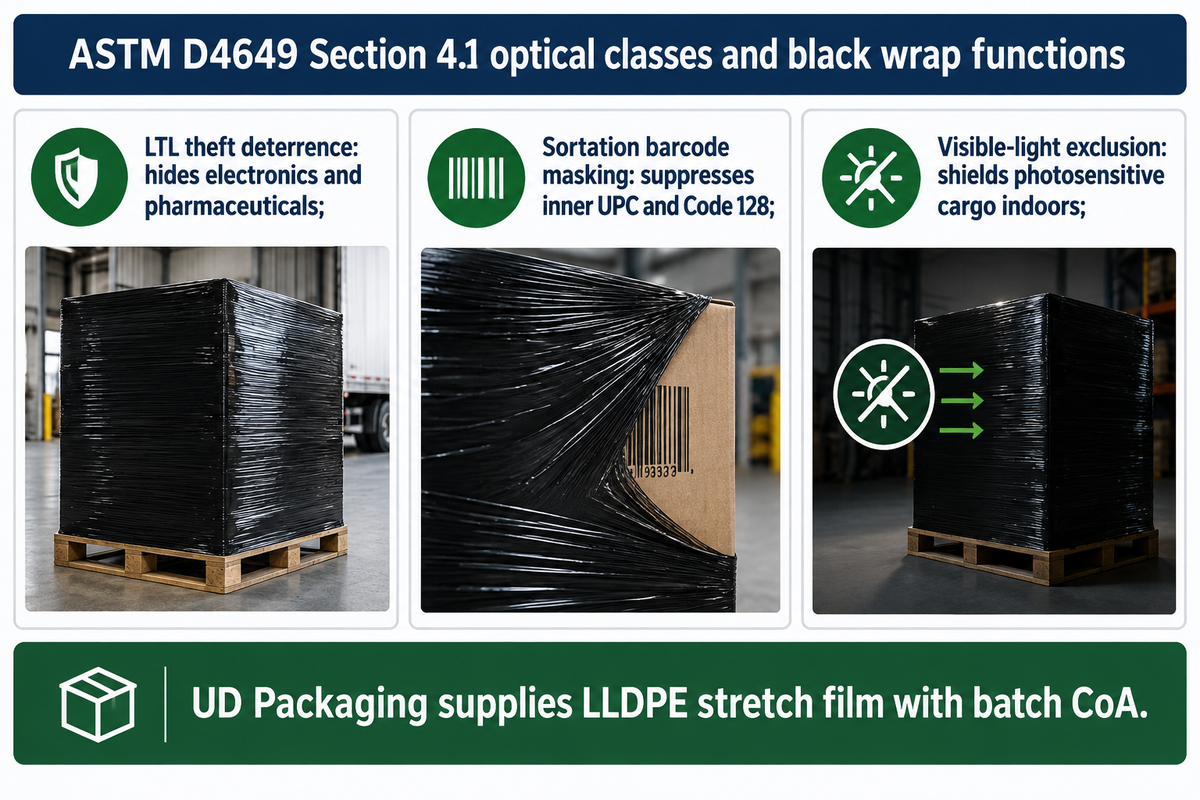
Within logistics, opaque black stretch film wrap serves three operational functions that clear stretch wrap can’t perform:
- For theft deterrence on less-than-truckload (LTL) freight, industrial black stretch film application reviews show that hiding electronics, pharmaceuticals, and branded cartons behind an opaque black shroud prevents casual pilferage at cross-dock terminals.
- For inner-carton barcode suppression at automated sortation tunnels, unitized pallets often hold dozens of master cartons carrying individual Universal Product Code (UPC) or Code 128 labels. Clear plastic wrap allows inner carton barcodes to be read by scanners in an overhead tunnel. Clear plastic wrap allows overhead tunnel scanners to read random inner boxes, whereas opaque black stretch film masks interior labels so scanners read only the exterior pallet tag.
- For visible-light exclusion on photosensitive cargo, colored and opaque stretch film warehouse comparisons note that opaque black wrap shields dyed textiles, photographic chemicals, and pigmented resins from indoor warehouse lighting.
Carbon-Black Masterbatch Opacity, 80-Gauge Thresholds, and Why 63-Gauge Film Windows at Corners
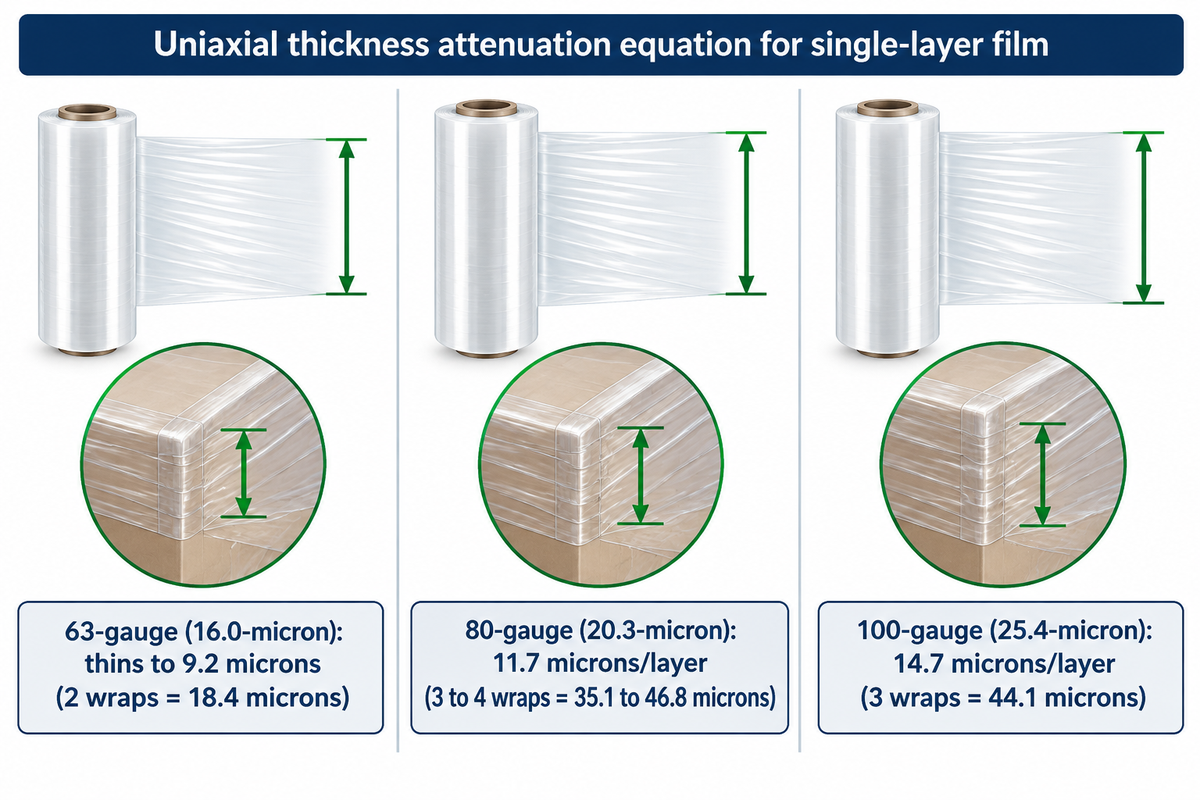
A roll of black stretch wrap film always appears jet black when several inches are wound up on a cardboard core. However, one unwound layer stretched over a pallet corner becomes gray and semi-transparent. Opacity in polyethylene film extrusion is achieved by incorporating a linear low density polyethylene melt with a concentrated carbon black masterbatch. As documented in peer-reviewed pallet wrapping studies (Sensors 2025, PMC12656129), industrial stretch film typically starts at 15 microns to 23 microns unstretched thickness and undergoes 150% to 300% pre-stretch elongation during application.
When a powered wrapper carriage or manual brake stretches the film web, polymer volume remains constant while the web thins down. Packaging engineers determine the post-stretch single-layer thickness using the uniaxial thickness attenuation equation.
Post-Stretch Thickness (microns) = Unstretched Thickness (microns) / sqrt(1 + Pre-Stretch Ratio)
Applying this equation with standard conversions from stretch film gauge-to-micron technical references and Thong Guan’s 17–23 µm and 200% stretch opacity analysis explains why thin black hand wrap fails concealment audits:
- When a 63-gauge (16.0-micron) economy hand film is stretched to 200% pre-stretch (ratio = 2.0), then 16.0-microns is divided by 1.732, the single-layer thickness becomes 9.2 microns. At 90-degree pallet corners where neck-down tension peaks, two wraps provide only 18.4 microns of pigmented polyethylene, letting white cartons show through. This allows the cartons to be seen through the film.
- In an 80-gauge (20.3-micron) industrial film stretched at 200% pre-stretch (ratio = 2.0), dividing 20.3 microns by 1.732 yields 11.7 microns per stretched layer. Applying 3 overlapping layers builds a 35.1-micron pigmented stack, and 4 layers build 46.8 microns for full visual concealment.
- In a 100-gauge (25.4-micron) heavy duty plastic film stretched at 200% pre-stretch (ratio = 2.0), dividing 25.4 microns by 1.732 yields 14.7 microns per stretched layer. Three overlapping revolutions deliver a 44.1-micron opaque barrier over sharp corners.
This behavior is why lightweight film for moving often fails in commercial freight terminals. Light-duty plastic wrap roll for moving or stretch wrap for moving are constructed to be plastic wrap for moving furniture indoors to contain dust and guard upholstery. Online catalogs often advertise a thin roll as stretch industrial strength moving wrap. Substituting that light roll for an engineered wrap roll for pallet wrap containment causes immediate corner windowing and film tears on wooden skids.
| Film Gauge Class & Application Type | Unstretched Thickness (mil / microns) | Single-Layer Thickness at 200% Pre-Stretch | Stacked Corner Thickness (2 vs. 3 vs. 4 Wraps) | Corner Windowing & Concealment Verdict |
|---|---|---|---|---|
| 60 Gauge Light Moving Film Class | 0.60 mil / 15.0 µm | 8.7 µm | 2 wraps: 17.3 µm | 3 wraps: 26.0 µm | 4 wraps: 34.6 µm | Severe corner windowing; intended only for light indoor dust bundling |
| 63 Gauge Hand / Moving Film Class | 0.63 mil / 16.0 µm | 9.2 µm | 2 wraps: 18.4 µm | 3 wraps: 27.6 µm | 4 wraps: 36.8 µm | High corner windowing risk at 2–3 wraps; requires 4–5 wraps over white boxes |
| 70 Gauge Light Industrial Hand Wrap Type | 0.70 mil / 17.8 µm | 10.3 µm | 2 wraps: 20.6 µm | 3 wraps: 30.8 µm | 4 wraps: 41.1 µm | Borderline corner opacity; requires 4 overlapping wraps on high-contrast cartons |
| 75 Gauge Hybrid Hand Wrap Type | 0.75 mil / 19.1 µm | 11.0 µm | 2 wraps: 22.0 µm | 3 wraps: 33.0 µm | 4 wraps: 44.0 µm | Moderate concealment for uniform boxed loads with rounded corner boards |
| 80 Gauge Standard Hand Stretch Wrap Class | 0.80 mil / 20.3 µm | 11.7 µm | 2 wraps: 23.4 µm | 3 wraps: 35.1 µm | 4 wraps: 46.8 µm | Industry baseline for manual cargo concealment in 3 to 4 overlapping wraps |
| 80 Gauge Standard Machine Stretch Film Type | 0.80 mil / 20.3 µm | 11.7 µm | 2 wraps: 23.4 µm | 3 wraps: 35.1 µm | 4 wraps: 46.8 µm | Standard powered turntable baseline; 3 to 4 wraps hide printed carton logos |
| 85 Gauge Heavy Hand Wrap (4 Rolls Case) Class | 0.85 mil / 21.6 µm | 12.5 µm | 2 wraps: 25.0 µm | 3 wraps: 37.5 µm | 4 wraps: 50.0 µm | Strong corner hide in manual application where operator pull tension varies |
| 100 Gauge Heavy Duty Machine Wrap Class | 1.00 mil / 25.4 µm | 14.7 µm | 2 wraps: 29.4 µm | 3 wraps: 44.1 µm | 4 wraps: 58.8 µm | Full concealment in 3 wraps; suited for irregular pallets and bright cartons |
| 120 Gauge Export Security Wrap Tier | 1.20 mil / 30.5 µm | 17.6 µm | 2 wraps: 35.2 µm | 3 wraps: 52.8 µm | 4 wraps: 70.4 µm | Maximum puncture resistance and visual block for heavy export or metal loads |
Why does 63-gauge black stretch wrap turn translucent at pallet corners after 200% pre-stretch?
A 63-gauge (16.0-micron) black stretch wrap turns translucent at pallet corners after 200% pre-stretch because polymer elongation thins each single layer to roughly 9.2 microns. That elongation pulls the carbon-black pigment particles farther apart per the unit area. Over 90-degree carton corners where local contact tension spikes, two layers leave high-contrast box graphics visible.
As Thong Guan’s technical analysis of black opaque stretch wrap documents, commercial black films in the 17-micron to 23-micron range lose substantial opacity when stretched up to 200% during wrapping. Clients reviewing microns and gauges in our stretch wrap thickness and gauge guide and 80-gauge (20.3 micron) blown black stretch wrap specs, should choose 80 gauge with a minimum of 50% layer overlap, to ensure complete visual privacy.
Barcode Scanning, GS1-128 Label Placement, and UHF RFID Through Black Stretch Wrap
Warehouse automation engineers must plan pallet identification differently when switching from clear stretch film to opaque black stretch wrap. Handheld red laser scanners (operating at 630 nm to 680 nm) and 2D CMOS camera imagers rely on diffused light reflection between dark bars and a bright white label background. Since carbon-black pigment absorbs the entire spectrum of visible and near-infrared light, an optical barcode reader can’t read a carton label located on the inside of the opaque black film.
To keep automated receiving lanes and cross-dock sorters running without manual data entry, shipping teams follow the GS1 Logistic Label Guideline for pallet barcodes and GS1 UK pallet label placement standards:
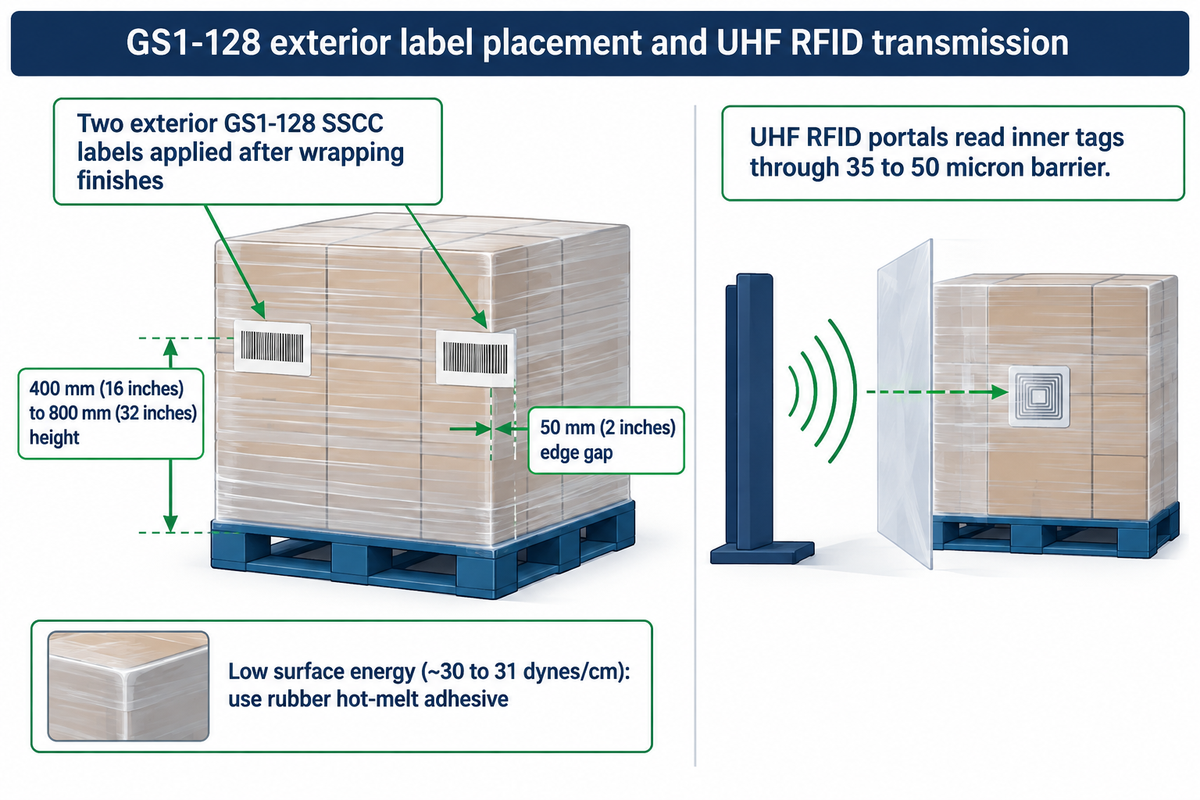
- For exterior post-wrap label application, operators apply two identical GS1-128 Serial Shipping Container Code (SSCC) labels to the exterior of the black stretch wrap after the wrapping cycle finishes. The label is applied to the short side (fork entry side) and the long side of the pack.
- For height and edge-clearance placement, GS1 UK pallet label placement rules require barcode symbols to be placed between 400 mm (16 inches) and 800 mm (32 inches) above the pallet base. Operators must also keep the label at least 50 mm (2 inches) away from vertical pallet edges so corner ridges don’t distort the 32 mm minimum bar height.
- For high-tack adhesive or placard backing, polyethylene stretch film, which has low surface energy (~30 to 31 dynes/cm) and a polyisobutylene (PIB) cling tackifier, creates a waxy interface. Standard acrylic paper labels often curl and fall off black wrap in cold trailers. Shippers should specify rubber-based hot-melt adhesives, slide a corrugated placard under the top wrap, or use custom printed stretch film for brand identification.
Can optical barcode scanners or UHF RFID readers read pallet labels through black stretch wrap?
Optical laser and 2D camera barcode scanners cannot read labels underneath opaque black stretch wrap because carbon-black pigment absorbs the 630 nm to 680 nm light beam, preventing reflection from the label substrate.
Electromagnetic separation gives logistics teams a practical dual-layer security architecture. Opaque black stretch wrap blocks external optical cameras and prevents overhead sortation tunnels from accidentally scanning inner sub-carton barcodes. Meanwhile, pallet-level or item-level UHF RFID portals read inner tags through a 35 to 50 micron polyethylene barrier.
Automated Turntable Wrapper Photoeye Sensors, 200%–250% Pre-Stretch Limits, and Hand Dispensers
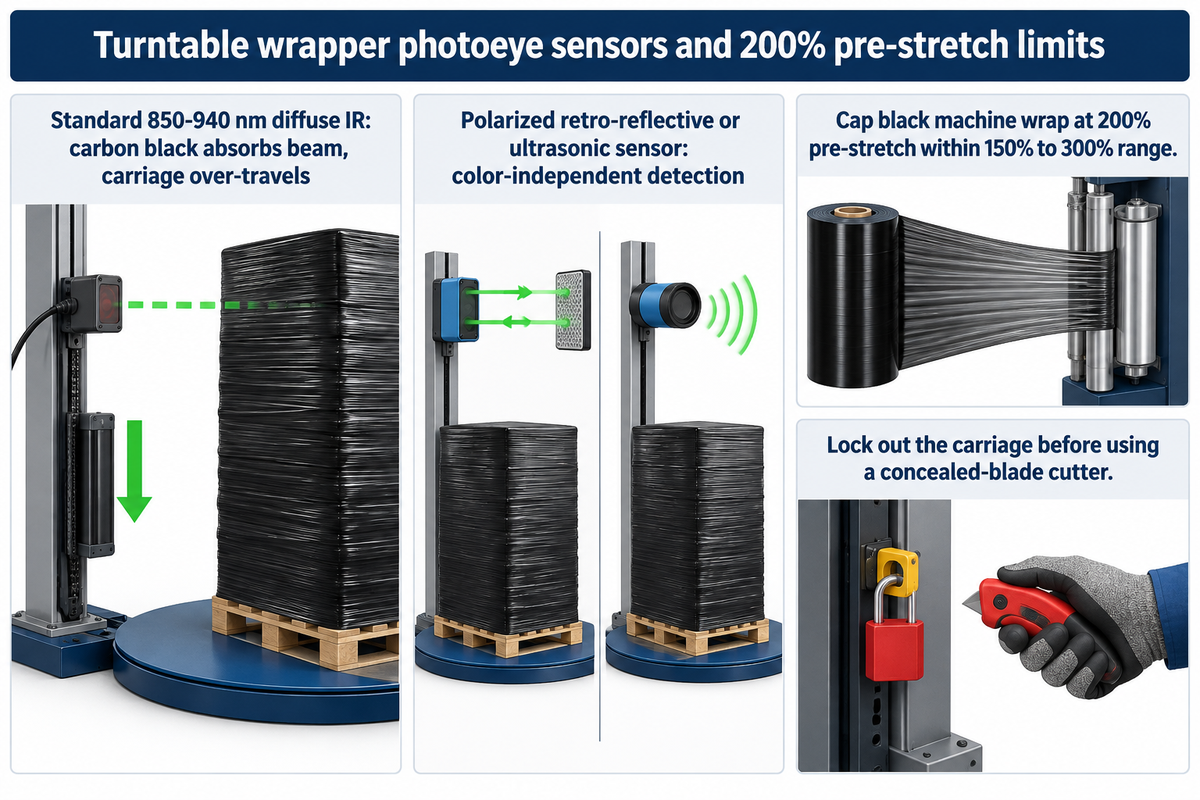
Switching a semi-automatic turntable or rotary-arm pallet wrapper from clear stretch film to black stretch wrap frequently triggers an immediate machine fault. In many factories, the film carriage fails to stop at the top of the palletized load and continues to travel up the mast. Standard wrapper carriages use a diffuse infrared photoelectric sensor (850 nm to 940 nm) that emits an infrared beam and waits for light to bounce back off the palletized boxes. With black stretch wrap, or dark cartons, the infrared beam gets absorbed and the sensor assumes no cargo is present.
Refer to Lantech Q-300 turntable stretch wrapper specifications and field service reports for industrial maintenance technician discussions on wrapper sensors for resolution of dark-load conditions. Plant engineers address dark-load conditions using one of the following four sensor configurations:
| Warehouse Subsystem | Standard Hardware Failure on Black Film | Root Physical Mechanism | Verified Engineering Workaround | Operating Range & Setup Rule |
|---|---|---|---|---|
| 1D Laser & 2D CMOS Barcode Scanners | Zero read through opaque black film; or edge curl on exterior paper labels | Carbon black absorbs 630–680 nm visible red light; PIB cling lowers PE surface energy | Exterior post-wrap GS1-128 labels with rubber-based hot-melt adhesive or hanging placards | Place 2 identical labels 400–800 mm above pallet base and ≥50 mm from vertical corners |
| UHF RFID Portals & Forklift Readers | Minimal attenuation on dry film; detuning only if wet conductive water layer forms | 860–960 MHz radio frequency waves penetrate thin polyethylene and carbon-black pigment | Standard passive UHF RFID pallet/carton tags inside or under the black film shroud | Keep top sheet dry; avoid direct tag contact with metal drums or liquid containers |
| Standard Diffuse Infrared Wrapper Photoeye | Carriage over-travels past top of black pallet or fails to detect dark load height | Matte carbon-black surface absorbs 850–940 nm infrared beam below receiver threshold | Adjust gain/dark-mode sensitivity only for dark tinted film; replace sensor for jet-black wrap | Unreliable when wrapping mixed clear, white, and matte black loads on the same line |
| Polarized Retro-Reflective Wrapper Photoeye | False reflection off shiny clear film if unpolarized | Polarizing filter checks beam broken between carriage emitter and mast/wall corner-cube reflector | Mount a polarized retro-reflective photoeye with a fixed reflector opposite the turntable | Detects any opaque or clear pallet load that physically interrupts the reflector beam |
| Laser Time-of-Flight / Ultrasonic Height Sensor | None on dark colors; ultrasonic ignores optical reflectivity entirely | Measures acoustic pulse echo time (ultrasonic) or phase-shift time-of-flight (Class 1/2 laser) | Install ultrasonic or background-suppression time-of-flight sensor on the film carriage | Color-independent detection across matte black, glossy white, and clear stretch film |
In addition to sensor calibration, powered pre-stretch carriages running machine-grade black stretch wrap require attention to roller elongation ratios and maintenance safety:
- In solid carbon-black based masterbatches, stress-concentration microscopic points are present in the LLDPE polymer matrix. While virgin clear metallocene cast film can operate across the 150% to 300% pre-stretch range on rotary wrappers, running pigmented black machine film above 200% pre-stretch increases web snap rates and thins the film below its opacity threshold.
- When a black film web snaps and wraps around powered carriage rollers, maintenance crews must isolate hazardous energy first. Per OSHA 29 CFR 1910.147(b) servicing and unjamming lockout/tagout rules, a maintenance employee must lock out the carriage before using a non-marring concealed-blade cutter to slice a wrapped film.
- Low-volume shipping bays typically order either 18-inch by 1,500-foot 80-gauge hand stretch wrap packed 4 rolls per case, or narrow bundled wrap roll with handle cores for unitizing pipes and loose cartons. When dock workers switch from clear plastic wrap with handles to an opaque stretch wrap with handle dispenser, tension control depends on operator braking effort. An extended-core stretch wrap roll with handles, which is often listed in catalogs as wrap with handles or industrial strength with plastic handle bundling film with light shrink wrap for moving supplies, achieves modest manual elongation. As a result, hand rolls contain more unstretched opacity than a machine carriage, and exert less containment force on heavy pallets.
Outdoor Storage Limits: Why Black Film Absorbs Solar Heat and Does Not Equal UV Stabilization
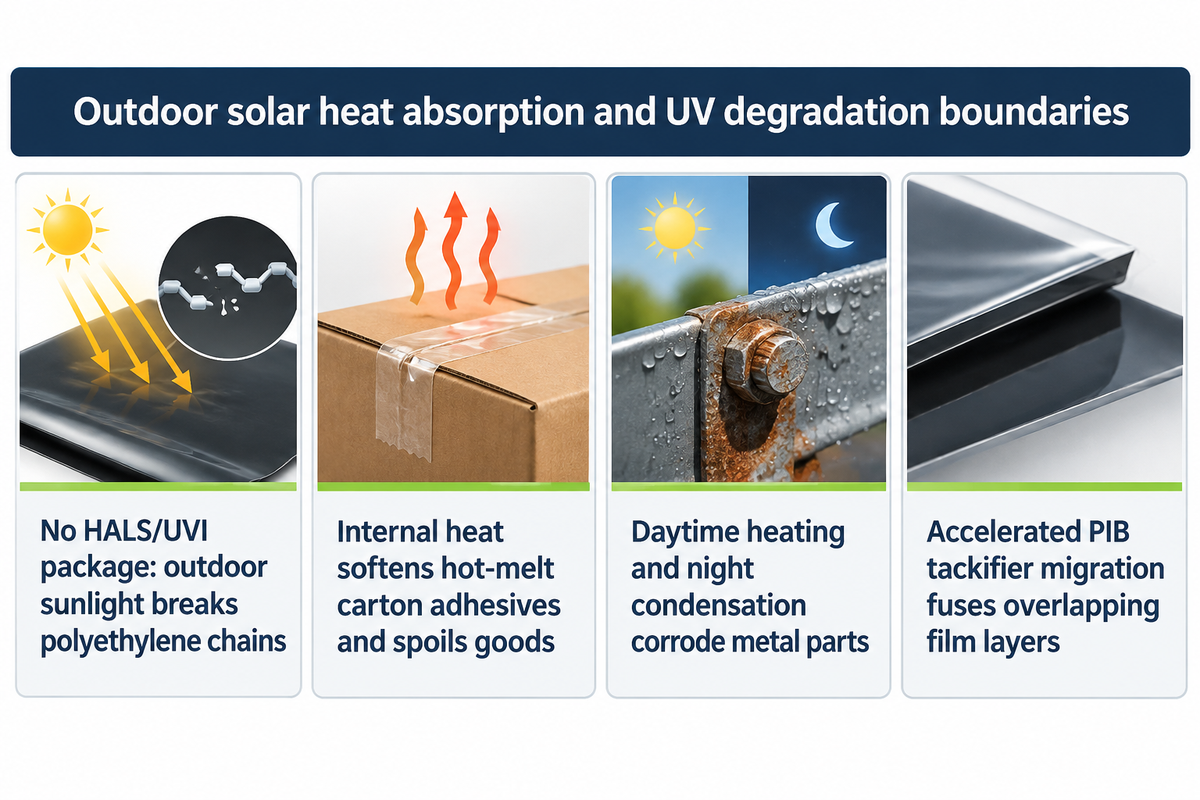
One of the most expensive procurement mistakes in industrial packaging is assuming that black stretch film wrap is UV-stabilized for prolonged outdoor storage, since the film is black. In polymer chemistry, compounding standard pigment-grade carbon black into LLDPE for visual privacy only blocks visible light. It does not replace formulating an outdoor weatherable film with Hindered Amine Light Stabilizers (HALS) or dedicated ultraviolet inhibitor (UVI) additive packages.
As indicated in the AAA Polymer Technical Guide Outdoor pallet wrap vs. shrink wrap, standard stretch wrap is manufactured for indoor use in warehousing and transport packaging. Lack of UV stabilizers and the effect of prolonged exposure to the sun causes the polyethylene chains to break, thus making the stretched film web brittle, lose containment, and break at pallet corners. Spiral-wrapped stretch film also leaves the top of the pallet corners partially open in horizontal seams, thus allowing rainwater to seep in between the layers unless a waterproof Polyethylene sheet is shingled under the top wraps.
Does standard black stretch film protect pallets from outdoor UV degradation and solar heat?
No—standard black stretch film is pigmented for visual privacy and does not automatically contain Hindered Amine Light Stabilizers (HALS) for long-term outdoor UV survival. Worse, the black film acts as a solar absorber in the direct sunlight, raising the internal pallet temperatures and triggering the moisture condensation compared with the opaque white stretch film.
When a pallet wrapped in black plastic stretch wrap sits in a sunlit yard or open flat-rack container, the dark carbon-black surface absorbs incoming solar radiation and converts it into conductive heat.
- Condensation Softens: The internal pallet temperatures of the packaging increase and soften hot-melt adhesives, making it difficult to seal cartons, and further condenses the packaging materials, leading to spoilage of the packaged products, e.g. food and beverages, chemicals, and pharmaceuticals.
- Moisture in Wooden pallet stringers and corrugated board evaporates due to daytime solar heating. At night, the water vapor condenses on the inner surface of the black stretch film, and corrodes the metal parts.
- High film surface temperatures speed up the migration of liquid polyisobutylene (PIB) cling resin. When this occurs, overlapping film layers fuse, resulting in a solid skin that rips carton printing when a package is opened.
Black Stretch Wrap vs. Opaque White Film, Clear Wrap, and Heat-Shrunk Poly Hoods
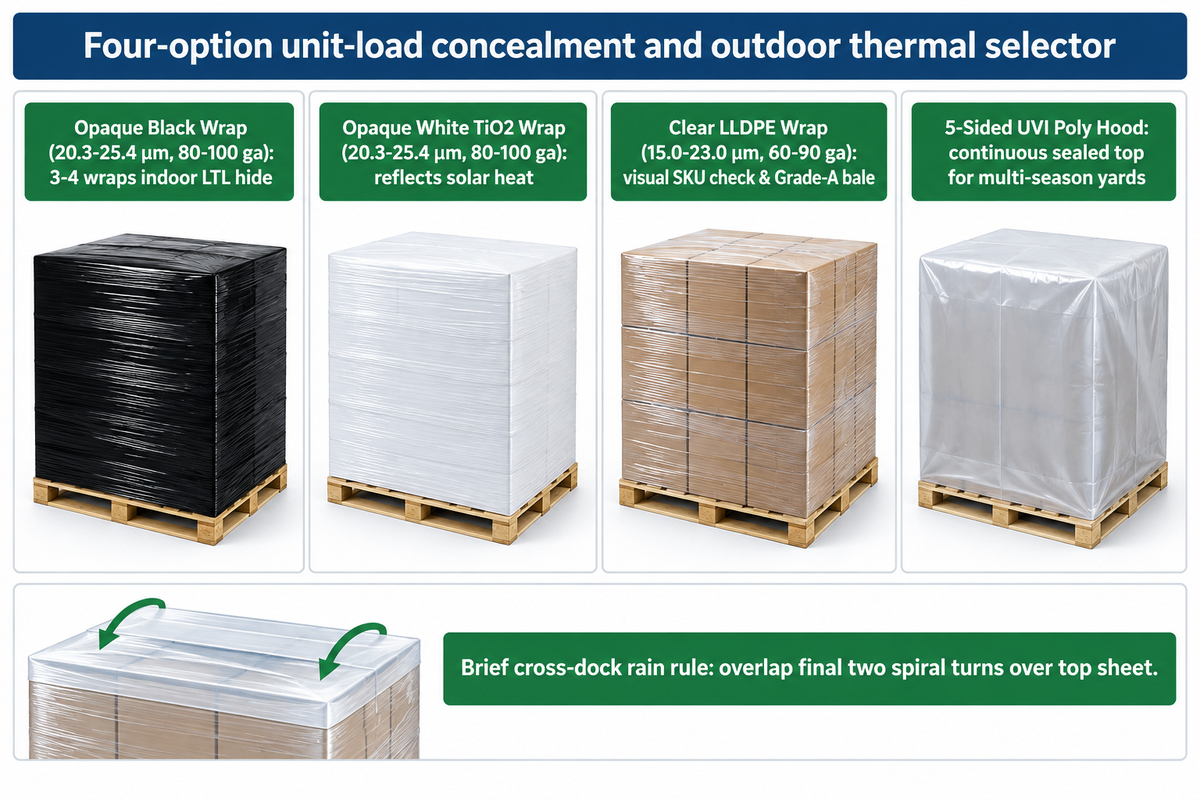
When a shipping manager needs solar reflection or one or more of the following: long-term (i.e., months) outdoor exposure, visual concealment, comparative evaluation of four different unit-load materials prevents misapplying indoor black security film to outdoor yards.
Buyers also need to discern between cold-applied LLDPE stretch wrap and thermal heavy duty shrink wrap. Hardware and office supply catalogs often confuse the two by labeling an elastic LLDPE product as a stretch film shrink wrap roll or advertising shrink wrap for pallet wrap when in fact the web is cold-stretched polyethylene. True thermal packaging heavy duty shrink film starts at a much greater gauge and shrinks biaxially when heated to form a rigid weatherproof hood.
| Selection Criterion | Opaque Black Stretch Film Wrap (80–100 Gauge) | Opaque White Stretch Film Wrap (TiO2 Pigmented) | Standard Clear LLDPE Stretch Wrap | 5-Sided UVI Heat-Shrunk / Stretch Poly Hood |
|---|---|---|---|---|
| Primary Pigment & Thickness | Carbon-black masterbatch; 20.3–25.4 µm (80–100 ga) | Titanium dioxide (TiO2) white masterbatch; 20.3–25.4 µm (80–100 ga) | Unpigmented virgin LLDPE; 15.0–23.0 µm (60–90 ga) | HALS/UVI-stabilized LDPE/LLDPE heavy-gauge hood |
| Cargo Concealment & Inner Barcode Masking | High concealment in 3–4 overlapping wraps; blocks inner 1D/2D barcodes | Good visual concealment in 3–4 wraps; blocks inner barcodes when opaque | Zero concealment; inner cartons and barcodes remain fully visible | Opaque white or black options conceal cargo completely |
| Solar Heat Absorption in Direct Sunlight | High solar heat absorption; elevates internal pallet core temperature | Reflects solar radiation; minimizes internal pallet temperature rise | Greenhouse transmission; sunlight heats dark inner cartons directly | White UVI shrink/stretch hood reflects sunlight and limits thermal gain |
| Outdoor UV Service Life | Short indoor/transit rating unless custom-compounded with HALS/UVI package | Extended multi-season rating when compounded with outdoor UVI stabilizer | Short indoor/transit rating unless specified as UVI agricultural film | Long-term multi-season outdoor yard rating with specified UVI package |
| Top-Surface Rain & Weather Shedding | Open top unless paired with a shingled polyethylene top sheet | Open top unless paired with a shingled polyethylene top sheet | Open top; spiral seams trap windblown rain without top sheet | Continuous 5-sided sealed top shedding rain, snow, and yard dust |
| Differential Cling & Trailer Pallet Locking | Requires 5-layer one-sided cling to stop adjacent black pallets locking | Available in one-sided slip outer skin for smooth trailer loading | Available in one-sided or two-sided cling for indoor racking | No tackifier; heat-shrunk or elastic hood outer surface is slip-neutral |
| End-of-Life NIR Optical Sorting & Recycling | Absorbs NIR sorting beams; requires segregated back-of-house baling | Reflects NIR beams; compatible with commercial pigmented PE streams | Reflects NIR beams; highest-value Grade-A clear LLDPE bale stream | Sorted by pigment class; clear and white hoods enter standard PE bales |
| Best-Fit Industrial Application | Indoor/enclosed-trailer LTL theft deterrence and sortation barcode masking | Sunlit staging yards, heat-sensitive beverages, resin bags, and construction goods | Standard indoor warehousing requiring instant visual SKU verification | Long-term outdoor storage of cement, appliances, lumber, and export machinery |
Some operations require the black pallets to be wrapped briefly outdoors during cross dock transfers. For these operations, the pallet must be wrapped from the bottom up. Wrap must be paused before the final two revolutions of the spiral. A polyethylene top sheet must then be placed over the pallet to cover the exposed print. Overlapping the final two turns of the spiral over the sheet skirt helps shed water from the load.
Cast vs. Blown Extrusion, PIB Cling Migration, PCR Content, and Receiving Unwrapping Safety
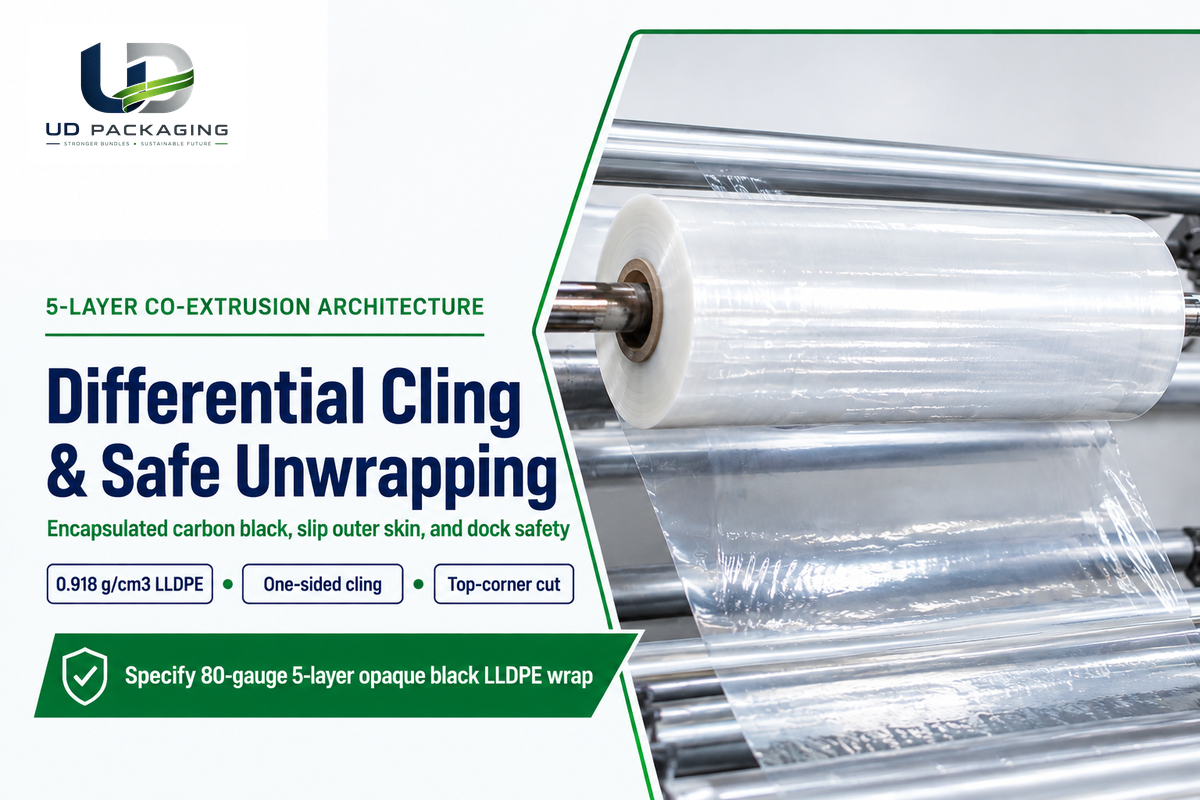
How a manufacturer extrudes black stretch film wrap impacts the variety of characteristics including unwind noise, tear resistance, cling and compatibility with recycled polyethylene. As described in Doverco’s Stretch Film 101 and industrial stretch Comparative Material guides, the extrusion method of casting extrusion rapidly cools the molten LLDPE web (using polished chrome rolls), resulting in a film with a high gloss and a uniform gauge. Blown extrusion creates a web with an irregular gauge and a rough surface, however, it’s stronger and generates a louder unwind noise compared to cast extrusion.
In black stretch wrap manufacturing, multilayer co-extrusion addresses two challenges detailed in U.S. Patent Application US20220388285A1 and U.S. Patent Application US20120219814A1:
- High-surface-area carbon black compounded into a monolayer film can absorb migrating polyisobutylene (PIB) liquid tackifier, causing erratic peel cling. Using a 5-layer cast co-extrusion line encapsulates the carbon-black masterbatch and Post-Consumer or Post-Industrial Recycled (PCR/PIR) resin inside internal core layers. That structure leaves a virgin metallocene (nominal density ~0.918 g/cm³) inner cling skin and a smooth outer slip skin.
- When two double-sided-cling black pallets rub together inside a vibrating highway trailer, their tacky outer skins weld together and rip the film open during forklift unloading. If a differential cling is specified, the tacky layer can be placed against the load, while the outer layer can be a low-friction layer for the pallet in direct contact.
- Opaque black stretch wrap conceals shifted upper carton tiers, crushed bottom boxes, and tensioned internal strapping. This makes it impossible for receiving personnel to assess load stability prior to cutting. Using OLFA receiving-dock pallet unwrapping safety guidance, dock crews first check to see if the load is stable across all four corners. Cuts are made using either an OLFA SK-10, or a concealed-blade stretch film cutter. The cut is made in the top corner of the load to remove the unstable portion of the load prior to removal of upper tiers.
How to Specify and Audit Black Stretch Film Rolls: Gauge, Core, Cling, and NIR Recycling Realities
Because carbon-black masterbatch hides visual gauge streaks, some suppliers substitute thinner economy film in place of specified 80-gauge (20.3-micron) rolls or short-wind roll footage. ASTM D4649-20(2025) selection and specification guidelines define purchase tolerances for single-point thickness and roll weight between buyer and seller. Meanwhile, ASTM D8314-20 applied stretch film testing standards and LLDPE resin density specifications (0.918 g/cm³) allow buyers to verify roll mass gravimetrically.
Receiving quality teams can audit inbound black stretch film rolls, including 18 in. × 1,000 ft 85-gauge 4-roll cases and 3-inch core opaque hand stretch film rolls using the gravimetric net roll weight equation:
Net Film Weight (g) = Roll Length (cm) × Roll Width (cm) × Film Thickness (cm) × LLDPE Density (g/cm³)
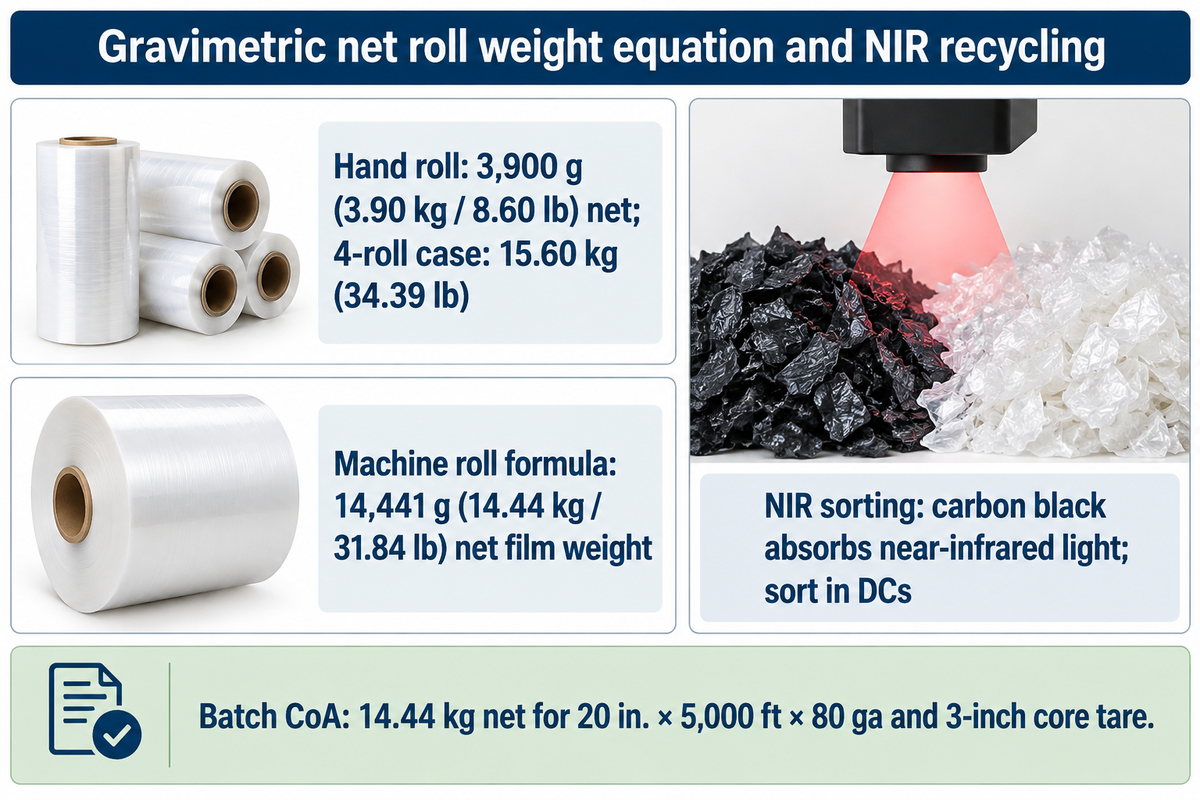
- For an 18 in. × 1,500 ft × 80 gauge (20.3 µm) hand roll at 0.918 g/cm³ LLDPE density, multiplying length, width, thickness, and density yields 3,900 g (3.90 kg / 8.60 lb) net film per roll. Across a 4-roll case, total net polyethylene equals 15.60 kg (34.39 lb) before adding the tare weight of four 3-inch paper cores.
- For a 20 in. × 5,000 ft × 80 gauge (20.3 µm) machine roll at 0.918 g/cm³ LLDPE density, the gravimetric formula yields 14,441 g (14.44 kg / 31.84 lb) net film weight. You can pair this incoming roll weigh-in with our cut-and-weigh stretch film test procedure on wrapped pallets.
Finally, sustainability and warehouse recycling managers must account for the end-of-life sorting physics of carbon-black polyethylene. The WRAP report on the recyclability of black plastic packaging and peer-reviewed NIR polymer sorting research (PMC12527066, 2025) detail how film is separated at municipal materials recovery facilities (MRFs). Automated optical sorters are programmed to sort clear plastics based on the reflection of near-infrared light. Conventional carbon-black pigment absorbs near-infrared light, thus making black film invisible to optical sorters. To remove black LLDPE from landfill, black pallet wrap should be collected and color-sorted for re-pelletizing in distribution centers.
B2B Black Stretch Film Wrap Specification & Sample Audit Checklist
When asking for sample rolls of black stretch film or reviewing a stretch film technical datasheet from UD Packaging, ensure the following six engineering parameters are included:
- Specify true opaque carbon-black masterbatch compounding under ASTM D4649 capable of blocking interior 1D/2D barcode scanning after 3 to 4 overlapping wraps.
- Specify 80-gauge (20.3 µm) or 100-gauge (25.4 µm) film for 200% powered pre-stretch carriages, and avoid 63-gauge (16.0 µm) film on high-contrast cartons.
- Request 5-layer cast-co-extruded black film with differential cling on one side to prevent black pallets from sticking together inside trailers.
- Confirm that outbound lines apply high-tack hot-melt GS1-128 SSCC labels 400 mm to 800 mm above the pallet base, and verify that turntable wrappers use polarized retro-reflective or ultrasonic load-height sensors.
- Do not allow standard unstabilized black stretch wrap to be stored outdoors. Also, require TiO2 opaque white UVI stretch film or 5-sided UV poly hoods when pallets are left in outdoor yards.
- Require batch Certificates of Analysis listing net polyethylene weight (such as 14.44 kg net for 20 in. × 5,000 ft × 80 ga at 0.918 g/cm³) and 3-inch core tare weight.
Frequently Asked Questions
What is the difference between opaque black stretch film wrap and dark-tinted colored stretch wrap?
Under ASTM D4649-20(2025), opaque black stretch film wrap uses concentrated carbon-black masterbatch to block visible light transmission and prevent optical barcode scanners from reading interior carton labels after 3 to 4 overlapping layers. Dark-tinted colored stretch wrap remains semi-translucent for warehouse staging lane identification, allowing operators and handheld laser scanners to read carton markings directly through the stretched polyethylene web.
How many wraps of 80-gauge black stretch film are needed to completely hide high-contrast carton logos?
At a 200% machine pre-stretch ratio, an 80-gauge (20.3-micron) black stretch film thins down to roughly 11.7 microns per single unwound layer. Because local neck-down tension peaks around 90-degree pallet edges, operators must apply 3 to 4 overlapping wraps (building 35.1 to 46.8 microns of total stacked film thickness) with 50% layer overlap to completely hide high-contrast white cartons and dark printed brand logos.
Why do automated turntable stretch wrappers fail to detect pallets wrapped in black stretch film?
Standard automated turntable stretch wrappers use 850 nm to 940 nm diffuse infrared photoeyes that rely on emitted infrared light bouncing back off the palletized load. Carbon black film absorbs infrared and doesn’t reflect it, so the film carriage overshoots the pallet and continues traveling past it, unless it’s upgraded to a polarized retro-reflective photoeye, a laser time-of-flight sensor, or an ultrasonic height sensor.
Can black stretch wrap be recycled in standard warehouse polyethylene film balers?
Black low-density polyethylene (LLDPE) is mechanically recyclable into dark pallets, plastic lumber, or trash bags, however, warehouses must bale black LLDPE film wraps separately from clear film because carbon black absorbs near-infrared (NIR) beams for optical sorting.
Should shippers choose black or opaque white stretch film for pallets staged in sunlit outdoor yards?
Standard black wrap absorbs solar radiation—raising internal pallet temperatures, accelerating condensation sweating, and softening carton adhesives—and degrades rapidly outdoors unless custom-formulated with UV stabilizers.
Does black stretch film wrap leave black pigment residue on corrugated boxes or white totes?
No, 5-layer co-extruded black stretch film prevents rub-off of carbon black from the masterbatch onto corrugated cartons and totes by encapsulating the masterbatch between the structural layers.
How should receiving dock operators safely unwrap pallets concealed in opaque black stretch film?
Opaque film wraps hide shift and tension in cartons and strapping during transit. This requires receiving personnel to first look in all four corners for leaning pallets. Operators should then pierce the upper corner with a concealed-blade stretch film cutter and remove the top half of the film first, leaving the bottom wrap intact while upper tiers are unloaded.
References & Sources
- ASTM International ASTM D4649-20(2025) Standard Guide for Selection and Use of Stretch Wrap Films (Section 5.3.7 Optical Classes & Table 3 Tolerances)
- ASTM International / iTeh Standards ASTM D8314-20 Standard Guide for Performance Testing of Applied Stretch Films and Stretch Wrapping
- National Library of Medicine / PMC (Tkaczyk et al., Sensors 2025) Assessment of 15-23 Micron LLDPE Stretch Film Pre-Stretch (150%-300%) and Containment Forces (PMC12656129)
- National Library of Medicine / PMC (Hu et al., 2025) Near-Infrared (NIR) Spectroscopy Sorting Limits on Carbon-Black Pigmented Polymers (PMC12527066)
- U.S. Occupational Safety and Health Administration (OSHA) 29 CFR 1910.147 The Control of Hazardous Energy (Lockout/Tagout for Machine Servicing and Unjamming)
- GS1 Global Standards GS1 Logistic Label Guideline: Pallet Label Placement (400–800 mm Height & 50 mm Edge Clearance)
- GS1 UK Knowledge Hub Where Should Pallet Labels Be Placed? Picket Fence Orientation and Exterior Wrap Rules
- WRAP (Waste and Resources Action Programme) Recyclability of Black Plastic Packaging: Carbon Black Pigment Absorption in NIR Optical Sorting
- United States Patent and Trademark Office US20220388285A1 Multilayer Polyethylene Stretch Film Formulations (0.918 g/cm³ LLDPE Density)
- United States Patent and Trademark Office US20120219814A1 Multilayer Co-Extruded Stretch Film Cling Layer Control
- Thong Guan Industries Costly Snag to Black Opaque Stretch Wrap: 17-23 Micron Thinning at 200% Stretch
- AAA Polymer – Pallet Wrap vs. Shrink Wrap for Outdoor Storage: UV Stabilization and Moisture Limits
- Doverco – Stretch Film 101: Cast vs. Blown Extrusion, Cling Types, and Pre-Stretch Mechanics
- SourceBySpec – Stretch Film Technical Encyclopedia: Gauge to Micron and Mil Conversion Formulas
- Neway Packaging – Colored and Opaque Stretch Film Uses: Solar Reflection in White vs. Black Film
- BASCO USA – 80-Gauge (20.3-Micron) Blown Black Hand Stretch Wrap Technical Specifications
- Lantech – Q-300 Semi-Automatic Turntable Stretch Wrapper Pre-Stretch and Photoeye Specifications
- OLFA Industrial Safety – Eliminate Pallet Unwrapping and Cardboard Handling Hazards on Receiving Docks
- Packaging Hero – Shrink Film vs. Stretch Film: Elastic LLDPE Containment vs. Thermal Polyolefin Hoods
- BestyPack Advantages and Industrial Uses of Black Stretch Film for Cargo Concealment
- GPack USA 18 in. × 1,000 ft 85-Gauge Black Hand Stretch Film (4 Rolls/Case) Specifications
- U.S. Packaging & Wrapping 3-Inch Core Opaque Hand Stretch Film Roll Dimensions and Application Specs
- r/IndustrialMaintenance Field Reports Turntable Wrapper Photoeye Troubleshooting on Dark and Black Pallet Loads