Get in touch with UD Packaging Company

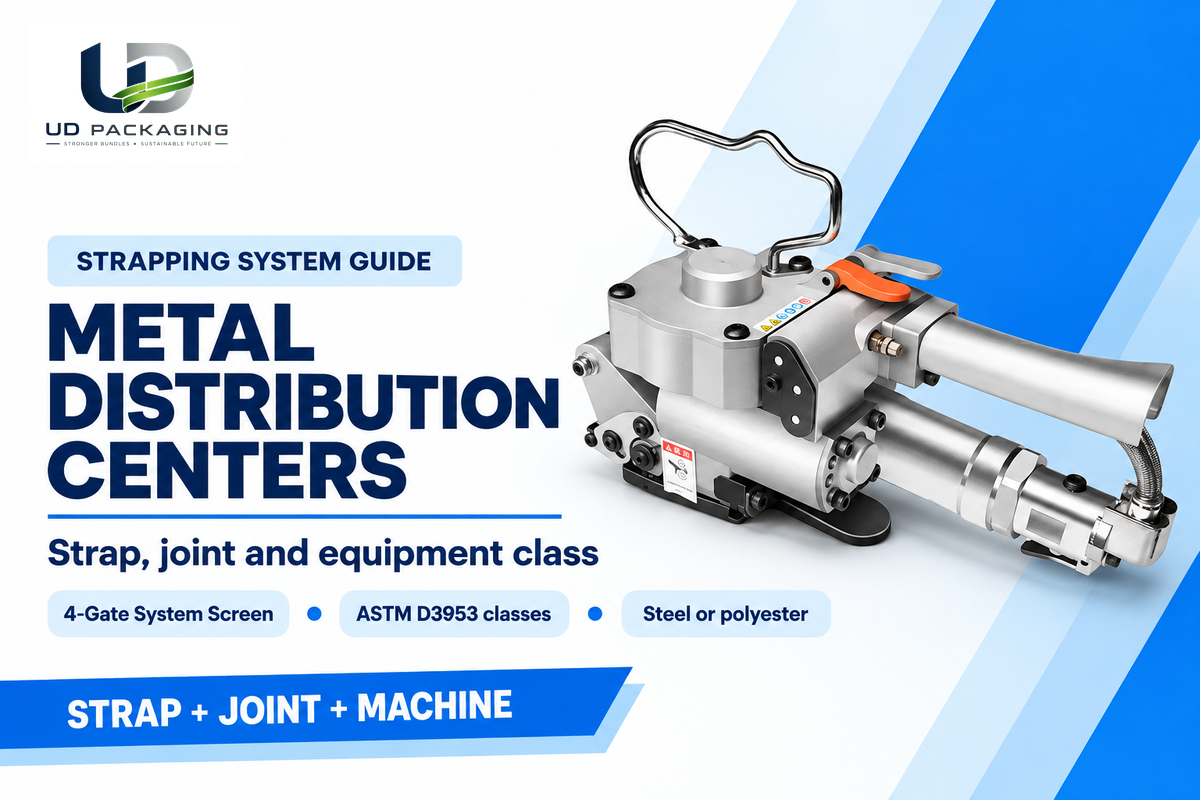
The question “What types of strapping systems are used in high-volume metal distribution centers?” has a three-part answer: steel or polyester strap, a seal or sealless joint, and a hand tool, semi-automatic or an automatic inline machine matched to the load.
Four qualities sort products into one combination of parts: edge, load, rhythm and form. UD Packaging supplies PET and plastic strapping tools and machines, so the steel strap and steel coil lines that metal centers also run come from other makers. This guide shows how to screen and specify them; it does not offer them. Updated November 2026.
Strapping Systems in Metal Distribution Centers: Strap, Joint and Equipment Class
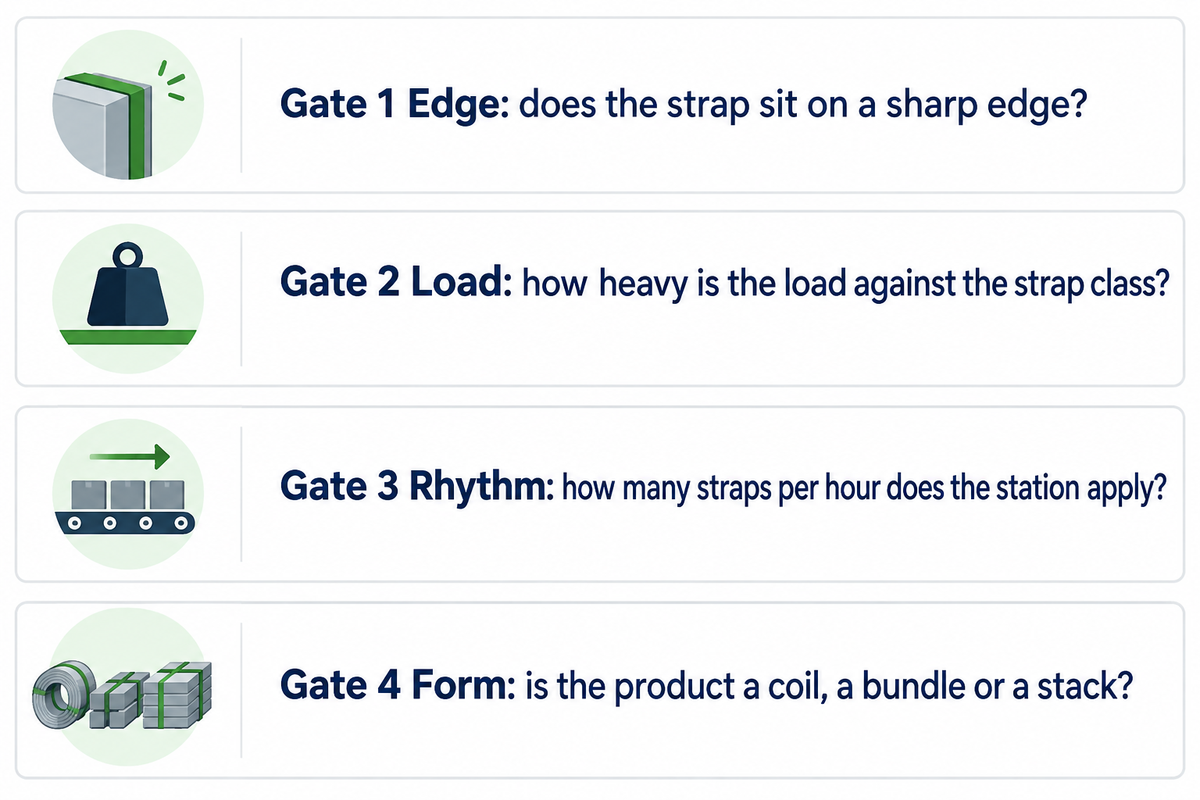
At a metal distribution center a strapping system is made up of three parts which are chosen together: the strap, the joint which closes it, and the tool or machine which tensions and joins it. Changing one part changes what the other two can run.
Four standards concern the strap and the joint. ASTM D3953-15(2022) covers flat steel strapping and seals and excludes specialty strapping and strapping made from alloy metals. ASTM D3950-23 covers nonmetallic strapping and its joining methods. ISO 24259:2022, edition 1 of May 2022, specifies the classification, dimensions, shape, technical requirements, inspection rules and testing methods for steel strapping used in packaging. ASTM D4675-14a(2022) is the guide for selecting a strapping material. In the packaging industry these documents define classes, sizes and tests; none of them picks a strap for a given load, and the four gates below do that job.
What is a strapping system and how does it work?
In a strapping system, the strapping process occurs in four steps. The strap is routed around the load, pulled to the working tension, joined to a seal or sealless joint that holds the strap ends, and cut from the coil. The three equipment classes differ in how many of those steps a person performs.
| Equipment class | Who does the work | What limits it |
|---|---|---|
| Hand tool station | The operator feeds, tensions and seals the strap with manual strapping tools | Operator minutes per strap |
| Semi-automatic machine | The operator positions the package; the machine feeds, tensions and joins the strap | Load size against the arch opening |
| Automatic inline machine | The line delivers the product and a sensor starts the cycle | Power, air, footprint and conveyor hand-off |
The first class is covered in detail by the guide to tensioners, sealers and combination tools. The 4-Gate System Screen puts a product through four questions in a fixed order and ends with a strap plan and an equipment class.
| Gate | Question | Measurable test | Decision it makes |
|---|---|---|---|
| 1. Edge | Does the strap sit on a sharp edge? | Check each strap contact point for a cut or rolled edge | Unprotected sharp edge: steel strap. Otherwise steel or polyester |
| 2. Load | How heavy is the load against the strap class? | Mass against minimum break strength; coils that individually or grouped together weigh 2,268 kg (5,000 pounds) or more also fall under 49 CFR 393.120 on the truck | Strap class, width and thickness |
| 3. Rhythm | How many straps per hour does the station apply? | Bundles per shift × straps per bundle ÷ hours per shift | Hand tool, semi-automatic or automatic inline machine |
| 4. Form | Is the product a coil, a bundle or a stack? | Match it to a row of the Load-Form System Matrix | Strap path and machine type |
Suppose a 2,500 kg slit coil with cut edges ships on a flatbed, and the line straps 40 such coils per shift at 4 straps each. Edge: the cut edges are sharp, so steel strap. Load: 2,500 kg is above 2,268 kg, so 49 CFR 393.120 also governs the truck. Rhythm: 40 × 4 = 160 straps per shift, or 20 an hour over 8 hours (160 ÷ 8). Form: a coil, so the strap runs through the eye and around the outside.
⚠️ Common mistake: buying the machine first. The load fixes strap class and joint, and a machine built for one strap width and seal cannot take another, so name both before asking for machine quotes.
Types of Strapping by Load Form: Coils, Pipe Bundles, Bar Packs and Sheet Stacks
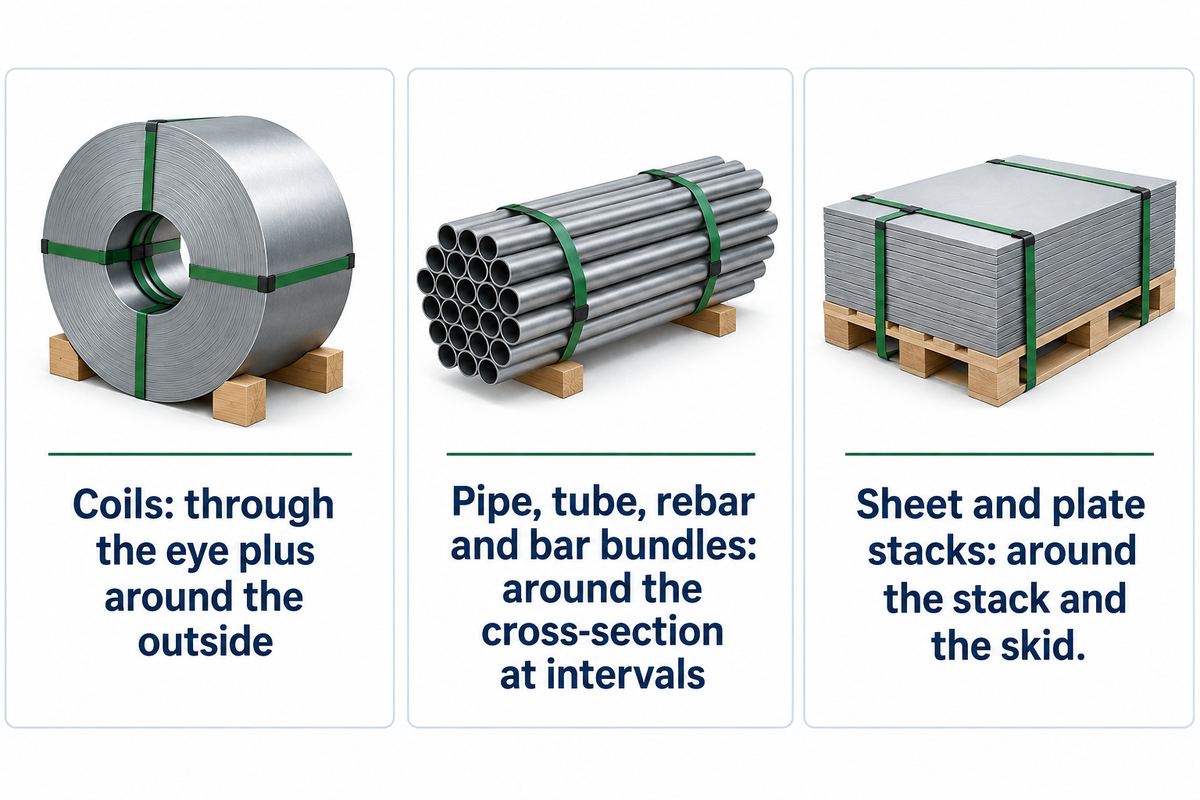
Each load form calls for its own type of strapping and path. Steel coils take straps through the eye and around the outside. Pipe and bar bundles take straps around the whole cross-section. Sheet and plate stacks take straps around the stack and the skid, with edge protectors on the corners.
Truck securement for the transportation of goods is a separate rule set. 49 CFR 393.120 applies to metal coils that, individually or grouped, weigh 2,268 kg (5,000 pounds) or more, and lighter coils follow 49 CFR 393.100 to 393.114. The clause sets rules for tiedowns, blocking and bracing on the vehicle, which is a different task from binding a coil or a bundle in the center.
“Attaching tiedowns diagonally through the eye of a coil to form an X-pattern when viewed from above the vehicle is prohibited.”
This ban covers coils loaded with the eyes crosswise on a flatbed, sided vehicle or container with anchor points. Tiedowns through the eye there make an angle of no more than 45 degrees with the floor when practicable, and nailed blocking or cleats cannot be the sole means of holding coil timbers or chocks.
The Load-Form System Matrix reads off the strap path, strap, joint, equipment class and edge protection for nine products. Packaging needs follow the shape. A bundle strap holds items together as one unit. A rebar bundle, which belongs with building materials and is irregularly shaped, takes its cross-section strap at several points along the length; the supplier’s drawing fixes the exact positions.
| Product | Strap path | Strap | Joint | Equipment class | Edge protection |
|---|---|---|---|---|---|
| Hot-rolled coil | Through the eye plus around the outside | Steel, heavy-duty class | Notched seal or sealless | Automatic inline coil strapper; hand tool for low counts | Protectors under the strap at the outer edges |
| Slit coil | Through the eye plus around the outside | Steel | Notched seal or sealless | Semi-automatic or automatic inline | Protectors on both coil edges |
| Aluminum coil | Through the eye plus around the outside | Polyester with protectors, or steel | ASTM D3950 method for polyester; seal for steel | Semi-automatic or hand tool | Protectors required with polyester |
| Pipe bundle | Around the cross-section at intervals along the length | Steel for heavy pipe; polyester for light bundles with protected edges | Notched seal, or ASTM D3950 method for polyester | Automatic bundle strapper on a pipe line; hand tool | Protectors at the bundle corners |
| Tube bundle | Around the cross-section at intervals along the length | Polyester or steel; tension set low enough not to crush the wall | Seal, or ASTM D3950 method for polyester | Semi-automatic bundle strapper or hand tool | Protectors at the bundle corners |
| Rebar bundle | Around the cross-section at several points | Steel | Notched seal or sealless | Hand tool or automatic bundle strapper | Not applicable |
| Flat bar pack | Around the pack at intervals | Steel | Notched seal or sealless | Hand tool or semi-automatic | Protectors at the bar edges |
| Sheet stack | Around the stack and the skid | Steel on cut edges; polyester with protectors | Notched seal, or ASTM D3950 method for polyester | Hand tool or semi-automatic | Protectors at every edge crossing |
| Plate stack | Around the stack and the skid | Steel, heavy-duty class | Notched seal or sealless | Hand tool or semi-automatic | Protectors at every corner |
Steel or Polyester Strap on Sharp, Heavy Metal: Decision Rules for the Strapping Material
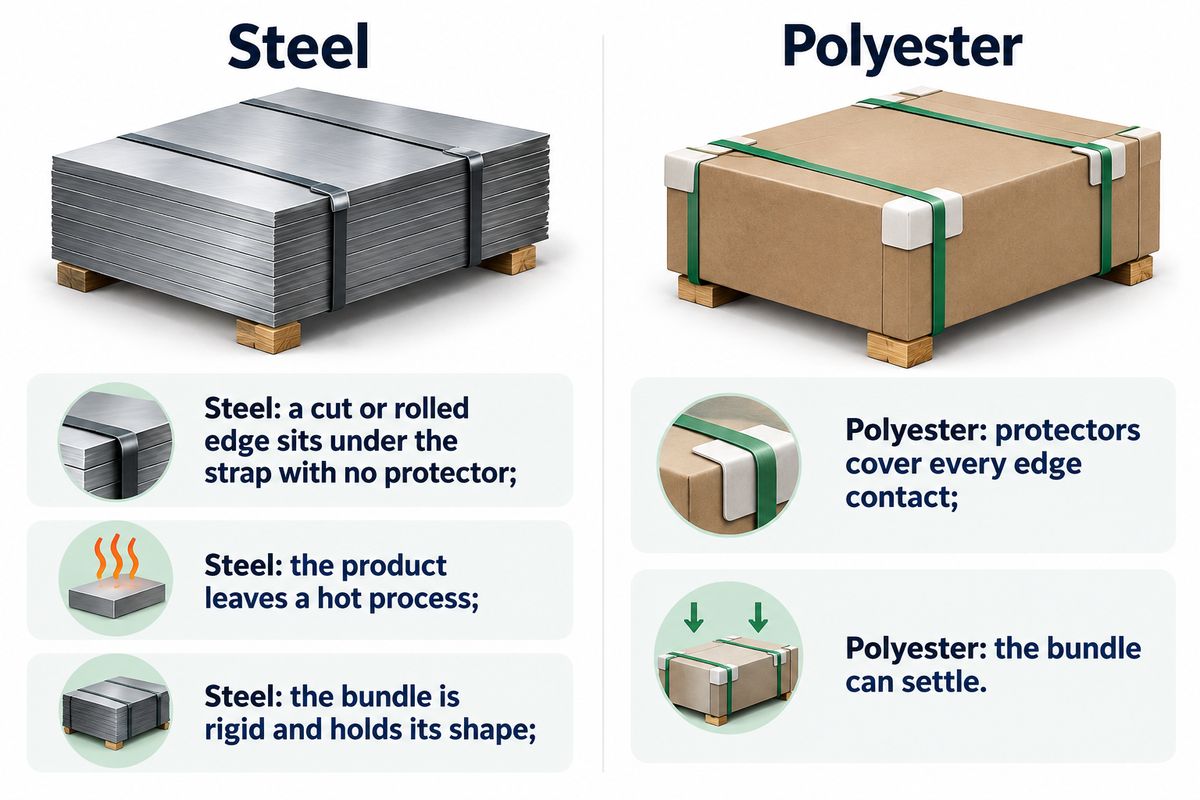
On exposed sharp edges, heavy loads, hot product and rigid bundles, steel strap stays the default; polyester strap suits protected edges, loads that settle in transit and surfaces that must stay unmarked. No standard treats polyester as ordinary practice on metal, and ASTM D4675 gives no instruction for a particular load, so the polyester options here follow strap makers’ guidance and should be confirmed by a trial on the actual bundle. Packaging Digest’s industrial packaging guide considers heavy pallet loads and machinery and construction materials to be what steel strapping is used to secure in industrial use.
Stretch divides the strapping materials. One U.S. strap maker’s public guide rates a rigid strap like steel at 1 percent elongation, polyester at 10 to 12 percent and polypropylene strapping at 18 to 34 percent. The guide measures them in the working range of 40 to 60 percent of break strength. Of the nonmetallic straps like PET and polypropylene, the same guide says polyester keeps the highest retained tension when properly applied. A load that settles in transit slackens a steel strap that can’t stretch, while polyester strapping offers a strap that follows the load and keeps its pull.
Those figures are working-range values, and the limits in ASTM D3953-15(2022) are measured at break, so the two sets are not directly comparable. The standard limits steel strap elongation at break to 0.5 to 4.0 percent for regular duty and 0.5 to 8.0 percent for regular-duty high-strength strap. Heavy-duty strap is limited to 5.0 to 12 percent under 0.031 inch (0.79 mm) and 6.5 to 12 percent at 0.031 inch and thicker.
| Test | Steel strap when | Polyester strap when |
|---|---|---|
| Edge | A cut or rolled edge sits under the strap with no protector | Protectors cover every edge contact; one maker notes that sharp edges on metal sheets and I-beams can cut through polyester in transit |
| Temperature | The product leaves a hot process | The product is at room temperature when strapped |
| Load settling | The bundle is rigid and holds its shape; steel’s working-range elongation is 1 percent | The bundle can settle; the 10 to 12 percent working-range elongation lets the strap follow it |
| Surface | A surface mark or rust stain does not matter before further processing | A finished surface must stay unmarked, and polyester does not rust |
| Tool | The tool or machine tensions and seals steel strap | The tool tensions and joins polyester strap |
Steel stays necessary at an exposed sharp edge, on hot product and on any bundle that must not stretch. Two opposite mistakes recur: considering all metal as a steel-strap job, which adds recoil and surface marks where protected polyester would hold. Treating polyester as the safe default leaves a strap to be cut at an unprotected corner. A polyester rule, carried over from food and beverage pallets, fails on metal, because a cut sheet edge is sharper than a carton corner. The choice between polypropylene or polyester follows the same edge and load tests, and environmental conditions in storage and transportation, such as a wet yard, feed into the surface test.
For a more complete comparison that includes the other strap materials, see the five strap materials compared by joint efficiency; comparing the whole load system for PET and steel approaches the same choice from a load perspective. Centers that protect their products with corner protectors can size them with matching edge protectors to strap width.
Strap Size and Joint Strength: What the Standards Say Before You Order
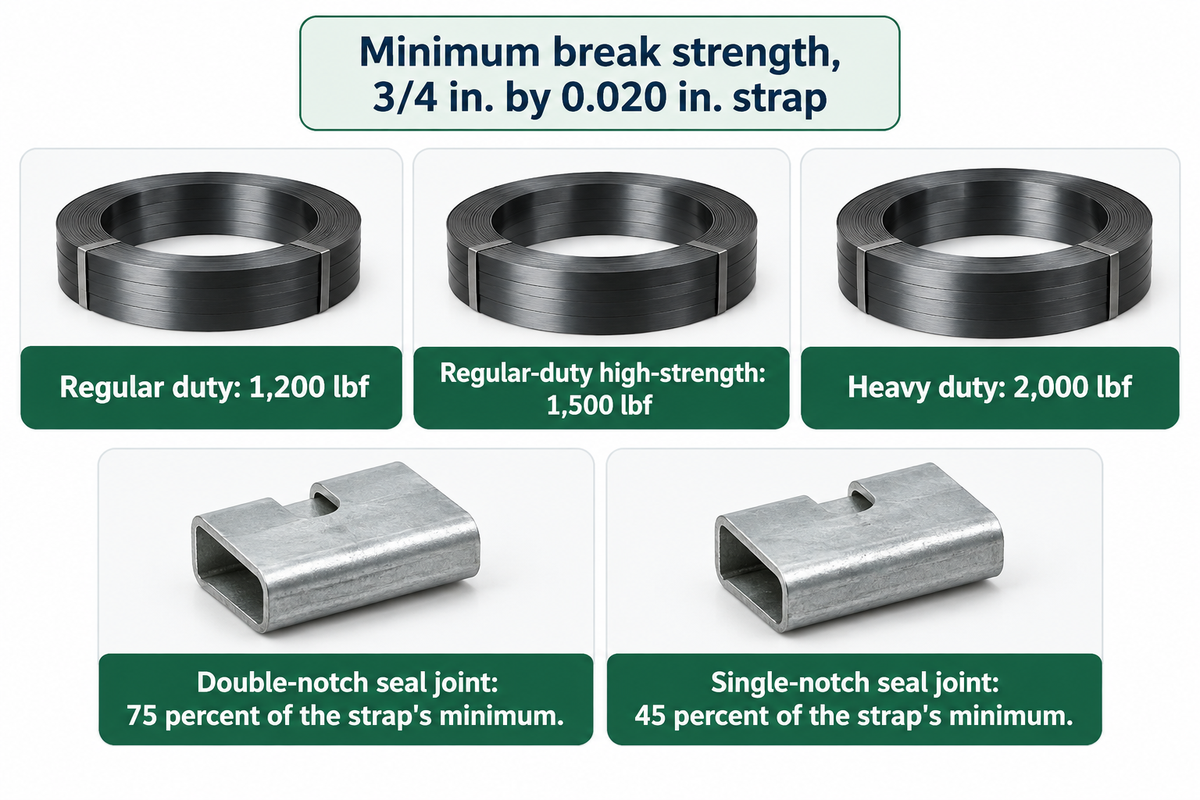
ASTM D3953-15(2022) is the U.S. specification for flat steel strapping and seals. Its minimum break strength for 3/4 in. by 0.020 in. strap is 1,200 lbf for regular duty, 1,500 lbf for regular-duty high-strength and 2,000 lbf for heavy duty. The seal joint, not the strap, usually sets the working limit.
| Class and thickness | Minimum break strength | Double-notch joint (75 percent) | Single-notch joint (45 percent) |
|---|---|---|---|
| Regular duty, 0.020 in. | 1,200 lbf (5,340 N) | 900 lbf (1,200 × 0.75) | 540 lbf (1,200 × 0.45) |
| Regular duty, 0.035 in. | 2,100 lbf (9,340 N) | 1,575 lbf (2,100 × 0.75) | 945 lbf (2,100 × 0.45) |
| High-strength, 0.016 in. | 1,200 lbf (5,340 N) | 900 lbf (1,200 × 0.75) | 540 lbf (1,200 × 0.45) |
| High-strength, 0.020 in. | 1,500 lbf (6,672 N) | 1,125 lbf (1,500 × 0.75) | 675 lbf (1,500 × 0.45) |
| Heavy duty, 0.020 in. | 2,000 lbf (8,896 N) | 1,500 lbf (2,000 × 0.75) | 900 lbf (2,000 × 0.45) |
These are the minimums the ASTM classes require; makers list average break strength, which is higher. A high-strength strap reaches 1,200 lbf at 0.016 in. where regular duty needs 0.020 in., and the heavy-duty table rises to 4,050 lbf in its thickest 3/4 in. column.
A seal is what lets a tool secure straps under tension. The importance of strapping joint strength shows in the notched seal rule: the standard requires 75 percent of the strap’s minimum break strength with a double notch and 45 percent with a single notch. A single-notch joint need only reach 45 percent of the strap’s minimum break strength, less than half of what the strap holds, and the strap’s maximum strength stays out of reach until the joint matches it. Whatever amount of tension the tool is set to has to stay below the joint figure, which is why the quote should state tension as a share of break strength. The guide to how to test strapping joint strength treats the joint as the weak link, and measuring strap tension covers tension as a share of break strength.
What is the difference between hand grade and machine grade strapping?
The difference is straightness. One strap maker’s guide says camber, a sideways curve in strap, is not a large factor in manual strapping. But, in machine grade strapping, it must be fairly camber free to go through the machine’s arch. ASTM D3953 lists straightness (camber, coil set, and spiral twist) among the properties it controls for steel strapping. On the order line, mention whether the coil will run on a hand tool or in an arch machine.
Makers sell high tensile strapping, a term that ASTM D3953 does not use for its classes (regular duty, regular-duty high-strength and heavy duty). Ask which class a high tensile strength claim meets before comparing it with another quote.
Suppose an order line reads 3/4 in. by 0.023 in., regular duty. Table 1 of the standard gives 1,380 lbf; a double-notch seal must then reach 1,035 lbf (1,380 × 0.75) and a single-notch seal 621 lbf (1,380 × 0.45). Write the tension setting as a share of the 1,380 lbf, and keep it under the seal figure.
Strapping Machine or Hand Tool: Straps per Hour and the Case for Automatic Strapping
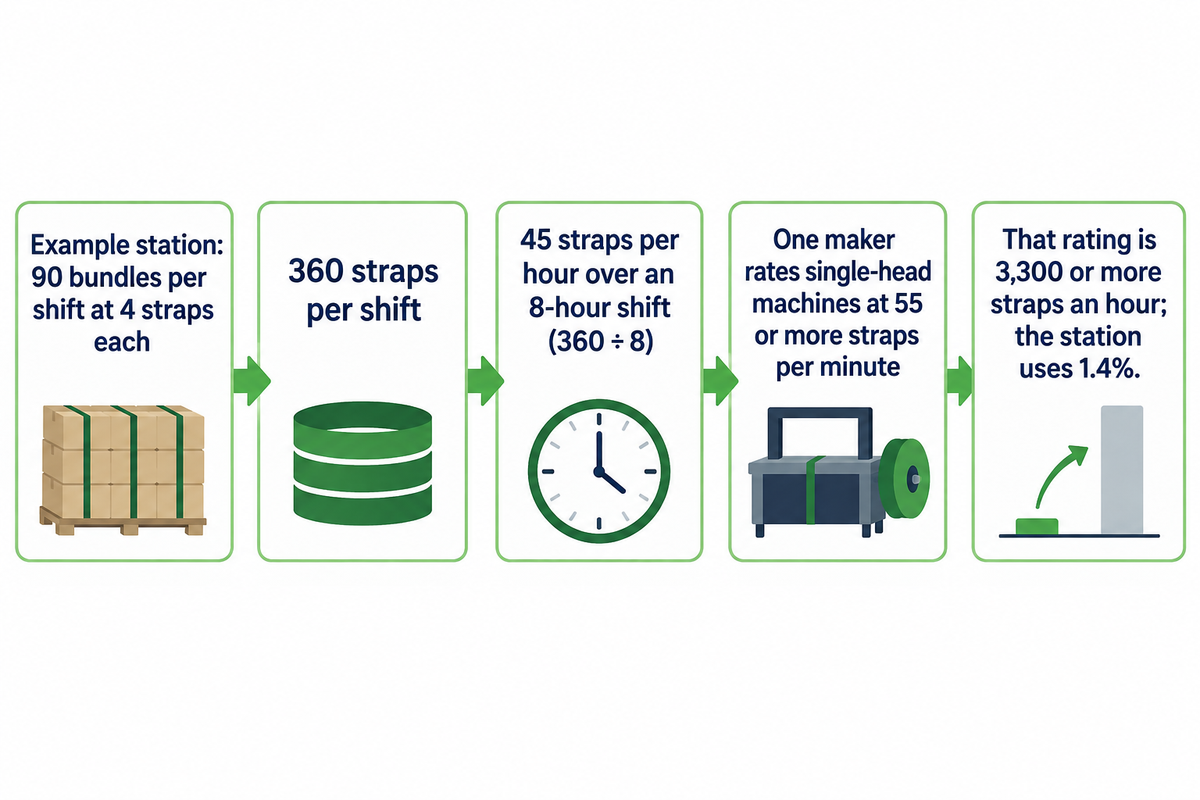
Count straps, not bundles: To illustrate, a station that handles 90 bundles per shift at 4 straps each processes 360 straps, or 45 per hour over an 8-hour shift (360 ÷ 8). That straps per hour, not the count of products or packages, determines the equipment class.
The different types of strapping machines differ in who does the strapping and sealing. At a hand tool station, the operator must feed the strap around the package, then tension and seal it. Semi-automatic machines suit the small to medium-sized loads that one operator can position; the operator still positions the package and triggers each cycle with a foot pedal or button. Fully automatic models take the load from the line and run the strapping cycle without an operator at the machine.
Rated speeds show how far apart the classes sit. One plastic-strap machine maker rates its automatic machines at 55 or more straps per minute on single-head models and above 110 on dual-head models, and an equipment supplier’s blog puts the max for automatic systems at 65 straps per minute, a figure between single-head and dual-head ratings. Hence a rated speed depends on the maker and the number of heads.
| Rating source | Straps per minute | Straps per hour (× 60) |
|---|---|---|
| Single-head automatic, maker rating | 55 or more | 3,300 or more |
| Dual-head automatic, maker rating | More than 110 | More than 6,600 |
| Automatic systems, distributor guide maximum | Up to 65 | Up to 3,900 |
These speeds are ratings from the machine makers. Straps per hour in a center also fall with how fast loads reach the strapping station. Against the 3,300 straps an hour of one maker’s single-head plastic-strap machine, the 45 straps an hour above is 1.4% (45 ÷ 3,300). The count of straps per bundle matters more than the count of bundles.
| Straps per bundle | Straps per shift (90 × n) | Straps per hour (÷ 8) | Share of 3,300 an hour |
|---|---|---|---|
| 2 | 180 | 22.5 | 0.7 percent |
| 4 | 360 | 45 | 1.4 percent |
| 8 | 720 | 90 | 2.7 percent |
Even at 8 straps per bundle the machine’s speed is mostly unused, so count alone doesn’t justify automatic strapping. The case rests on a slitting, cut-to-length or tube line that discharges product at its own pace, where strapping machines are essential and operator minutes per strap determine the saving.
For the machine classes in general, see strapping machine types, safety and buying guide; choosing a polyester strapping tool covers the battery tools used for station work. The semi-automatic machines in between suit a station whose count is too high for hand tools but loads still need an operator to place them.
Automate the Strapping Line: Utilities, Footprint and Conveyor Integration
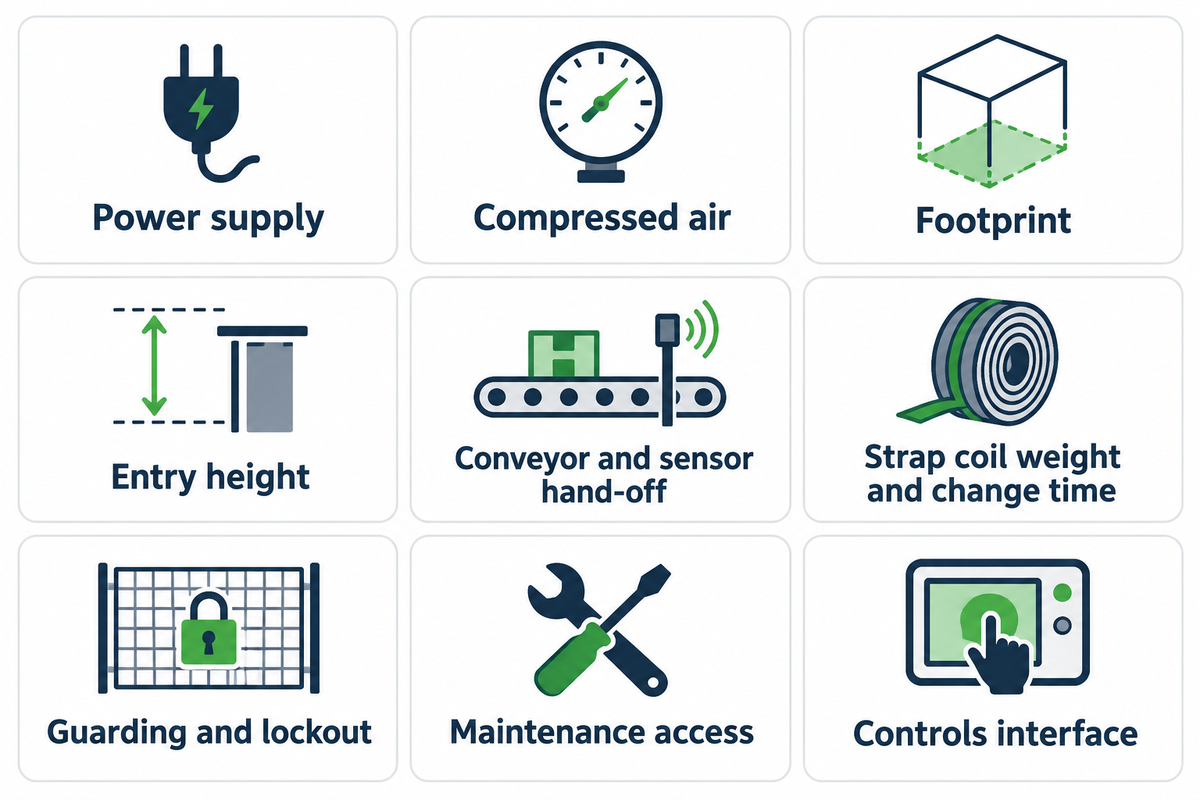
An automatic strapping machine has to fit the line’s power, compressed air, floor space, product length and conveyor hand-off, and the time to change a strap coil determines how long the line stops. Automated strapping machines move the cost from operator minutes to these interfaces, so automation is specified before prices are compared.
Fully automatic machines sit at the end of a slitting, cut-to-length or tube line, which is the metal center’s packaging line. A conveyor brings each load to a stop position, and a sensor tells the machine the load is there. Both hand-offs require a signal wire to the line controller and a stop position that’s agreed to by the machine and the line. Projects that are approved solely on price stall on three points: the product length the machine can’t take, power or air the plant can’t provide, and a strap coil change which stops the line.
| Requirement | What the line must supply or allow | Question that closes it |
|---|---|---|
| Power supply | Voltage, phase and kW available at the machine position | Which supply does the model need, and how far is the nearest feeder? |
| Compressed air | Pressure and flow at the machine position, if the model is pneumatic | What pressure and flow does the model draw at full cycle rate? |
| Footprint | Floor length and width beside the conveyor, plus a service aisle | Does the footprint include the strap dispenser and the control cabinet? |
| Entry height | Clear opening above the conveyor for the tallest bundle or coil | Is the arch opening larger than the tallest product? |
| Conveyor and sensor hand-off | A stop position and a sensor signal at the strapping point | Who supplies the stop sensor and the signal wiring? |
| Strap coil weight and change time | Weight of one strap coil and minutes to load and splice a new one | How many bundles does one coil cover (strap length on the coil ÷ strap used per bundle)? |
| Guarding and lockout | Guards on moving parts during production; lockout steps for jam clearing | Where is the isolation point, and where does the operator stand to clear a jam? |
| Maintenance access | Reach to the cutter, feed and sealing head | Can a technician reach the head without moving the machine off the line? |
| Controls interface | Start, stop and fault signals between machine and line controller | Which signals does the line controller exchange with the machine? |
The OSHA lockout/tagout eTool places normal production under machine guarding standards, 29 CFR 1910.212 and 1910.219, and servicing and maintenance under the lockout standard, 29 CFR 1910.147. The guide to mapping strapping machine tasks before controls treats the guarding and lockout side across the packaging processes on the line.
Cost per Bundle: Strapping Tool and Strapping Machine Price Bands
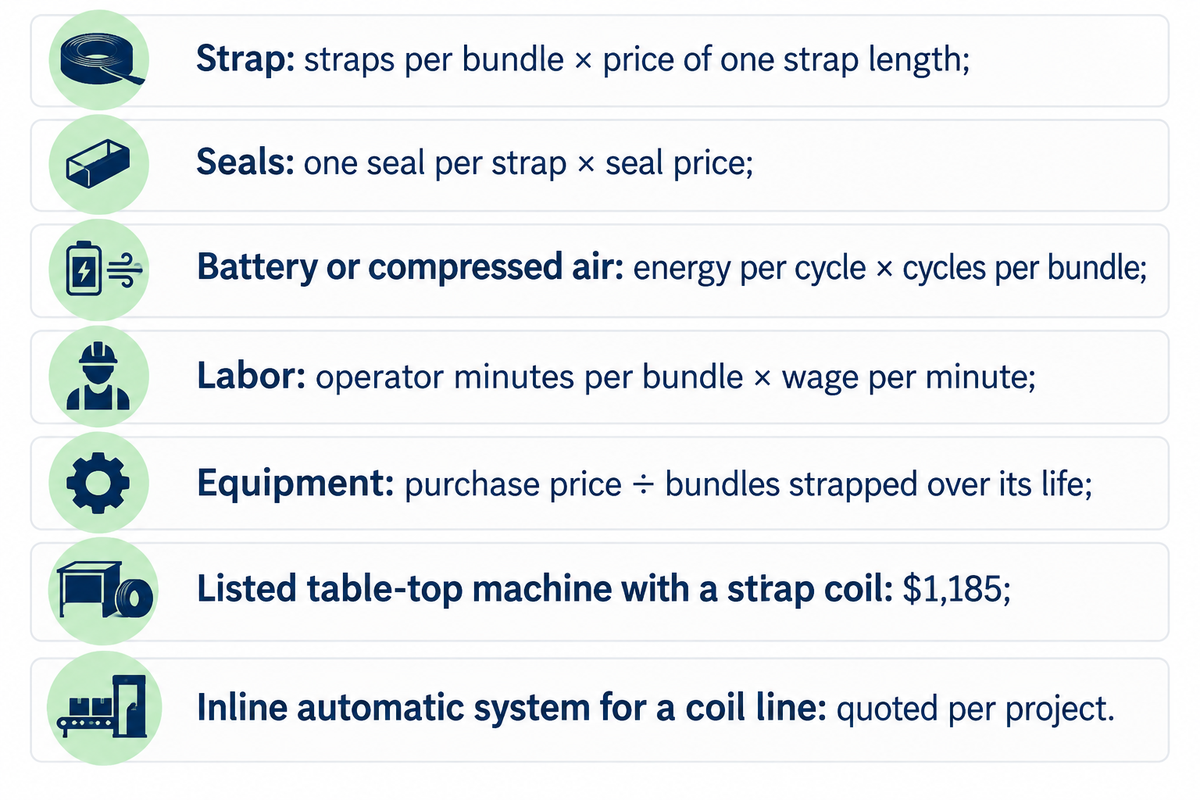
Table-top semi-automatic strapping machines and sealless steel strapping tools are priced in the low thousands of dollars on three price lists from 18 November 2026. Inline automatic systems for coil lines are quoted per project. The cost per bundle decides which class is the cost-effective one at a given volume.
| Equipment | Listed price | What the listing says |
|---|---|---|
| Table-top semi-automatic machine with a polypropylene strap coil | $1,185 (list price $1,198) | Reseller listing; the price includes the strap coil |
| Semi-automatic open-cabinet strapping machine | $1,060 | Reseller price list |
| Semi-automatic table-top paper and plastic banding machine | $2,790 | Reseller price list |
| Sealless steel strapping tool for 1/2 to 3/4 in. strap, tension up to 1,400 lbs | $1,850 | Reseller list; the price is for the tool only |
| Sealless steel strapping tool for 3/4 in. strap, tension up to 1,300 lbs | $3,062 | Reseller list; the price is for the tool only |
| Reconditioned pneumatic tensioner for 3/4 to 1-1/4 in. regular-duty and high-tensile strap | $2,000 | Reseller list; rebuilt tool |
| Inline automatic system for a coil line | Quoted per project | Price comes with the maker’s quote for the line |
These are retail listing prices from three resellers for table-top machines and tools, and prices move, so a dated quote is the number to carry into a budget request. Strapping equipment is the smaller part of the cost: strap and seals are packaging materials bought for every bundle, and downtime and operator minutes add to that. A budget owner who compares a tool price to a machine price alone is comparing the smaller part. Name the ASTM D3953 class and size on the strap line of the quote for steel strap, because the class sets the minimum break strength.
How much does a strapping machine cost?
The semi-automatic machines in the table are listed at $1,060 to $2,790, and one machine bundled with a strap coil at $1,185. These are table-top machines for plastic strap; machines sized for coils, bar packs and plate stacks, and inline automatic systems for coil lines, are quoted per project, so the budget figure comes from a written quote that names the strap width, the joint and the line interface.
The cost per bundle adds five lines, each with their inputs named:
- Strap: straps per bundle × price of one strap length.
- Seals: one seal per strap × seal price (Not applicable for sealless joints).
- Battery or compressed air: energy per cycle × cycles per bundle.
- Labor: operator minutes per bundle × wage per minute.
- Equipment: purchase price ÷ bundles strapped over its life.
Suppose the $1,185 machine above strapped 1,000 bundles over its life: 1,185 ÷ 1,000 = $1.19 per bundle for the equipment line. At 10,000 bundles the same line is 1,185 ÷ 10,000 = $0.12. Volume moves the equipment line by a factor of ten, so the class that’s cheapest at 1,000 bundles may not be the cheapest at 10,000.
The labor line is the one automation attacks. If a hand station needs m operator minutes per bundle and a machine needs n, the saving per bundle is (m-n) × wage per minute. The bundles needed to pay back the price difference are that amount ÷ that saving. A machine that saves little labor per bundle needs a long run of bundles before it’s the cheaper class.
Safety at the Strapping Station: Recoil, Edges and Strap Removal
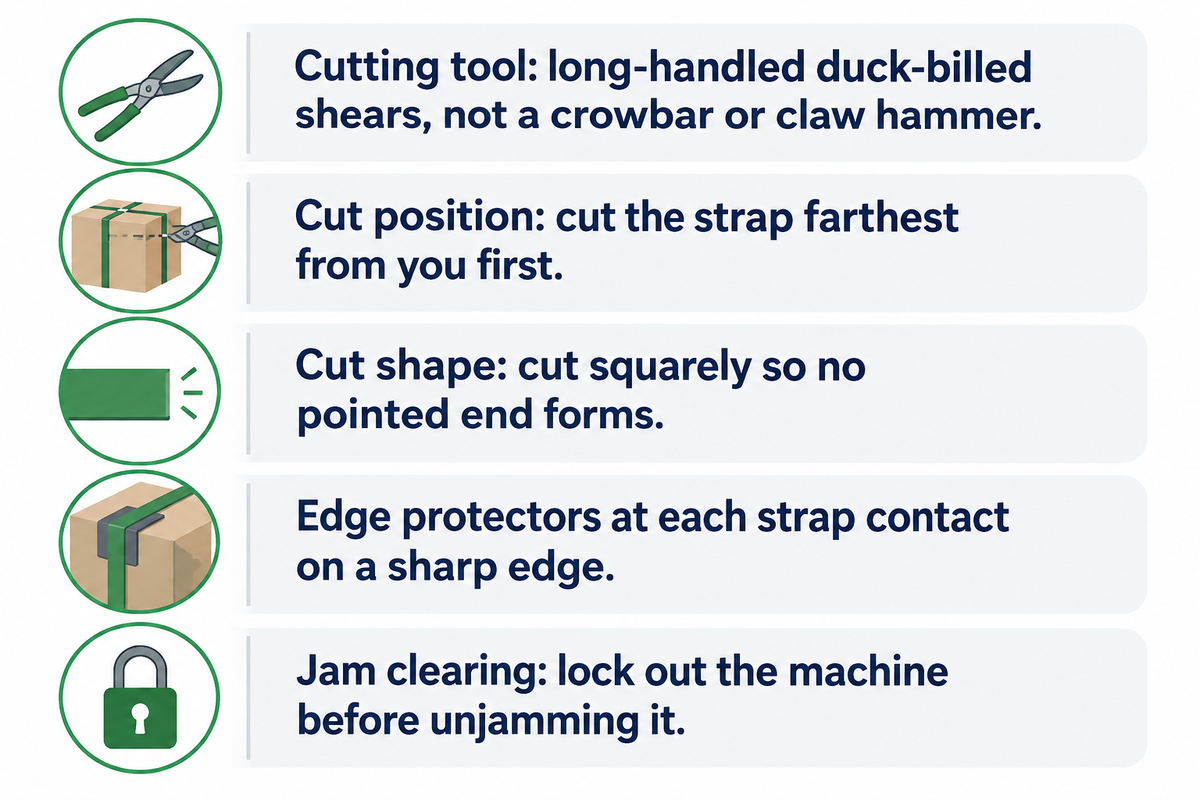
Cut steel strap recoils. The five controls that come first are the cutting tool, the cut position, the cut shape, edge protectors, and a lockout step before anyone clears a machine jam; protective equipment comes after those controls.
The Oregon Department of Transportation’s steel strapping tailgate talk sets the cut order for a load with several straps.
“If there are several straps, cut the one farthest away from you first.”
Before cutting the strap, pick the tool and the position: the same talk names duck-billed shears with long handles as the usual tool and rules out a crowbar or claw hammer. It wants cuts made squarely, so the strap ends don’t create sharp points. OSHA’s personal protective equipment overview places protective equipment after engineering, work practice and administrative controls. Employers provide this equipment when the above controls aren’t feasible or don’t provide adequate protection. The list is located in the guide to protective equipment by touchpoint.
| Control | What to do | Where it comes from |
|---|---|---|
| Cutting tool | Use long-handled duck-billed shears, not a crowbar or claw hammer | Oregon DOT tailgate talk |
| Cut position | Cut the strap farthest from you first and stay out of the recoil line | Oregon DOT tailgate talk |
| Cut shape | Cut squarely so no pointed strap end forms | Oregon DOT tailgate talk |
| Edge protectors | Keep protectors at each strap contact on a sharp edge so the strap is not cut through in transit | One metal-products maker’s comparison of steel and polyester |
| Jam clearing | Lock out the machine before unjamming it; OSHA counts unjamming as servicing and maintenance | OSHA lockout/tagout eTool and 29 CFR 1910.147 |
The last row applies to every automatic or semi-automatic machine in the station. The (OSHA eTool) lists “lubrication, cleaning or unjamming of machines or equipment, and making adjustments or tool changes” as servicing and maintenance. 29 CFR 1910.147 covers servicing and maintenance where unexpected energization, start-up or release of stored energy could injure employees. A site that purchases gloves and glasses but skips the cutter, cut position and lockout step has purchased the last control and missed the controls that come first.
Specifying a Strapping System: Supplier Spec Sheet and What UD Packaging Covers
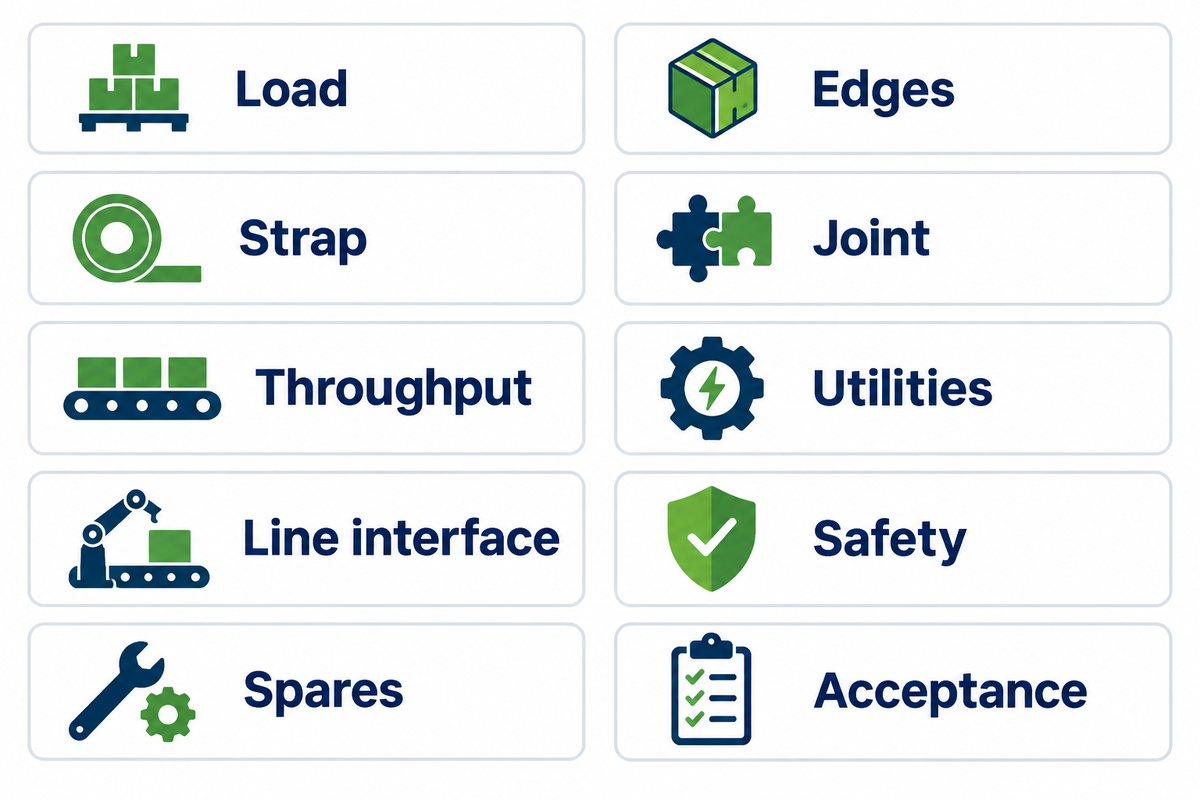
A supplier spec sheet for a strapping system needs ten lines: load, edges, strap, joint, throughput, utilities, line interface, safety, spares, and acceptance. UD Packaging supplies PET strapping, polyester strapping tools, strapping machines, and tensioners; steel strap and steel coil lines come from other manufacturers. Quotes compare cleanly only when they answer the same ten lines.
According to UD Packaging’s strapping tools page, “We supply PET strapping,” and the tools should be matched to the strap, joint, load and workcell, prior to selecting a product route, which is the same order as the checklist below.
RFQ checklist: copy these ten lines into the quote request.
| Parameter | Recommended range | Why it matters | How to verify |
|---|---|---|---|
| Load | Mass and form per bundle; coils at or above the 49 CFR 393.120 weight line carry truck securement rules | Sets strap class and the truck rule set | Quote lists mass per bundle against a Load-Form matrix row |
| Edges | Protector at every strap contact on a sharp edge | An unprotected edge can cut polyester strap | Protector material and size named on the quote |
| Strap | ASTM D3953 (steel) or ASTM D3950 (nonmetallic) class named with width and thickness, and the minimum break strength stated in lbf | Fixes the break strength | Test report for the strap lot |
| Joint | Seal or sealless method named, with joint strength stated as a share of strap break strength | The joint sets the working limit | Joint-strength test report |
| Throughput | Straps per hour at the peak shift, counted as straps | Selects the equipment class | Rated cycle time per strap at your strap width |
| Utilities | Voltage, phase, kW, air pressure and flow, footprint and entry height from the line table | The machine stalls without them | Supplier drawing with the utility values |
| Line interface | Conveyor stop, sensor signal and controller signals | Defines the strapping position | Interface sheet agreed by both sides |
| Safety | Guarding under 29 CFR 1910.212 and 1910.219; lockout under 29 CFR 1910.147; cut and removal routine | Jam clearing counts as servicing | Guard and lockout points marked on the drawing |
| Spares | Seals, strap coils, cutter and sealing-head parts; coil change time | Spares set downtime | Spare-parts list with lead times |
| Acceptance | A trial on your own bundle, with joint and tension read against the order line | Settles disputes before payment | Written trial result signed by both sides |
Quotes which don’t include the strap class, joint, throughput or utilities can’t be compared line by line. A buyer who assumes one supplier covers steel coil lines and PET tools alike finds the gap at delivery. UD Packaging’s tools and machines are described on its strapping tools page; strapping machine makers compared by line shows which makers serve which line.
Frequently asked questions
Q: What are some common uses for steel strapping?
Steel strapping secures heavy pallet loads, machinery and construction materials, according to a trade-press packaging guide, and ISO 24259 names metallic material, glass, light industrial products and logistics as the packaging jobs it covers.
ASTM D3953 adds bundling for shipment, unitizing, palletizing and bracing for carloading and truckloading to the uses it lists.
Q: What are the different types of strapping materials?
Steel, polyester and polypropylene cover metal handling. ASTM D3953 specifies the steel strap and its seals, and ASTM D3950 specifies nonmetallic strap and its joining methods.
Polyester keeps the highest retained tension of the nonmetallic types when properly applied, and polypropylene stretches the most of the three. Steel stretches the least, at about 1 percent in the working range of one maker’s guide.
Q: Will steel strapping rust or mark finished metal?
Yes, bare steel strap can rust where moisture reaches it, and the rust can stain the metal it presses on.
Polyester strap doesn’t rust. For finished or polished surfaces, polyester with edge protectors avoids the stain; steel stays the choice for exposed sharp edges. A dry indoor stack lowers the rust risk, and a protector under the strap keeps the strap off the finished surface.
Q: Why is it called strapping?
Strapping is named for the strap, a flat band of steel or plastic pulled tight around a load.
ASTM D3953 calls the steel product flat steel strapping, and ASTM D3950 covers the nonmetallic form.
Q: At what straps per hour should a distribution center move from hand tools to a machine?
One plastic-strap machine maker rates its single-head automatic machine at 55 or more straps per minute (3,300 an hour), so on that rating the count alone rarely justifies one. Move when a line delivers product faster than an operator can position and strap it.
Work out the count as bundles per shift × straps per bundle ÷ hours per shift, then compare it with how fast the line discharges product. A semi-automatic machine, where the operator still positions each package and triggers the cycle, is the middle step before an inline machine.
Q: Which standard covers steel strapping?
In the United States the steel strap and its seals fall under ASTM D3953-15(2022), and ISO 24259:2022 is the international standard for steel strapping for packaging.
ASTM D4675 is the selection guide, and it gives no instruction for a particular load.
References & Sources
Standards, regulations and safety pages checked November 2026.
- ASTM D3953-15(2022), Standard Specification for Strapping, Flat Steel and Seals, ASTM International
- ASTM D3950-23, Standard Specification for Strapping, Nonmetallic (and Joining Methods), ASTM International
- ASTM D4675-14a(2022), Standard Guide for Selection and Use of Flat Strapping Materials, ASTM International
- ISO 24259:2022, Steel strapping for packaging, International Organization for Standardization
- 49 CFR 393.120, cargo securement rules for metal coils, Electronic Code of Federal Regulations
- 29 CFR 1910.147, lockout/tagout standard for servicing and maintenance, OSHA
- Lockout/Tagout eTool, normal production operations, OSHA
- Personal protective equipment overview, OSHA
- Steel Strapping Safety tailgate talk, Oregon Department of Transportation
- Industrial packaging guide, Packaging Digest