Get in touch with UD Packaging Company

Trial starting point
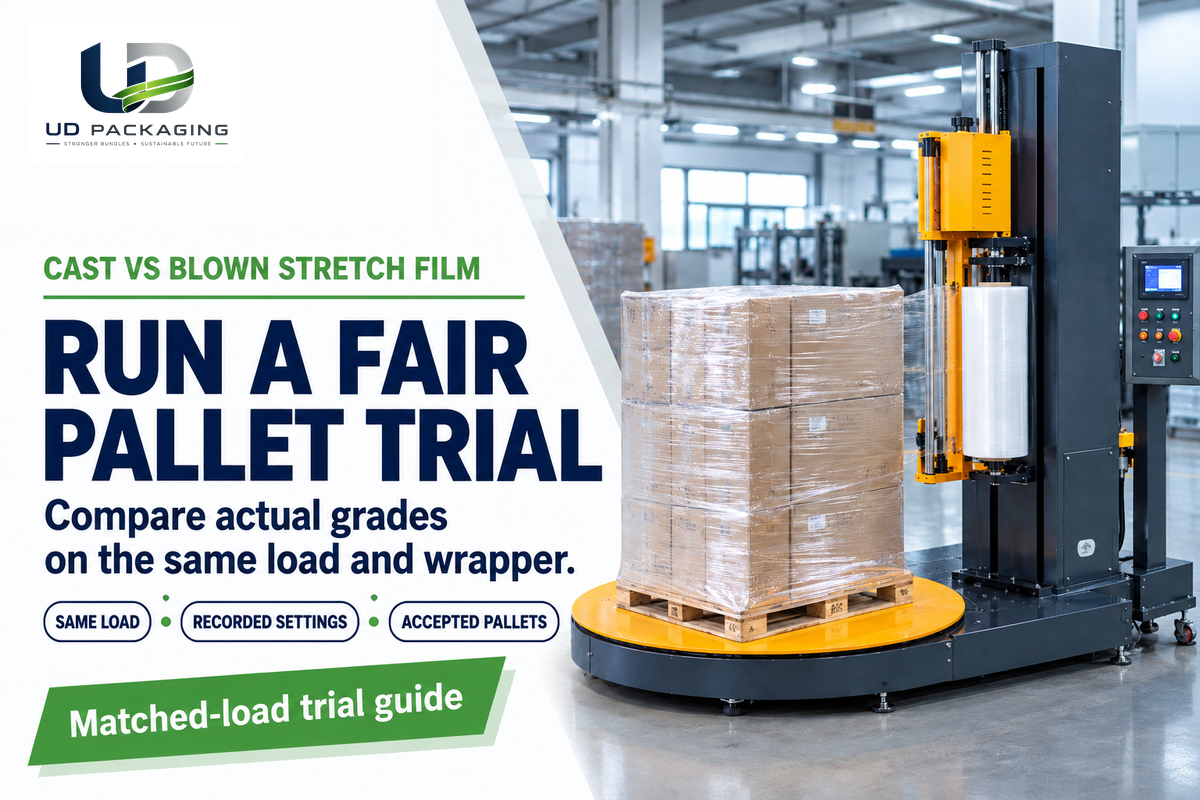
Compare one cast grade and one blown grade on the same load design and wrapper. Start with the current approved wrapping recipe, within both films’ operating ranges. Record actual containment, scan results, breaks and film mass. Repeat measurements at matching locations and waiting times.
Cast stretch film is stretchable plastic film made through a flat die and cooled on a roller. Generally, it provides clear visibility and a quiet unwind; however, these features don’t define whether a pallet stays together. Compare cast and blown samples on the same load and pick the grade and wrapping recipe that best fulfill your handling needs for the lowest cost per accepted pallet.
Cast stretch film commonly suits clear-label, quieter wrapping applications. Blown film is another candidate where puncture or tear is a concern. Compare actual grades on matched loads, with the same acceptance checkpoint and recorded wrapper settings.
Before ordering trial rolls
- Equal wrapper settings don’t guarantee equal containment force.
- A quieter roll or clearer film can still fail a corner or label check.
- Count rewrap film once and divide costs by unique accepted pallets.
- Record when and where containment is measured, because film relaxes after wrapping.
Cast vs Blown Stretch Film at a Glance
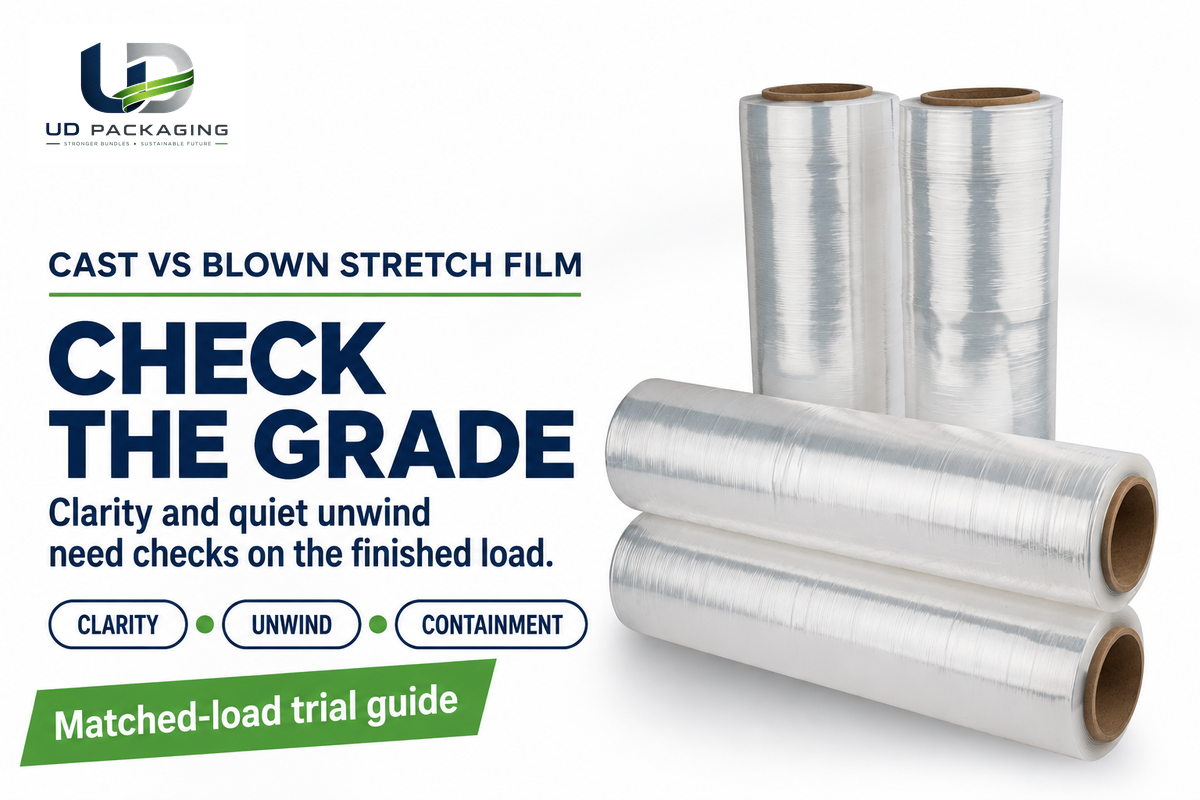
In contrast, blown and cast stretch films describe two types of stretch film manufacture, rather than two fixed performance levels. Suppliers tend to place cast grades for high clarity and quieter unwind on the market, and blown grades for higher performance handling. The useful difference between blown film and cast film is the behavior of the particular rolls on your load.
What is cast stretch film?
Cast stretch film is a polyethylene wrapping film produced using the cast extrusion process. Manufacturers extrude molten material through a flat die, and cool the sheet against a chill roller. The film can be used for hand or machine application. Its thickness, formulation and stretch range must be matched with the wrapper and the goods being secured.
In blown film extrusion, a circular die and air form a bubble. Suppliers describe the process as blowing heated resin vertically into a bubble, prior to cooling and winding. Compare the finished grade’s puncture and tear results to select a roll for exposed corners. An additive or a different layer structure can alter the behavior of either family.
| Observation | Cast sample: what to check | Blown sample: what to check |
|---|---|---|
| Clarity | Scan the actual label through the final wrap layers. | Check the same label, lighting and scanner position. |
| Unwind noise | Observe at normal application speed. | Repeat at matching station and distance. |
| Puncture and tear | Inspect vulnerable corners and tear paths. | Use the same corners and handling sequence. |
| Cling | Confirm the cling side and tail attachment. | Check tail retention and adjacent-pallet contact. |
| Containment | Measure at agreed locations and times. | Repeat matching measurement method. |
Signode’s cast-film description lists quiet unwind, transparency and cling on one side. A high level of cling therefore doesn’t mean that both sides are sticky. Orient the supplied film according to its specified cling side, especially when wrapped pallets touch in storage.
Fix the Load and Wrapper Before Comparing Film
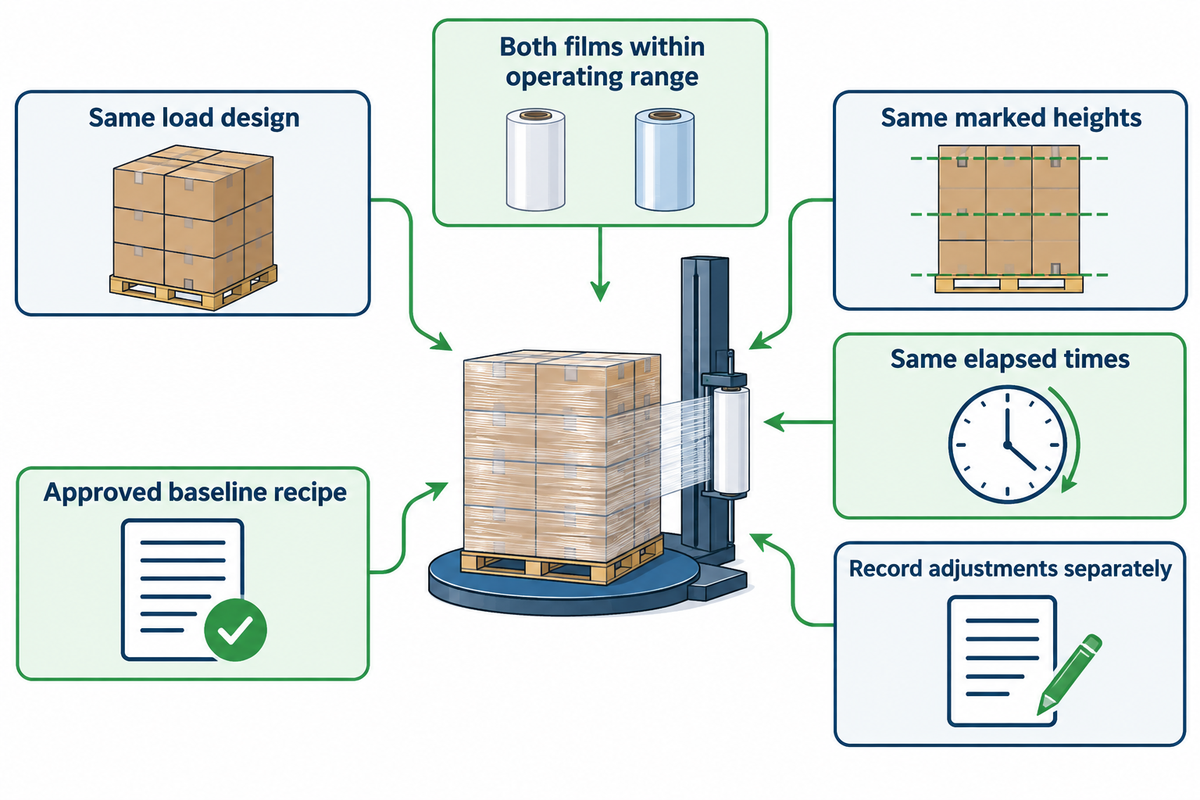
A fair pallet wrapping trial starts with a repeatable load and an approved wrapper recipe. Keep the carton arrangement, pallet condition and wrapping pattern constant during the first comparison. Measure the resulting containment, rather than assuming the same control-panel number applies the same force, and allow a separately recorded setup for each grade.
Use your existing successful film as the baseline. Record pre-stretch, force-to-load setting, carriage speed, overlap and top-and-bottom revolutions. For a machine stretch film trial, include the wrapper model and available pre-stretch range. Hand wrapping needs the same operator and repeatable route around the pallet; if one operator pulls tightly around every corner while another relaxes the film before the turn, the comparison includes a change in technique as well as a change in material.
ASTM D4649-20(2025) provides guidance on selecting, specifying and using stretch film for indoor applications, including storage and closed transport containers. Outdoor exposure is outside its stated scope. If the route includes temperature changes or U.V. exposure, add those conditions to the trial request.
Measure containment at corresponding marked heights and elapsed times after wrapping. Virginia Tech’s 2019 time-and-temperature study found that heat and time ultimately affected the final containment force. Its exploratory results warrant controlling those variables; they don’t anticipate a loss percentage for your film.
Example trial setup: Let’s say a warehouse is replacing the wrap on a square pallet of boxed household goods. The team selects one carton pattern and marks the bottom, middle and top measurement positions. It wraps the existing film and both candidates using the approved baseline recipe. Use the recipe within the candidate’s stated operating range. The operator records breaks without quietly turning down the tension. A second stage lets the supplier recommend a compatible recipe, and that’s documented separately as well. Now the buyer can tell the difference between film and a setup change, instead of attributing all changes to the manufacturing process.
Check Clarity and Unwind Noise in the Working Area
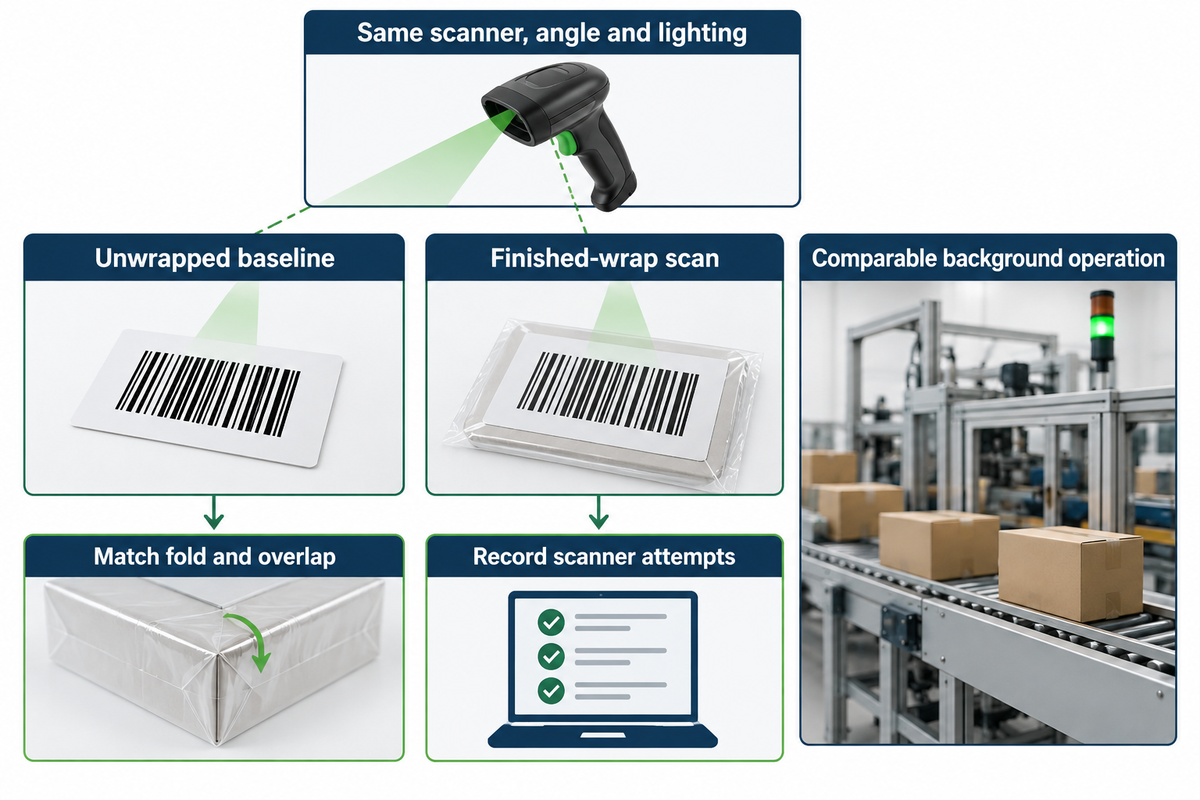
Clarity and unwind noise are working-area checks, which require the finished wrapped pallet, the normal scanner and a consistent observation position. A clear sheet held up to a light doesn’t show overlapping layers on a label. Compare film at wrapping speed and layer count that the operation will use.
How can labels stay readable through pallet wrap?
Labels will remain legible if the barcode prints correctly and if there’s a usable optical path left by the finished wrap. To compare barcode readability, scan the label before and after the finished wrap is applied. Repeat the scanning process for each film using the same scanner, angle, distance and lighting. Keep the location of the label and the number of layers constant, and record scanning failures rather than judge film transparency by looking at the film.
There are many reasons why a barcode can be unreadable. The barcode could be printed in the wrong location. The label could be folded. The barcode could lack contrast. There could be creases or wrinkles on the label. GS1’s barcode-quality guidance provides reasons for a poor quality barcode, including quiet zones and packaging obstructions. Record where the label is located, under the wrap or on its outside, so the two different samples face the same conditions.
For noise, use the same location, speed and observation distance with background machinery in a comparable operating state. A phone app can help with a consistent comparison, but an official assessment requires the right method and equipment. NIOSH describes specific device and calibration conditions for their sound-level application; a quick warehouse check doesn’t automatically have those conditions.
Example scan problem: An e-commerce distribution center uses a clear cast roll that, according to the team, improves label visibility compared to the current blown roll. Before selecting it, the team scans the same label under both finished wrapping patterns. One pallet has a fold across the barcode, and another pallet has an extra overlap at label height. The operator removes the fold, matches the overlap and repeats the wrap. If, in the process, the advantage disappears, then the first problem is placing the label, and that needs to be corrected. If, after that adjustment, the roll still doesn’t scan as intended, then one or more pallets need repeated scanner attempts. The scanner attempts and their locations should be described in detail along with photographs to the supplier.
Separate Puncture, Tear and Load Containment
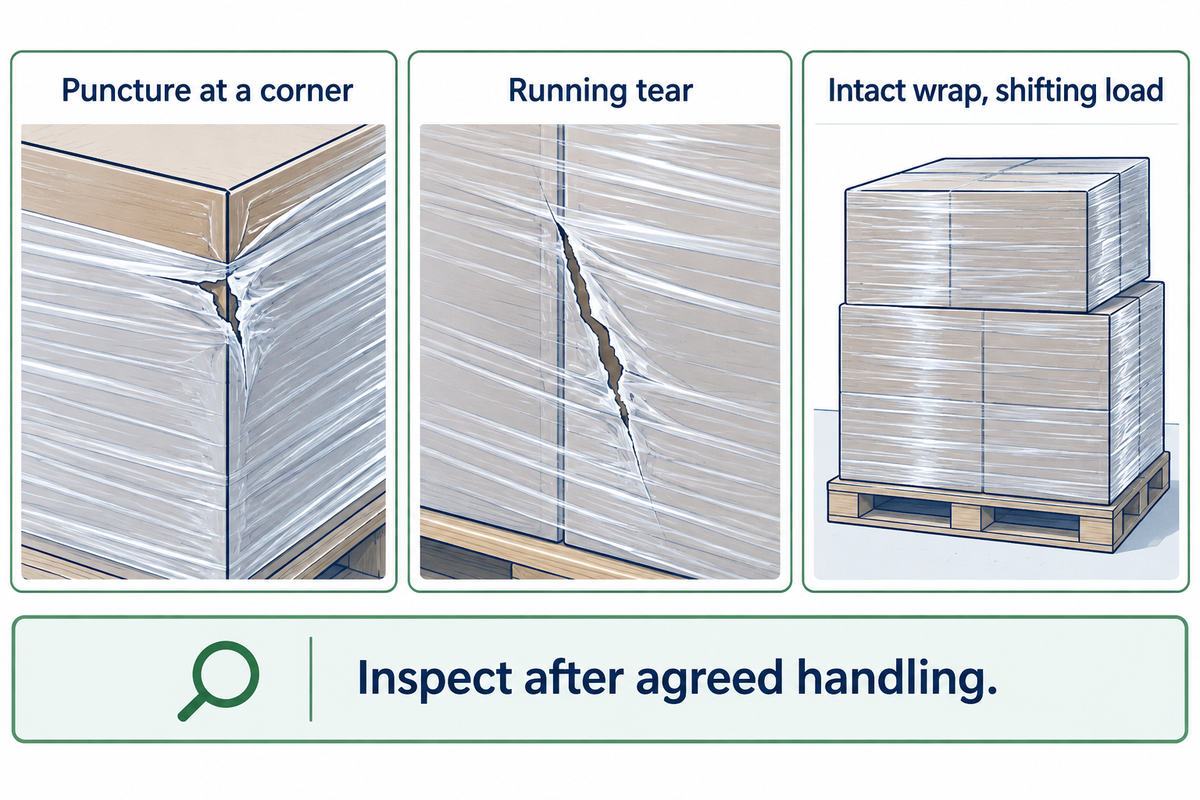
Puncture resistance and tear behavior and load containment describe different failure mechanisms. An outside corner of a carton can initiate a puncture or a tear, and a small, barely noticeable defect can become a running tear. Intact wrap can still allow shifting and damage if the application leaves too little retained force after handling. Look for defects due to corner failure and tear mechanisms separately, and inspect load movement after the agreed handling sequence. Assess load stability after the intended transit conditions and at the wrapping station.
ASTM D5748-26 measures protrusion puncture response under biaxial stress using a probe at a single low test rate. Its public documents state that the method does not replicate all field conditions. Compare the specimen conditions and test methods on both documents and then check the finished load under the intended use conditions.
Is blown stretch film better than cast stretch film?
Blown stretch film can be a better choice for a given job, only if the tested grade meets the job requirements more effectively. A buyer facing sharp or irregularly shaped corners should assess candidate films against those corners. Cast film can be a better choice if it passed the same handling checks and offers useful scan clarity, lower unwind noise or lower accepted-pallet cost.
Strong cling is a separate property from resistance to a puncture. Check the tail after the agreed storage interval and see if adjacent pallets stick together. For heavy loads, record movement and measured containment instead of using weight alone as a selection criterion. A louder roll can feel firmer without proving superior strength.
If a sample breaks, photograph the starting point before changing settings. Lantech’s troubleshooting guidance covers film, load and machinery causes. Lowering tension may prevent breakage; however, this may result in less containment. Record any compensation, for example more layers, and include the additional material in the cost comparison.
Run the Matched-Load Trial Record
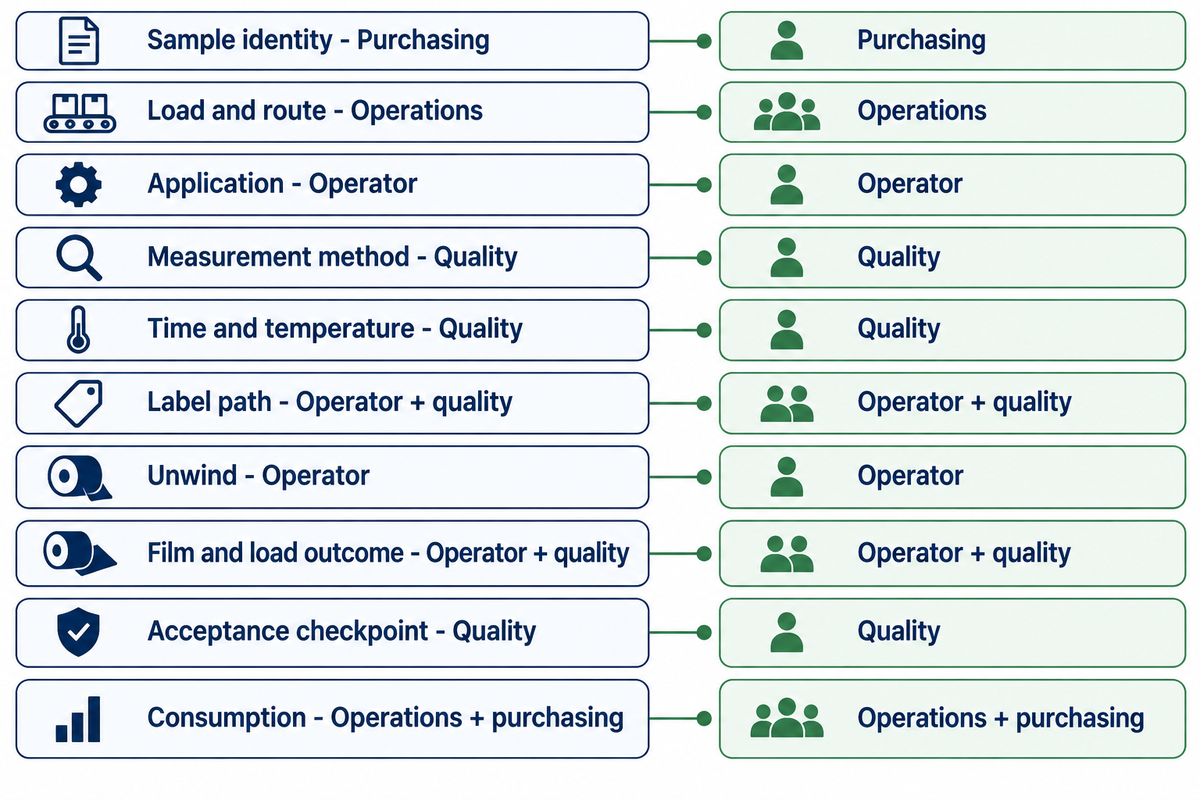
The Matched-Load Trial Record is a worksheet for comparing two film grades for a given load design without getting confused by the changes in settings. Purchasing identifies the rolls and prices and the operator records the application. Quality records the agreed inspection result. Initially compare a representative load design and extend the comparison to other packaging needs if found worthwhile.
| Trial category | Write this down for each film | Owner |
|---|---|---|
| Sample identity | Supplier, grade, lot, cast or blown, gauge, width, net film mass and core. | Purchasing |
| Load and route | Pallet dimensions, mass, carton pattern, corners and planned handling sequence. | Operations |
| Application | Wrapper, pre-stretch, force setting, speeds, overlap, revolutions and film orientation. | Operator |
| Measurement method | Instrument, procedure and marked measurement locations. | Quality |
| Time and temperature | Elapsed time after wrapping, waiting interval and temperature history. | Quality |
| Label path | Unwrapped barcode baseline, scanner position and scans through the finished layers. | Operator + quality |
| Unwind | Normal speed, observation distance, background and noise observations. | Operator |
| Film and load outcome | Breaks, punctures, tears, tail release and load movement. | Operator + quality |
| Acceptance checkpoint | Named endpoint, agreed pass criteria, unique pallets accepted and reasons for rejection. | Quality |
| Consumption | Net film used, including rewrap and waste, plus separately recorded direct rewrap labour. | Operations + purchasing |
Define the checkpoint before starting: for example, after the agreed warehouse handling sequence and waiting interval. If transport performance is the purchasing question, include the relevant route or qualified simulation and inspect afterwards. Passing a dock check can’t supply a missing delivery result.
“differences only become relevant when considered systematically against relevant variables.”
His systems approach links the film to the load and wrapping machine. Troubleshooting the packaging challenges starts with the failed load and its recorded recipe. Keep a dated recipe of each accepted combination; if the same packaging challenges recur, the record shows which film and settings were actually used rather than requiring the next operator to work it out. The unit-load containment method guide can help frame the test discussion, while the buyer and seller agree the actual acceptance conditions.
| Observed failure | Evidence to collect next | Decision before another roll |
|---|---|---|
| Hole at one corner | Corner photograph, contact point and starting defect. | Correct the projection or trial a compatible grade; repeat that corner. |
| No breaks, but loose load | Containment at the agreed heights and elapsed times. | Review the recipe and retained force before accepting. |
| Barcode needs repeat scans | Unwrapped baseline, fold/overlap photograph and scan attempts. | Correct the label path, then compare films again. |
| Good trial, poor repeat run | Lot identity, settings and temperature history from both runs. | Locate the changed input before extending approval. |
Compare Cost per Accepted Pallet
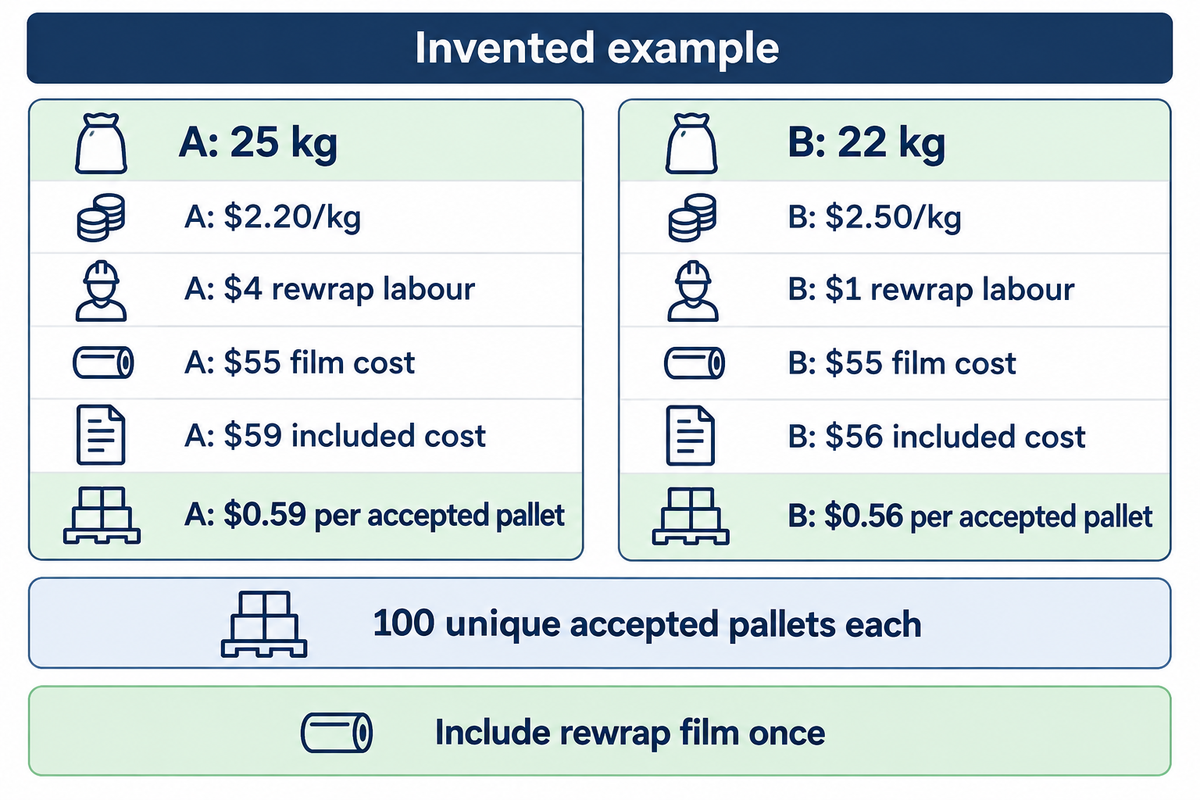
Cost per accepted pallet divides costs within an agreed trial boundary by the number of unique pallets that pass its named checkpoint. Use the same boundary for both films and include rewrap material once. A less expensive roll can cost more to use if breaks, waste or extra wrapping consume its purchase-price advantage. Track usable yield from each roll against accepted output before crediting a cheaper consumable with better efficiency.
Formula: (Net film used x price per kilogram + direct rewrap labour) / unique accepted pallets. This simplified comparison isolates film and rewrap labour. Add other costs separately if the film change alters them; don’t mix a dock-only result with a delivery-inspected result.
Assumed inputs: The following example uses invented prices and consumption for two samples, A and B. Each produces 100 unique pallets accepted at a matching warehouse checkpoint. Total film mass includes waste and all rewrapping. Initial wrapping labour, equipment, freight and unmeasured downstream damage are assumed to be the same and are excluded from the narrow comparison.
| Input or result | Sample A | Sample B |
|---|---|---|
| Total net film used | 25 kg | 22 kg |
| Assumed film price | $2.20/kg | $2.50/kg |
| Film cost | $55 | $55 |
| Direct rewrap labour | $4 | $1 |
| Included trial cost | $59 | $56 |
| Unique accepted pallets | 100 | 100 |
| Cost per accepted pallet | $0.59 | $0.56 |
On these assumptions, A costs (25 × $2.20 + $4) ÷ 100 = $0.59, while B costs (22 × $2.50 + $1) ÷ 100 = $0.56. B has the higher kilogram price and the lower included cost per accepted pallet. These figures illustrate the calculation; they aren’t measured UD Packaging savings.
Purchasing decision: Suppose the buyer receives a higher quote for B after the trial. Holding its assumed 22 kg consumption and $1 rewrap labour fixed, the break-even price is ($59 − $1) ÷ 22 = about $2.636/kg. Above that price, B loses its cost advantage within this example’s boundary. The buyer should also check whether the quoted roll has the same grade and net film mass as the tested roll. If the supplier substitutes a thinner construction, the old consumption result can’t simply be carried across. Purchasing can negotiate against the calculation while operations checks the sample identity.
Send a Sample Request the Supplier Can Act On
Providing the supplier with information about the goods being wrapped, the equipment applying the film, and the kind of failure that’s occurring is very helpful. Send us the current successful specification as a starting point and request that one cast candidate and one blown candidate be suited to that equipment. Using the approved recipe within the stated stretch range of the candidate, separately indicate the grade-specific adjustment, if any, that was made.
Provide load photographs, pallet dimensions and masses, sharp edges, storage conditions and planned route. Include the roll width and length, thickness and core and net film mass. For manual pallet-wrapping trials, include the operator method and the dispenser. For high-volume packaging on an automatic line, include the speed of the wrapper and the limits of the film carriage.
Match the quoted grade to the wrapper’s pre-stretch system and orient its stated cling surface to the contact area. A machine wrap that’s outside its stretch range is a poor candidate for a trial. Request datasheet test methods and the trial-roll lot ID, so that a later order can be compared to the accepted sample.
The supply page for UD Packaging’s stretch film provides cast, blown and pre-stretched routes and requests application details. Send the completed trial record with your enquiry. Confirm the supply route and production source for the quoted film in the quotation. The name of the process doesn’t identify who manufactures a particular grade for the film.
Industry Outlook: Retest Changes to the Film Grade
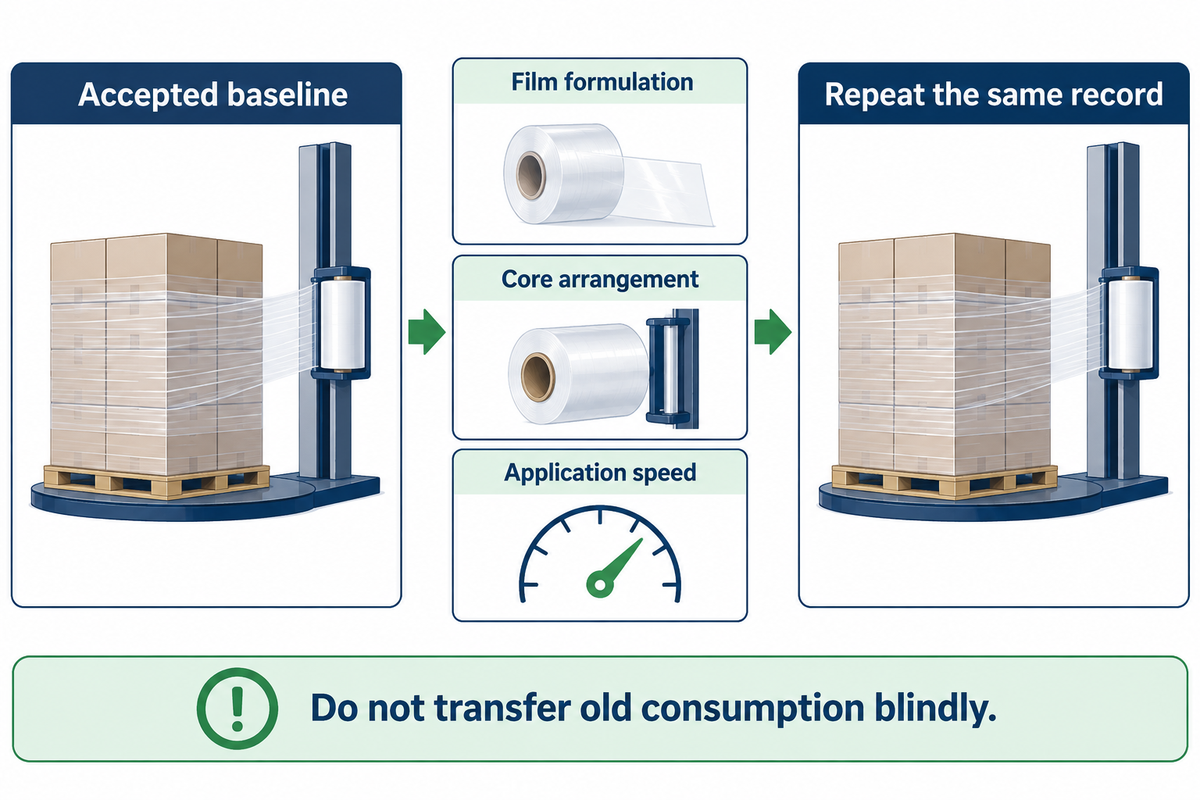
Decreased film consumption is only effective if the altered grade meets the required load performance. Buyers evaluating thinner films in 2026 should compare accepted-pallet cost and the same outcome of handling, rather than making gauge reduction the acceptance target. In order to be able to compare the impact of a possible replacement, it’s essential to keep the old recipe and results.
Newer constructions can alter the trade-off between stretch, cling and resistance to damage, but the process label alone can’t guarantee similarity. Thong Guan’s discussion of thinner-film claims goes beyond the multilayer film to assert that a thin multilayer film is not always better than other film types. Treat its manufacturer guidance as a means to compare specific grades of packaging solutions, rather than as an overall ranking.
Editions of test methods must be identified precisely as well. ASTM’s public page lists D5748-26 as being active and last updated on April 29, 2026. That date identifies the puncture method discussed. It does not mean that an update to that edition renders a previous pallet trial invalid. Compare method, specimen condition, and the reported results prior to combining information from multiple trials.
Retained force deserves a place in the specification alongside initial appearance. ASTM D5459-95(2025) covers recovery, permanent deformation and stress retention of stretch wrap film. The public scope supplies no single pallet acceptance force. Agree the load-specific measurement method with the supplier and repeat it after the same waiting interval and temperature history used for the accepted baseline.
For distribution centers, one accepted grade may serve several carton patterns, but approval should name those patterns. A change in film formulation, core arrangement or application speed may change the result of the next run. Compare the replacement using the same record before extending it to the operation. Start with the accepted grade currently in use and one candidate at a time; keep any supplier-recommended setup change in a separate trial run. That provides purchasing with an identifiable replacement and operations a recipe it can repeat.
Frequently Asked Questions
What is the difference between stretch wrap and shrink wrap?
Stretch wrap grips through applied stretch; shrink wrap contracts when heated.
Stretch wrap is stretched around the goods during application, and its recovery helps hold them together. Shrink wrap uses a compatible heat process to contract the film. A pallet stretch-wrapper recipe can’t be transferred to a shrink-wrapping operation. When requesting samples, identify the application equipment so the supplier doesn’t quote the wrong type of film.
Does cast stretch film work for heavy loads?
Cast film can work for heavy loads when the tested grade and wrapping recipe meet the load’s requirements.
Load mass is only one input. Carton compression, sharp corners, pallet arrangement and handling can change the result. Trial the actual load with the intended wrapper, then record containment and movement at the agreed checkpoint. A general kilogram rating can’t replace that comparison, especially if a different carton pattern or transport route is introduced later.
What is a stretch film machine?
A stretch film machine may mean a pallet wrapper or equipment used to manufacture film.
For a pallet trial, the relevant machine is normally the wrapper that applies film to the load. Its carriage, pre-stretch system and controls affect application. A film extrusion line instead manufactures the film itself. Specify the wrapper model in an enquiry for trial rolls, since production-line information won’t tell the supplier how your pallet is wrapped.
Can I compare rolls by gross weight?
Use net film mass for consumption comparisons, because gross weight includes the core.
Record core mass separately and compare the usable film supplied. Otherwise, a heavier core can look like more wrapping material. Keep roll width and grade identity on the same purchasing record.
Should cloudy cast stretch film be replaced?
Replace or investigate cloudy film when it fails the required visibility or other agreed application checks.
First check whether the cloudiness belongs to the film or comes from folds, overlapping layers, contamination or a damaged label. Scan the unwrapped label, then repeat through the completed wrap with the normal scanner. If the result changes between rolls, retain lot details and photographs for the supplier. A visible change deserves investigation, but it doesn’t by itself prove that the pallet has lost containment or that a different manufacturing process will solve the problem.
Request two grades for one comparable trial
Send UD Packaging your load photos, wrapper model and current specification. Include the failure you want to solve and the checkpoint at which both samples will be judged.
Trial notes: The worksheet and numerical example are practical comparison aids, not reported factory trial results. Manufacturer descriptions remain attributed to their sources. Public standards’ summaries denote the test scope; the buyer and the supplier agree the application-specific acceptance criteria.
References & Sources
- ASTM International, D4649-20(2025), stretch-film selection and use, public scope.
- Virginia Tech, Effect of Time and Temperature on Stretch Wrap, 2019 research summary.
- GS1, Barcode-quality checks, 2024.
- NIOSH, Sound Level Meter App.
- ASTM International, D5748-26, protrusion puncture resistance, public scope.
- Sterling Anthony, Understanding Systematic Load Containment, Packaging World, 2020.
- ASTM International, D5459-95(2025), recovery and stress retention, public scope.