Get in touch with UD Packaging Company

A stretch film technical data sheet provides lab coupon data measured on linear low-density polyethylene (LLDPE) film conditioned at 23 °C and 50% relative humidity for a minimum of 40 hours as described in ASTM D618-21 Procedure A. A stretch film technical data sheet summarizes laboratory coupon measurements recorded on linear low-density polyethylene (LLDPE) plastic film conditioned at 23 °C and 50% relative humidity for at least 40 hours per the standard ASTM D618-21 Procedure A. The measurement of physical properties of film is provided against their respective standard tests, namely ASTM D882-26 for tensile and elongation, ASTM D1922 for machine direction (MD) and transverse direction (TD) Elmendorf tear, ASTM D1709 for free-falling dart drop, ASTM D5458 for peel cling, and ASTM D1003 for optical haze, to allow packaging engineers to compare industrial stretch film resin formulations prior to pallet tests.
Updated November 2026 · By karry, UD Packaging
Read a stretch film technical data sheet by checking five elements together: nominal film thickness (gauge, mil, and microns), test standard edition, specimen orientation (MD versus TD), test method variant (such as ASTM D1709 Method A versus Method B), and whether published numbers represent non-binding typical averages or purchase-specification limits verified on a lot-specific Certificate of Analysis (COA).
Quick Specs: ASTM Stretch Film Datasheet Baseline
- Standard Conditioning: Condition specimens for at least 40 hours at 23 °C and 50% relative humidity per the standard ASTM D618-21 Procedure A before testing in the same laboratory atmosphere.
- Gauge-to-Mil-to-Micron Conversion: 50 gauge = 0.50 mil = 12.7 microns (0.0127 mm); 80 gauge = 0.80 mil = 20.3 microns (0.0203 mm); 90 gauge = 0.90 mil = 22.9 microns (0.0229 mm).
- Dart Drop Method Split (ASTM D1709): Method A drops a 38.1 ± 0.13 mm head from 0.66 ± 0.01 m; Method B drops a 50.8 ± 0.13 mm polished stainless steel head from 1.50 ± 0.01 m.
- Dock-Level Gravimetric Verification: Net film weight (kg) = width (m) × thickness (µm) × length (m) × density (0.92 g/cm³) ÷ 1,000; a 500 mm × 23 µm × 1,500 m machine roll holds 15.87 kg of net film plus 1.0 to 1.5 kg paper core tare.
What a Stretch Film Technical Data Sheet Actually Measures: Line-by-Line Property Map
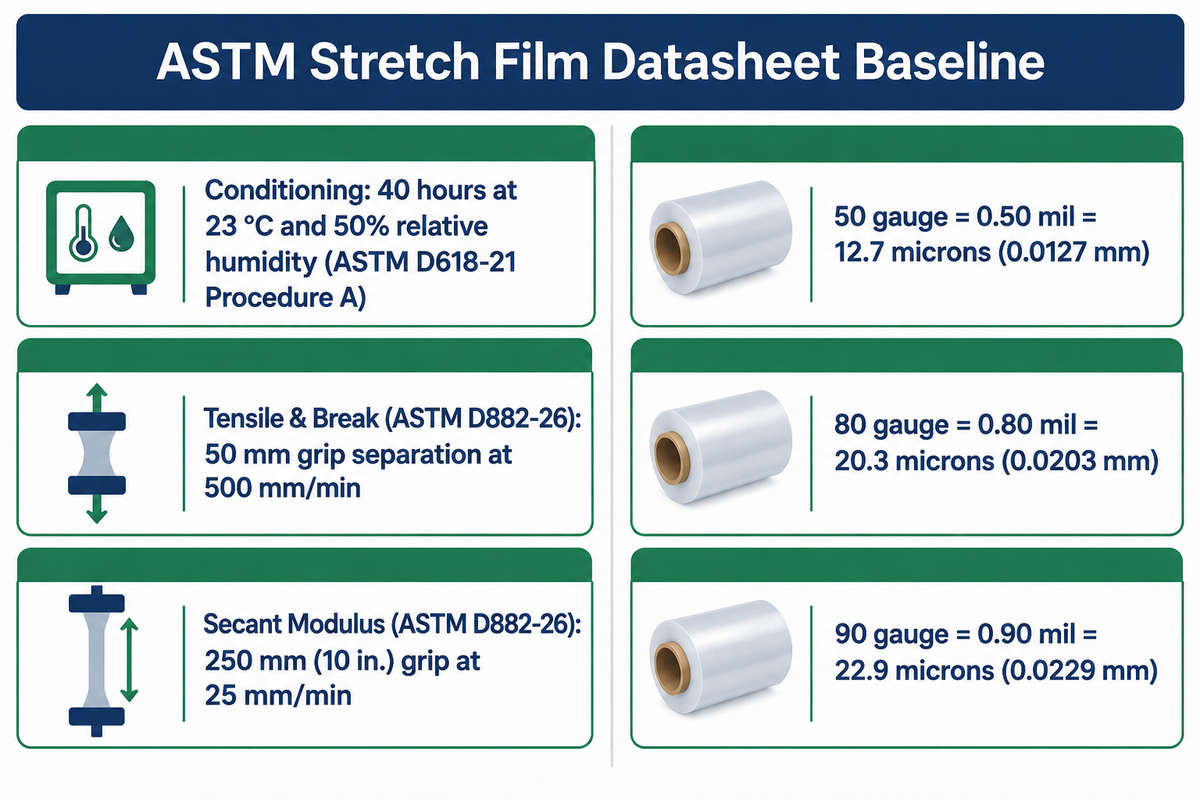
A standard stretch film technical data sheet reports laboratory values on flat coupons conditioned for at least 40 hours at 23 °C and 50% relative humidity per the standard ASTM D618-21 Procedure A , covering thickness, density ( ASTM D792 ), tensile ( ASTM D882-26 ), tear ( ASTM D1922 ), dart impact ( ASTM D1709 ), cling ( ASTM D5458 ), and haze ( ASTM D1003 ). A standard stretch film technical data sheet reports laboratory values on flat coupons conditioned for at least 40 hours at 23 °C and 50% relative humidity per the standard ASTM D618-21 Procedure A, covering thickness, density (ASTM D792), tensile (ASTM D882-26), tear (ASTM D1922), dart impact (ASTM D1709), cling (ASTM D5458), and haze (ASTM D1003).
When buyers evaluate packaging material across various converters, datasheet rows only make sense when the underlying test design and specimen direction are held constant. While global buyers sometimes ask for both ASTM and ISO methods, the verified research records for this guide cover the governing ASTM standards and do not list specific ISO method numbers. According to the BioPDI technical breakdown of ASTM D882-26 (updated April 29, 2026), ASTM D882-26 covers tensile testing of thin plastic films and sheeting under its stated scope across both machine direction (MD) and transverse direction (TD) strip specimens conditioned for at least 40 hours at 23 °C and 50% relative humidity per the standard ASTM D618-21 Procedure A. Under ASTM D882-26, tensile yield strength (in MPa or psi), tensile strength at break (in MPa or psi), and percentage elongation at break on films exceeding 100% elongation (as reported in BioPDI’s protocol) are measured at a 50 mm initial grip separation and 500 mm/min crosshead speed, whereas common 1% or 2% secant modulus (in MPa or psi, as reported in BioPDI’s protocol) requires a separate specimen tested at a 250 mm (10 in.) grip separation and 25 mm/min (1.0 in./min) speed.
ASTM D882-26 tensile values from fixed crosshead speeds on narrow strips are not direct stand-ins for applications whose force-time scale differs widely from the laboratory setup. To bridge benchtop coupon numbers with warehouse transport and unitizing design, ASTM D4649-20(2025) provides the official industry standard guide for selecting and using stretch wrap films in palletizing environments.
The TDS Line-by-Line Property & ASTM Method Decoder
Use the TDS Line-by-Line Property & ASTM Method Decoder below to convert every line on a converter or resin supplier specification sheet, like the multilayer polyethylene test procedures documented by the Dow Chemical Company affiliate in patent publication WO2018140308A1, to real-world pallet-wrapping actions:
| Datasheet Property Row | Governing ASTM / ISO Standard | Test Conditions, Orientation & Units | What It Controls on the Pallet Wrapper |
|---|---|---|---|
| Nominal Film Thickness | Micrometer / Gravimetric | Gauge, mil, or µm (80 gauge = 0.80 mil = 20.3 µm / 0.0203 mm) | Base web cross-section prior to pre-stretch carriage drawdown |
| Base Resin Density | ASTM D792 | 0.917–0.920 g/cm³ standard LLDPE density | Crystallinity, film stiffness, and gravimetric roll-weight mass balance |
| Tensile Yield & Break Strength (MD/TD) | ASTM D882-26 | MD & TD stress in MPa or psi; elongation in % (50 mm grip, 500 mm/min) | Peak web tension before necking (yield) and final rupture (break) |
| Secant Modulus at 1% or 2% Strain | ASTM D882-26 | MD & TD stiffness in MPa or psi; 250 mm (10 in.) grip separation at 25 mm/min | Elastic snap-back stiffness and load-holding force on rigid cartons |
| Elmendorf Tear Resistance (MD/TD) | ASTM D1922 | MD & TD tear force in grams-force (g) or mN; any g/mil value is a separately derived thickness-normalized figure | Resistance to a corner nick zipping across or down the stretched web |
| Free-Falling Dart Impact | ASTM D1709 | Grams (g); Method A (38.1 mm, 0.66 m) or Method B (50.8 mm, 1.50 m) | Sudden dynamic impact resistance against sharp pallet splinters |
| Slow-Probe Puncture Resistance | ASTM D5748-95 | Newtons (N) and Joules (J) at 250 mm/min probe speed | Quasi-static corner protrusion resistance under sustained wrap tension |
| Peel Cling & Highlight Ultimate Stretch | ASTM D5458 / ASTM D4649-20(2025) | ASTM D5458 measures peel cling (g); the cited ASTM D4649 Highlight test stand in WO2018140308A1 uses 56 m/min (185 ft/min), so cling and unwind force are separate measurements | Film tail tack to the underlying wrap layer versus powered carriage stretch capacity |
| Optical Haze | ASTM D1003 | Percentage (%) light scatter through the unstretched film | Warehouse laser and camera barcode readability through multiple wraps |
Gauge, Mil, and Micron Conversion Rules on Global Datasheets
North American converters list thickness in gauge or mil, whereas European and Asian technical data sheets report microns (µm) or millimeters (mm). Because 1 mil equals 25.4 µm (0.0254 mm) exactly, 50 gauge equals 0.50 mil or 12.7 microns (0.0127 mm), 80 gauge equals 0.80 mil or 20.3 microns (0.0203 mm), and 90 gauge equals 0.90 mil or 22.9 microns (0.0229 mm). Note that commercial warehouse reference tables, such as the TCD Tape stretch wrap gauge thickness conversion chart, round those nominal micron equivalents to 12.5 microns, 20 microns, and 23 microns. Keeping both the exact mathematical conversion and common commercial rounding in mind prevents unit mix-ups when comparing an imported 20 µm datasheet against a domestic 80 gauge specification.
MD vs TD Orientation and Dart Impact vs Puncture: Avoiding False Comparisons
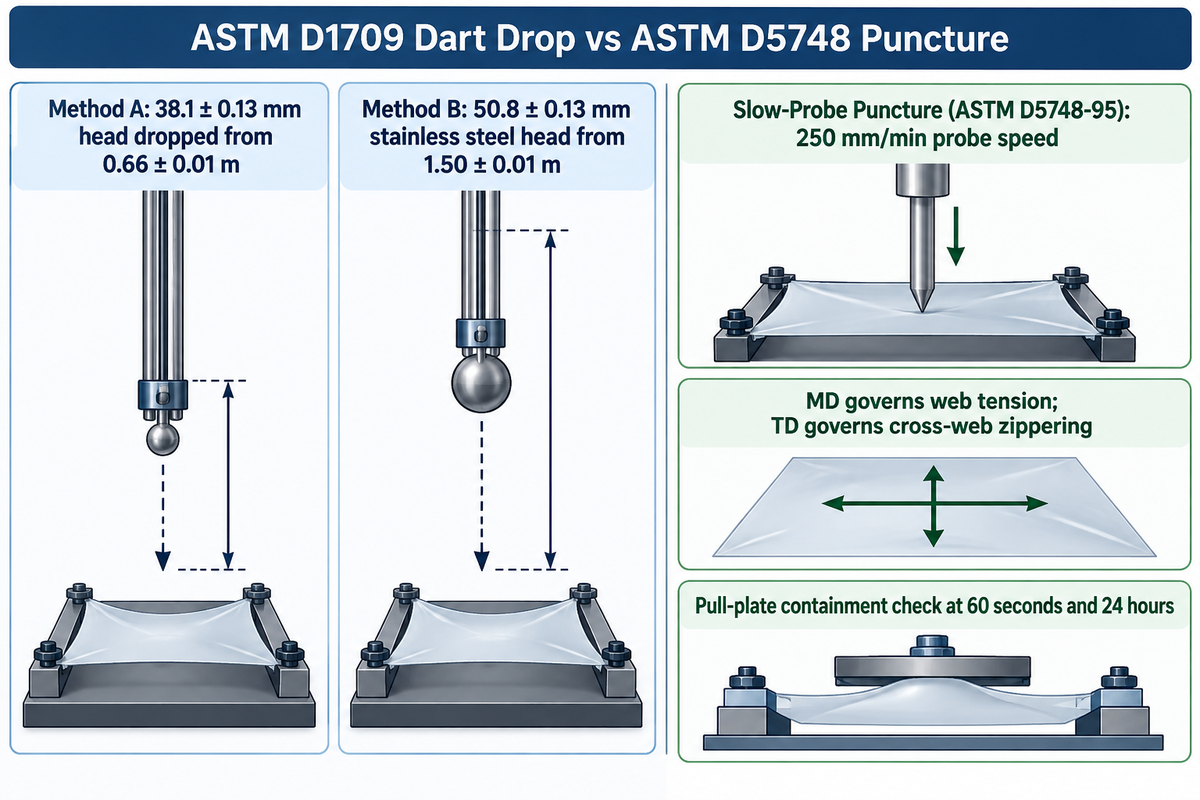
MD properties govern longitudinal web tension as film passes through powered pre-stretch rollers, and TD properties govern cross-web zippering as a stretched band catches a sharp pallet corner.
Select stretch wrap by checking whether tensile values are reported at yield or final break and whether tear resistance is normalized by thickness, rather than by the highest single tensile number. When comparing typical values versus minimum guaranteed tolerances across two specification sheets for a 250% pre-stretch pallet wrapper, require minimum threshold benchmarks, such as an MD second-yield stress of at least 21.0 MPa and 56 m/min (185 ft/min) Highlight test-stand ultimate stretch as documented in WO2018140308A1 and verify them on a lot-specific Certificate of Analysis (COA). BioPDI’s analysis of ASTM D882-26 points out that tensile strength at break uses the force at the exact moment of rupture rather than the maximum peak load; while the two sometimes coincide, they do not always match on strain-softening polyethylene films, so the standard requires reporting both. In addition, as reported by Lantech’s stretch film engineering guide, a 65 gauge (0.65 mil) film does not reduce to 26 gauge under the usual percentage-extension definition of 250% pre-stretch (which stretches 1 unit of length to 3.5 units, or approximately 18.6 gauge / 19 gauge on the load); Lantech’s 26 gauge figure divides 65 gauge by a 2.5× stretch factor, so buyers should verify which stretch-ratio convention a specification uses.
ASTM D1709 Method A vs Method B Dart Drop and ASTM D5748 Slow-Probe Puncture
Datasheet reviewers frequently see “Dart Impact: 150 g (ASTM D1709)” on two competing quotes and assume identical puncture toughness. According to Industrial Physics’ technical guide to ASTM D1709, ASTM D1709 actually contains two distinct test setups with incompatible impact energies: Method A uses a hemispherical dart head of 38.1 ± 0.13 mm diameter dropped from a height of 0.66 ± 0.01 m, whereas Method B uses a larger 50.8 ± 0.13 mm polished stainless steel dart head dropped from 1.50 ± 0.01 m. Consequently, ASTM D1709 Method A and Method B gram values cannot be compared directly across datasheets, nor can they replace ASTM D5748-95 slow-probe puncture testing, which drives a probe into clamped film at 250 mm/min to simulate slow corner creep.
Static coupon numbers do not capture shipping-skid relaxation, so evaluate unitized containment with pull-plate testing at 60 seconds or 24 hours after application, as described by ASTM Subcommittee D10.25, while ASTM D4649-20(2025) provides a standard guide for selecting and using stretch films in wrapping applications. In a peer-reviewed November 2025 *Sensors* study (PMC12656129) evaluating commercial LLDPE stretch films of 15 µm, 17 µm, and 23 µm thickness at pre-stretch ratios of 150%, 200%, and 250% (and up to 320% on high-performance stretch grades), researchers proved that using a standard 23 µm film limited to 150% pre-stretch consumed 101 g of film for 6 wraps (138 g for 9 wraps, generating 42.80 N stabilizing force at 123 mm deflection), whereas as reported in the same *Sensors* study, a 17 µm film stretched at 240% to 320% consumed only 68 g to 57 g of film while delivering 42.70 N to 53.60 N stabilizing force for an economic wrap cycle.
| Observed Wrapping Line Failure | Primary TDS Property to Audit | Direction & ASTM Method | Diagnostic Verification Step |
|---|---|---|---|
| Web snaps between pre-stretch rollers | Ultimate Elongation & 2nd Yield | MD — ASTM D882-26 | Verify MD elongation and second-yield stress per the standard ASTM D882-26 against benchmark formulations (such as 21.0 MPa MD second yield reported in WO2018140308A1) |
| Small edge nick zips horizontally across roll | Elmendorf Tear Propagation | TD & MD — ASTM D1922 (grams-force g) | Inspect roll edge slitting quality and verify reported ASTM D1922 TD and MD tear-force values (such as 560 to 580 g TD tear on 0.8 mil cast film in US6265055B1) |
| Pallet corner pokes through during sudden fork lift | Free-Falling Dart Drop Impact | Film Face — ASTM D1709 Method A | Confirm whether the datasheet reports Method A (38.1 mm, 0.66 m) or Method B (50.8 mm, 1.50 m) and pair with ASTM D5748-95 slow-probe puncture data |
| Load shifts in transit 24 hours after wrapping | 2% Secant Modulus & Pull-Plate Force | MD — ASTM D882-26 (250 mm, 25 mm/min) | Audit pull-plate containment at both 60 seconds and 24 hours post-application as described by ASTM Subcommittee D10.25 |
| Film tail flags loose or adjacent pallets stick | Peel Cling & Coefficient of Friction | Cling/Release Faces — ASTM D5458 / ASTM D1894 | Verify ASTM D5458 peel cling on the inner cling layer and ASTM D1894 coefficient of friction on the outer release layer |
Cast vs Blown LLDPE at 80 Gauge (20 Micron): Side-by-Side Technical Data Sheet Comparison
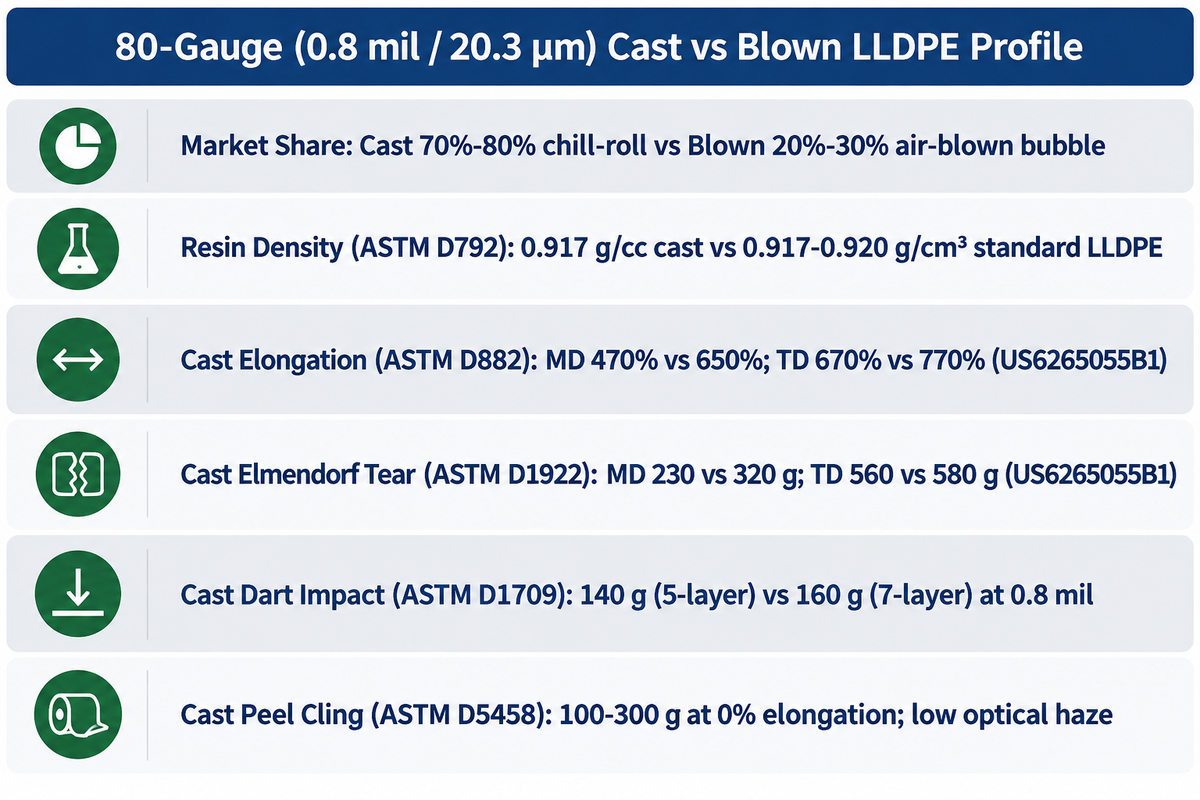
In US6265055B1 Table 1, the 0.8 mil (80 gauge / 20.3 µm) cast LLDPE structures show ASTM D1922 MD tear of 230 to 320 g and TD tear of 560 to 580 g as the reported tear-force values (or 230 to 320 g/mil MD and 560 to 580 g/mil TD when normalized by thickness), whereas Lantech reports that cast film represents 70% to 80% of the stretch film market and blown film represents 20% to 30%.
Automated summaries often state that cast film has higher machine-direction tear resistance than blown film, but polymer processing physics and patent test tables show the opposite trend for chill-roll cast web structures. As documented in US Patent US6265055B1 (Example 1, Table 1) for 0.8 mil (80 gauge) cast hexene/metallocene LLDPE film at 0.917 g/cc density, a 5-layer versus 7-layer cast structure tested per ASTM D882, D1922, D1709, and D5458 shows MD elongation of 470% versus 650% and TD elongation of 670% versus 770%. In the patent table, the two cast structures show MD Elmendorf tear of 230 versus 320 g and TD tear of 560 versus 580 g as the reported tear-force values (while Claim 13 expresses thickness-normalized ranges of 50 to 350 g/mil MD and 400 to 700 g/mil TD), along with dart impact of 140 versus 160 g and peel cling of 100 to 300 g at 0% elongation. Notice that in both cast structures, TD Elmendorf tear (560–580 g) is roughly double the MD Elmendorf tear (230–320 g) because rapid chill-roll draw aligns polymer chains lengthwise along MD. Treat these 0.8 mil (80 gauge) figures in US6265055B1 as formulation-specific: they apply to 0.917 g/cc 5-layer and 7-layer hexene/metallocene LLDPE formulations, and while our reviewed industry sources (Lantech and IPG) document cast versus blown extrusion processes and market share, they do not publish a matching numerical blown-film table for Elmendorf tear, dart drop, cling, and optical haze at 80 gauge.
The 80-Gauge (20 µm) Cast vs. Blown LLDPE Datasheet Benchmark Table
In Lantech’s engineering comparison of blown vs. cast stretch film and IPG’s industrial stretch film catalog (covering 40 to 120 gauge / 10.2 to 30.5 microns at up to 250% and 300% pre-stretch as reported by IPG), cast extrusion dominates high-speed uniform pallet wrapping, while blown extrusion is better suited for heavy, irregular loads requiring superior corner tear resistance. Meanwhile, Packaging Digest’s report on 5-layer cast metallocene stretch film mentions that modern 5-layer cast metallocene grades, in 43 and 63 gauge (20-in and 30-in widths, 7,500 ft and 10,500 ft lengths, respectively) reach up to 300% pre-stretch as reported by Packaging Digest, without losing load-retaining stiffness.
| Datasheet Parameter | ASTM Method | 80-Gauge (0.8 mil / 20.3 µm) 5-Layer & 7-Layer Cast LLDPE (US6265055B1) | Blown LLDPE Process Profile (Lantech & IPG Baseline) |
|---|---|---|---|
| Market Share & Cooling Method | Extrusion Process | 70%–80% market share reported by Lantech; rapid chill-roll quench | 20%–30% market share reported by Lantech; vertical air-blown bubble |
| Base Resin Density | ASTM D792 | 0.917 g/cc (hexene / metallocene LLDPE) | 0.917–0.920 g/cm³ standard LLDPE range |
| Ultimate Elongation (MD / TD) | ASTM D882-26 | MD: 470% (5-layer) vs 650% (7-layer); TD: 670% vs 770% reported in US6265055B1 | ASTM D882 reports MD and TD ultimate elongation on coupons; wrapper pre-stretch (up to 250%–300% reported by IPG) is a separate product specification |
| Elmendorf Tear (MD / TD) | ASTM D1922 | MD: 230 vs 320 g; TD: 560 vs 580 g reported tear-force values in US6265055B1 | More balanced MD/TD tear orientation for sharp irregular corners |
| Dart Drop Impact | ASTM D1709 | 140 g (5-layer) vs 160 g (7-layer) at 0.8 mil | ASTM D1709 reports dart-drop impact resistance; slow-probe puncture and corner resistance require separate ASTM D5748-95 measurements |
| Peel Cling & Optical Clarity | ASTM D5458 / D1003 | 100–300 g peel cling at 0% elongation; low optical haze and quiet unwind | Higher cling tack and higher optical haze; louder unwind release |
When your application extends beyond standard indoor warehouse storage, check the additive rows on the technical data sheet: outdoor yard storage requires UV-stabilized outdoor stretch wrap, ocean export of machined steel or automotive castings calls for VCI corrosion inhibiting stretch film, and palletizing of drummed chemicals or electronics requires anti-static stretch film.
Typical Values vs Minimum Specification Limits: Turning a TDS into a Purchase Spec and COA
A standard stretch film technical data sheet lists non-binding typical values for product screening. A standard stretch film technical data sheet lists non-binding typical values for product screening, while the purchase specification sets minimums or tolerances, which a lot-specific Certificate of Analysis (COA) must report against.
Public ASTM test standards and published research records do not provide universal numerical tolerances for roll weight, film thickness, or roll width; buyers must define those bilateral acceptance tolerances directly in their purchase specification or quality agreement with the converter. As such, these tolerances must be defined in a buyer’s purchase specification or quality agreement with the converter.
The Gravimetric Roll-Weight & COA Tolerance Verification Checklist
Receiving docks rarely have a conditioned 23 °C laboratory micrometer, but any warehouse with a calibrated platform scale can verify whole-roll net mass and average micron thickness in two minutes. The detail provided in the Tuosheng Pack stretch film roll weight calculator enables us to determine net polyethylene film mass, which follows a direct physical formula:
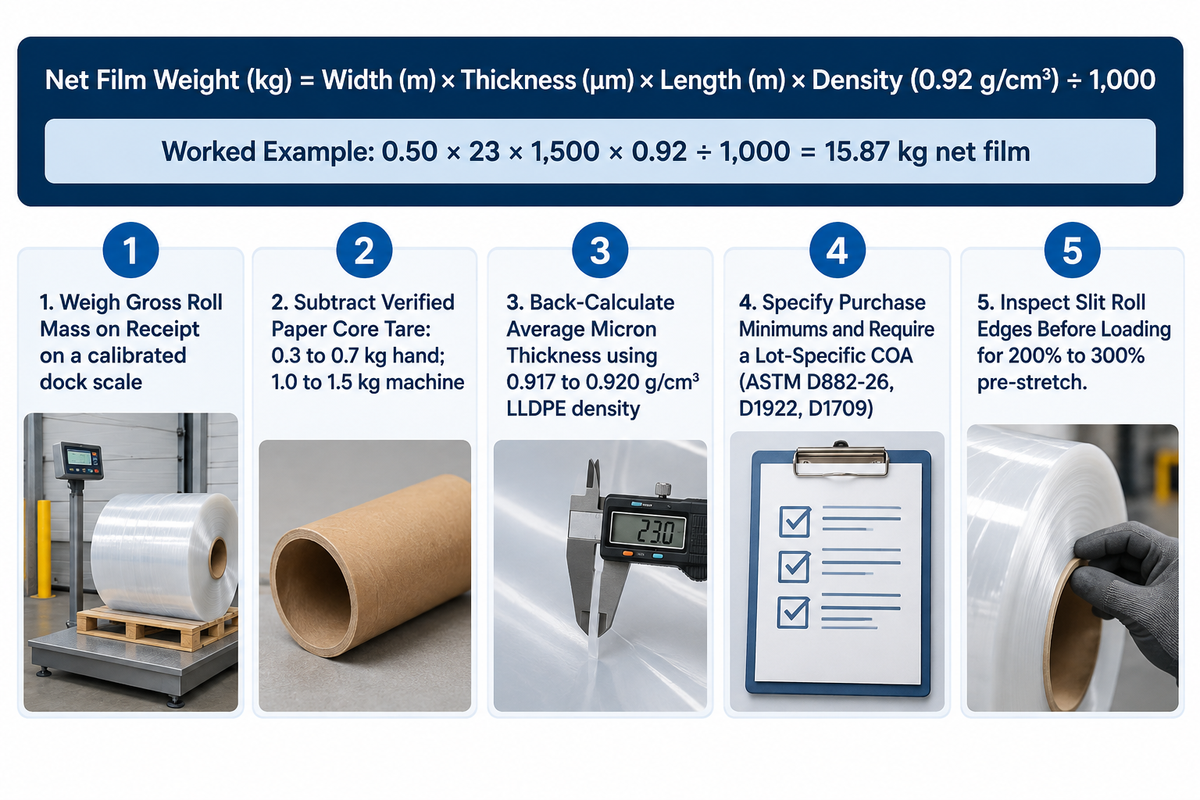
Net Film Weight (kg) = Width (m) × Thickness (µm) × Length (m) × Density (0.92 g/cm³) ÷ 1,000. Worked Example: For a standard machine roll measuring 500 mm (0.50 m) wide × 23 µm (90 gauge) thick × 1,500 m long at 0.92 g/cm³ LLDPE density: 0.50 × 23 × 1,500 × 0.92 ÷ 1,000 = 15.87 kg of net stretch film. Adding a standard machine paper core tare weight of 1.0 to 1.5 kg yields a gross scale weight of 16.87 to 17.37 kg (whereas hand-wrap paper cores weigh 0.3 to 0.7 kg).
Note that this gravimetric roll-weight formula measures whole-roll average thickness (based on 0.917 to 0.920 g/cm³ standard LLDPE density or 0.92 g/cm³ nominal calculation density after subtracting the paper core tare weight); if a supplier TDS specifies a stiffer LMDPE or coextruded density under ASTM D792, substitute that declared density, and pair scale checks with cross-web micrometer profiling to detect localized gauge bands. Additionally, a roll marketed as “equivalent gauge” should never be assumed as true micron thickness when determining net roll weight. For converters buying parent jumbo rolls, we have a guide on stretch film jumbo roll converting to adjust slitting tolerances and core wall weights.
- Weigh Gross Roll Mass on Receipt: Place incoming sample rolls on a calibrated dock scale and record the gross weight in kilograms on the purchase order.
- Subtract Verified Paper Core Tare: Deduct the exact 3-inch paper core tare weight (0.3 to 0.7 kg for hand rolls; 1.0 to 1.5 kg for machine rolls) rather than letting core cardboard count as plastic film.
- Back-Calculate Average Micron Thickness: Divide net film weight (kg) × 1,000 by
Width (m) × Length (m) × the supplier-declared density(such as 0.917 to 0.920 g/cm³ for standard LLDPE or 0.92 g/cm³ nominal) to confirm true average micron thickness matches the purchase order. - Specify Purchase Minimums and Require a Lot-Specific COA: Specify the minimum acceptable values and dimensional tolerances in the purchase specification and require a lot-specific COA to report ASTM D882-26 MD elongation, ASTM D1922 MD/TD tear, and ASTM D1709 Method A dart-drop test results against those limits and tolerances.
- Inspect Slit Roll Edges Before Loading: Reject rolls with telescoped winds, crushed cores, or razor-slit edge nicks that can trigger web breaks at up to 200% to 300% pre-stretch as reported in IPG’s machine-film specifications.
How to Audit Supplier Datasheets and Specify Trial Rolls for Your Wrapping Line

A qualified stretch film supplier should provide complete ASTM method numbers and MD/TD directional splits, show that downgauged or recycled-content (PIR) films meet required tear and pre-stretch limits, and pass a controlled pallet trial measuring actual film grams per skid and 24-hour load containment.
Sustainable packaging design, resin downgauging, and closed-loop recycling are reshaping industrial stretch wrap procurement across global supply chains. According to a 2026 life-cycle assessment published in *Sustainability* (MDPI Sustainability 18(12), 5960), the global packaging film market is projected to grow from USD 105.4 billion in 2024 to USD 159.7 billion by 2033, and switching from a traditional 23 µm virgin film to a 20 µm coreless film containing 30% post-industrial recycled (PIR) LLDPE reduces climate change impact by 15% as reported in the study. However, as patent publication WO2018212962A1 cautions regarding multilayer polyolefin stretch films, aggressive formulation changes aren’t always possible without risking higher waste if mechanical tear and pre-stretch stability aren’t verified first.
Peer-reviewed testing in PMC12656129 notes that some commercial catalog sheets list only five basic items, thickness, roll weight, roll length, pre-stretched length, and pre-stretch percentage, while omitting dynamic load-stabilizing force. Similarly, while manufacturers such as Intertape Polymer Group (IPG) supply both machine-wrap and hand-wrap stretch film grades across 40 to 120 gauge (10.2 to 30.5 microns), public web catalog pages do not confirm which commercial manufacturers publish complete ASTM test-condition data sheets alongside both product lines, so buyers must request the lot-specific ASTM datasheet directly during supplier qualification. ASTM D5458 cling results and the Highlight test-stand ultimate-stretch results (evaluated at 56 m/min or 185 ft/min and referenced alongside ASTM D4649 in WO2018140308A1) are separate measurements taken under stated laboratory conditions; neither result can be extrapolated directly to cold-storage freezers or dusty distribution docks without running a live wrap test. When requesting a quote or trial roll for machine stretch film from UD Packaging, share your wrapper carriage pre-stretch ratio (such as up to 200%, 250%, or 300% as reported in commercial wrapper specifications), pallet dimensions, load weight, and storage temperature so our team can recommend an appropriate cast or blown grade and provide trial rolls for on-site verification.
Frequently Asked Questions
Why do two 80-gauge stretch films with similar ultimate tensile strength fail differently on a 250% pre-stretch wrapper?
Two 80-gauge stretch films fail differently because a 250% pre-stretch carriage (as reported in Lantech’s wrapper guide) operates below the break point, so films with lower second-yield stress, lower common 2% secant modulus per the standard ASTM D882-26, or lower ASTM D1922 Elmendorf tear resistance propagate edge nicks into web breaks. Under ASTM D882-26, ultimate tensile strength is recorded at final specimen rupture, while 470% to 650% is the corresponding MD elongation range reported for the 0.8 mil cast-film formulations in US6265055B1.
How can a receiving warehouse verify stretch film thickness if the supplier TDS only lists typical values?
Weigh the incoming roll on a calibrated scale, subtract the 3-inch paper core tare weight (0.3 to 0.7 kg for hand rolls or 1.0 to 1.5 kg for machine rolls), and apply the gravimetric mass-balance formula: Net film weight (kg) = width (m) × thickness (µm) × length (m) × 0.92 g/cm³ ÷ 1,000. A standard 500 mm × 23 µm × 1,500 m roll yields 15.87 kg of net film.
What is the difference between ASTM D1709 Method A and Method B dart drop values on a stretch film datasheet?
ASTM D1709 Method A drops a 38.1 ± 0.13 mm hemispherical dart head from a height of 0.66 ± 0.01 m, whereas Method B drops a larger 50.8 ± 0.13 mm polished stainless steel dart head from 1.50 ± 0.01 m. Because both the dart geometry and kinetic drop energy differ, Method A and Method B gram ratings cannot be compared directly across supplier datasheets.
Why is machine direction (MD) Elmendorf tear lower on cast LLDPE film than on blown LLDPE film of the same gauge?
During cast extrusion, rapid chill-roll quenching draws the molten LLDPE web lengthwise, aligning polymer chains along the machine direction (MD). In US6265055B1 Table 1, the 0.8 mil (80 gauge) cast structures show ASTM D1922 MD tear of 230 to 320 g and TD tear of 560 to 580 g as the reported tear-force values.
When should a buyer require a batch Certificate of Analysis (COA) instead of relying on a standard stretch film TDS?
Require a lot-specific Certificate of Analysis (COA), rather than relying on a standard stretch film technical data sheet, whenever operating automated wrappers at up to 200% to 300% pre-stretch (as reported in IPG’s machine-wrap specifications), shipping heavy export pallets, or enforcing net roll-weight and micron thickness tolerances. A standard technical data sheet lists non-binding typical values for product screening, while the purchase specification sets the minimums or tolerances that a lot-specific COA reports against.
Need help matching a stretch film technical data sheet to your pallet wrapper’s pre-stretch ratio, load geometry, and net roll-weight tolerances? Contact UD Packaging to review your target specifications and arrange sample rolls via our UD Packaging contact page.
References & Sources
- NCBI PubMed Central (PMC12656129, Sensors 2025), Evaluation of 15 µm, 17 µm, and 23 µm LLDPE Stretch Films and Pre-Stretch Containment Forces
- BioPDI, ASTM D882-26 vs. ISO 527-3:2018 Tensile Testing of Thin Plastic Films and ASTM D618-21 Procedure A Conditioning
- ASTM International, ASTM D4649-20(2025) Standard Guide for Selection and Use of Stretch Wrap Films
- ASTM Subcommittee D10.25, Stretch Wrap Films Pull-Plate Evaluation at 60 Seconds and 24 Hours
- Industrial Physics, Falling Dart Impact Testing (ASTM D1709 Method A vs. Method B Specifications)
- US Patent US6265055B1, Multilayer Cast LLDPE Stretch Cling Film 0.8 Mil (80 Gauge) ASTM D792, ASTM D882, ASTM D1922, ASTM D1709, ASTM D5458, ASTM D1894, and ASTM D1003 Property Table
- WIPO Patent Publication WO2018140308A1, Multilayer Stretch Film ASTM D882, ASTM D1922, ASTM D1709, ASTM D5748-95, and ASTM D4649 Test Methods
- Lantech, Blown vs. Cast Stretch Film Manufacturing, Market Share, and 250% Pre-Stretch Thinning
- TCD Tape, Stretch Wrap Gauge, Mil, Micron, and Millimeter Conversion Chart
- Intertape Polymer Group (IPG), Cast and Blown Machine and Hand Stretch Film Specifications
- Tuosheng Pack, Gravimetric Stretch Film Roll Weight Formula and Core Tare Reference
- Packaging Digest, Five-Layer Cast Metallocene Stretch Film at 300% Pre-Stretch
- MDPI Sustainability (2026, 18(12), 5960), Life-Cycle Assessment of Downgauged and 30% PIR LLDPE Stretch Films
- WIPO Patent Publication WO2018212962A1, Multilayer Stretch Film Formulation and Mechanical Stability