Get in touch with UD Packaging Company

Updated November 2026
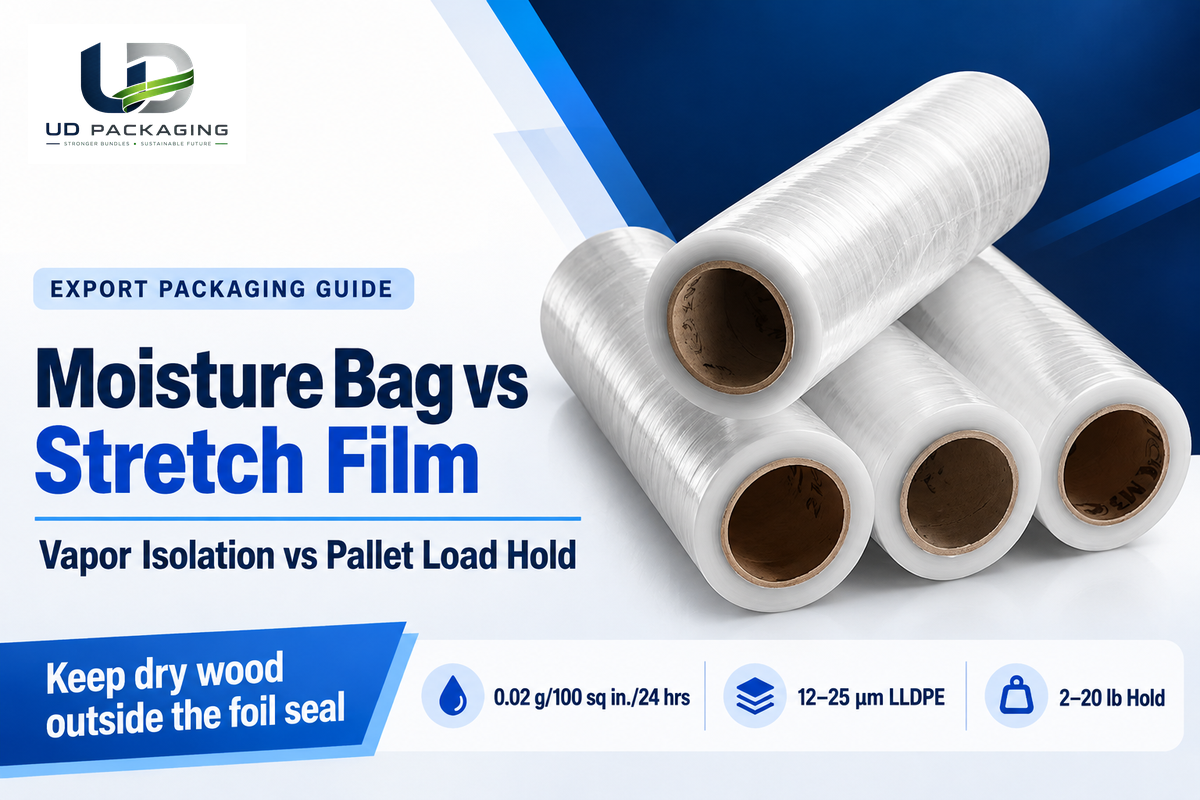
In moisture bag vs stretch film selection, 3D Barrier Bags’ MIL-PRF-131L Class 1 summary caps post-flex material WVTR at 0.02 g/100 sq in./24 hrs (73 ± 3 °F, 50 ± 5% RH conditioning; state WVTR chamber °C/% RH on POs). Over a 150 ft wrap path, The Cary Company’s 80-gauge SKUs #81B1X5 and #81BJB3 yield $0.93–$2.59 per pallet in film.
Ocean freight carrying hygroscopic electronics or machined steel often pairs both packaging solutions in separate mechanical lanes. An inner 3D foil liner encapsulates dried cargo and desiccant and is placed on a smooth slip sheet. Outer elastic plastic film and polyester strapping then secure the shrouded load onto a kiln-dried wooden pallet.
Export rule of thumb: use tensioned LLDPE wrap alone for dry indoor freight, and keep wooden pallet decks outside any vapor seal. Consider a heat-sealed foil moisture barrier liner with desiccant when container roofs risk cooling below internal dew point or J-STD-033D limits apply (168 hours at ≤ 30 °C / 60% RH for MSL 3 parts).
Moisture Bag vs Stretch Film: Core Export Packaging Boundaries at a Glance
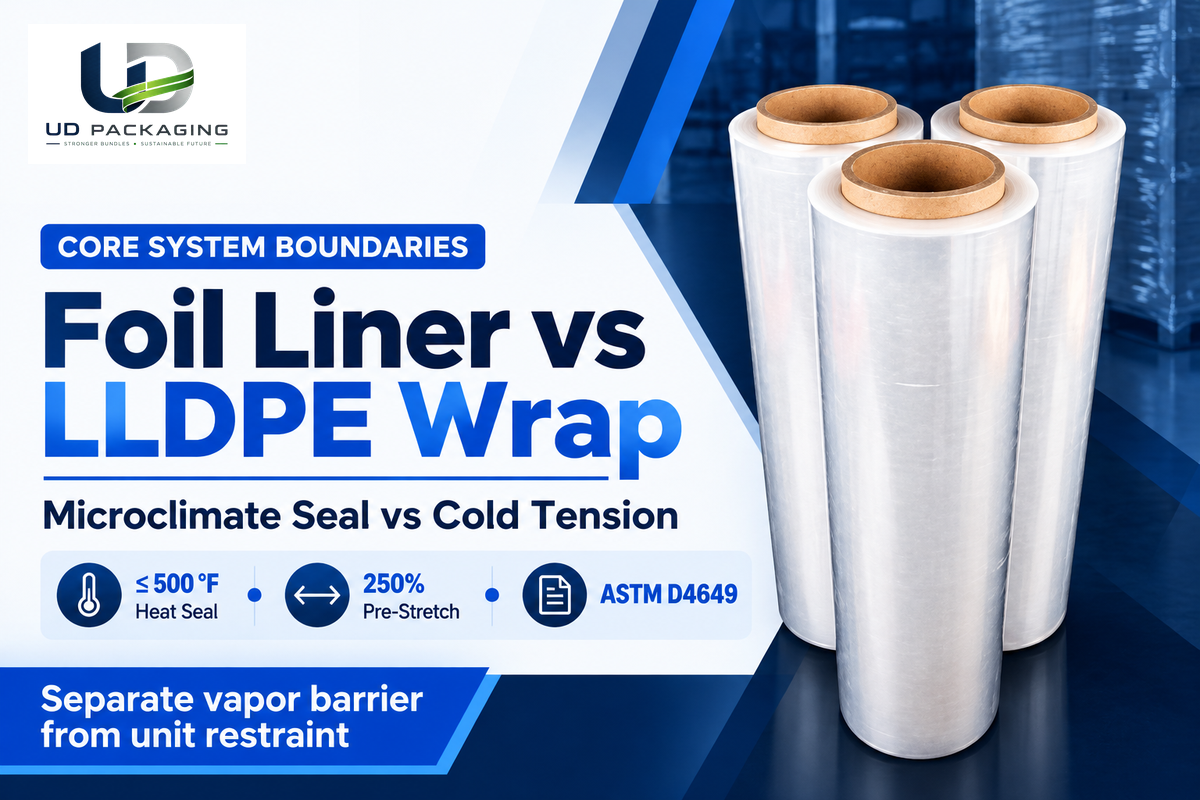
Cargo is isolated from water vapor by moisture barrier bags that are hermetically heat sealed. Stretch film doesn’t use a moisture barrier and uses cold elastic tension for securing loads on pallets which extends from uniform cartons to bulky items. Packaging materials don’t substitute for each other during transport by sea or during humid staging.
Warehouse crews often apply five or six spiral revolutions around export cartons and assume humidity stays outside. Under Scope 1.1 of ASTM D4649-20(2025) stretch-film selection guidance, pallet wrap covers indoor warehouse and closed-vehicle unitizing and excludes outdoor exposure. Buyers ordering industrial hand and machine stretch film separate mechanical load holding from vapor control before issuing RFQs.
| Engineering Parameter | Foil Moisture Barrier Bag | LLDPE Pallet Stretch Film |
|---|---|---|
| Material architecture | 3- to 4-layer laminate (PET or nylon outer, aluminum foil core, PE heat-seal inner) | Mono-material or coextruded cast or blown LLDPE (12–25 µm UD hand range; 60–120 gauge Cary examples) |
| Primary engineering job | Microclimate vapor isolation paired with calculated internal desiccant | Elastic horizontal containment force for unitized cartons and bulky items |
| Water vapor barrier capability | Post-flex WVTR ≤ 0.02 g/100 sq in./24 hrs on MIL-PRF-131L Class 1 material conditioned at 73 ± 3 °F / 50 ± 5% RH (3D Barrier Bags; state WVTR test °C/% RH) | Vapor-permeable polyolefin chains plus open air paths at spiral overlaps |
| Closure and application | Compatible constant-heat or impulse jaws (≤ 500 °F on MIL-PRF-131L material) + vacuum draw | Spiral tension wrapping via turntable/rotary arm machine or manual dispenser |
| Load containment force | Zero elastic recovery; requires an outer carton, crate, or overwrap for restraint | 2–20 lb field containment targets across top, middle, and bottom pallet zones |
| Corner and puncture behavior | 15 lb puncture spec (MIL-PRF-131L Class 1), yet unpadded metal corners cause flex pinholes | High elongation (up to 250% on Cary #81B1X5 machine wrap) absorbs dull box corners |
| Governing reference standards | MIL-PRF-131L, MIL-PRF-81705F, ASTM F1249-25, ASTM F3299, IPC/JEDEC J-STD-033D | ASTM D4649-20(2025) indoor guide, ASTM D882 tensile, ASTM D5459 recovery, ASTM D8314 |
| Published catalog cost per pallet | $48.95 for one 45 × 45 × 90 in. 3D bag ($24.35 at 100+ bags), before desiccant and labor | $0.93 machine wrap ($0.80 at 40+ rolls) or $2.59 hand wrap ($2.30 at 20+ cases) over 150 ft when containment holds |
| Primary misuse failure | Enclosing damp green-wood pallets or skipping corner foam before vacuum draw | Expecting unsealed spiral layers to stop sea-container humidity or condensation |
Sources: ASTM D4649-20 (2025) Scope 1.1, 3D Barrier Bags MIL-PRF-131L Class 1 summary, Cary SKUs #81B1X5/#81BJB3, and SorbentSystems SKU 45VF4MN45SG90PP.
Dry domestic goods packaging calls for a steady applied force in the horizontal plane at the least possible film cost. Ocean export of corrosion-prone assemblies requires a verified level of protection against gaseous humidity prior to container loading.
Why Polyethylene Stretch Wrap Sheds Splashes Yet Needs Barrier Film for Vapor
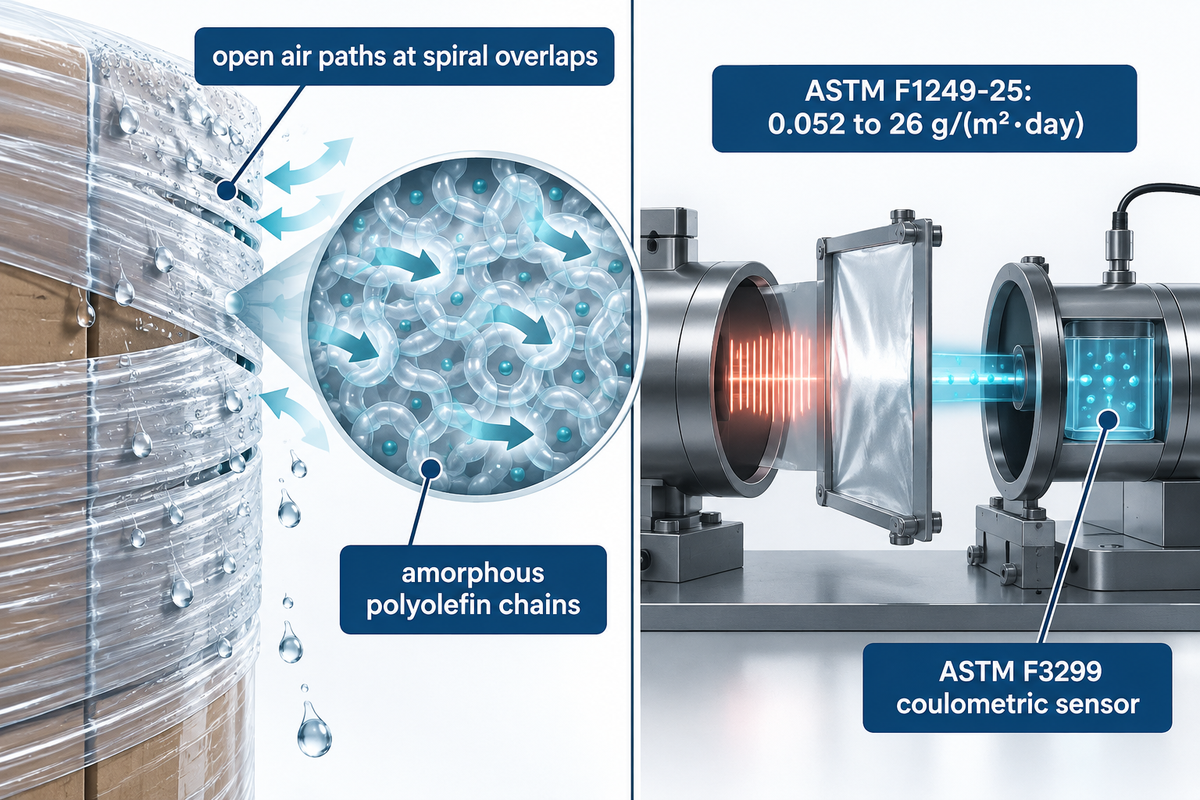
Undamaged LLDPE stretch wrap sheds brief surface splashes when shingle overlaps drain down, however, open seams, punctures, or pooling still admit liquid water. In the meantime, individual water vapor molecules diffuse through the amorphous polyolefin chains and enter unsealed spiral overlaps. Sealed dry packs pair low-permeation barrier film, intact seals, dry cargo, and desiccant, with material WVTR measured under ASTM F1249-25 modulated infrared procedures or ASTM F3299.
Two physical pathways defeat ordinary pallet wrap during humid shipping and storage. First, spiral wrapping leaves open air channels at the pallet deck, top corners and film tail overlaps. Humid air equalizes through those unsealed seams. Second, a heat-sealed single-layer polyolefin bag allows molecular permeation across the polymer wall.
ASTM F1249-25 covers modulated-infrared water vapor transmission testing across flexible films and foils up to 3 mm (0.1 in.) thick. Its published interlaboratory study spans a transmission rate range of 0.052 to 26 g/(m²·day). Note 1 of ASTM F1249-25 warns that doubling film thickness may not halve permeation linearly. Purchase orders for ASTM F1249-25 testing must state exact temperature, relative humidity, and post-flex limits.
Ultra-low permeation electronics or OLED laminates fall below modulated-infrared interlaboratory floors. Laboratories test those films under ASTM F3299 using a coulometric phosphorus pentoxide (P₂O₅) sensor (per AMETEK MOCON technical guidance). That sensor verifies extreme barrier properties to protect products over multi-week voyages, trading longer baseline leak recalibration for trace sensitivity.
Can Water Go Through Plastic Bags?
Polyethylene bags are able to block liquid water during brief contact with a surface. However, water can still enter through seams, pinholes and standing water. Water vapor is able to permeate through the walls of standard polyolefin films on a daily basis. Whether ocean cargo needs a foil barrier liner with desiccant depends on product moisture sensitivity, primary packaging, and voyage exposure.
Loading-dock rain beading on clear wrap misleads many buyers into skipping vapor liners. Surface tension clusters liquid droplets on intact film, yet vapor molecules migrate through polymer free volume whenever outside vapor pressure exceeds package air.
Container Rain and Pallet Sweating: When Ocean Freight Needs a Sealed Foil Barrier Bag
For moisture-sensitive ocean cargo, a heat-sealed foil moisture barrier bag with desiccant provides a dry enclosure when its barrier performance, seals, and desiccant capacity keep internal humidity below the cargo’s tolerance throughout transit. Container desiccants, VCI films, or climate-controlled transport offer alternative moisture defense depending on primary packaging and route exposure. Foil dry packs also protect surface-mount electronics under IPC/JEDEC J-STD-033D, where MSL 3 floor life is 168 hours at ≤ 30 °C / 60% RH.
“It is important to note that heat treating a pallet is not the same as kiln drying it.”
Center for Packaging and Unit Load Design, Virginia Tech, White Paper #3: Moisture in Sea Containers
Daytime sun heats steel ocean containers and drives moisture out of wooden pallets, container floors, and corrugated cartons. Nighttime cooling then drops steel roof panels below the internal dew point. Water droplets rain onto upper tiers. Virginia Tech reports that green-wood pallets carry 50% to 100% moisture content, often over 10 pounds of water, versus ~19% in kiln-dried pallets.
Export shippers frequently report condensation trapped under tight wrap when warm warehouse pallets cool rapidly at sea without airflow. Pre-loading container guides from Desiccant.com advise verifying wood container floors below 18% to 20% moisture before stuffing. Hygroscopic materials sorb vapor across any humid air toward equilibrium. Desiccant.com and a 2026 instrument reliability study cite ~60% RH as a common benchmark for rising mold, corrosion, and failure risk. Under IPC/JEDEC J-STD-033D, parts exceeding floor life require baking per standard thickness, MSL, and exposure tables. Neotel’s summary illustrates a 192-hour, 40 °C carrier-tape schedule where tape distortion limits oven heat. Dry storage below 10% RH pauses the floor-life clock.
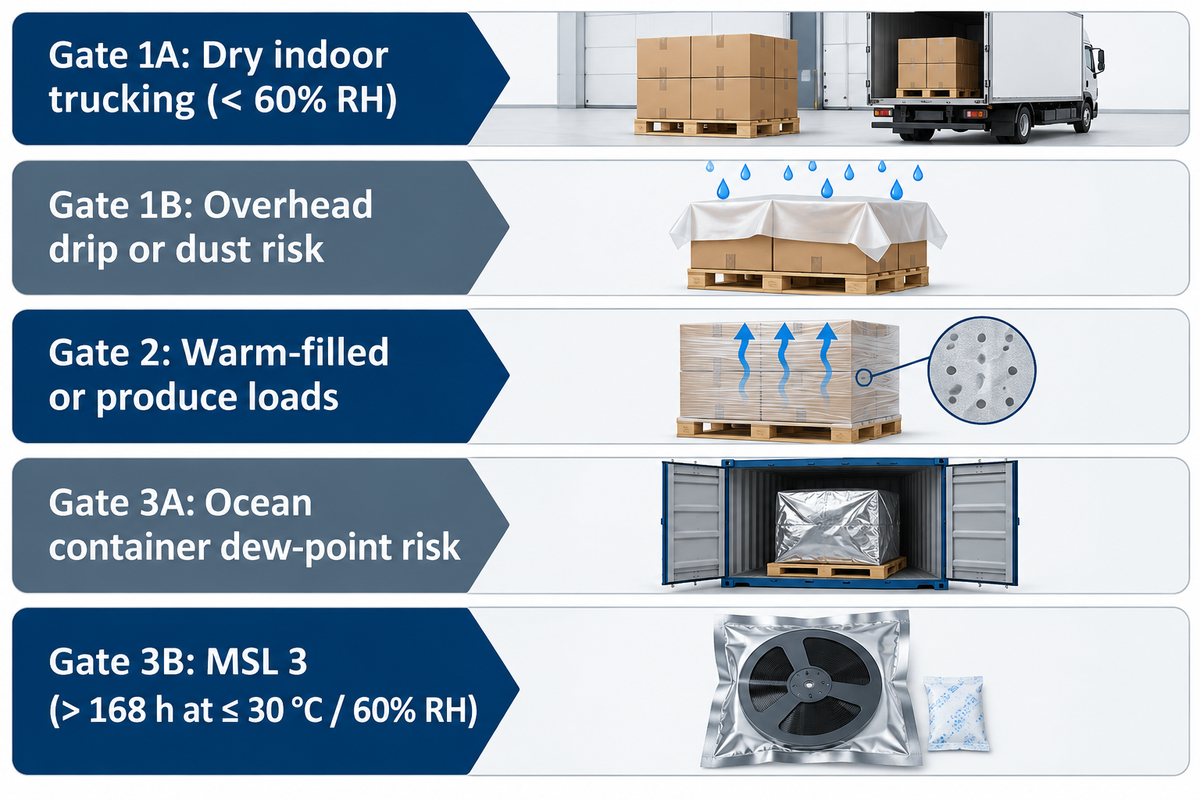
Run each export shipment through the 3-Gate Dew-Point & Restraint Selector (five scenario rows across Gates 1-3) below. Generally, loads that sweat internally (e.g. agricultural or bottled loads) need vented stretch film for condensation-prone loads rather than a solid film.
| Gate Condition & Cargo Profile | Moisture Defense Mechanism | Recommended Packaging Setup |
|---|---|---|
| Gate 1A: Dry indoor trucking, non-hygroscopic goods (< 60% RH) | Horizontal unitization only; no vapor isolation required | Standard cast or blown LLDPE pallet wrap on inspected dry wood |
| Gate 1B: Dock staging with overhead drip or dust risk | Top-surface liquid shedding without vapor seal | Polyethylene top sheet overlapped under upper stretch-film wraps |
| Gate 2: Warm-filled beverages, produce, or hot-stacked cartons | Ventilation during cooling or respiration to release heat and vapor | Vented pallet wrap throughout transit for respiring produce; for non-respiring warm goods, vent until cool and dry before any barrier seal |
| Gate 3A: Ocean freight, precision steel, powders, or optical gear facing container dew-point risk | Hermetic vapor isolation plus DIN 55474 sized desiccant | Heat-sealed 3D aluminum foil liner above slip sheet + outer stretch wrap |
| Gate 3B: Moisture-sensitive surface-mount devices (e.g., MSL 3 > 168 h at ≤ 30 °C / 60% RH) | Vapor barrier + ESD/EMI shielding + < 10% RH dry-pack pause target (bake per J-STD-033 tables if expired) | MIL-PRF-81705F Type I, Class 1 barrier bag + humidity indicator card |
Multi-Layer Moisture Barrier Laminates vs Cast and Blown LLDPE Construction
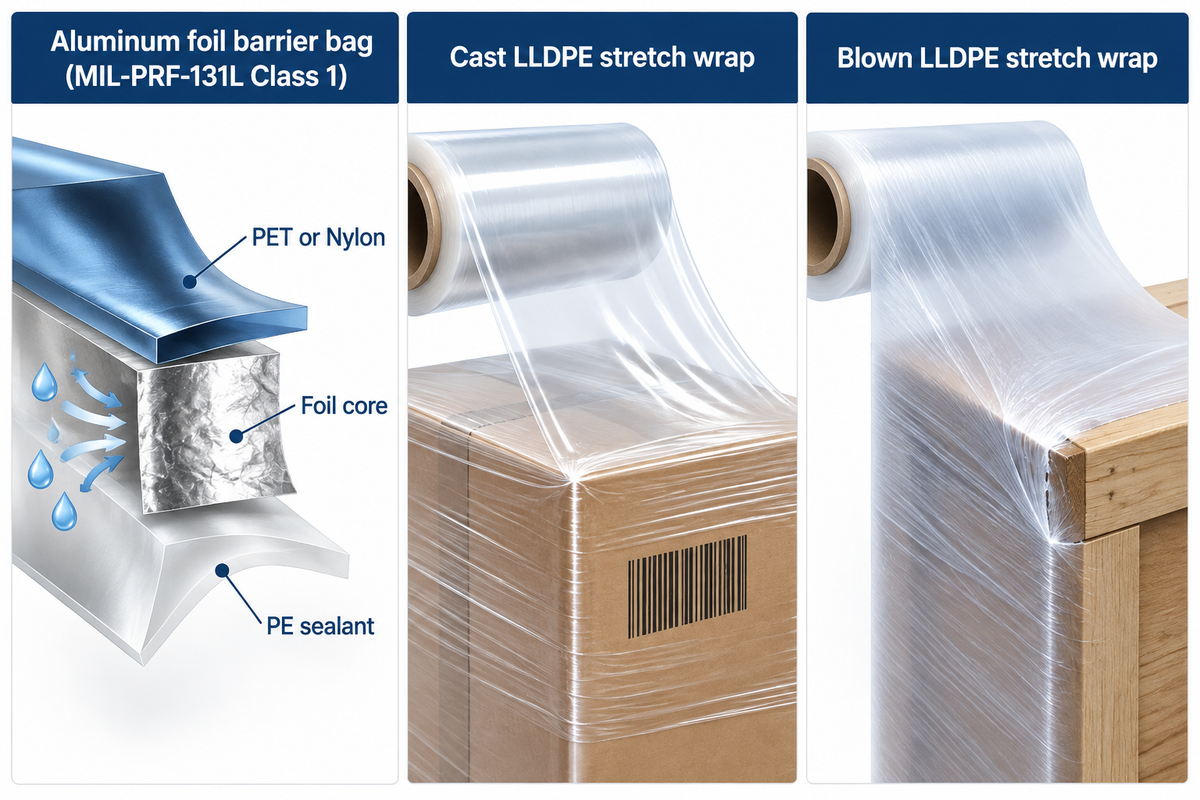
Export moisture barrier bags bond a polyester or nylon outer ply to dead-soft aluminum foil and a heat-sealable inner ply to form a multilayer laminate (e.g. 4.0 mil SorbentSystems PalletPAK). On the other hand, cast and blown pallet wraps consist of mono-material or coextruded LLDPE without a metallic barrier core.
Military dry-pack specifications stipulate laminate durability after creasing. Under MIL-PRF-131L Class 1 (updated April 2022 over MIL-PRF-131K, per 3D Barrier Bags summaries), post-flex WVTR stays at or below 0.02 g/100 sq in./24 hrs in a 73 ± 3 °F, 50 ± 5% RH conditioning atmosphere. Low-temperature flexing caps WVTR at 0.03 g/100 sq in./24 hrs. Qualified laminates also meet 50 lb/in breaking strength, 15 lb puncture resistance, and seam sealing at 500 °F or less.
Circuit boards require anti-static and electromagnetic shielding, as well as vapor control. Protective Packaging Ltd. says that MIL-PRF-81705F Type I, Class 1 regulates flexible barrier materials to control water vapor, ESD, and EMI simultaneously. Packaging Compliance Labs (PCL) describes Gelbo flex testing as per ASTM F392, Standard Practice for Conditioning Flexible Barrier Materials for Flex Durability. Labs use it as an R&D tool to assess relative flex durability of nonporous, flexible film.
| Film / Laminate Format | Layer / Extrusion Build | Vapor & Static Role | Best Mechanical Use |
|---|---|---|---|
| Aluminum foil barrier bag (MIL-PRF-131L Class 1) | PET or Nylon / Foil core / PE sealant (e.g., 4.0 mil PalletPAK) | ≤ 0.02 g/100 sq in./24 hrs post-flex WVTR (73 ± 3 °F / 50 ± 5% RH conditioning per 3D Barrier Bags); non-ESD | 3D pallet liners, crate liners, multi-week ocean freight |
| ESD barrier bag (MIL-PRF-81705F Type I, Class 1) | Conductive outer / Foil barrier core / Static-dissipative inner | Combined water vapor, ESD, and EMI protection | Smaller items such as SMT reels, PCBs, and avionics modules |
| Metallized PET barrier pouch | Vacuum-deposited aluminum on PET + PE heat-seal layer | Moderate vapor barrier; more prone to flex pinholes than solid foil | Short-duration dry packs and inner carton pouches |
| Cast LLDPE stretch wrap | LLDPE cast film route selected for optical clarity and smooth unwind | No vapor barrier rating; splash and dust cover only | Quiet unwind (up to 75% less noise per Cary), barcode scanning, uniform loads |
| Blown LLDPE stretch wrap | LLDPE blown film route with higher optical haze and unwind noise | No vapor barrier rating; unsealed spiral overlaps remain open | Tear-resistance route evaluated on irregular, sharp-edged pallet loads |
What Is the Difference Between Cast and Blown Stretch Film?
Cast stretch film provides clear barcode visibility and smooth release that reduces warehouse unwind noise up to 75% (per The Cary Company). Blown stretch film presents increased unwind noise and optical haze, and is better suited for loads consisting of irregular, sharp-edged materials (per UD Packaging).
Evaluating thicker and stronger blown machine stretch film rolls alongside corner boards helps limit corner tearing on rough crates. Sharp protrusions still call for an on-load puncture trial as film construction alone doesn’t guarantee load retention.
Stretch Film Gauge, Pre-Stretch, and Indoor Restraint Limits Under ASTM D4649
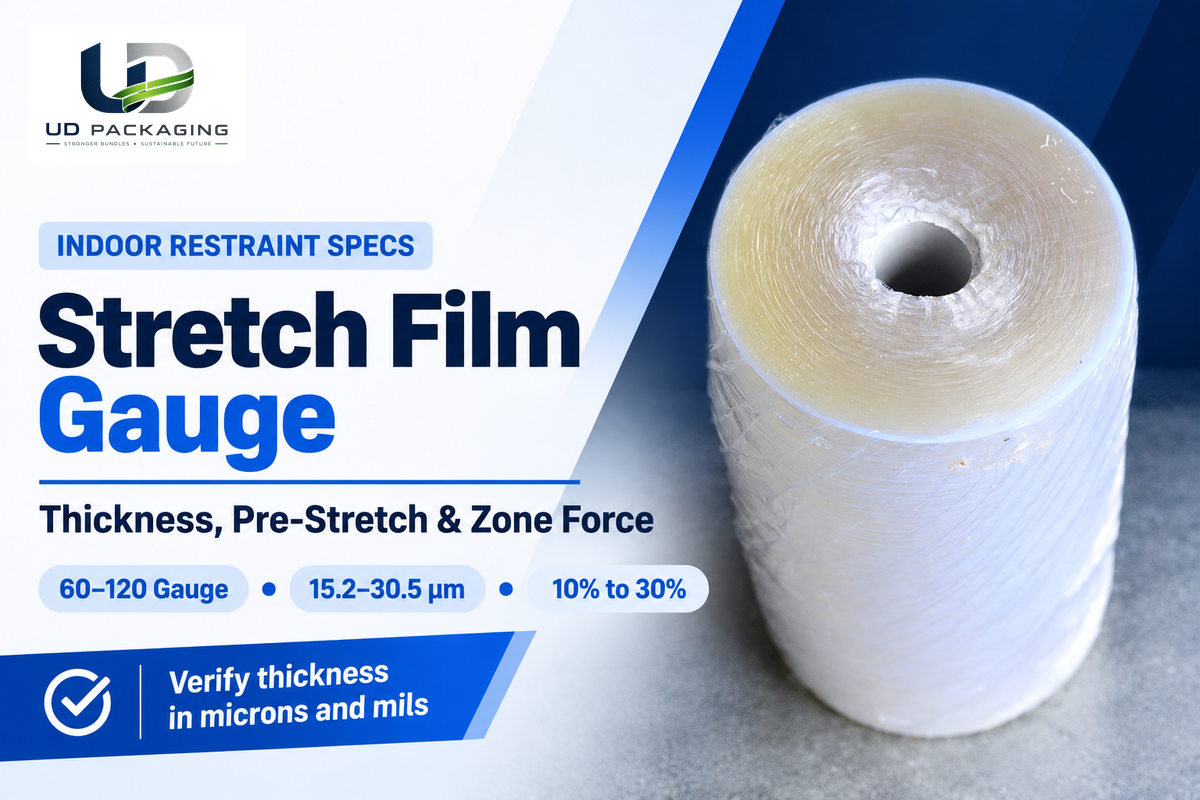
Nominal gauges, 60 gauge (0.6 mil / 15.2 µm), 80 gauge (0.8 mil / 20.3 µm), and 120 gauge (1.2 mil / 30.5 µm), describe film thickness alone; containment force and tear performance also reflect film formulation, applied stretch, wrap count, and load geometry.
Reliable load retention matches film gauge, pre-stretch ratio, and wrap-force targets across top, middle, and bottom zones. According to Lantech’s quotation of ASTM D4649 Paragraph 12.1, the test methods in Annex A1 are not ASTM standards. Lantech field audits suggest starting containment targets: 2–4 lb for light loads, 5–7 lb for stable cartons, 8–12 lb for unstable cases, and 12–20 lb for slick bottles. Add 10% to 30% extra force at the pallet base.
Consistent force control cuts both transit shifting and resin waste. In Packaging World’s July 2026 Coca-Cola Consolidated report, automated monitoring covered 11 plants and over 70 wrappers (> 6 million loads yearly). That rollout lowered film spend by 20%, cut film weight by 30% within 0.5 oz variance, and reduced breaks from 5% to 2%.
Clear LLDPE degrades under open-yard ultraviolet rays and sun damage outside ASTM D4649 indoor boundaries. Teams staging freight outdoors review black stretch film outdoor storage limits and verify roll thickness on a mils to microns film thickness chart.
| US Gauge | Mil (in. × 1,000) | Microns (µm) | Cary #81B1X5 Page Reference (Not a Universal Gauge Limit) |
|---|---|---|---|
| 60 Gauge | 0.60 mil | 15.2 µm | Cary #81B1X5 chart lists ~1,300–1,600 lbs on uniform indoor boxes; actual hold depends on stretch and wraps |
| 78.7 Gauge (Metric 20 µm) | 0.787 mil | 20.0 µm | UD Packaging metric reference near US 80-gauge trade label; verify containment on actual load |
| 80 Gauge | 0.80 mil | 20.3 µm | Cary #81B1X5 chart lists ~2,200–2,500 lbs on uniform indoor loads; verify resin, stretch, and wraps |
| 120 Gauge | 1.20 mil | 30.5 µm | Cary #81B1X5 chart lists ~3,400–4,000 lbs on uniform indoor loads; sharp edges require load testing |
What Is Thicker, 60 Gauge or 80 Gauge Stretch Wrap?
Eighty-gauge wrap is 33.3% thicker than 60-gauge wrap, measuring 0.80 mil (20.3 µm) against 0.60 mil (15.2 µm). Heavy 120-gauge wrap steps up to 1.20 mil (30.5 µm). Divide US gauge by 100 for mils, then multiply mils by 25.4 for microns.
Watch for a common catalog typo when comparing various thicknesses for securing and stabilizing loads. Some distributor tables mistakenly print “80 Mil” instead of 80 gauge (0.8 mil). Eighty mils equals a rigid 2.03 mm sheet, 100 times thicker than pallet wrap.
Sealing Foil Barrier Bags Correctly: Desiccant Sizing, Vacuum Padding, and Humidity Cards
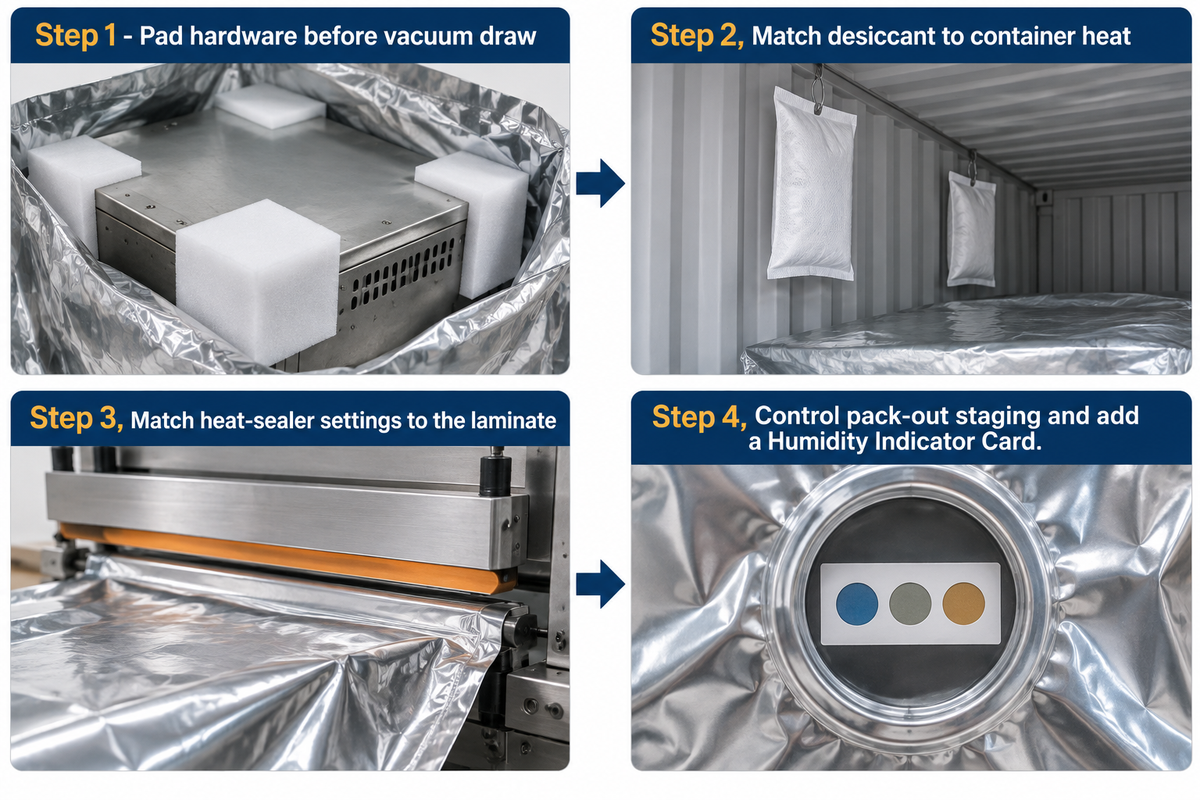
Even a MIL-PRF-131L foil bag fails on the pack floor if sharp metal punctures the laminate or damp wood is inside. Pad sharp edges before vacuum draw and size the desiccant using a documented calculation, such as DIN 55474. Form a tight seal with compatible constant-heat or heavy-duty impulse jaws matched to the sealant ply (≤ 500 °F on MIL-PRF-131L material).
Virginia Tech cites DIN 55474 to size desiccant units from air volume, dunnage mass, bag area, WVTR, and transit days: n = (1/a) × (V·b + m·c + A·e·D·t). Suppose an exporter seals a 6-face 45 × 45 × 90 in. foil bag (20,250 sq in., or 202.5 hundred-sq-in. units) at 0.02 g/100 sq in./24 hrs for 35 days. Vapor permeation across the intact bag totals 202.5 × 0.02 × 35 = 141.75 g. A green-wood pallet holding 10 lb (4,536 g) of water carries 32.0 times that 35-day permeation total inside the bag as the wood dries.
- ✔Step 1 – Pad hardware before vacuum draw: closed-cell PE foam padding stops vacuum pressure from pulling foil into flex pinholes.
- ✔Step 2, Match desiccant to container heat: silica gel adsorbs 20%–30% of its weight in lab air, while bentonite clay (e.g., 5 lb / 80-unit SorbentSystems LDT800-01) suits dry packs below 50 °C. Calcium chloride locks vapor into brine gel along container walls.
- ✔Step 3, Match heat-sealer settings to the laminate: calibrate constant-heat or compatible industrial impulse jaws for temperature, pressure, and dwell (≤ 500 °F on MIL-PRF-131L material) to protect component shelf life.
- ✔Step 4, Control pack-out staging and add a Humidity Indicator Card: Desiccare audits state that open bench staging pre-saturates sorbent prior to sealing. Add a multi-spot Humidity Indicator Card inside a sight window to verify packaging needs upon arrival.
Combining Both Systems: Inner Foil Barrier Liner Plus Outer Stretch Film Load Restraint
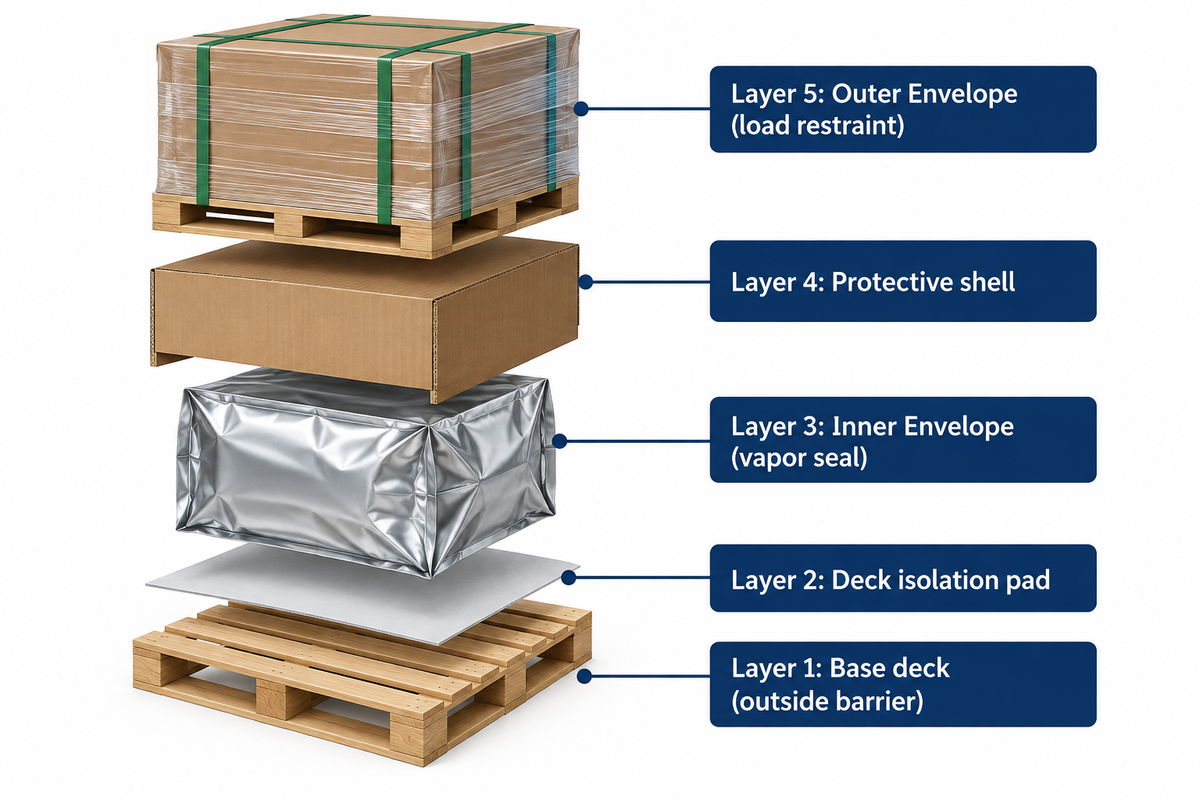
Export packers protect goods during storage and transportation via the 2-Envelope Export Pallet Architecture. Dry cargo is housed in a 3D heat-sealed foil liner, seated on a smooth slip sheet over a wood deck. A corrugated shroud is placed over the bag, and an external PET Strap and stretch wrap secure the load.
Never pull an aluminum barrier hood down around pallet stringers or fork pockets. Forklift blades and deck splinters rip the bottom vapor seam on the first pickup. For assemblies containing moisture- and reflow-sensitive devices (MSL 2–6), Neotel notes that automotive (IATF 16949), medical (ISO 13485), and aerospace (AS9100) quality systems reference J-STD-033. Customer audits check MSD handling against that standard rather than general non-electronic cargo. Preserving the inner seal requires that mechanical restraints be placed outside the shroud.
| Assembly Layer | Material Specification | Mechanical or Vapor Job |
|---|---|---|
| Layer 1: Base deck (outside barrier) | ISPM-15 kiln-dried wooden pallet (~19% MC) or plastic export pallet | Keeps fork openings clear and excludes wood moisture from the foil bag |
| Layer 2: Deck isolation pad | Heavy double-wall corrugated pad or high-density PE slip sheet | Prevents nail heads and deck board edges from abrading the bottom foil panel |
| Layer 3: Inner Envelope (vapor seal) | 3D gusseted foil barrier bag + foam corner pads + DIN 55474 desiccant + HIC | Hermetic humidity control for goods during storage and transportation |
| Layer 4: Protective shell | Triple-wall corrugated pallet sleeve/cap or plywood export crate | Shields the sealed foil bag from strap cutting and adjacent cargo friction |
| Layer 5: Outer Envelope (load restraint) | PET strap + corner boards + 20 µm LLDPE pallet stretch film (approximately US 80-gauge class) | Locks the outer shell to the pallet base to stabilize freight in sea motion |
Specialized barrier converters, including 3D Barrier Bags Inc., Protective Packaging Ltd., and SorbentSystems (IMPAK), manufacture Layer 3 foil moisture barrier liners. For Layer 5 outer restraint, UD Packaging produces PET strap lines in-house and offers cast, blown, and pre-stretched LLDPE pallet wrap. Teams combining strapping and film on heavy crates follow how to strap a pallet before release so straps anchor through stringers before overwrapping.
Shrink Wrap, Cling Wrap, and Food Packaging Films: Clearing Up Adjacent Confusion
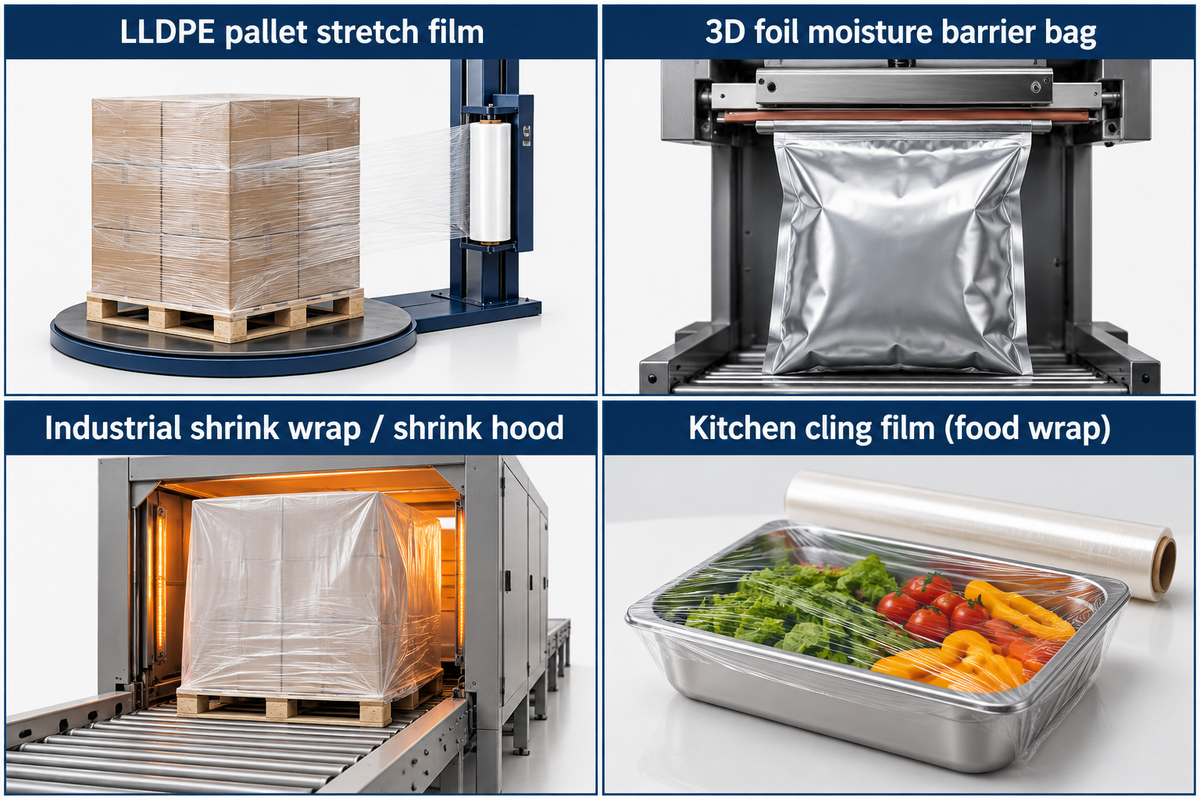
Purchase orders tend to lump pallet stretch wrap, heat-shrink hoods, household and commercial kitchen cling film, VCI corrosion film and retail barrier pouches together. Each has different polymers, sealing mechanisms and regulatory approvals. Orders placed by the nicknames used by the shop floor result in failed containment or compliance holds.
Thin PVC or LDPE cling film (plastic wrap or saran wrap) covers food containers during chilled food storage in household and commercial kitchens. Warehouse pallet wrap is a non-food contact highly elastic plastic film built strictly for freight restraint, unless otherwise reviewed for food packaging. Retail dry good pouches that protect food from humidity rely on multi-layer laminates instead of thin dish wrap.
Buyers comparing shrink wrap and stretch film separate heat-tunnel contraction from cold turntable tension. VCI film emits corrosion inhibitors and remains vapor permeable. On indoor docks, polyethylene pallet top sheets shed overhead drips, while breathable pads guide wrapping finished wood without trapping moisture.
| Packaging Film / Bag Type | Polymer / Structure | Application & Closure | Vapor, Splash & Food Scope |
|---|---|---|---|
| LLDPE pallet stretch film | Cast or blown LLDPE (12–25 µm UD hand range; 15.2–30.5 µm in 60–120 gauge Cary examples) with one- or two-side cling | Cold mechanical stretch around palletized cartons | Splash/dust shed only; non-food-contact industrial restraint |
| 3D foil moisture barrier bag | Example build: PET or Nylon / Aluminum foil / PE laminate (4.0 mil PalletPAK) | Compatible constant-heat or impulse seal with desiccant (≤ 500 °F on MIL-PRF-131L material) | Example spec: ≤ 0.02 g/100 sq in./24 hrs post-flex WVTR on MIL-PRF-131L Class 1 material conditioned at 73 ± 3 °F / 50 ± 5% RH (3D Barrier Bags; state WVTR °C/% RH on PO) |
| ESD barrier bag (MIL-PRF-81705F Type I, Class 1) | MIL-PRF-81705F Type I, Class 1 conductive/foil/dissipative laminate | Heat-sealed (with or without vacuum) in an ESD packing station | Combined water vapor, ESD, and EMI shielding for circuit boards |
| Industrial shrink wrap / shrink hood | LDPE or polyolefin heat-shrink film hood | Draped loosely and shrunk with heat tunnel or propane gun | Tight weather/dust hood; vent holes prevent true vapor barrier |
| Kitchen cling film (food wrap) | Thin food-contact PVC or LDPE household and catering sheet | Hand-pulled cutter-box sheet pressed onto dish rims | Direct food-contact cleared; zero pallet restraint strength |
| VCI corrosion stretch film | LLDPE co-extruded with volatile corrosion inhibitors | Wrapped directly around clean bare ferrous/non-ferrous metal | Passivates metal surfaces; still vapor-permeable polyolefin |
| Vented pallet stretch film | Reinforced LLDPE with die-cut macro air vents | Turntable or hand tension wrap on breathable loads | Purges heat and sweat; zero liquid or vapor barrier |
| Polyethylene pallet top sheet | Flat die-cut LDPE or LLDPE dust and drip cover sheet | Laid across top tier and locked under upper stretch wraps | Overhead sprinkler/rain drip shield; open bottom air path |
| Retail barrier food pouch | PET / EVOH, AlOx, or foil / food-grade PE laminate | Form-fill-seal thermal jaws on consumer pack lines | Food-grade oxygen and moisture barrier for retail units |
What Is the Difference Between Stretch Film and Cling Wrap?
Industrial stretch film is an LLDPE freight wrap (such as UD Packaging’s 12–25 µm hand film or Cary’s 80-gauge / 20.3 µm machine SKU #81B1X5 rated up to 250% stretch). Cling wrap, called saran wrap in kitchens, is a thin food contact PVC or PE sheet used to cover kitchen trays and food containers for food storage. Treating stretch film and cling film interchangeably presents compliance and load safety hazards.
Pallet wrapping suitability doesn’t establish direct food-contact compliance; buyers reviewing stretch film and cling specifications run a separate material, migration, and market-regulation review before any food contact (per UD Packaging). Equally, thin kitchen rolls lack the tensile recovery needed on truck freight.
Per-Pallet Cost Worked Example: 80-Gauge Stretch Film vs 3D Foil Moisture Barrier Bag
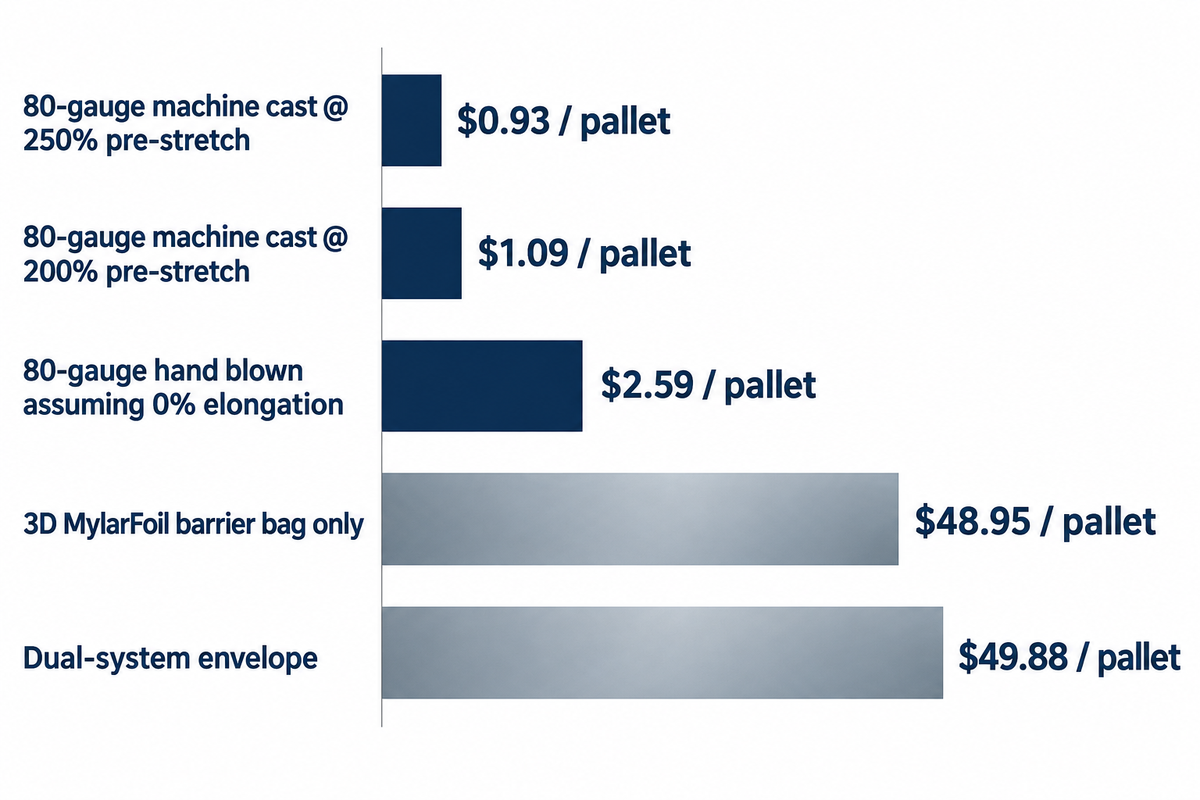
On a 48 × 40 in. pallet carrying a 44 × 38 × 60 in. cargo block, 80-gauge machine wrap (Cary #81B1X5 at 250% pre-stretch) costs $0.93/pallet ($0.80 at 40+ rolls). Hand wrap (Cary #81BJB3 assuming 0% elongation) costs $2.59/pallet ($2.30 at 20+ cases) across the same 150 ft path. Adding a 45 × 45 × 90 in. 3D foil bag lists at $48.95 ($24.35 at 100+ bags) before desiccant and labor.
Assumed inputs: Suppose a packer wraps a 44 × 38 × 60 in. cargo block on a slip sheet atop a 48 × 40 in. kiln-dried pallet. Assume a 150 ft applied film path for costing (10.5 horizontal revolutions around the 44 × 38 in. footprint total 143.5 ft before spiral rise and overlap allowances). Machine film uses Cary Part #81B1X5 (20 in. × 6,000 ft 80-gauge cast: $130.59 for 1 roll; $112.64 at 40+ rolls). Hand film uses Cary Part #81BJB3 (18 in. × 1,500 ft 80-gauge blown, 4-roll case: $103.62 or $25.91/roll; $92.14 at 20+ cases). Barrier bag pricing uses SorbentSystems PalletPAK SKU 45VF4MN45SG90PP (45 × 45 × 90 in., 4.0 mil MylarFoil: $48.95 at 1 bag, $36.10 at 10–24, $24.35 at 100+, excluding 5 lb / 80-unit clay desiccant LDT800-01 and labor).
| Packaging Option & Catalog SKU | Roll / Bag Consumption Formula | 1-Unit / 1-Case Cost per Pallet | Volume-Bracket Cost per Pallet |
|---|---|---|---|
| 80-gauge machine cast @ 250% pre-stretch (Cary #81B1X5, 20″ × 6,000′) | 150 ft ÷ 3.5 = 42.86 ft roll film (0.714% of 6,000 ft roll) | $0.93 / pallet ($130.59 roll) | $0.80 / pallet at 40+ rolls ($112.64 roll) |
| 80-gauge machine cast @ 200% pre-stretch (Cary #81B1X5, 20″ × 6,000′) | 150 ft ÷ 3.0 = 50.0 ft roll film (0.833% of 6,000 ft roll) | $1.09 / pallet ($130.59 roll) | $0.94 / pallet at 40+ rolls ($112.64 roll) |
| 80-gauge hand blown assuming 0% elongation (Cary #81BJB3, 18″ × 1,500′) | 150 ft ÷ 1.0 = 150.0 ft roll film (10.0% of 1,500 ft roll) | $2.59 / pallet ($103.62 / 4-roll case) | $2.30 / pallet at 20+ cases ($92.14 case) |
| 3D MylarFoil barrier bag only (SorbentSystems 45VF4MN45SG90PP, 4.0 mil) | 1 gusseted 45″ × 45″ × 90″ liner per pallet (before desiccant/labor) | $48.95 / pallet (1 bag) | $36.10 (10–24 bags) / $24.35 (100+ bags) |
| Dual-system envelope (3D foil bag + 250% pre-stretch machine wrap) | 1 inner 4.0 mil foil liner + 42.86 ft outer machine cast film | $49.88 / pallet (1-bag + 1-roll list tier) | $25.15 / pallet (100+ bags + 40+ rolls, before desiccant/shroud) |
Published distributor SKU prices exclude desiccant, outer shrouds, labor, and freight across high-volume distribution centers and industrial and logistics networks. Factory-direct containerload roll quotes track bulk resin markets. German LLDPE averaged USD 1,088/MT in Q2 2026 (+1.2% QoQ, Expert Market Research), while US export LLDPE jumped 64% before easing 16% in June 2026 (Price Watch). Pre-stretch savings hold only when target containment force prevents load shifting and re-wraps.
Sourcing Stretch Film vs Barrier Liners and Preparing for 2026 Transit Packaging Rules
Procurement teams break up export RFQs between foil barrier-bag converters and mono-material LLDPE wrap suppliers. Multi-layer foil laminates are used for moisture sensitive export where the container surfaces cool below the internal dew point, prolonged (multi-week) storage elevates the risk of humidity, or J-STD-033D floor-life limits are applicable. Dry freight uses recyclable LLDPE wrap aligned with the 2026 EU and Indian waste rules.
Across the global packaging industry, 2026 regulations favor mono-material polyolefin transit film whenever vapor isolation is unnecessary. The European Commission Packaging and Packaging Waste Regulation (Regulation (EU) 2025/40) entered into force on 11 February 2025 and applies generally from 12 August 2026. As macro context rather than a unit pass/fail test, the Commission reports 186.5 kg per-capita waste (2022) and 42.4% plastic packaging recycling (2024). Its policy overview states an aim to make EU packaging recyclable in an economically viable way by 2030, implemented via phased design-for-recycling criteria before later at-scale recycling stages. It also provides a delegated exemption pathway freeing pallet wrappings and straps from 100% reuse targets, while India’s 2026 Plastic Waste Management Rules mandate Central Pollution Control Board EPR registration and rising annual recycled-plastic targets.
Barrier R&D is moving toward metal-free recyclability while ASTM Committee F02 scheduled October 12–13, 2026 discussions on seal-strength and force-decay leak standards. General Mills patent US20240157690A1 (granted August 4, 2026 as US12697806B2) discloses a metal-free barrier film using 0.1–12 wt.% fumed silica (< 100 nm) in a porous polymer ply. That structure targets flexible pouches first, keeping aluminum foil as the industrial applications workhorse for heavy pallet liners across various industries. On testing schedules, AMETEK MOCON notes that absolute coulometric WVTR methods require longer test cycles because baseline leak rates must be recalibrated before each run. Separately, iTeh Standards’ summary of ASTM D4649-20 states that stretch-film performance characteristics may be negatively affected by extreme temperatures and that the guide excludes outdoor exposure.
The split schedule below shows how suppliers should quote against clearly defined acceptance tests. Please add this to your RFQ.
RFQ checklist — copy these split schedules into your quote request:
| Parameter | Recommended range | Why it matters | How to verify |
|---|---|---|---|
| Stretch film thickness & processing | 12–25 µm UD hand enquiry range (60–120 gauge / 15.2–30.5 µm Cary catalog examples); cast or blown, standard or pre-stretched | Sets indoor tear margin and barcode clarity without 80-mil unit typos | Micrometer check on sample roll + written resin grade |
| Stretch roll width & core ID | 450 or 500 mm hand width (or 20 in. machine); 50 or 76 mm core | Matches manual dispensers and turntable film carriages | Core caliper check + usable length / net film mass on PO |
| Target field containment force | 2–20 lb by load class (+10–30% at pallet base) | Prevents load shift while avoiding pre-stretch over-pull breaks | Consistent pull-plate or wrap-in audit at top, middle, bottom |
| Barrier laminate WVTR & spec class | ≤ 0.02 g/100 sq in./24 hrs post-flex on finished MIL-PRF-131L Class 1 material (73 ± 3 °F / 50 ± 5% RH conditioning per 3D Barrier Bags); or finished MIL-PRF-81705F Type I, Class 1 for ESD/EMI | Bounds daily vapor ingress across multi-week ocean voyages | ASTM F1249-25 or F3299 lab report at stated °C and % RH |
| 3D bag size & heat-seal ceiling | Cargo L × W × H + seal skirt; compatible seal jaws (≤ 500 °F on MIL-PRF-131L material) | Leaves room for corner foam and reworkable top seal seam | Converter seal-jaw temp/dwell sheet + seam peel check |
| Desiccant & pallet base moisture | DIN 55474 unit count + HIC; kiln-dried pallet ~19% MC outside bag | Stops > 10 lb green-wood water from saturating sorbent inside | Pin moisture-meter log (< 18–20% container floor) + HIC check |
Supplier scope note: UD Packaging manufactures PET strapping in-house and supplies mono-material LLDPE hand and machine film (450/500 mm hand widths, 12–25 µm thicknesses, and 50/76 mm cores). Standard terms include 24-hour business-day quotes, free evaluation samples, and 20–25 day production on 30% T/T deposit and FOB delivery. Export aluminum foil moisture barrier bags come from specialized converters such as 3D Barrier Bags Inc., Protective Packaging Ltd., and SorbentSystems (IMPAK), while accredited labs handle WVTR testing.
Frequently Asked Questions
Q: Is stretch film the same as shrink wrap?
No, stretch film doesn’t use heat to unitize pallet loads. Cold elastic tension is used instead.
Shrink wrap is a polyolefin or LDPE hood draped loosely over freight and heated with a propane gun or in a shrink wrap tunnel until tight. Neither spiral pallet wrap nor ventilated shrink wrap replaces a heat sealed aluminum foil moisture barrier bag.
Q: What type of stretch film is used for cold-weather storage?
Freezer warehouses below 0 °C require cold-temperature LLDPE stretch wrap grades conditioned and tested for sub-zero cling and elastic recovery.
Standard warehouse wrap can lose cling or stiffen in freezing air, allowing film tails to loosen. ASTM D4649-20(2025) flags sub-zero and high-heat storage as factors that alter film behavior. Moving cold pallets onto humid docks also triggers surface condensation unless staging transitions are controlled.
Q: Can you use stretch film over a moisture barrier bag on the same pallet?
Yes, export packers pair both layers inside a separated two-envelope pallet build.
First, load dried cargo, corner foam, and calculated desiccant into an open 3D foil liner positioned on a slip sheet above a kiln-dried deck, then heat-seal the bag. Next, wrap the sealed bag with a corrugated sleeve and/or crate wall and secure with PET strapping and stretch wrap.
Q: Are cellophane and polypropylene the same as LLDPE stretch wrap?
Cellophane is a stiff sheet of regenerated cellulose, while BOPP/CPP polypropylene is more suitable for retail overwrapping. LLDPE serves industrial pallet wrap for high elongation and elastic recovery.
Q: Do silica gel packets work inside standard pallet stretch wrap?
No, silica gel saturates rapidly inside unsealed spiral wrap.
Open seam overlaps and vapor-permeable LLDPE walls let outside humid air enter continuously, exhausting packets within hours or days.
Q: What roll and liner specifications should buyers confirm on an export packaging RFQ?
Buyers provide two separate material schedules on export RFQs: an outer unit-load stretch-film schedule and an inner vapor barrier liner schedule, which include lab test methods.
For outer LLDPE wrap, specify hand or machine grade, cast or blown extrusion, thickness in microns and mils (e.g., 20.3 µm / 0.80 mil), pre-stretch ratio, width, length, and 50/76 mm core ID. For inner barrier bags, specify finished MIL-PRF-131L Class 1 material or finished MIL-PRF-81705F Type I, Class 1 material for ESD and EMI shielding. State the post-flex WVTR ceiling (such as ≤ 0.02 g/100 sq in./24 hrs), exact ASTM F1249-25 or F3299 chamber °C and % RH, 3D gusset size, DIN 55474 desiccant units, and multi-spot Humidity Indicator Cards.
About This Export Packaging Analysis
In Jiangyin, Wuxi, Jiangsu Province, China, UD Packaging produces PET strapping and provides cast, blown, and pre-stretched LLDPE wrap for indoor and export pallet unitization. Aluminum Foil Moisture Barrier Liners, VCI bags, and WVTR lab testing are outside UD Packaging’s production. Reviewed by the UD Packaging technical team.
References & Sources
- ASTM D4649-20(2025): Standard Guide for Selection and Use of Stretch Wrap Films ASTM International
- ASTM F1249-25: Standard Test Method for Water Vapor Transmission Rate Through Plastic Film and Sheeting Using a Modulated Infrared Sensor ASTM International
- White Paper #3: Moisture Damage in Sea Containers Center for Packaging and Unit Load Design, Virginia Tech
- Coca-Cola Consolidated Cuts Stretch Film Costs 20% with Automated Monitoring Packaging World
- Packaging and Packaging Waste Regulation (Regulation (EU) 2025/40) European Commission
- US20240157690A1 / US12697806B2: Multilayer Moisture Barrier Film United States Patent and Trademark Office via Google Patents