Get in touch with UD Packaging Company

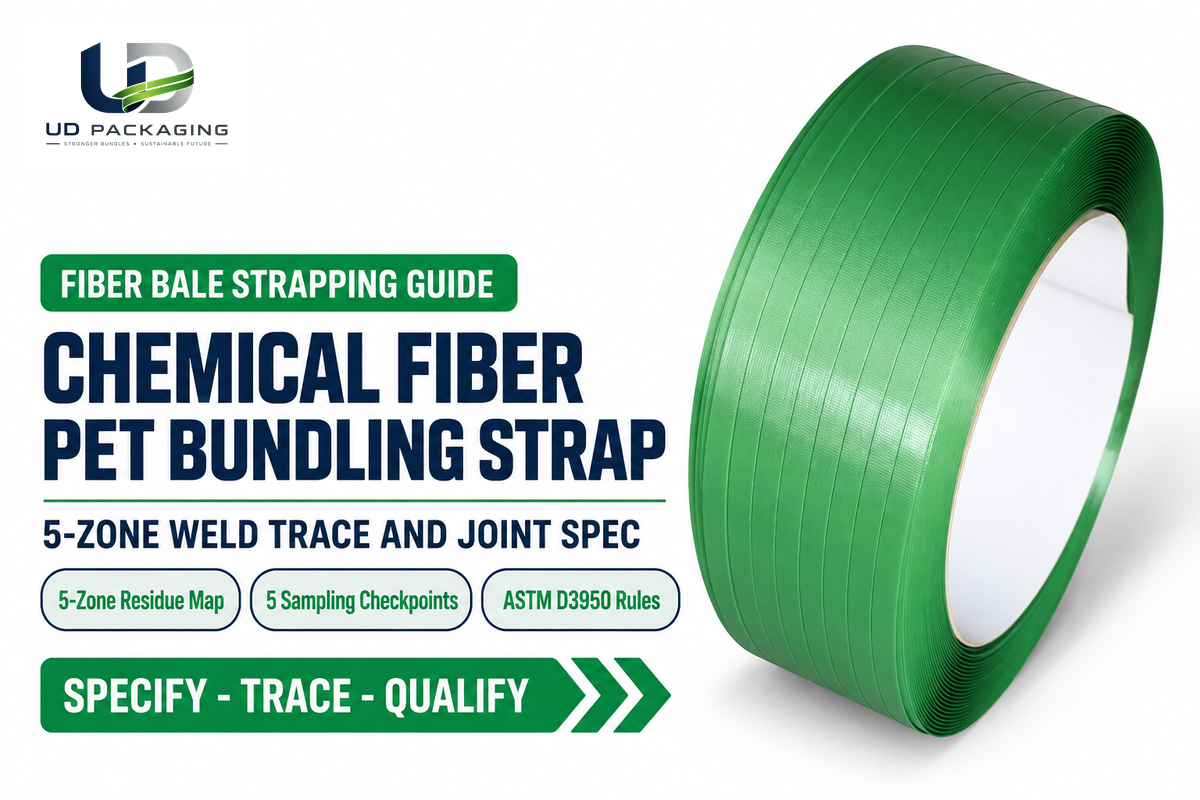
A chemical fiber PET bundling strap is an extruded polyethylene terephthalate band used to hold compressed synthetic fiber bales under high rebound tension. Engineers specify strapping for chemical fiber balers under ASTM D3950-23, which covers nonmetallic plastic bands and joining methods. On synthetic fiber lines, most broken loops fail at the friction weld joint rather than mid-span. Airborne lint and spin finish oils block polymer fusion across five different physical zones. Plant teams and any qualified strap manufacturer prevent transit bursts by pairing our 5-Zone Weld Residue Map with the 6-Field Joint Specimen Trace Code. Together, these tools trace weld failures to exact coil lots and shift cleaning cycles.
Compressed viscose, polyester, nylon, and acrylic bales act like loaded springs when the press platen lifts. According to USPTO Patent US6536336B1, conventional side crimped ties place the joint on the bale side where lateral expansion peaks. That mechanical reality makes clean joint formation and documented sampling more important than buying a thicker roll.
What Is a Chemical Fiber PET Bundling Strap and How Does It Differ from PP and Steel?
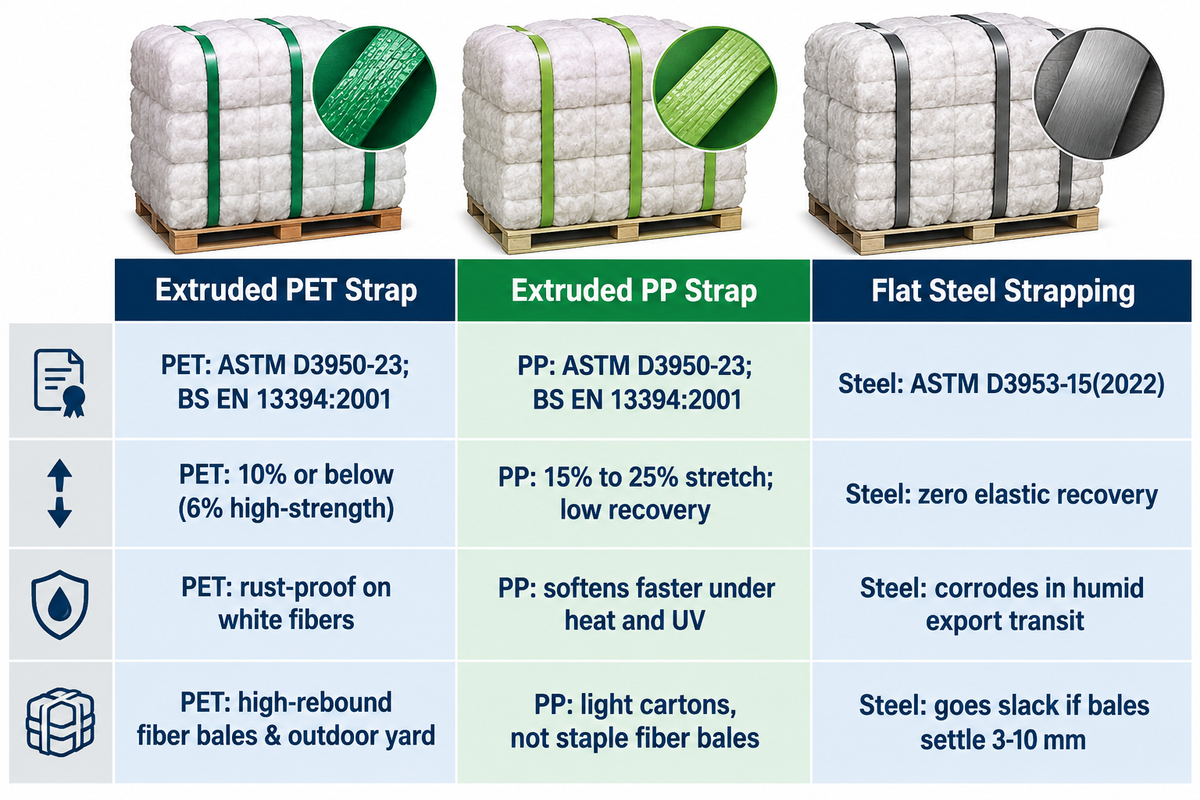
Extruded from polyethylene terephthalate resin, a chemical fiber PET bundling strap holds elongation at 10% or below per Jushuo Packaging, versus 15% to 25% stretch on polypropylene (PP) strap and zero elastic recovery on steel. Standard polyester strap elongates 10% to 15%, while high-strength fiber-grade PET holds stretch at 6% or below. Steel strapping falls under ASTM D3953-15(2022) and delivers high linear strength, yet it goes loose when compressed bales settle during storage and transportation.
Debate swirls over whether cheaper PP strap can sheathe staple fibers, or if traditional steel belts are safer for export containers. In fact, PP tends to lose tension over time with sustained outward bale pressure. Steel bands, on the other hand, go permanently slack if the bale shrinks a few millimeters. Compared to steel, a high-tensile grade polyester removes the recoil hazard while also preventing rust stains on textile fibers. Extruded PET remains durable under harsh conditions and stays resistant across tough environmental conditions. It serves as a highly durable, rust-proof alternative to steel while preventing load shifting across long ocean voyages.
| Property or Decision Factor | Extruded PET Strap (Polyester) | Extruded PP Strap (Polypropylene) | Flat Steel Strapping |
|---|---|---|---|
| Governing Standard Scope | ASTM D3950-23; BS EN 13394:2001 | ASTM D3950-23; BS EN 13394:2001 | ASTM D3953-15(2022) |
| Typical Elongation (Supplier Guides) | 10%–15% standard; ≤10% fiber-grade (≤6% high-strength) | 15%–25% high elongation; low elastic recovery | Minimal stretch; zero elastic recovery on load settlement |
| Rust & Fiber Contamination Risk | Rust-proof; non-staining on white synthetic or viscose fibers | Rust-proof; softens faster under heat and UV rays | Corrodes in humid export transit; sharp edges cut wrap |
| Best Fit in Packaging Scenarios | High-rebound chemical fiber bales, heavy pallets, outdoor yard | Light cartons, everyday packaging, short-term indoor bundles | Rigid hot steel coils or sharp metal loads needing metal bands |
| Primary Limitation | Friction welds drop sharply if lint or spin finish fouls jaws | Not recommended for compressed staple fiber bales due to creep | Goes slack if bales settle 3–10 mm; recoil injury risk |
What Is the Difference Between PET and PP Strapping?
PET (polyethylene terephthalate) strapping displays better tension retention and less creep and stretch, compared to PP (polypropylene) strapping, when used on heavy, industrial loads. Signode differentiates the two polymers clearly. Polypropylene is suitable for light-to-medium cartons and bundles. Polyester, on the other hand, can withstand heavy-duty pallet packing, outdoor UV exposure, and long-distance shipment without losing grip.
In the case of synthetic fiber plants, choosing PP or PET comes down to the cleanliness of the weld. Polypropylene strapping is cheaper per meter for the manual packaging of light boxes. However, its high elongation allows bales of fiber to expand out of shape. PET packaging keeps steady load restraint after press release and resists moisture and temperature swings. For a full polymer trade-off and rebound mechanics, review our dedicated PET vs. PP strapping and PET vs. steel strapping comparisons.
Where Does Fiber Residue Collect Inside a PET Strap Friction-Weld Joint?
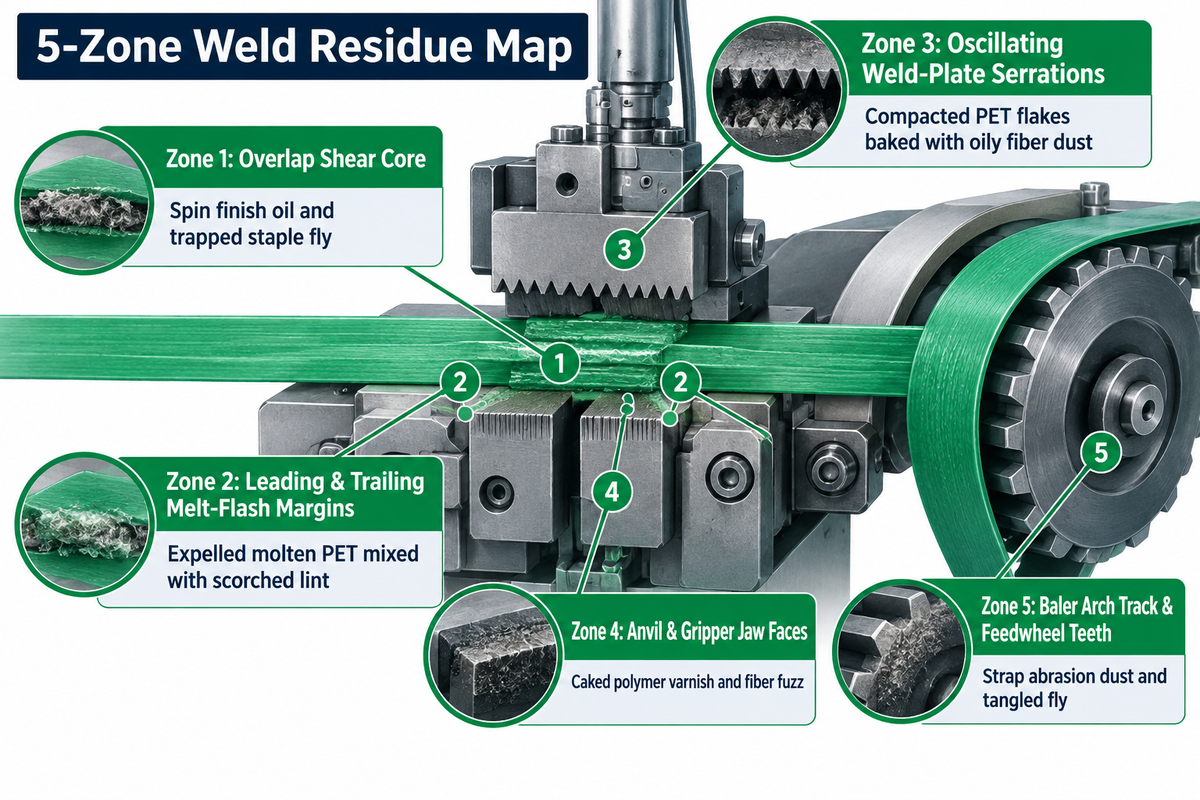
In a friction-welded strapping system, fiber lint, spin finish oil, and abraded PET dust accumulate in five distinct zones: the overlap shear core, melt-flash margins, oscillating weld-plate serrations, anvil and gripper jaws, and the baler arch track with its feed wheel. These zones include the overlap shear core, melt flash margins, oscillating weld plate serrations, anvil and gripper jaws, and baler arch track and feed wheel. Residue in the polymer seam and dust in machine teeth are a good source of information in determining the cause of repeated joint failures.
Friction welding is similar to rubbing two dry hands together to make them warm. A strapping head oscillates between polyester faces until the thermoplastic resin melts and fuses. If there are oil films or degraded layers on the mating polymer surfaces, the friction welding won’t be successful, states TWI Global. In a staple fiber bay, airborne short fibers and spin finish oils from the previous cycle coat the bale wrap and the incoming PET strap. Low surface friction from the oils causes the weld plate to skid instead of melting the resin. Fiber lint and other short fibers can also bridge the seal like splinters in glue. Under forklift shock, these seals can come apart.
“A strapping seal is the weakest point if the strap ends do not join correctly. A load can leave the machine looking secure and still fail during forklift handling if the joint is contaminated, overheated, underheated, or stressed by the wrong tension.”
It’s common for maintenance supervisors to associate joint bursts with the need for a plant to use thicker and more expensive strap for secure bundling. Increasing strap gauge never resolves issues with a contaminated weld interface. Use our 5-Zone Weld Residue Map whenever you pull apart a failed or sampled joint on a synthetic fiber baler.
| Zone & Location | Primary Contaminant | Visual Cue on Cut Specimen | Failure Mechanism | Immediate Source Isolation |
|---|---|---|---|---|
| Zone 1: Overlap Shear Core (center of fused seam) | Transferred spin finish oil and trapped staple fly | Glossy, unmelted spots or embedded white fibers after peel | Cold weld from lost surface friction and blocked fusion | Check bale wrap integrity and open-coil storage dust cover |
| Zone 2: Leading & Trailing Melt-Flash Margins | Expelled molten PET mixed with scorched lint | Dark brown brittle beads or flaky burrs along weld edges | Overheated joint brittleness; sharp burrs slice bale wrap | Reduce weld duration; inspect rPET batch melt stability |
| Zone 3: Oscillating Weld-Plate Serrations | Compacted PET flakes baked with oily fiber dust | Shallow, uneven tooth imprint across outer strap back | Plate skids over top strap; energy fails to reach seam | Lock out head; air-blow and nylon-brush weld-plate teeth |
| Zone 4: Anvil & Gripper Jaw Faces | Caked polymer varnish and fiber fuzz in lower jaws | One-sided fusion; bottom strap shifted during cycle | Uneven clamp pressure and base-plug misalignment | Clean lower gripper; check jaw teeth for rounding or play |
| Zone 5: Baler Arch Track & Feedwheel Teeth | Strap abrasion dust and tangled cotton spinning or synthetic fly | Scuffed longitudinal tracks on strap; slack loop tension | Feedwheel slips before target tension; strap enters dirty | Blow out chutes; brush feedwheel weekly; check wheel wear |
Why Does PET Strapping Fail at the Joint Even When Strap Tensile Strength Passes?
Failure of PET strapping at joints occurs because nominal breaking strength measures unbroken polymer, not the finished welded seam. PeFilmPack points out that joint quality, not datasheet break force, sets the real working limit of a strapped loop.
Two field factors widen this gap on chemical fiber presses. First, USPTO Patent US6536336B1 shows that side-mounted joints sit where lateral bale expansion peaks. See USPTO Patent US6536336B1 for the bale-side lateral pressure analysis. Second, even microscopic oil or lint in Zone 1 will cut the fused area in half and won’t leave an external mark. A loop can look tight after exiting a press, but still unzip when a forklift clamps the bale.
When Should You Sample Bale Joints and How Do You Structure Traceable Specimen IDs?
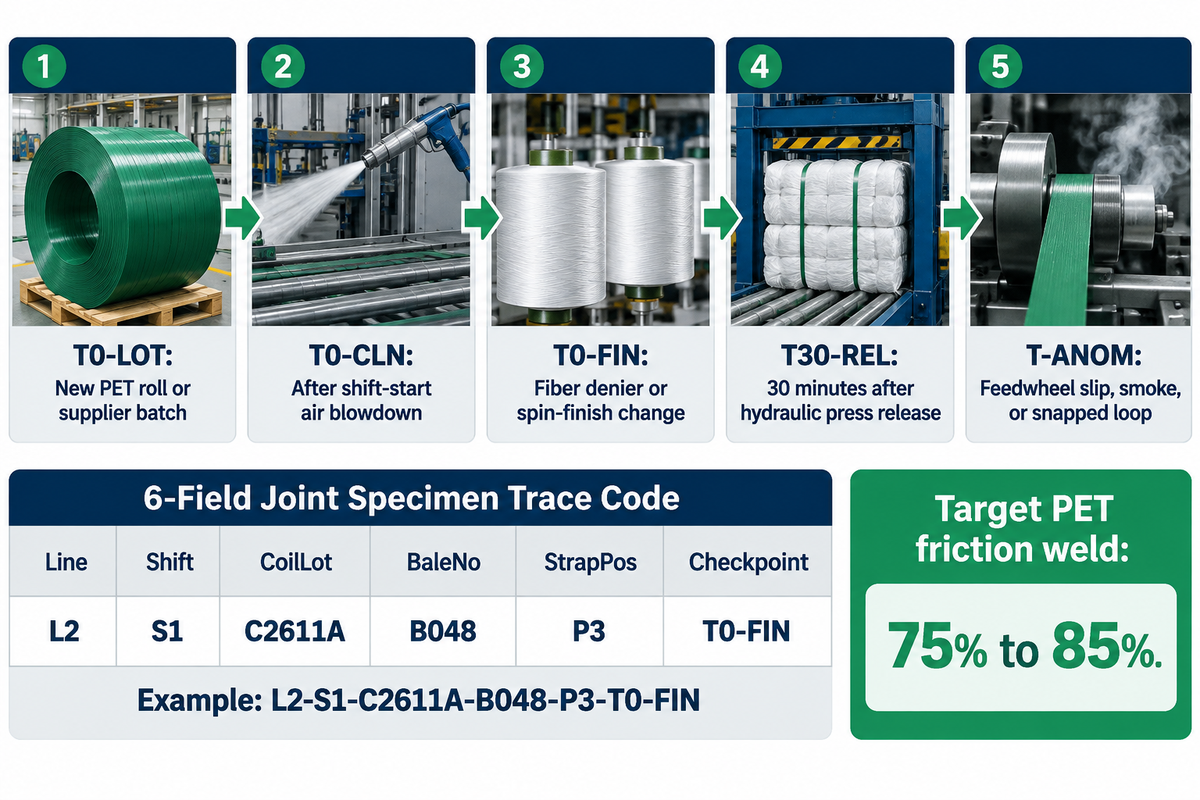
Sample PET strap joints at five triggers: coil lot changeover, post-cleaning shift start, fiber or spin-finish grade switch, 30 minutes after bale release, and any slip event. Tag every cut joint with our 6-Field Joint Specimen Trace Code. Without time-stamped coding, a broken joint found in the warehouse cannot show whether the fault came from an rPET coil or a skipped blowdown.
Quality leads understand baling needs and therefore resist destructive sampling, as cutting a live strap slows baler output. Not every bale needs to be sampled. Targeted sampling at five critical transition points catches most process drift while wasting very few straps in a given shift. Amass transit failure data notes that compressed loads can settle 3 to 10 mm within 48 hours. Combining a visual check of tension with a sampled triggered cut of the bound load catches immediate cold welds, as well as delayed slip.
| Checkpoint Code | Operational Trigger | What to Inspect | Pass / Action Boundary |
|---|---|---|---|
| T0-LOT | First bale after loading a new PET strapping roll or supplier batch | Full-width fusion, weld flash color, straightness feed | Peel test must show fiber-tearing PET bond; quarantine lot if cold weld repeats |
| T0-CLN | First bale after shift-start air blowdown and gripper cleaning | Zone 3 tooth imprint depth and Zone 4 jaw alignment | Baseline reference specimen stored for shift comparison |
| T0-FIN | Change in fiber polymer, denier, or spin-finish oil dosage | Zone 1 oil sheen or unmelted glossy streaks on peeled seam | Wipe strap guides; verify weld time window before full run |
| T30-REL | 30 minutes after bale exits hydraulic press and rebounds | Non-destructive visual check of seam creep, edge indentation, slack | Cut and test if seam shows white stress whitening or edge lift |
| T-ANOM | Any feedwheel slip sound, scorched smoke, or snapped loop | All 5 residue zones plus adjacent straps on same bale | Stop press strapping head; inspect zones 3–5 before resuming |
Tag every cut specimen with an indelible label formatted by our 6-Field Joint Specimen Trace Code: Line-Shift-CoilLot-BaleNo-StrapPos-Checkpoint (for example, L2-S1-C2611A-B048-P3-T0-FIN). Recording StrapPos (positions P1 through P6 across the bale) matters because outer and center straps carry uneven rebound tension. USPTO Patent US6536336B1 notes that hydraulic press leakage loads early-tied straps harder than later ones. Log each code with its residue zone score and pull-test result against the 75% to 85% PET friction-weld efficiency range from Rockcub bench tests (up to 90% on TITAN VK10 heat-sealed heads) under ASTM D3950-23 or BS EN 13394:2001. For clamping setup and damage limits, read our guide on strapping joint strength testing.
How to Specify Width, Thickness, Surface Finish, and Cut Length for Synthetic Fiber Bales
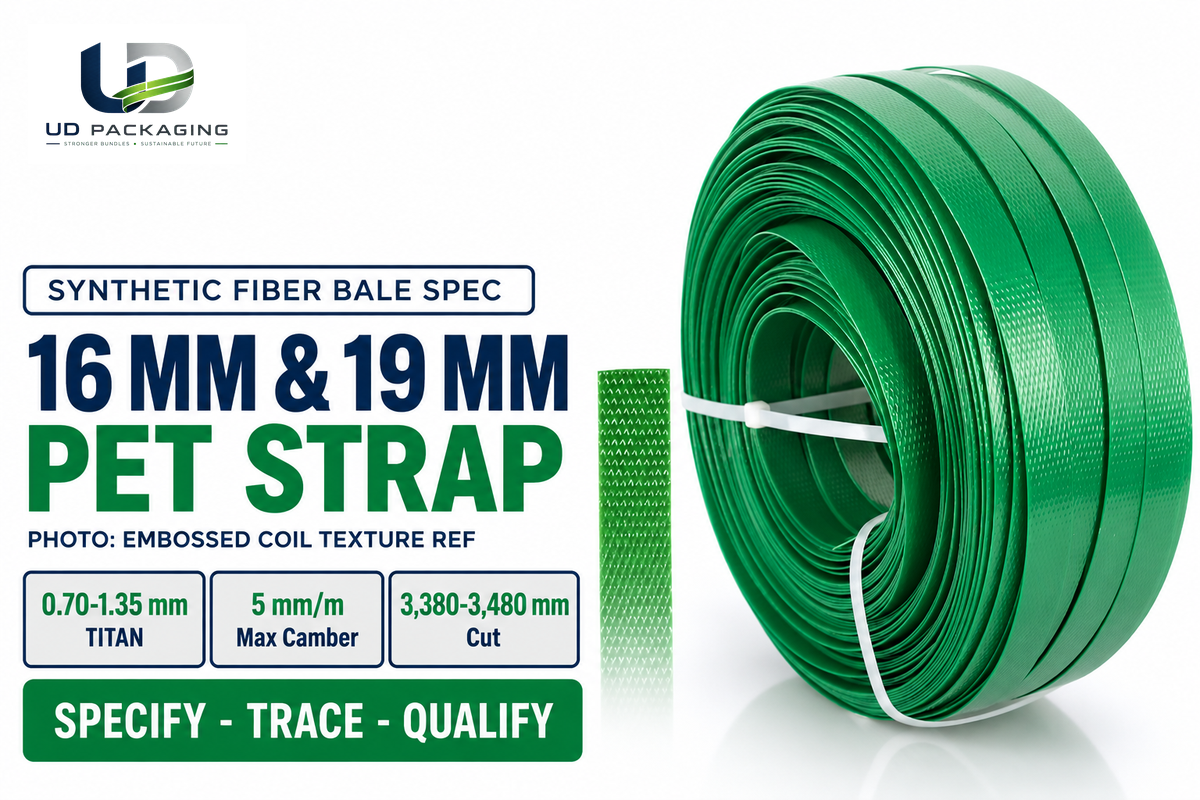
Published OEM and extrusion guides place automated fiber-bale PET straps mainly in 16 mm and 19 mm widths. TITAN specifies 0.70 to 1.35 mm thicknesses for its 16 and 19 mm fiber straps, while Jushuo Packaging lists 0.40 to 1.27 mm across fiber-grade PET with straightness deflection of 5 mm per meter or less and elongation of 10% or below. Teufelberger documents 19 mm smooth PET in 4,800 m Mega Jumbo Coils on viscose lines at Kelheim Fibers. Jushuo Packaging also records 16 × 1.0 mm pre-cut straps in 3,380 mm, 3,430 mm, and 3,480 mm loop lengths on Sateri fiber balers.
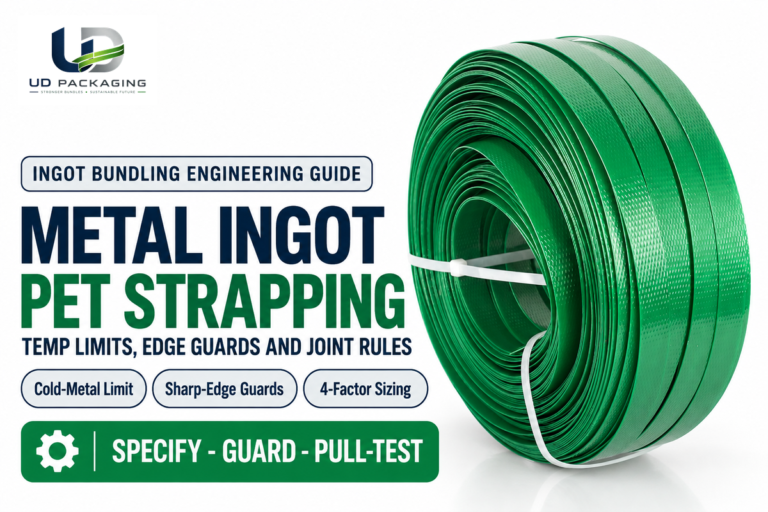
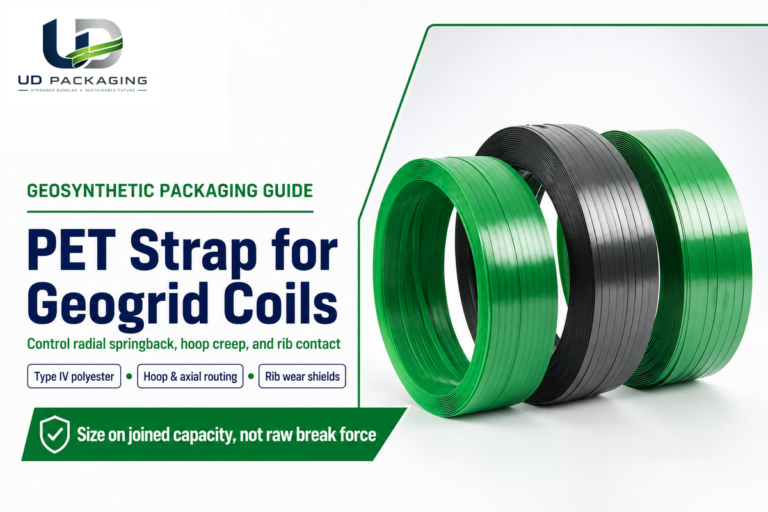
Two coils of the same width in 0.80 mm and 1.27 mm gauges yield different weld qualities and feed characteristics in automatic press heads. Surface finish is of equal importance. In automated tracks, however, raised patterns trap airborne lint and must melt flat before full fusion forms. Flat green PET (commonly ordered as green polyester strapping) is excellent for multi-head press chutes and is suitable for delicate yarns. Please review our chemical fiber PET bundling strap page to learn about alternative extrusion profiles and formats.
Worked Example, Effective Joint Load Capacity Check: Compute real joined loop strength before ordering trial coils rather than trusting raw tensile ratings. We use four verified public inputs here. Unit conversions follow 1 lbf = 4.4482 N and 1 kgf = 9.80665 N. Complete Packaging Products lists a Signode Tenax 5/8″ (15.9 mm) × 0.035″ (0.89 mm) coil at 1,400 lbf (6,228 N / 635 kgf) break strength. We pair that with fiber-grade (650 kgf) and high-strength (900 kgf) profiles inside Jushuo Packaging’s published 160–1,360 kg range. Efficiency tiers come from Rockcub bench pull tests: 60% for low-end crimped metal seals, 75% for low-end friction welds, and 85% for well-calibrated friction welds. Formula: Effective Loop Strength = Nominal Break Strength × Joint Efficiency.
| Strap Profile (Width × Thickness) | Nominal Break Strength | Joint Method Tier | Efficiency Assumed | Effective Loop Capacity | Typical Baler Fit & Limitation |
|---|---|---|---|---|---|
| 5/8″ (15.9 mm) × 0.035″ (0.89 mm) Embossed (Signode Tenax) | 1,400 lbf (6,228 N) | Crimped Metal Seal (Low) | 60% | 840 lbf (3,737 N) | Manual rework only; slow and uneven crimp risk |
| 5/8″ (15.9 mm) × 0.035″ (0.89 mm) Embossed (Signode Tenax) | 1,400 lbf (6,228 N) | PET Friction Weld (Low) | 75% | 1,050 lbf (4,671 N) | Medium-density bales; check wrap abrasion on embossed |
| 5/8″ (15.9 mm) × 0.035″ (0.89 mm) Embossed (Signode Tenax) | 1,400 lbf (6,228 N) | PET Friction Weld (High) | 85% | 1,190 lbf (5,294 N) | Requires clean weld plate and dry, dust-free strap |
| 16 mm × 1.0 mm Smooth (Fiber Grade) | 650 kgf (6,374 N) | Crimped Metal Seal (Low) | 60% | 390 kgf (3,825 N) | Not recommended for high-rebound viscose bales |
| 16 mm × 1.0 mm Smooth (Fiber Grade) | 650 kgf (6,374 N) | PET Friction Weld (Low) | 75% | 488 kgf (4,781 N) | Standard viscose/polyester staple lines (e.g., 3,380–3,480 mm cut) |
| 16 mm × 1.0 mm Smooth (Fiber Grade) | 650 kgf (6,374 N) | PET Friction Weld (High) | 85% | 553 kgf (5,418 N) | Automatic multi-head baler with clean smooth track |
| 19 mm × 1.0 mm Smooth (Heavy Fiber Grade) | 900 kgf (8,826 N) | Crimped Metal Seal (Low) | 60% | 540 kgf (5,296 N) | Wastes 360 kgf capacity at joint; high seal cost |
| 19 mm × 1.0 mm Smooth (Heavy Fiber Grade) | 900 kgf (8,826 N) | PET Friction Weld (Low) | 75% | 675 kgf (6,619 N) | High-rebound dense synthetic bales; wider corner load spread |
| 19 mm × 1.0 mm Smooth (Heavy Fiber Grade) | 900 kgf (8,826 N) | PET Friction Weld (High) | 85% | 765 kgf (7,502 N) | Automated friction-weld press heads (distinct from TITAN VK10 in-press heat-seal heads at up to 90%) |
Using these inputs, switching from a 60% crimped seal to an 85% friction weld lifts a 900 kgf heavy fiber strap from 540 kgf (5,296 N) to 765 kgf (7,502 N). That delivers a 41.7% gain in real holding power without adding extra resin. These figures serve as arithmetic screening benchmarks, not a replacement for ASTM D3950-23 testing or live bale trials. Start from wider smooth profiles inside Jushuo Packaging’s 160 to 1,360 kg break-force range, then verify final loop count and gauge on your press as tonnage, fiber crimp, and moisture vary. Smaller 12 mm widths fit light cartons and sub-bundle strapping applications.
Friction Welding vs. Serrated Metal Seals and Wire Buckles: Which Joint Survives Fiber Lint?
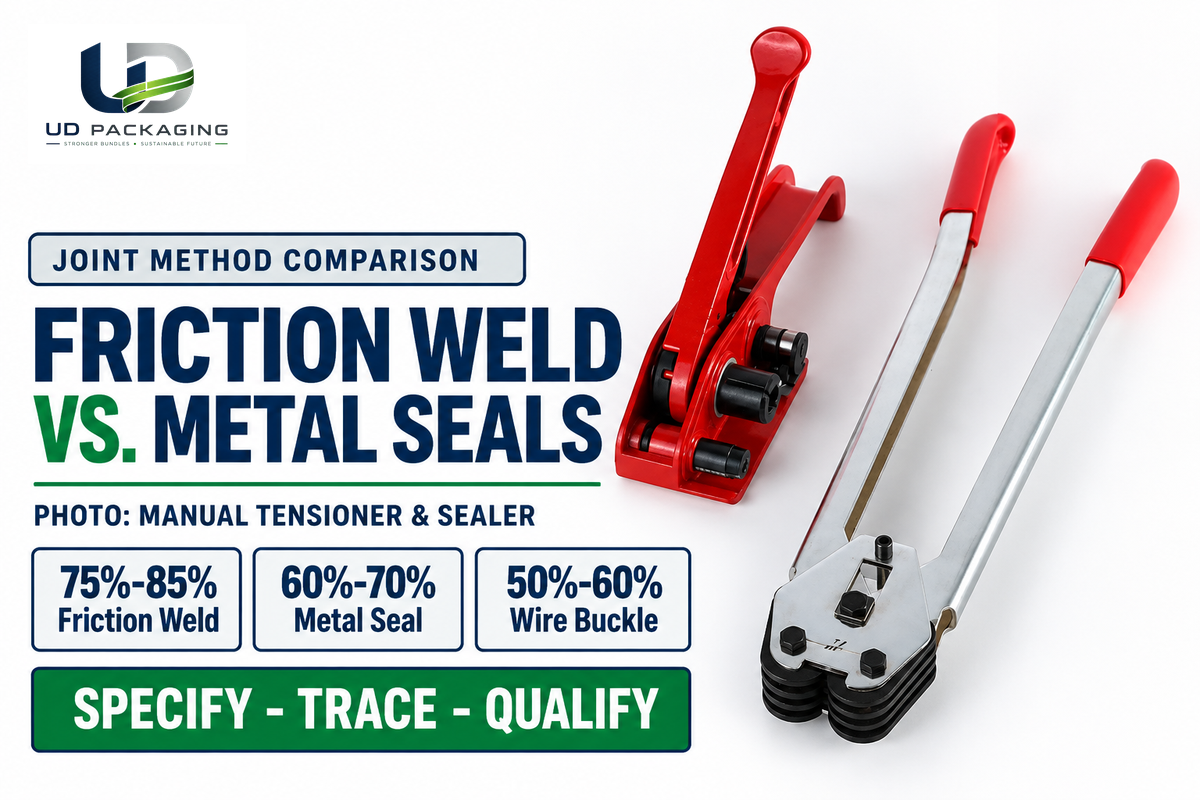
Friction welding and controlled heat-sealing deliver the highest joint efficiency for extruded PET fiber straps without putting metal clips near spinning lines. Rockcub bench tests report 75% to 85% joint efficiency for PET friction welds, while TITAN’s VK10 press head data claims up to 90%. Crimped serrated metal seals drop to 60% to 70% efficiency with wide operator variance. Wire or plastic buckles average only 50% to 60% on extruded plastic bands.
When cold welds strike on a dusty shift, plant managers sometimes propose switching back to metal seals. Friction welding requires disciplined cleaning of Zones 3 and 4.
| Joining Method | Published Efficiency Range | Lint & Spin-Finish Sensitivity | Best Use Case | Key Limitation |
|---|---|---|---|---|
| Friction Weld (Sealless) | 75%–85% on PET (Rockcub bench) | High in Zones 1 & 3; needs clean weld plate | Automated balers and battery/pneumatic fiber tools | Cold welds if oil or dust blocks oscillation heat |
| In-Press Heat Seal / Ultrasonic | Up to 90% (TITAN VK10 OEM spec) | Moderate; enclosed press heads limit ambient fly | High-speed 24/7 continuous staple fiber presses | High capital cost; strict camber tolerance (≤5 mm/m) |
| Serrated Metal Seal | 60%–70% (Rockcub bench; lower if uneven) | Moderate; spin finish oil increases slip inside seal | Manual offline bale repair or low-volume rework | Metal contamination hazard; over-crimping cuts strap |
| Wire / Plastic Buckle | 50%–60% on PET (Rockcub bench) | Low sensitivity to dust, high sensitivity to threading error | Re-tensionable composite cord (not extruded PET presses) | Not recommended for automated extruded PET balers |
Can You Use Embossed PET Strapping or Metal Seals on Automated Chemical Fiber Balers?
Automated chemical fiber balers generally don’t use heavily embossed PET strap or loose metal seals. High-speed friction welding heads, especially when used with polyester, can create a better, more repeatable seam compared to seals, and can be less abrasive. It can also better protect bale wraps.
Embossed PET strap with serrated metal seals works only for offline manual rework when an automatic head is down. When doing a rework, matching seal serration depth to strap thickness ensures the crimper does not notch the edge of the strap. For jaw-setup limits on manual closures, read our guide on strapping seals setup and faults.
Preventing Lint Buildup: Tooling Setup, Cleaning Intervals, and Edge Protection on Fiber Balers
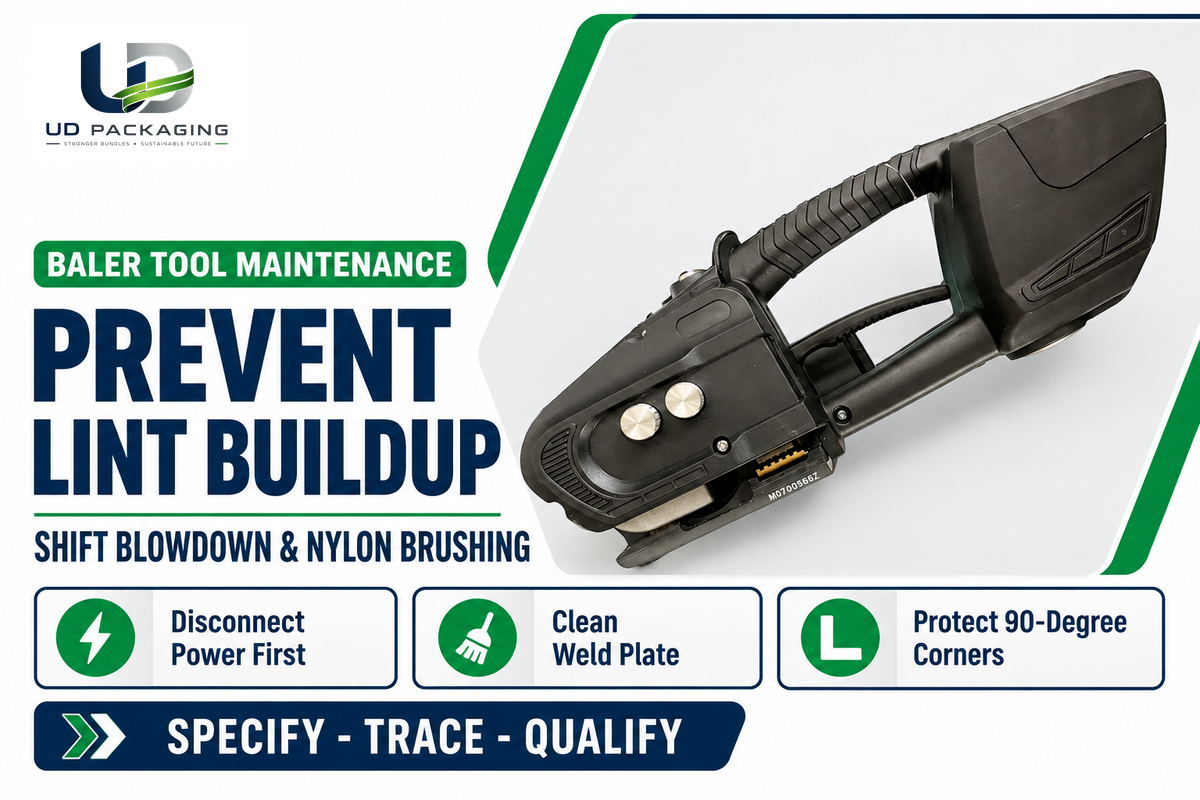
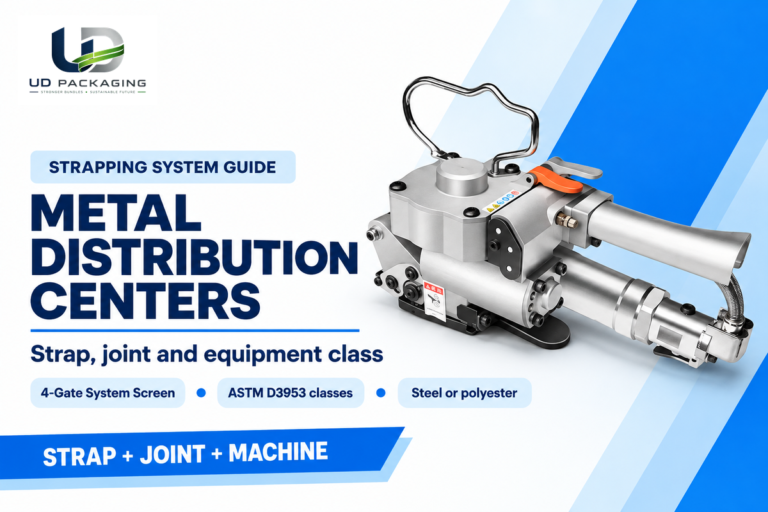
Prevent lint-driven cold welds with four routine actions on every baling line. Disconnect tool power, blow out weld plates and feedwheels with dry compressed air, and brush away packed PET flakes with a stiff nylon brush. Add edge protection to sharp 90-degree bale corners. Don’t scrape gripping teeth with steel screwdrivers. Never clean electric strapping tools with acetone or harsh solvents.
One bad habit of baler operators negatively affects more straps than anything else. When lint builds up in feedwheels and causes slip, operators increase weld time or tension. Increased weld time and tension shave flakes off the strap, pack the grip teeth, and worsen cold welds. Recent handheld baler designs, such as the USPTO Patent US12397943B2, incorporate an electrical contact sensor between the grip member and welding element, before a weld cycle is initiated. Similarly, on standard pneumatic tools, manual checks perform the same function as the contact sensor.
Combine shift-level blowdowns with the symptoms shown below for troubleshooting. Always diagnose the physical break pattern first before changing strap thickness or supplier lots. For detailed hand tool calibration and edge protection corner guards, see our guides on polyester strapping tool setup and maintenance and strapping edge protectors.
| Observed Symptom | Primary Root Cause | Immediate Corrective Action | Stop / Replace Trigger |
|---|---|---|---|
| 1. Joint peels apart cleanly by hand (Cold Weld) | Spin finish oil or lint in Zone 1; clogged Zone 3 weld plate; short weld time | Disconnect power; air-blow and nylon-brush weld plate; verify base plug | Replace weld plate if serration points look flattened |
| 2. Joint snaps with brown or scorched brittle edges | Excessive friction-weld time degrading PET chains | Reduce weld timer in small steps; hold cooling dwell steady | Quarantine coil if rPET melt viscosity varies sharply |
| 3. Joint slides open seconds after gripper release | Insufficient cooling dwell under high bale rebound | Increase cooling hold time before releasing clamping jaws | Inspect pneumatic pressure drop or weak battery pack |
| 4. Feedwheel slips and fails to hit target tension | Packed polyester dust and fiber fuzz inside Zone 5 wheel teeth | Air-blow and clear tooth grooves with stiff brush or scrap PET | Retire or rebuild feedwheel once teeth round off |
| 5. Strap breaks cleanly mid-span at a 90° bale corner | Edge abrasion and vibration sawing across unprotected corner | Place corner boards or edge protectors beneath every loop | Inspect baler platen chamfers for sharp metal burrs |
| 6. Strap snaps mid-span away from corners or joints | Undersized tensile grade or hidden UV/heat storage damage | Move coils indoors out of sunlight; step up strap cross-section | Pull-test retained coil specimen against COA break force |
| 7. Intact straps turn slack 48 hours after baling | Load settlement (3–10 mm) or excess strap elongation | Run 30-minute re-check; verify elongation ≤10% (≤6% high-strength) | Switch from PP or high-stretch grade to low-elongation PET |
| 8. Frequent chute jams or curled feeding in press | Excess strap camber (>5 mm/m), collapsed core, or sensor lint | Clear track sensors; verify 406 mm (16″x6) core fit and dispenser drag | Reject coils exceeding straightness tolerance |
| 9. Protective plastic bale wrap tears along strap line | Sharp weld-flash burrs, excessive tension, or rough embossed edge | Trim weld flash by tuning cycle; switch to smooth snag-free PET | Audit cutter blade alignment and strap edge burrs |
Industrial Pricing, MOQ, Lead Time, and RFQ Checklist for Chemical Fiber PET Strapping
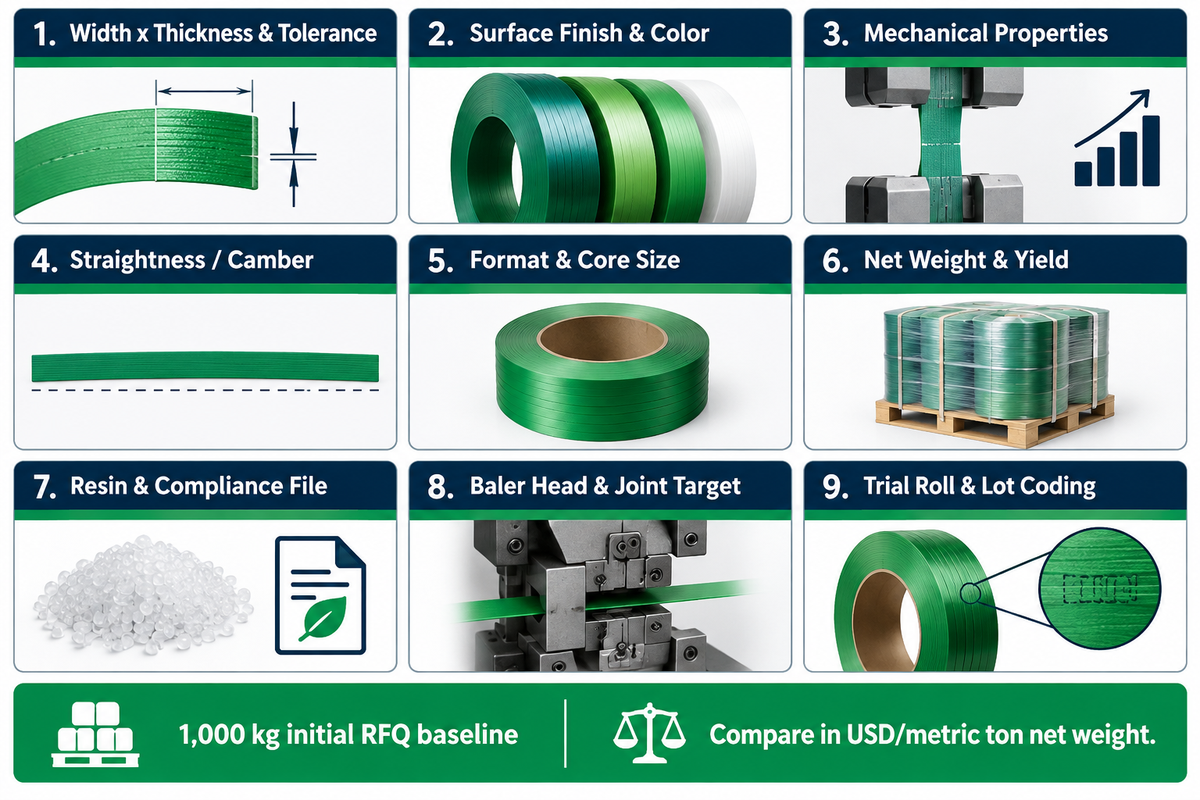
As a November 2026 U.S. distributor reference, Complete Packaging Products lists a Signode Tenax 5/8″ × 0.035″ × 4,000 ft embossed green polyester coil at $103.40 (MSRP $151.25). The Tenax coil uses a 16″×6″ core with a break strength of 1,400 lbf and reflects single-coil retail distribution rather than bulk ex-factory tonnage rates. For tonnage rate requests, confirm the grade and coil weight, cross-section, virgin-to-rPET ratio, and type of resin (if any), and Incoterms, as the prices would vary.
Comparing two supplier quotes in dollars per roll alone conceals significant weight differences. A 20 kg banding roll and a 17 kg roll can carry the same coil price while differing by 17.6% per kilogram of resin. Inherent viscosity, control of polymerization in the solid state, custom sizes, pre-cut lengths, and SGS test files can also impact landed cost. Adjust for USD/metric ton (net strap weight excluding core and pallet) and include a full strap specification in your RFQ. For receiving inspection steps, read our PET strapping sourcing and quality verification guide.
What Minimum Order Quantity and Lead Time Should Fiber Plants Plan For?
Plan for a 1 metric ton (1,000 kg) initial RFQ baseline, as UD Packaging states on its official PET strapping page, with final MOQ confirmed by formal quote. Lead time is determined by whether the exact width, gauge, and core size are in stock at the factory or if custom extrusion and cutting are required. Confirm lead time in the formal quote.
Request 1 to 2 machine-matched trial coils before agreeing to a full 20-foot container. Test those coils on your live press across all five sampling checkpoints defined above. Check camber deflection and peel-weld consistency, and then lock in the passing datasheet values to your purchase order.
| RFQ Parameter | What to Specify in Writing | Why It Prevents Baler Failure or Quote Drift |
|---|---|---|
| 1. Width × Thickness & Tolerance | Exact mm (e.g., 16 × 1.0 mm or 19 × 1.0 mm) plus ± tolerance | Prevents chute drag and uneven friction-weld clamping |
| 2. Surface Finish & Color | Smooth snag-free vs embossed; green color or transparent | Protects bale wraps and avoids lint buildup in automatic heads |
| 3. Mechanical Properties | Minimum break force (N or kgf) and max elongation (≤10% or ≤6%) | Suppresses high-rebound fiber bale expansion after press release |
| 4. Straightness / Camber | Maximum deflection (e.g., ≤5 mm/m for automatic feed) | Eliminates curved-strap misfeeds inside multi-head press tracks |
| 5. Format & Core Size | Continuous coil (406 mm / 16″×6″ core or jumbo) vs exact cut length | Ensures immediate fit on baler dispensers without adapter rework |
| 6. Net Weight & Yield | Net kg per roll, meters per roll, and tare weight per pallet | Enables true USD/ton and USD/bale comparison across bids |
| 7. Resin & Compliance File | Virgin vs rPET percentage, lot COA, and EU PPWR DoC if exporting | Guards weld-zone melt viscosity and satisfies EU market audits |
| 8. Baler Head & Joint Target | Exact strapping head model, weld method, and target joint % | Allows supplier to pre-screen friction-weld compatibility |
| 9. Trial Roll & Lot Coding | 1–2 trial coils before bulk PO; printed coil lot ID on every core | Supports the 6-Field Joint Specimen Trace Code on the plant floor |
How to Evaluate and Compare PET Strapping Manufacturers for Synthetic Fiber Balers
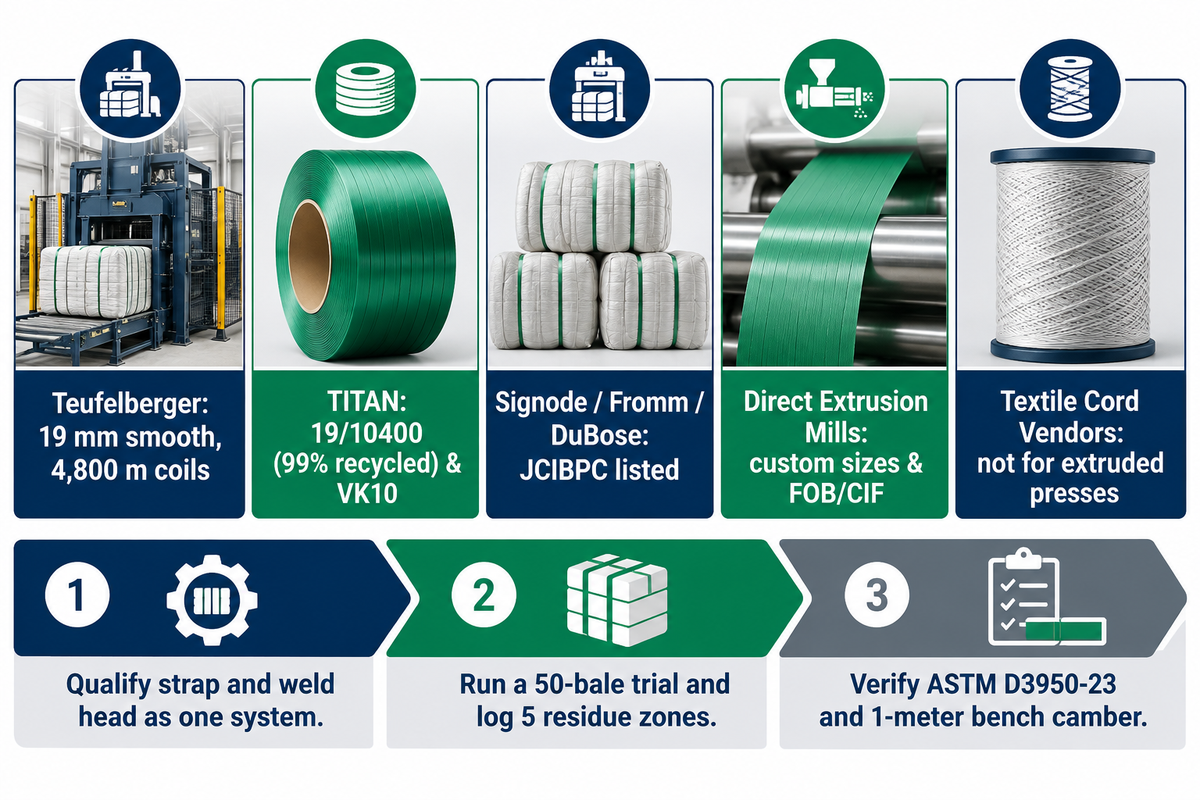
First, separate extruded PET (polyester) manufacturers from hot-melt textile or composite cord vendors. Next, compare press system OEMs such as Teufelberger, TITAN, Signode, Fromm, and DuBose with direct extrusion mills on line fit and camber control. Never choose a fiber-bale strap maker based on unit price before verifying real press feeding and weld peeling.
U.S. cotton baling provides a qualification benchmark under Federal Rule 7 CFR 1427.5. The Joint Cotton Industry Bale Packaging Committee (JCIBPC) approves PET strapping makers strictly by welding system: Z-weld, P-weld, and CSF 1955. DuBose Strapping Inc. appears across all three systems alongside Fromm Packaging Systems, Polychem (dba Greenbridge), Samuel Strapping Systems, HWJ Designs, and Signode Industry Packaging Systems. JCIBPC focuses on cotton rather than synthetic fibers, but in effect, their rule would still apply. A strapping system and welding head must be qualified as a single matched system.
| Supplier / Route | Published Fiber-Bale Evidence | Best Fit Scenario | Verify Before Ordering |
|---|---|---|---|
| Teufelberger (TYCOON®) | Published Kelheim Fibers reference using 19 mm smooth PET in 4,800 m Mega Jumbo Coils | 24/7 European automated viscose and staple presses needing long coil uptime | Regional stock lead time and landed cost outside Europe |
| TITAN | Publishes fiber-specific PET strap 19/10400 (99% recycled) and VK10 vertical press head (up to 90% seal claim) | Plants pairing new in-press strapping heads with high-recycled strap | Compatibility with non-TITAN legacy baling heads |
| Signode / Fromm / DuBose | Global Tenax® / integrated strapping equipment; listed on JCIBPC cotton-bale PET approvals | Multi-plant North American operations standardized on OEM tools and service | Confirm smooth vs embossed finish for wrapped synthetic fiber |
| Direct PET Extrusion Mills (e.g., UD Packaging, Jiangsu) | In-house PET granulation to finished strap in Jiangyin, Jiangsu; compatible seals and strapping equipment; 1,000 kg initial RFQ | Industrial buyers sourcing custom sizes, FOB/CIF bulk tonnage, and consolidated strap + tools | Run 1–2 trial coils on live press; confirm lot COA and camber spec |
| Textile / Composite Cord Vendors | Hot-melt or woven polyester cord for manual buckle vertical balers | Low-volume manual vertical waste balers using wire buckles | Not interchangeable with extruded PET friction-weld presses |
Perform a six-point qualification check prior to granting bulk volume. First, confirm ASTM D3950-23 extruded PET material type and check camber on a 1-meter flat bench. Next, perform a 50-bale trial and log all five residue zones, verify lot break-force, and check elongation COAs. Finally, examine extrusion production line stability, production capacity, spare-coil stock, and local strapping equipment support. For wider supplier benchmarks across factories and machinery, consult our PET strapping manufacturers comparison guide.
What Is Changing in 2025–2026: High-PCR rPET Resin, EU PPWR Documentation, and Automated Weld Control
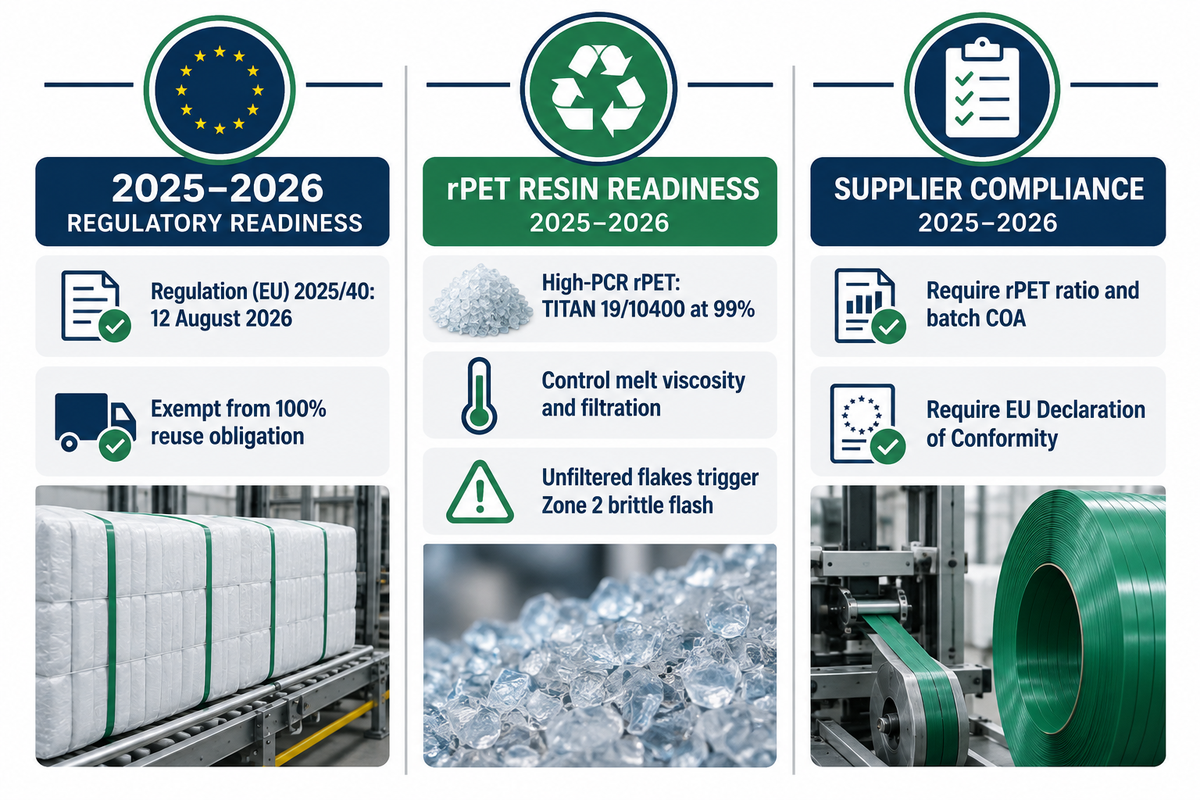
In 2025–2026, chemical fiber strapping is shifting toward 99% recycled bands (like TITAN’s 19/10400) and EU Regulation (EU) 2025/40, applicable 12 August 2026 with a 100% reuse exemption for transport straps. The main operational risk is no longer raw tensile strength. It’s melt-viscosity weld stability and formal compliance files. From 12 August 2026, the EU Regulation (EU) 2025/40 replaces the 1994 Packaging Directive (94/62/EC) in the EU Member States.
A fear among many buyers in 2024 and 2025 was that the EU rules would force plastic transport straps into mandatory reuse loops. The EU Packaging Waste Portal confirms an important update. The Commission adopted a Delegated Decision exempting operators using pallet wrappings and straps from the 100% reuse obligation. That exemption removes the immediate threat of banning extruded PET baling straps in Europe.
High-PCR high-performance strapping is gaining popularity on heavy fiber lines with TITAN publishing its 19/10400 fiber strap at 99% recycled content. Environmentally friendly recycled PET delivers dependable performance when extruders control melt viscosity with tight filtration and solid state polymerization. Poorly dried or unfiltered bottle flakes cause issues. Polyolefin specks and viscosity drops narrow the weld temperature window and trigger brittle Zone 2 flash. In 2026, require all vendors to disclose the rPET ratio, melt filtration, batch Certificate of Analysis (COA), and EU Declaration of Conformity. For information on recycled PET strapping mechanisms, please see our recycled PET strapping mechanics and recycling article.
Frequently Asked Questions
What does PET stand for in strapping, and what is it made of?
Polyethylene Terephthalate (PET) is a semi-crystalline thermoplastic polyester resin, extruded into high-strength industrial banding rolls. Mills make PET strapping from virgin polyester or cleaned recycled PET bottle flakes stabilized for steady viscosity. Stretching during strap production aligns the polymer chains lengthwise to deliver high tensile strength and low creep.
What are the main uses of chemical fiber PET bundling straps?
Chemical fiber PET bundling straps hold compressed bales of polyester staple fiber, viscose, nylon, acrylic and textile tow after hydraulic baling. Plants use bands to keep dense bales compact during stacking and for forklift and container-ship transport. Low elongation build and rust-proof construction protect white yarns from steel rust stains and strap slack.
What is the minimum joint strength required for PET strapping under ASTM D3950 and EN 13394?
In practice, plant qualification targets 75% to 85% of nominal strap break strength on friction-welded seams, compared with 60% to 70% on manual crimped metal seals. ASTM D3950-23 (North America) and BS EN 13394:2001 (Europe) govern formal test procedures and contractual joint minimums for nonmetallic strapping.
Should chemical fiber bales use smooth or embossed PET strapping?
Automated chemical fiber balers almost always use smooth PET straps. Smooth bands also evenly melt across the full overlap during friction welding and glide through chutes with less dust and snags.
How often should operators clean the weld plate and feedwheel on a fiber baling strapping head?
Blow the weld plate, anvil jaws and feedwheel teeth with dry air at every shift change. Disconnect tool power first, then remove packed PET flakes with a stiff nylon brush or a scrap polyester strip. Heavy spin-finish lines need mid-shift blowdowns whenever T0-CLN or T30-REL checks spot shallow tooth marks, peel checks show Zone 1 gloss, or wheel slip occurs during tensioning.
Can PET strapping be supplied in pre-cut lengths for automatic fiber baling presses?
Yes, extrusion mills can provide loop lengths matched to the press platen perimeter, along with standard 406 mm coils and continuous jumbo spools, for automatic balers.
How can a plant verify a new PET strap batch before committing to full container volume?
Before releasing a container order, audit the supplier’s lot COA for dimensional tolerances, break force, elongation, and ≤5 mm/m camber across 1 to 2 pre-production trial coils. Run those coils on your live press across all five sampling checkpoints, tagging cut joints at changeover and conducting the 30-minute rebound inspection using the 6-Field Joint Specimen Trace Code. Peel-inspect the five residue zones and approve volume only if there are clean polymer-tearing welds.
Plan a Live Trial for Your Fiber Baling Line
Auditing friction-weld joint drops or qualifying a backup extrusion source? Send your strap width, thickness, finish, core size, and baler head model to our engineering desk. Visit the UD Packaging PET strapping page to review specs and request trial coils for your own press.
Technical Review: Reviewed by the UD Packaging engineering team.
References & Sources
- ASTM International – ASTM D3950-23: Standard Specification for Strapping, Nonmetallic (and Joining Methods)
- ASTM International – ASTM D3953-15(2022): Standard Specification for Strapping, Flat Steel and Seals
- European Standards – BS EN 13394:2001 Packaging – Specification for Non-Metallic Tensional Strapping
- European Commission (Environment) – Packaging Waste: Regulation (EU) 2025/40 (PPWR) and Pallet Wrappings & Straps Delegated Decision
- National Cotton Council / JCIBPC – Approved PET Plastic Strapping Manufacturers (7 CFR 1427.5)
- USPTO / Google Patents – US6536336B1: Automatic Bale Strapping System
- USPTO / Google Patents US12397943B2: Handheld Strapping Device (Friction Weld Contact Sensing)
- TWI Global Thermoplastic Materials and Surface Preparation Prior to Fusion Welding
- Teufelberger Fibre Bale Strapping Solutions: Kelheim Fibers Reference (19 mm Smooth PET & 4,800 m Mega Jumbo Coils)
- TITAN TITAN Strapping for Baled Fibres (PET Strap 19/10400 & VK10 Head)
- Signode PET vs PP: Which Strap to Use?
- EAM-Mosca Plastic Strapping Guide: PP vs. PET Strap Uses, Benefits & Costs
- SelectPackTech Strapping Machine Troubleshooting Guide
- Amass Straps Why Does My Strapping Keep Failing During Transit? 7 Causes + Fixes