Get in touch with UD Packaging Company

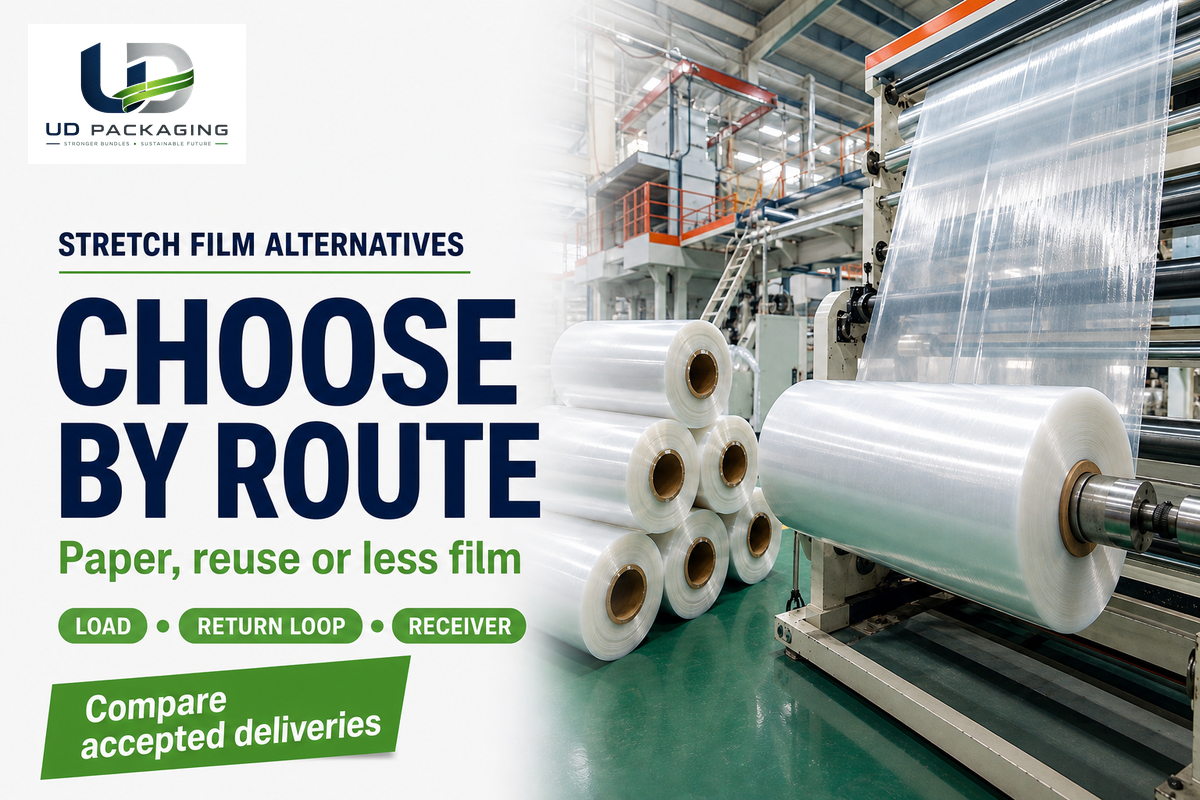
A stretch film alternative can be paper pallet wrap, a reusable cover or net, pallet bands, or some other system for securement of loads. Use paper for a compatible wrapping process and storage route. Use reusable protection where collection and returns are already worked out. On one-way routes, reducing the amount of applied film can be the more practical first change.
Start with the route: reusable wraps suit controlled return loops, engineered paper systems offer a single-use material change, and bands suit loads that need restraint without full coverage. Compare the complete delivered load, including extra protection, collection work and rejected deliveries.
Industrial pallet wrapping is a different job from replacing household plastic wrap. The buyer must keep a stack together through handling, and preserve the product condition. The goal is to give the receiving site a workable recovery route. This guide compares the industrial alternative to plastic film by route and recovery. For more information, see the product guides for individual materials.
Start with the Load and the Receiving Site
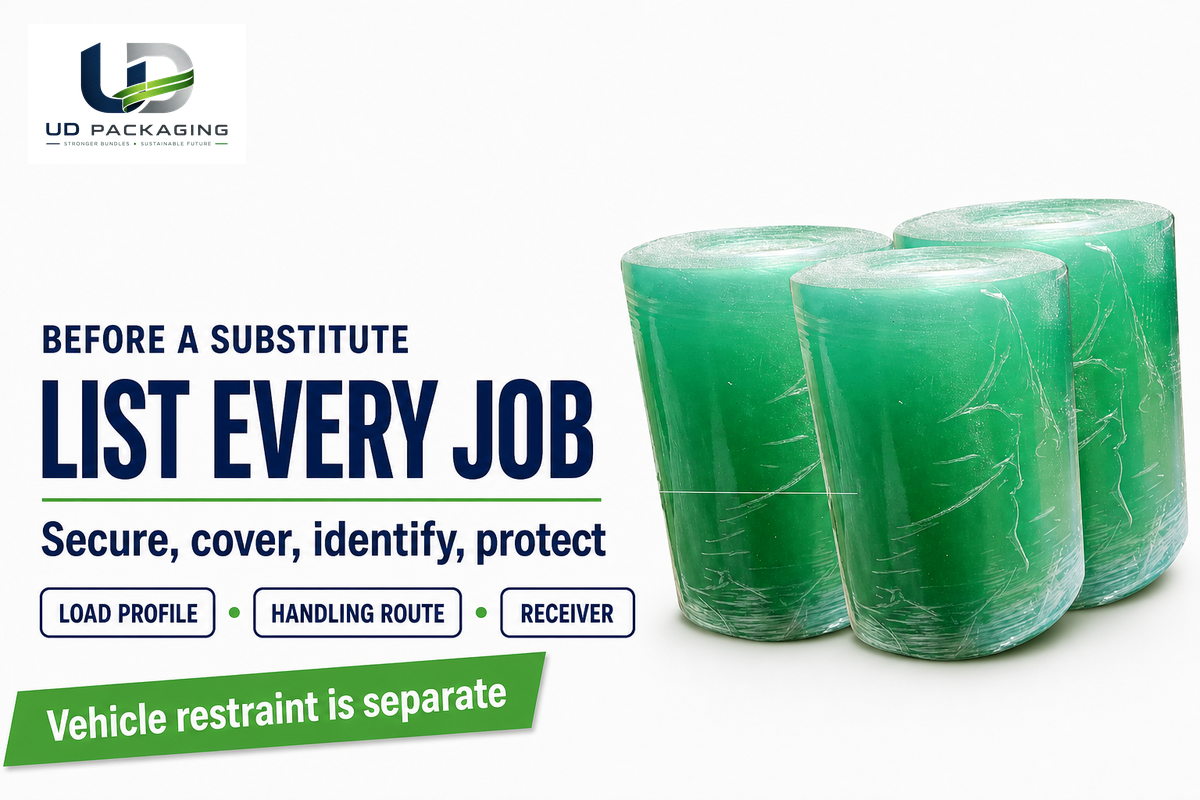
The same pallet profile, handling route and receiving site should be the anchor for all comparisons, including transit inside a freight container. Record what the current packaging does before removing it: unitizing cartons, covering exposed products, carrying labels or edge protection. A substitute that performs one of those jobs may still leave another job to a separate component.
For a dry warehouse-to-warehouse lane with regular cartons, shortlist a paper wrapping system or a reusable wrap if the empties return. For irregular machinery with sharp projections, address contact points and load support first. A material substitution alone won’t remove the geometry that caused tearing.
Maintain two decisions as separate. UK HSE load-security guidance differentiates goods that are stable when loaded from goods that are secured to the vehicle. A stable wrapped pallet still requires the appropriate vehicle load-restraint arrangement; a different wrapper doesn’t resolve that transport concern.
Compare Stretch Film Alternatives by Transport Route
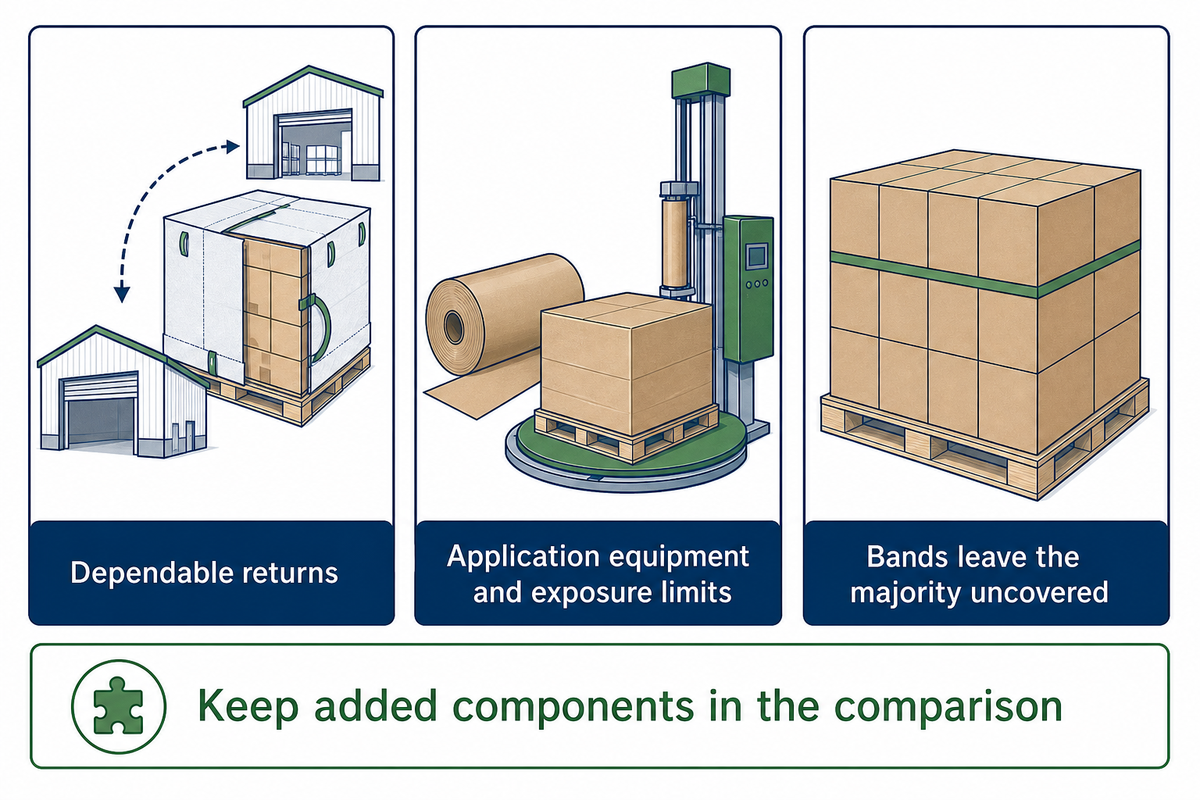
A reusable pallet wrap is a great option on a route with dependable returns. Paper is a good candidate where its application equipment and exposure limits align with the load. Bands leave the majority of the load uncovered, while an adapted polyethylene film system preserves the existing wrapping. The Route and Return Fit Table transforms these differences into an initial shortlist.
| Route or load | Start with | Keep in the comparison |
|---|---|---|
| Dry, one-way shipment of regular cartons | Engineered paper wrap or lower-mass film | Applied material, wrapping time and receiver collection |
| Repeat transfers between owned plants | Reusable wrap or net | Return transport and ready-to-use stock |
| Mixed customers with no return agreement | Single-use paper or qualified film system | Different receiving sites and disposal arrangements |
| Short internal moves of a coherent load | Pallet bands or reusable restraint | Exposed faces and removal before picking |
| Sharp corners or projecting parts | Load support and edge protection first | Tear initiation points and restraint position |
| Dust-sensitive goods | Closed covering plus load restraint | Top, side and bottom openings |
| Brief exposure during loading | A covering system matched to that exposure | Seams, closures and wet handling |
| Outdoor storage | Packaging designed for outdoor dwell | Weather exposure and storage duration |
| Irregular mixed-height stack | Stable pallet layout, then a conforming system | Bridged gaps, shifting cartons and label access |
A reusable sleeve and a paper roll are therefore different purchasing routes. One acquires a returnable asset as well as the work required to keep it circulating. The other changes a consumable and possibly the wrapping equipment. Compare both to the current system, including anything added to restore a missing function.
Match Paper Wrap to the Machine and Storage Route
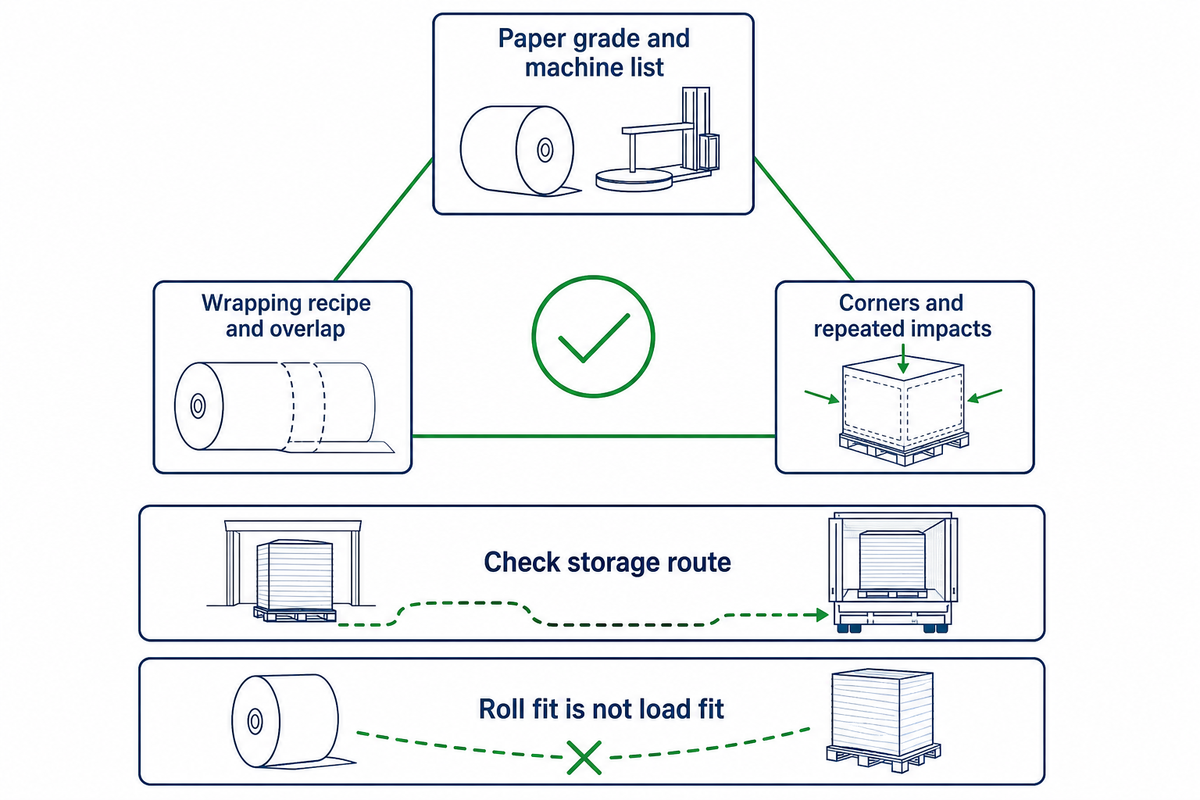
Engineered paper wrap can stabilize suitable pallet loads, but wrapping recipe and failure mode are key. University testing showed paper and plastic performed differently in impact, tilt and drop tests. Paper is a good candidate for consideration, especially for edge, overlap and storage.
Paper and plastic wrapping materials were studied in a Westrock-sponsored Virginia Tech project. In a Westrock-sponsored Virginia Tech project, four paper wrapping recipes were compared with a plastic control on identical loads. The researchers did some performance comparison tests and noted that plastic performed better in a rotational edge-drop test while paper performed better in the 22-degree tilt and incline impact tests. Paper tore at bottom corners, and tears spread under repeated impacts. The researchers also identified slippery product trays as an important factor.
Can I use paper wrap on my plastic wrapping machine?
There are paper products that require dedicated wrapping systems, while others are designed to work with particular machines. The machine list from the paper/board supplier is the point of departure. Mondi, for example, recommends using a dedicated system for its Ad/Vantage StretchWrap and limits its use to indoor storage. Those directives are specific to that product and not to the entire paper-based alternative.
The automation settings, carriage movement and overlap determine how far the wrap reaches corners. A roll that fits the carriage can still form a poor load. The 2021 Mondi and ACMI launch report suggests a paper and machine solution paired together. For the equipment discussion, use the paper stretch-wrap selection guide.
Count Completed Returns Before Choosing Reusable Wrap
A reusable wrap is defined as an alternative to single-use paper or film only if it returns in useable condition. A closed loop, controlled interplant, makes collection easier, because both ends can assign people and space to the job. On an open loop, a breaking link can be a receiver who discards or retains the cover.
StopWaste’s reusable transport-packaging guidance treats loss prevention, cleaning and reverse logistics as parts of the system. Their cost comparison guidance incorporates the transportation of empty assets back. As such, the purchasing unit is a working return loop, not simply a cover with a high reported cycle count.
Can a reusable cover replace film on one-way deliveries?
A reusable cover is suitable for a one-way outbound shipment if an agreed collection route brings the empty cover back. Without that return route, a single-use wrapping system is the more direct choice. Participation by the receiver, and the frequency and condition of the cover, determine if the cover can be used for the next shipment.
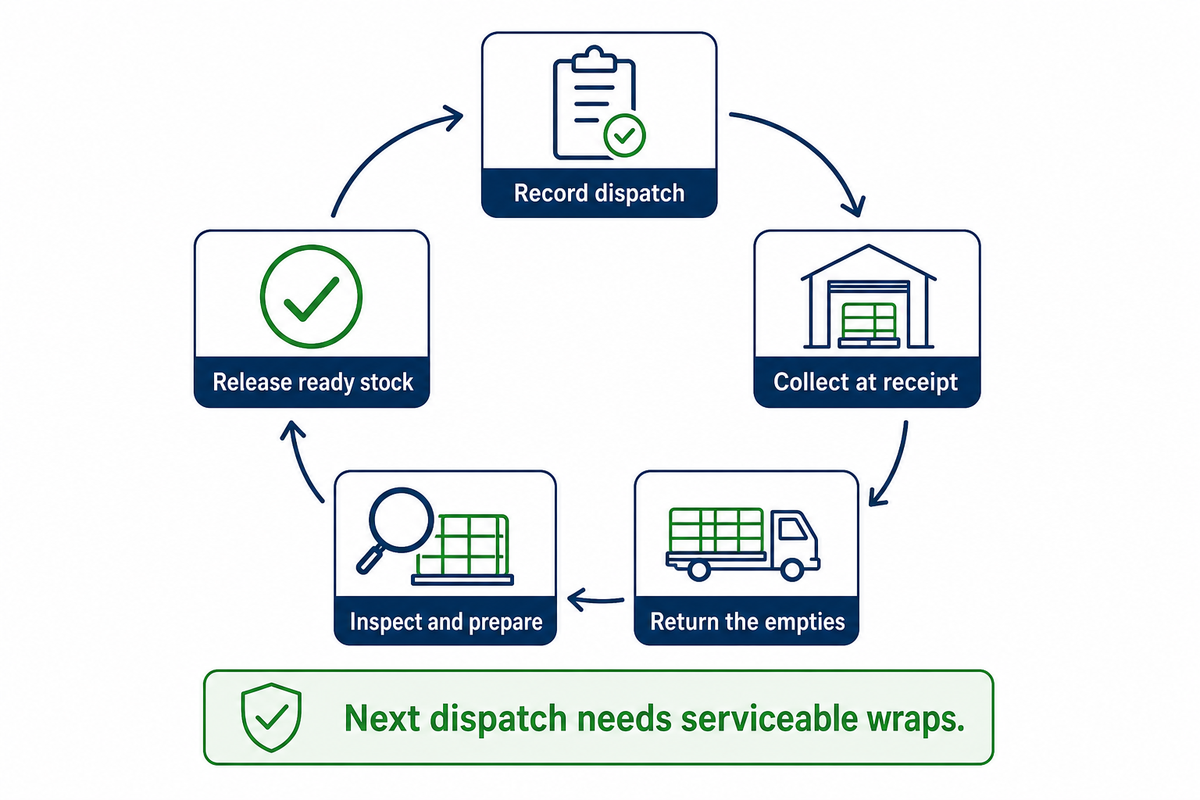
The Return-Loop Bottleneck Map indeed represents a flow diagram. Before buying the whole fleet, give each step in the diagram a named owner. A carrier’s promise to deliver goods isn’t necessarily a promise to collect empty wraps.
- Record dispatch: identify the wrap sent with each load.
- Collect at receipt: remove and store it in the agreed place.
- Return the empties: use the scheduled backhaul or collection service.
- Inspect and prepare: separate usable, repairable and rejected wraps.
- Release ready stock: count units available for the next dispatch.
Consider an illustrative 30-day check: 100 wraps leave, 90 return and 85 are ready for reuse. The ready-stock return is 85% and the physical return is 90%. Neither of these numbers indicates lifetime. The 15 missing or unavailable units still impact the next day’s dispatch. Recovering these assets can reduce waste without buying a different material. The reusable pallet-wrap guide addresses fitting and return arrangements in more detail.
Separate Restraint from Weather and Dust Protection
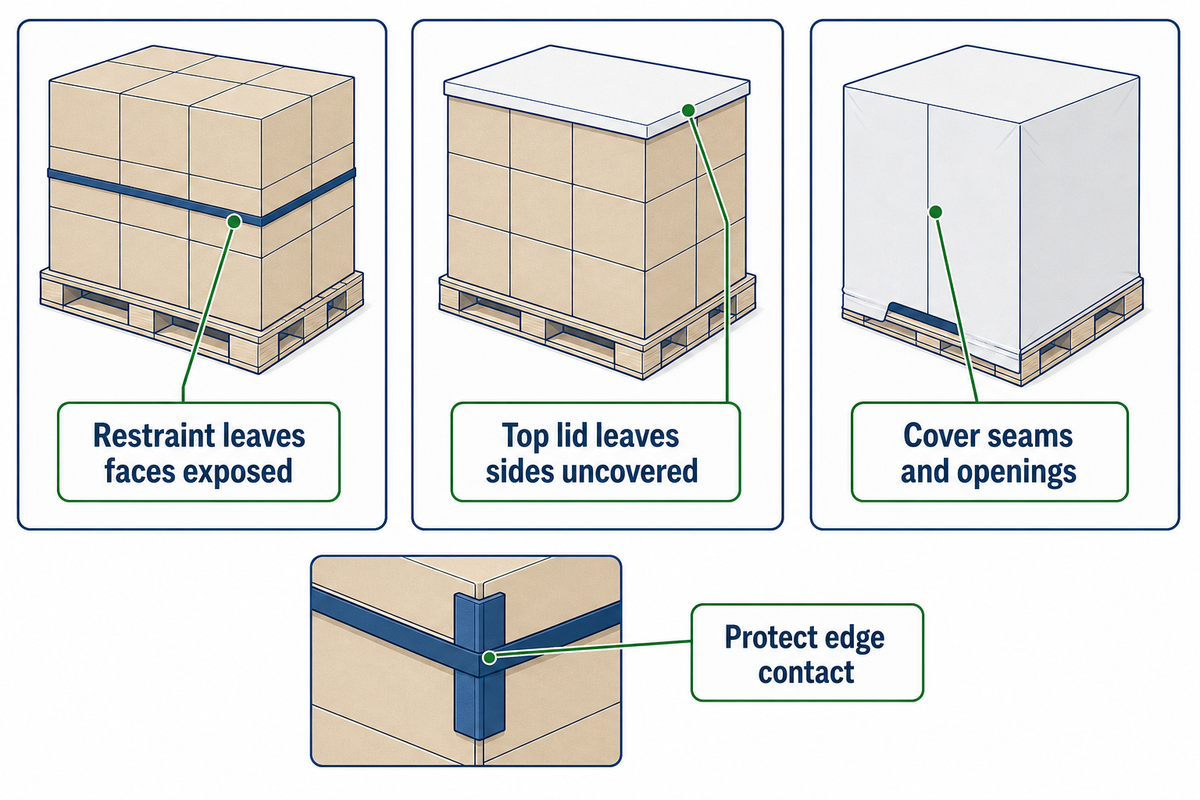
Bands and nets restrain selected parts of a load while leaving faces exposed. A closed cover adds coverage, but its seams and openings still determine what reaches the goods. If dust and water protection are separated from load restraint, buy the combination the route actually needs.
For carton transfers in an internal movement, pallet bands may reduce the task to applying and removing reusable restraints. The same bands leave a covering job for the loading area. In a loading area covered with dust, a lid covers the top of the load but leaves the sides and pallet interface uncovered.
Specify edge protection where a strap bears on a carton or a wrap crosses a projection. Virginia Tech’s paper trial found corner tears growing over repeated impacts, a concrete reason to examine contact geometry. Photograph the load at dispatch and arrival from comparable angles so that a shifted case or opened closure is visible in the trial record.
When Keeping Film Uses Fewer Resources
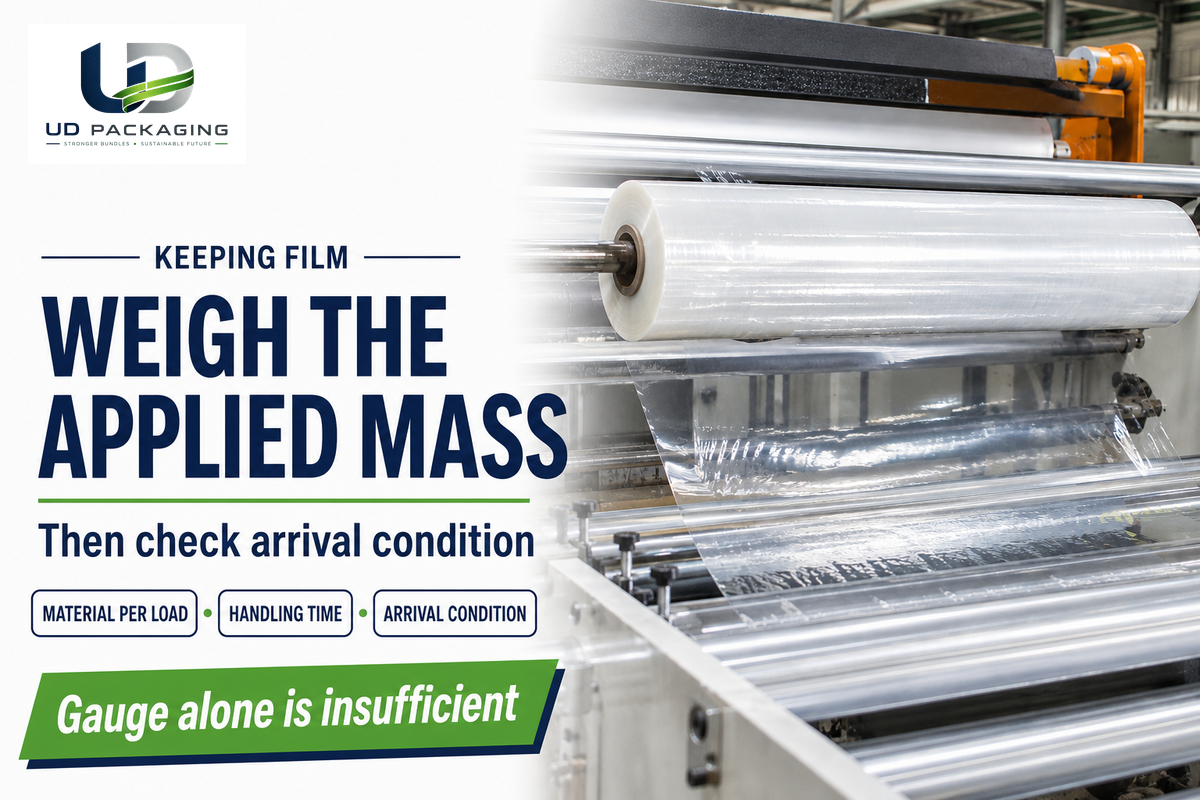
A film adjustment can reduce applied material without modifying the entire packing route. Keep track of grams per finished load, containment condition, and arrival condition. Gauge, resin formulation, pre-stretch and wrap pattern interact, so a thinner roll alone does not establish lower consumption or equivalent performance. Film, overall, deserves a place in the comparison.
A 2025 stretch-film pilot study illustrates the distinction. In Table 6, one six-wrap setting used 17 µm film at 240% pre-stretch and consumed 68 g. Another used 23 µm film at 150% and consumed 101 g. Their initial local forces at 123 mm displacement were 42.70 N and 42.80 N.
The apparatus was a Robopac 705 wrapping a fixed plywood box, 1200 × 800 × 1500 mm, with a combined box-and-pallet mass of 182 kg. The test was conducted at about 25 °C without transport vibration. Local readings explain the need to measure the mass applied; they do not show that either setting guarantees that every commercial load is secured. Film type and pre-stretch varied together.
A 2024 three-film lifecycle study recorded by Parma University compared conventional film, a thinner recycled-content option and a thinner high-prestretch option using producer-assisted data. Its abstract favored reduced material use in that study; it didn’t rank paper or returnable covers.
For a buyer who’s already using plastic, the first practical measurement is to weigh the applied mass of each accepted load. Compare recycled content and environmental impact separately. Wrapping pallets with recycled stretch wrap can meet the material sourcing objective and a different wrapping recipe can address over-application. Weighing film usage makes that sustainability objective measurable: less plastic waste per accepted load, rather than a thinner roll on its own.
Choose a Recovery Route the Receiver Can Use
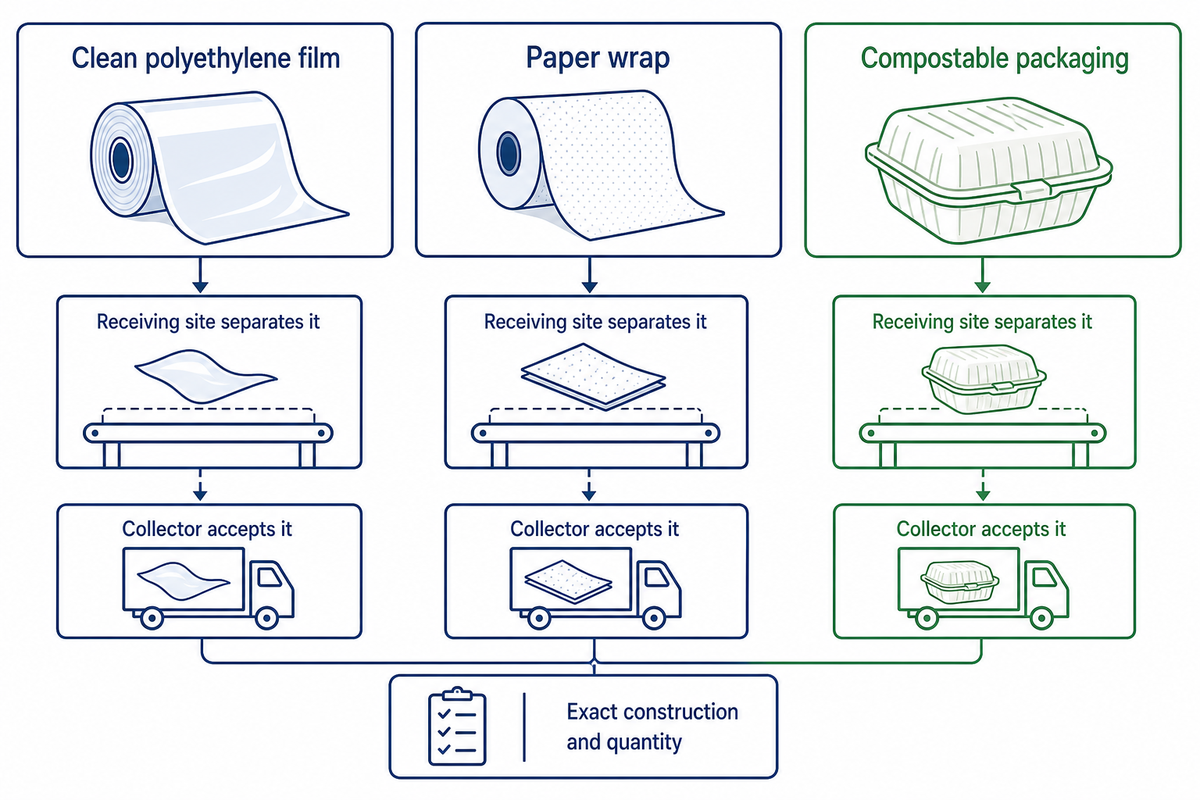
A recyclable packaging material needs a receiving site that can separate it and a collector that accepts it. Clean polyethylene film, paper wrap and compostable packaging, on the other hand, belong to different recovery options. Select the route for the exact construction and commercial quantity before describing the change as a sustainable solution or counting disposal savings.
The film-plastic collection guidance issued by the New York DEC accepts pallet wrap and stretch film when clean, dry and free of residue. Its listed retail collection route doesn’t set up a bulk pickup arrangement for warehouse material. Keep the polyethylene film accepted for collection separate from materials the collector refuses. The zero waste program still requires documentation of rejected or contaminated material, as opposed to counting the material as recovered.
“To prevent deceptive claims, qualifications and disclosures should be clear, prominent, and understandable.”
For a paper system described as plastic-free, identify what the wrap is made from, including coatings and adhesives. Confirm whether those components, labels and wet contamination change the collector’s acceptance. For a compostable option, identify a receiving compost facility rather than adding it to the polyethylene stream. The biodegradable stretch-film guide explains why a degradation claim doesn’t show a recovery route.
A receiving warehouse should be able to tell where staff places the used material, what condition the collector accepts, and how collection is charged. For a commercial film collection, see the warehouse stretch-wrap recycling guide. A material marked recyclable still requires the same working arrangement.
Compare Cost per Accepted Delivery
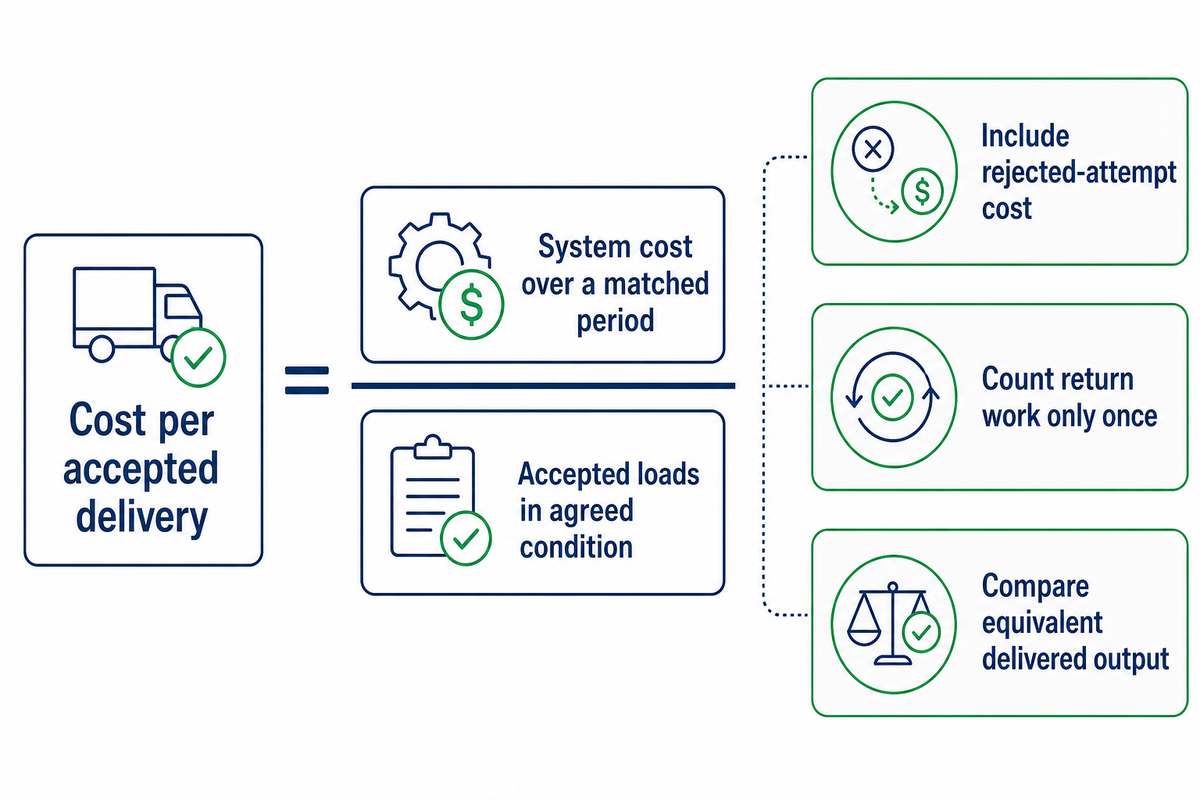
Cost per accepted delivery is the packaging system’s cost over one matched period divided by loads accepted in the agreed-upon condition. Return work and cost of rejected loads are included only once. This provides procurement a means of comparison when a cheap consumable causes rework, or when an expensive reusable asset completes many serviceable trips.
The Delivered-Load Cost Ledger identifies the cost-effective alternative by using actual case records. Reusable asset allocation for both options should use the same accounting basis, and equivalent delivered output should be compared prior to budget approval. StopWaste’s per-trip approach provides a good starting point. The accepted delivery measurement below provides the buyer’s arrival condition decision.
| Cost item | Record for the same period | Avoid counting twice |
|---|---|---|
| Wrapping material or allocated reusable assets | USD; applied kg or serviceable uses | Full asset purchase plus the same asset’s use allocation |
| Application labour | Minutes/load and USD/hour | Rework time already in another labour entry |
| Machine and energy allocation | USD over the trial output | Capital cost and a second identical machine charge |
| Receiver collection and sorting | Minutes and charged USD | Sorting included in a collection-service invoice |
| Reverse freight | USD per collection | Return transport already bundled in a service fee |
| Cleaning | USD per cleaning batch | Cleaning labour included in a contractor charge |
| Inspection and repair | Minutes, parts and USD | Repair cost recorded again as a full replacement |
| Loss, replacement and end-of-use handling | Units and additional USD | Replacement already included in the asset allocation |
| Damage, rejection and repeat delivery | Actual rework, goods loss and freight USD | The same rejected load or freight invoice entered twice |
Worked example, hypothetical USD amounts: a current system costs $1,200 for 600 accepted deliveries, or $2.00 each. A candidate costs $1,050 for 500 accepted deliveries, or $2.10 each. Its total spend is $150 lower, but its cost per accepted delivery is 5% higher. The lower total also delivered less accepted output. A candidate that promises to save you money should be assessed against equivalent accepted output.
Include costs of rejected attempts in the numerator; accepted deliveries in the denominator. A reusable system may save money in the long run, but collection and loss costs belong in that decision. Count completed uses during the comparison period rather than dividing purchase price by an advertised maximum lifetime. An example is simple arithmetic for a worksheet, and not a market price or environmental break even analysis.
Run a Matched Load Trial Before Changing Materials
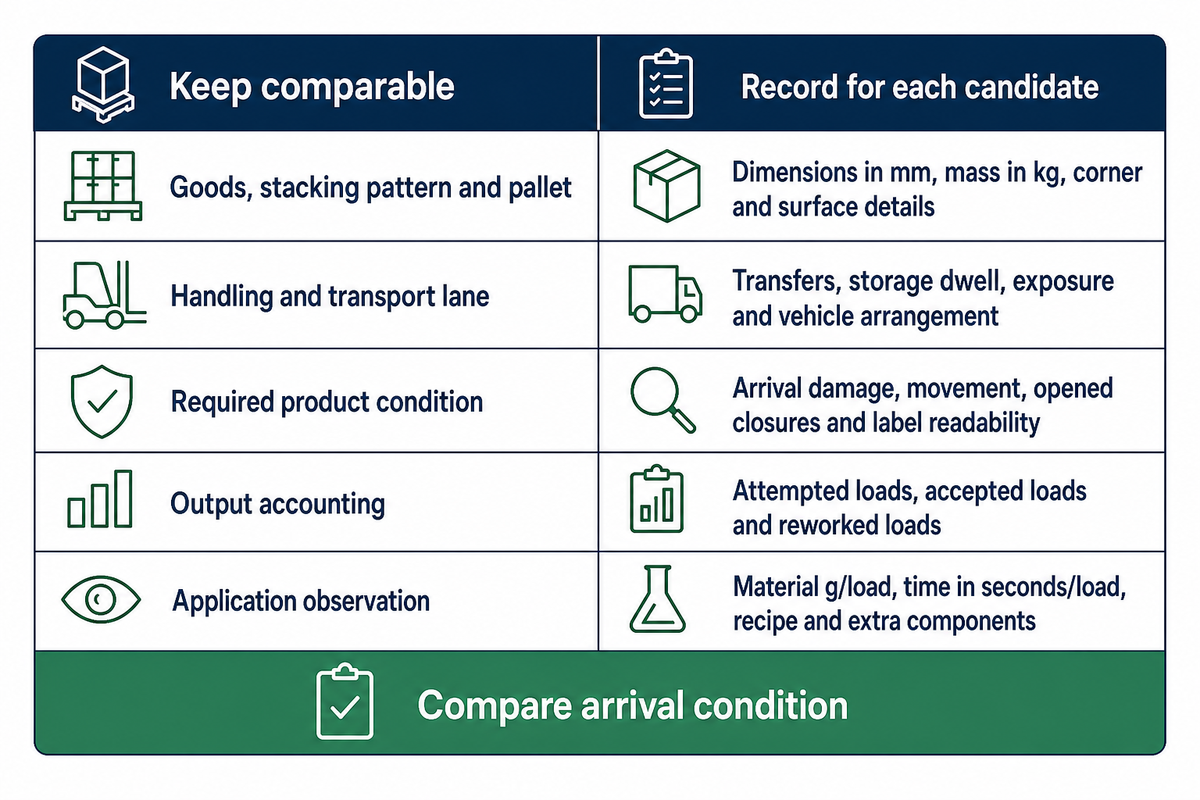
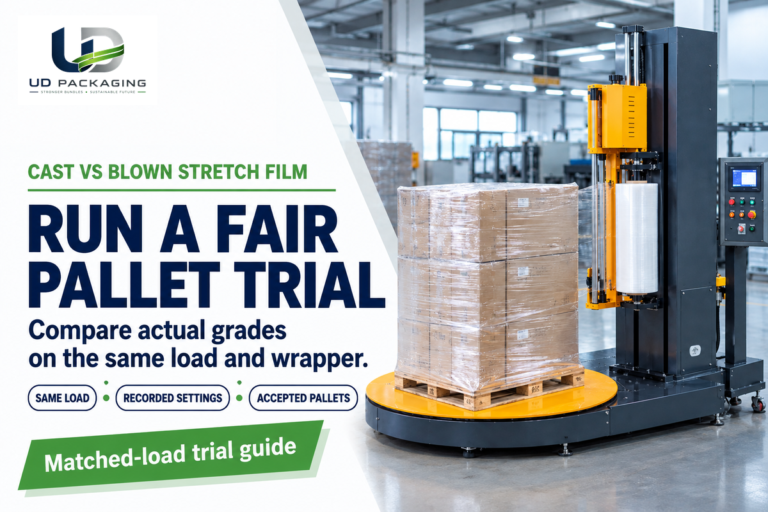
A matched load trial keeps the goods and route comparable while recording the adjustments necessary to apply each candidate correctly. Start with a repeatable baseline and compare arrival condition, material use and handling time. If a new machine recipe or added covering is required for the alternative, include both in the candidate system.
ASTM D5414-95(2025) addresses stretch-wrapped unitized loads and horizontal impact testing. Its public scope allows test levels to indicate the shipping and handling mode. It was noted that direct correlation to field performance has not been established. Use the appropriate test with an agreed load and purpose. A standard number by itself is not an acceptance criterion.
| Keep comparable | Record for each candidate |
|---|---|
| Goods, stacking pattern and pallet | Dimensions in mm, mass in kg, corner and surface details |
| Handling and transport lane | Transfers, storage dwell, exposure and vehicle arrangement |
| Required product condition | Arrival damage, movement, opened closures and label readability |
| Output accounting | Attempted loads, accepted loads and reworked loads |
| Application observation | Material g/load, time in seconds/load, recipe and extra components |
Examine where failure starts. Corner tearing calls for a different intervention from interlayer sliding or a loose attachment at the pallet. Mixed results at Virginia Tech demonstrate why the effect of a favorable tilt test shouldn’t override an unfavorable drop test. Record both and choose a system for the handling events the route contains.
Key takeaway
A packaging change earns its place when it delivers the required load condition at an acceptable measured cost. Paper, reusable wraps and lower-mass film each solve a different part of that decision.
Build the Supplier Enquiry Around the Route
A helpful supplier inquiry describes the load, the application method, transport route and receiving arrangement. Request the material and equipment as a working combination. UD Packaging’s published range covers hand and machine stretch film; use that route for a film comparison, and source paper systems or reusable assets from suppliers offering those products.
Before investing in technology or new wrapping machines, give the supplier measured current inputs. Copy this short list into the enquiry and attach load photographs, including the pallet interface and any damaged corners.
RFQ checklist — copy these into your quote request:
| Parameter | Recommended range | Why it matters | How to verify |
|---|---|---|---|
| Load envelope | Your measured minimum–maximum in mm and kg | Shows the size and mass the system must handle | Measure representative packed loads |
| Application rate | Your actual loads/hour and seconds/load | Connects labour and machine capacity | Measure application efficiency during normal work, including interruptions |
| Current material use | Your observed g/load | Provides the comparison baseline | Weigh applied material over the trial |
| Exposure and dwell | Your measured °C, relative humidity and hours | Defines storage and handling conditions | Use route and warehouse records |
| Return loop | Your observed days/return and serviceable units | Sizes reusable stock and collection work | Track dispatch, return and inspection |
| Acceptance | Your agreed product-condition criteria | Sets the accepted-delivery denominator | Record joint trial results |
The quote should separate rolls or assets from equipment, replacement parts and return services. Confirm the sample arrangement and the proposed wrapping recipe. Before accepting a claim of extreme elongation capability, request the operating pre-stretch for the proposed film and wrapper. Start the film route with UD Packaging’s hand and machine stretch film, then compare the offered specification against the same delivered-load requirements used for the alternatives.
Frequently Asked Questions
What is the difference between stretch film and shrink film?
Stretch film holds by stretching; shrink film contracts when heat is applied.
Stretch film holds a load by stretching around it; shrink wrap contracts when heat is applied. That difference changes the equipment, energy and product exposure involved. Neither name tells you whether the finished pallet will remain stable on your route. Compare the applied packaging system and any added covers, rather than choosing by a material label alone.
Where can I buy stretch wrap film?
Choose an industrial supplier that matches the roll to the load and application method.
Buy from a supplier that can match the roll and application method to your load, rather than offering only a gauge and price. Send pallet dimensions, weight, sharp edges, storage conditions, destination and current wrapper settings. UD Packaging’s published film page covers hand and machine routes; the written quotation should confirm the supplied construction, sample arrangement and commercial terms.
What is the best stretch film for a pallet load?
The best choice keeps the specified load stable with repeatable application and acceptable material use.
The best film is the one that keeps your particular load stable with repeatable application and acceptable material use. Thickness alone cannot settle that choice. Compare candidate films on the same pallet profile and route, recording applied mass, breaks, handling time and arrival condition. Keep recycled content and the receiving recycler’s acceptance as separate checks in the purchase decision.
How to use stretch film when moving?
Keep the load stable, protect contact points and treat vehicle restraint separately.
For an industrial move, start with a stable stack and protect sharp contact points before applying the specified wrapping recipe. Keep labels visible and inspect the completed load. Film holds the packaged unit together; the vehicle still needs its own suitable load-restraint arrangement.
Does paper wrap work on every stretch wrapper?
No; compatibility applies to the specified paper and wrapping system.
Paper grades have different mechanical behavior. Some systems use dedicated machinery. Check the exact material-and-machine combination instead of assuming that a roll fitting the carriage establishes compatibility.
How This Route Comparison Was Prepared
The paper-wrap and stretch-film examples come from the named external studies, not UD Packaging plant trials. The return-loop and cost worksheets combine those sources with public recovery guidance. Their example figures are hypothetical, and the comparison keeps material use separate from full lifecycle impact. The linked sources identify the researchers and organizations responsible for each external finding.
Compare a film specification for your route
Send the load profile, current roll and wrapper settings to start a hand- or machine-film enquiry.
References & Sources
- Virginia Tech: paper-based pallet-wrap research project
- Tkaczyk and coauthors: Pilot Study of Stretch Film for Securing Palletized Loads, 2025
- ASTM D5414-95(2025): horizontal-impact test public scope
- StopWaste: reusable transport packaging and cost-comparison resources
- FTC: Green Guides, Federal Register final rule, 2012
- New York DEC: film-plastic recycling guidance
- HSE: load stability and vehicle load security
- Packaging Strategies: Mondi and ACMI paper-wrap system launch, 2021
- University of Parma: three-film lifecycle study abstract, 2024