Get in touch with UD Packaging Company

Updated November 2026
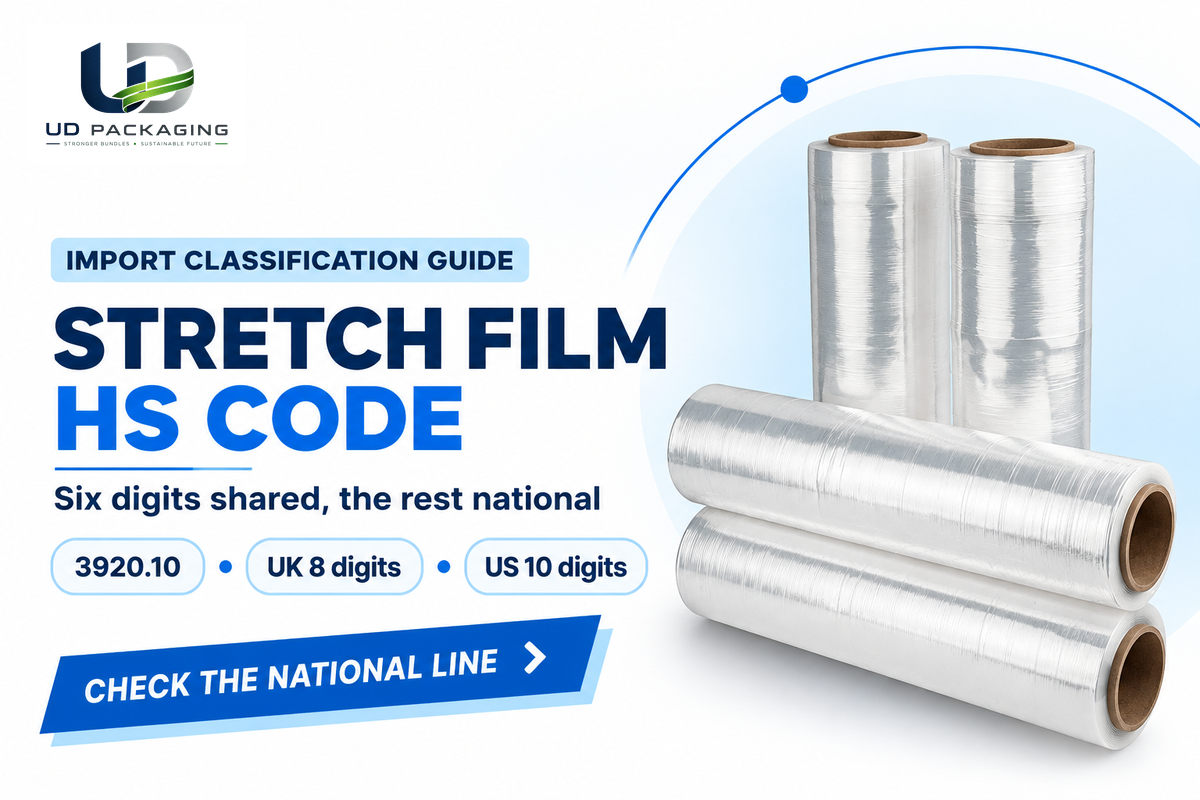
The LLDPE stretch film HS code is 3920.10 at six digits for plain, non-cellular polyethylene film with no adhesive layer, backing, reinforcement or lamination to other materials, and with only printing incidental to its use. Digits seven onward are national, and the national line varies based on film facts which a supplier can print on the datasheet.
A film’s thickness, adhesive status and layer structure can impact which line or heading it falls under. The sections below contain a six-fact checklist, a three-question heading test, the official sites for the UK and US national lines, and the invoice wording a customs broker will accept.
LLDPE Stretch Film HS Code: Six Digits Are Shared, the Rest Are National
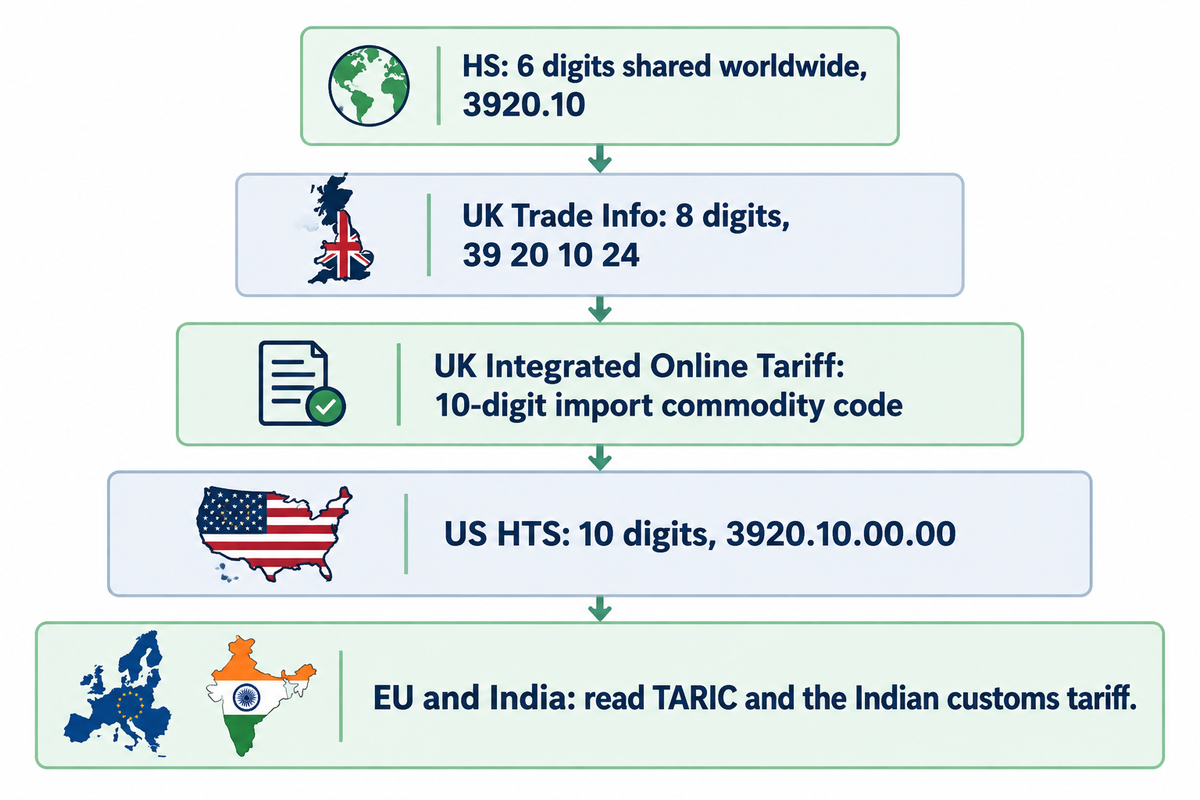
Non-cellular LLDPE stretch film falls under HS 3920.10, polymers of ethylene, when it has no adhesive, backing, reinforcement or lamination to other materials, and any printing is incidental to its use. The first 6 digits are the same for all countries in the Harmonized System. Digits seven onward are national: the UK Trade Info shows 8 digits for stretch film, the UK Integrated Online Tariff carries the 10-digit commodity code used for UK imports, and the US requires 10 digits.
“Other plates, sheets, film, foil and strip, of plastics, non-cellular and not reinforced, laminated, supported or similarly combined with other materials”
The 3920.10 subheading adds one condition to that wording: the polymer is ethylene. The trade.gov Harmonized System page says countries are allowed to add longer codes to the first six digits. The same six digits are also written without the dot, as in stretch film HS code 392010.
| Layer | Digits | Line for plain stretch film |
|---|---|---|
| HS (Harmonized System) | 6 | 3920.10 |
| UK commodity code | 8 | 39 20 10 24 |
| EU Combined Nomenclature and TARIC | National extension | Open TARIC for the line under 3920 10 |
| US HTS (Harmonized Tariff Schedule of the United States) | 10 | 3920.10.00.00 |
| India HSN | National extension | Open the Indian customs tariff for the line |
What is the difference between an HS code, an HTS code and an HSN code?
An HS code is the 6-digit international base, an HTS code is the 10-digit U.S. schedule built on it, and HSN is the name India uses for its version of the system. Those 6 digits match across all three for the same product. Check those 6 digits from a supplier’s quote against the film facts, then read the remainder of the digits in the importing country’s tariff.
A common mistake is pasting a supplier’s HSN into a US entry. The entry needs the 10-digit HTS number, so the supplier’s code supplies at most the first 6 of the 10 digits, and the broker still reads the other 4 in the US schedule.
Is stretch film LLDPE?
Not necessarily: stretch film names a use, and LLDPE names a resin. A roll sold as LLDPE stretch film is polyethylene film, and when it is non-cellular with no adhesive or backing it falls under the polymer subheading 3920.10. The UK Trade Info stretch film line is worded “Stretch film of non-cellular polyethylene,” and that wording doesn’t differentiate cast from blown film.
Linear low-density polyethylene is ethylene with a smaller share of another olefin, and Chapter 39 Note 4 and Subheading Note 1 keep such film with polymers of ethylene when ethylene predominates by weight. Resin names such as LLDPE or LDPE on a datasheet lead to the same test: does ethylene predominate by weight? For how the two processes differ, read cast and blown stretch film.
Six Film Facts That Decide the Tariff Line (the 6-Fact Code Sheet)
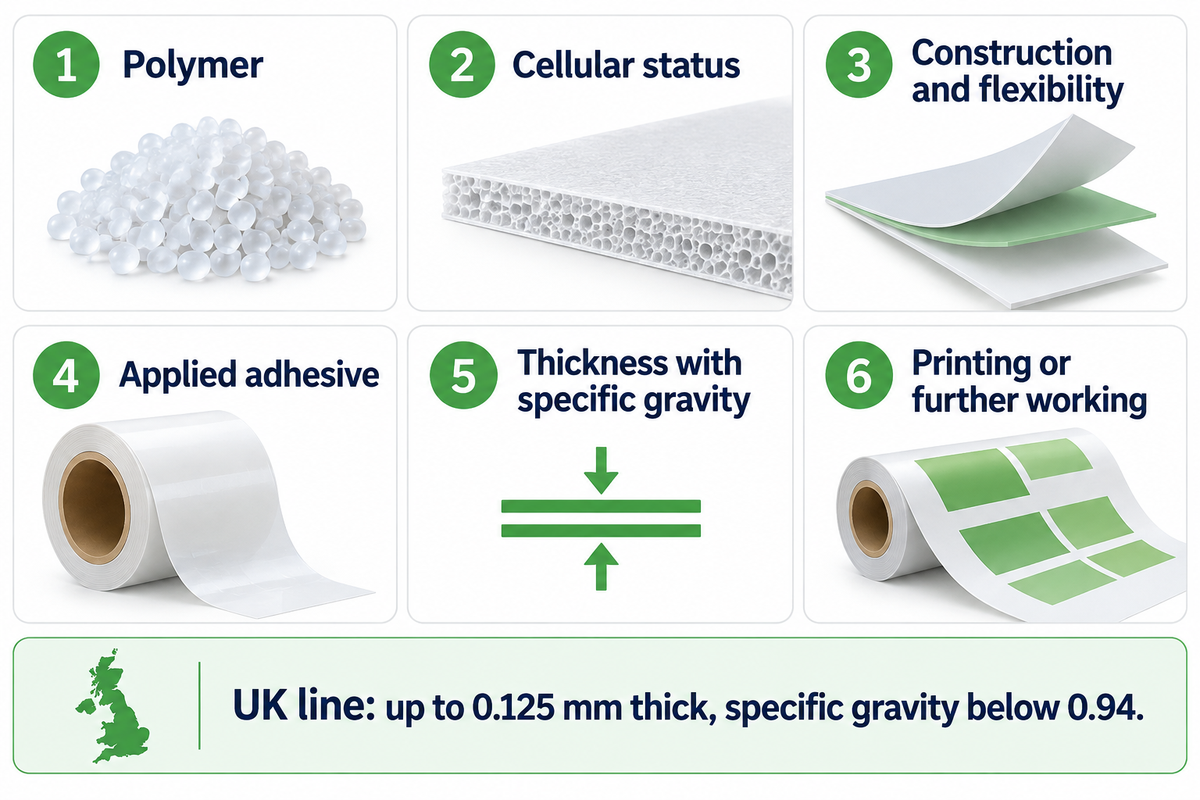
The UK Trade Info stretch film line covers unprinted, non-cellular polyethylene film up to 0.125 mm thick with a specific gravity below 0.94. The facts in the datasheet are classified in six categories: polymer, cellular status, construction and flexibility, applied adhesive, thickness with specific gravity, and printing or further working. These six aspects together constitute the 6-Fact Code Sheet.
The expression “copolymers” covers all polymers in which no single monomer unit contributes 95 % or more by weight to the total polymer content.
[…] copolymers […] and polymer blends are to be classified in the heading covering polymers of that comonomer unit which predominates by weight over every other single comonomer unit.
Ethylene predominates by weight in LLDPE, so film that meets the heading conditions reads as polymers of ethylene, which is the 3920.10 wording.
A film of another polymer, such as polypropylene or PET film, sits in another subheading: HS code 3920.20 and 3920.20.00 are the codes for propylene polymers, not for polyethylene film.
| Fact | Why it moves the code | Level it moves |
|---|---|---|
| 1. Polymer type: resin name and any recycled stretch film content | 3920.10 reads “Of polymers of ethylene”; other resins sit in other subheadings | Subheading |
| 1. Comonomer shares by weight | Note 4 sends a copolymer to the comonomer unit that predominates by weight over every other single comonomer unit | Subheading |
| 2. Cellular or non-cellular, in writing | UK Trade Info words heading 3920 as “of non-cellular plastics”; cellular film goes to 3921 | Heading |
| 3. Layer structure: each layer and its material | The 3920 wording excludes film laminated, supported or combined with other materials, so each layer must be named | Heading |
| 3. Backing or reinforcement | The UK 3920 wording reads “without backing” | Heading |
| 3. Combined with textile or other material: yes or no | 19 CFR 141.89 asks for it on the invoice for headings 3920 and 3921 | Heading and invoice |
| 3. Flexible or rigid: yes or no | The same invoice statement under 19 CFR 141.89 | Invoice |
| 4. Applied adhesive: yes or no | Heading 3919 is self-adhesive film | Heading |
| 5. Thickness in mm or µm; convert mils first | The UK stretch film line sets a thickness ceiling | National line |
| 5. Specific gravity with its test method, such as ASTM D792-20 | The same UK line sets a specific gravity ceiling | National line |
| 6. Printing: printed or plain, and any print coverage | The UK line says “not printed”; Section Note 2 sends film with non-incidental print to Chapter 49 (see printed stretch film) | National line; chapter |
| 6. Surface working: roll as made, or cut or worked further | The 3920 wording allows film unworked, merely surface-worked or merely cut into squares or rectangles | Heading |
Suppose a datasheet lists a roll at 80 gauge. In the film trade 100 gauge equals 1 mil, so 80 gauge is 0.8 mil, and at 25.4 µm per mil the film is about 20.3 µm, or 0.0203 mm, thick. The UK limit of 0.125 mm equals 125 µm, about 6.2 times that thickness (125 ÷ 20.3), so the thickness test passes. If the film also meets the heading’s other conditions (non-cellular, no adhesive, no backing, no lamination), a specific gravity below 0.94 and an unprinted surface complete the remaining checks for the UK line. For a datasheet in mils, convert first with the mils to microns converter.
Most of these facts are found in the stretch film technical data sheet; the adhesive, layer and flexibility statements are provided by the supplier in writing. Performance claims such as high transparency are not part of any heading wording, so they do not move the code.
When the Heading Moves: Classify Stretch, Shrink and Cling Film as 3919, 3920 or 3921
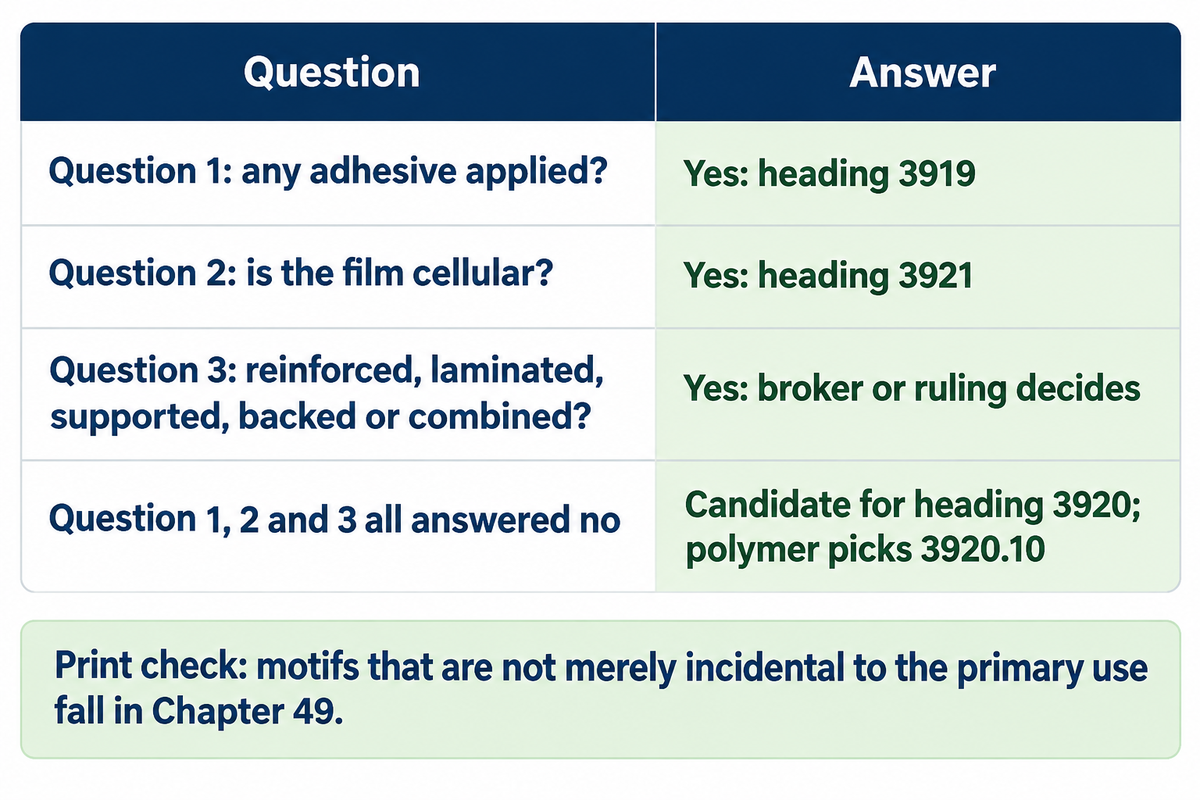
Three headings make the decision for placement of plastic film: 3919 for self-adhesive film, 3920 for non-cellular film that isn’t reinforced, laminated, supported or combined with other materials, and 3921 for other plastic film. So, plain stretch, shrink and cling film that is non-cellular, has no adhesive, backing, reinforcement or lamination to other materials, and has only printing incidental to its use will come under heading 3920, and self-adhesive film will go under heading 3919.
Except for the goods of heading 3918 or 3919, plastics, rubber, and articles thereof, printed with motifs, characters or pictorial representations, which are not merely incidental to the primary use of the goods, fall in Chapter 49.
The 3-Question Heading Test runs on a datasheet in this order, and print gets its own check afterwards:
- Is any adhesive applied to the film? Yes: heading 3919, the self-adhesive heading.
- Is the film cellular? Yes: heading 3921.
- Is the film reinforced, laminated, supported, backed or combined with another material? Yes: heading 3920 may no longer fit, and a broker or a ruling decides the line.
With three no answers, the film remains a candidate for heading 3920. The polymer then selects the subheading 3920.10 for polyethylene, and thickness, specific gravity and printing select the national line.
| Datasheet shows | Test result | Heading or chapter | Official wording or ruling |
|---|---|---|---|
| Non-cellular PE film, no adhesive, no backing, unprinted | Three no answers | 3920, subheading 3920.10 | UK heading 3920 wording |
| The same film with an applied adhesive layer | Question 1: yes | 3919 | “Self-adhesive plates, sheets, film, foil, tape, strip” (UK heading 3919) |
| Foamed polyethylene sheet | Question 2: yes | 3921 | “Other plates, sheets, film, foil and strip, of plastics” (UK heading 3921) |
| PE film laminated to another material | Question 3: yes | Leaves 3920 | 3920 wording: “not reinforced, laminated, supported” |
| PE film on a backing | Question 3: yes | Leaves 3920 | UK 3920 wording: “without backing” |
| Reinforced polyethylene film | Question 3: yes | Leaves 3920 | 3920 wording: “not reinforced” |
| Preprinted PE film for vegetable bags | Three no answers | 3920.10.0000 (US) | CBP ruling N346793, March 27, 2025 |
| Film with motifs that are not incidental to its use | Print check outside the test | Chapter 49, except 3918 and 3919 | Section Note 2 |
| Datasheet silent on cellular, adhesive and backing | Questions unanswered | No heading yet | Request the 6-Fact Code Sheet |
What is the difference between cling wrap and stretch film?
Stretch film wraps a pallet load under tension, while cling wrap is the name for thin film that clings to itself. Each film is tested in the 3-Question Heading Test. Question 1 decides whether the film enters the self-adhesive branch, and the other two questions and the print check still apply.
Both are packaging films sold in rolls, so the 6 groups of facts on the sheet apply to both, and a datasheet should indicate if a roll is for hand or machine use. For the general background of stretch film types, see stretch film guide.
Is shrink wrap the same as stretch film?
No. Shrink wrap is typically a biaxially oriented film that contracts under heat around a product, while stretch film is pulled tight by tension during wrapping. In the tariff both go through the same three questions, and the UK line 39 20 10 24 names stretch film specifically, so a shrink film needs its own datasheet facts before anyone assigns a line.
Variants such as vented stretch film go through the same tests, as perforation isn’t one of the three questions. A shrink film datasheet gets its own six groups of facts: polymer, cellular status, layers and backing, adhesive, thickness with specific gravity, and printing. Heat sets one film and tension sets the other, and neither fact enters the heading wording.
National Tariff Lines for the UK, EU, US and India
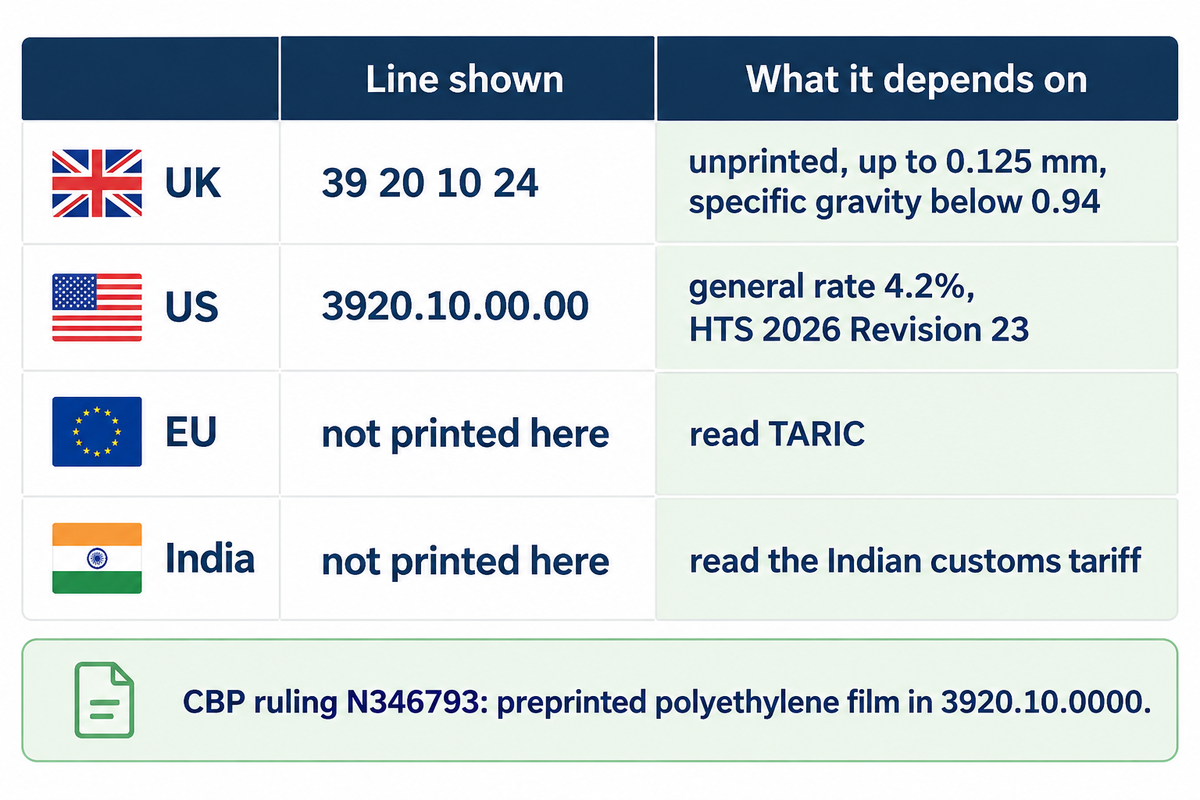
UK Trade Info lists stretch film as commodity code 39 20 10 24, 8 digits, and the US HTS lists film of polymers of ethylene as 3920.10.00.00, 10 digits, with a 4.2% general rate in HTS 2026 Revision 23. The EU and India share the same first 6 digits and publish lines in TARIC and the Indian customs tariff.
| Country | Official page | Line shown | What the line depends on | Date checked |
|---|---|---|---|---|
| UK | UK Trade Info, commodity 39201024 | 39 20 10 24 | Non-cellular polyethylene, not printed, up to 0.125 mm thick, specific gravity below 0.94 | 15 November 2026 |
| US | USITC HTS, 2026 Revision 23 | 3920.10.00.00, unit kg, general rate 4.2% | Of polymers of ethylene; no thickness or printing split | 15 November 2026 |
| EU | EU TARIC | Not printed here | The line under 3920 10 in TARIC | Not applicable |
| India | Indian customs tariff | Not printed here | The HSN line under 3920 10 | Not applicable |
CBP ruling N346793, dated March 27, 2025, placed preprinted polyethylene film in 3920.10.0000, which matches the single US line above. The 4.2% rate is the figure in Revision 23 and can change with the edition. Only the UK and US lines are published here as codes. For the EU and India, read the respective lines in TARIC and the Indian customs tariff; the HSN is the Indian term for the HS code.
What Is Changing: Origin and Entry Date Now Matter as Much as the Code
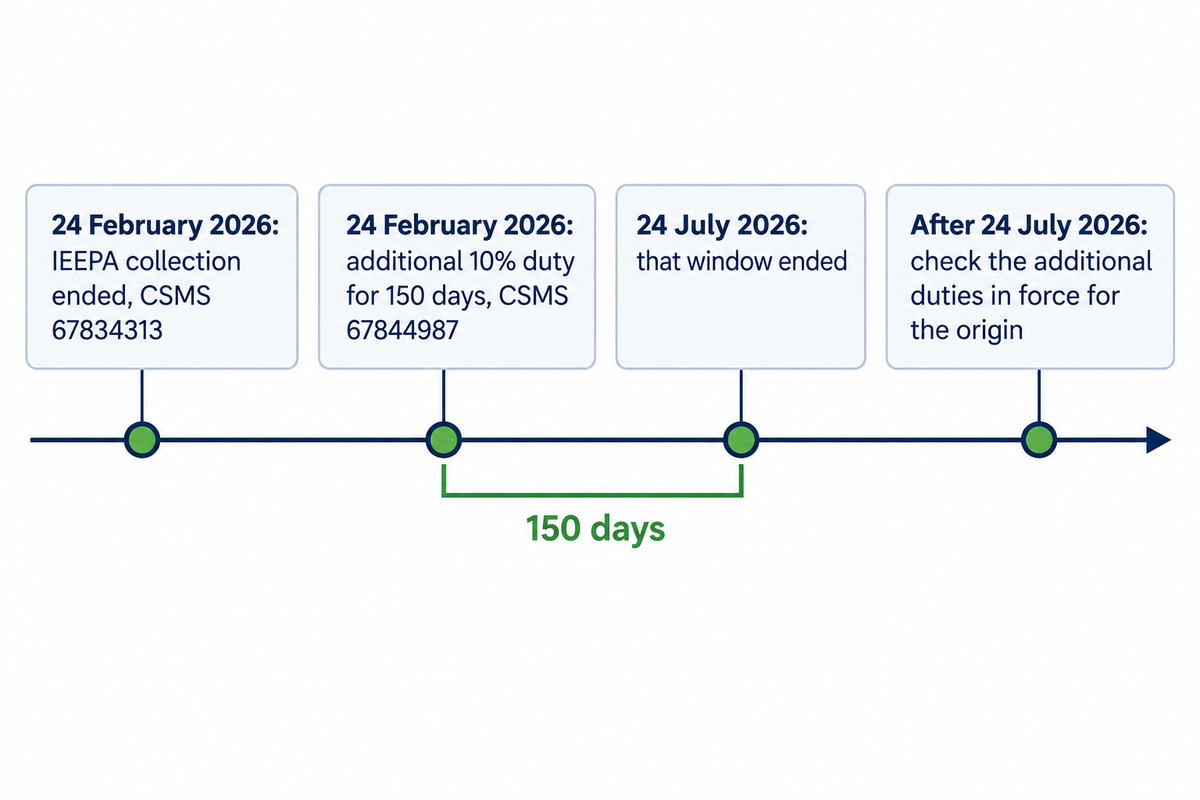
The codes indicate which line to read, but the duty on a 2026 entry will also depend on the country of origin and the date of entry, thus an all-in rate quoted without a date is of no use. The HTS line gives the general rate; additional duties for the country of origin are separate Chapter 99 lines that change by notice.
- General rate: the HTS line 3920.10.00.00 in the USITC HTS.
- Additional measures by origin and entry date: Chapter 99 numbers announced in CBP notices such as CSMS 67844987.
- Trade remedies: Section 232 and Section 301 duties, which CSMS 67834313 left unaffected.
Two CBP notices from February 2026 show how fast the stack moved. CSMS 67834313 gave CBP guidance on the 20 February 2026 Executive Order that ended collection of IEEPA duties for goods entered for consumption or withdrawn from warehouse on or after 12:00 a.m. eastern time on 24 February 2026. A second notice, CSMS 67844987, gave guidance on a presidential proclamation that imposed an additional 10% duty under heading 9903.03.01 for 150 days, unless specifically exempt, for entries from 12:01 a.m. eastern standard time the same day through 12:01 a.m. eastern daylight time on 24 July 2026. That window has closed. After 24 July 2026, check the additional duties in force for the film’s origin.
An entry on 23 February and one on 24 February therefore fall under different measures, even on one purchase order. CBP’s reporting order lists the Chapter 99 numbers before the Chapter 1-97 line, and the entered value goes on the Chapter 1-97 line.
The two notices are dated examples, and no stacked duty is provided here for any shipment. For film from China or any other origin, no combined rate is printed here: price the order from the HTS line plus the Chapter 99 measures in force for that origin on the entry date.
The WCO adds a second date: the eighth edition of the Harmonized System enters into force on 1 January 2028 with 299 sets of amendments, 1,229 headings and 5,852 subheadings. For Chapter 39 its summary names a restructured heading 39.15 for plastic waste, new subheadings for single-use plastic packaging articles, and a new Note 3 on single-use plastics. Subheading 3920.10 isn’t among the named changes, so re-read the line against the HS 2028 edition before that date.
Product Description for the Invoice: What the Supplier Should Write
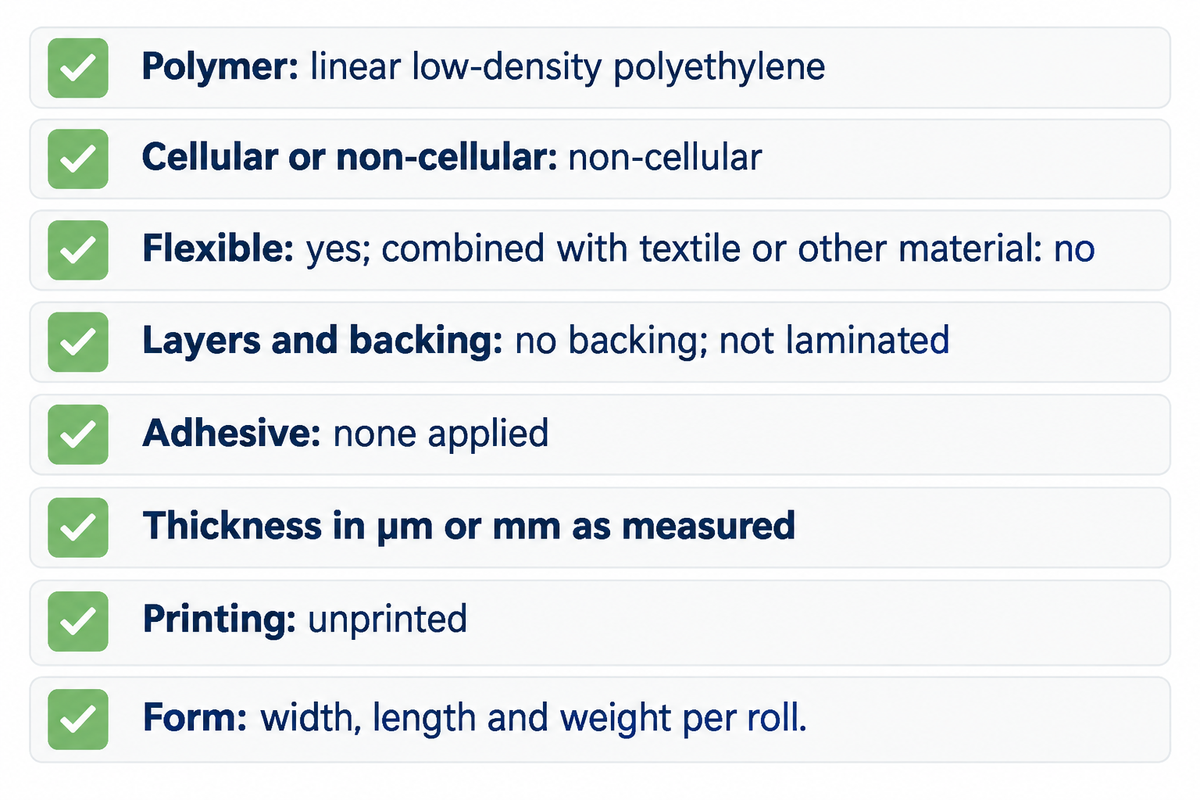
Describe the film by polymer, cellular status, flexibility, layer structure, adhesive status, thickness, width and roll length, not by the words stretch film alone. Under 19 CFR 141.86(a)(3) a US invoice must carry a detailed description of the merchandise, and plastic film of headings 3920 and 3921 needs three extra statements under 19 CFR 141.89.
A detailed description of the merchandise, including the name by which each item is known, the grade or quality, and the marks, numbers, and symbols under which sold by the seller or manufacturer to the trade in the country of exportation […]
The same part of the regulations adds three statements for plastic film:
Plastic plates, sheets, film, foil and strip of headings 3920 and 3921, (1) Statement as to whether the plastic is cellular or noncellular; (2) Specification of the type of plastic; (3) Indication of whether or not flexible and whether combined with textile or other material.
Fill-in product description for the purchase order and invoice
- Polymer: linear low-density polyethylene (LLDPE) film
- Cellular or non-cellular: non-cellular
- Flexible: yes; combined with textile or other material: no
- Layers and backing: ___ layers of ___ ; no backing; not laminated
- Adhesive: none applied
- Thickness: ___ µm (___ mm); specific gravity: ___
- Printing: unprinted
- Form: roll, width ___ mm, length ___ m, ___ kg per roll
⚠️ Common mistake
Writing “self-adhesive” for plain stretch film. Heading 3919 is the self-adhesive heading, so the word points a broker toward 3919 when the film belongs in 3920.
| Write this | Not this |
|---|---|
| Non-cellular polyethylene stretch film, no adhesive applied | Self-adhesive stretch film |
| Thickness in µm or mm as measured | Standard gauge |
| Flexible; not combined with textile or other material | No statement on flexibility |
| Width, roll length and weight per roll | Pallet wrap |
Name the application too: a roll for hand stretch film and a roll for machine stretch film share the same six groups of facts, plus the core, width and length. One description should travel through the whole supply chain, from the purchase order to the invoice, the packing list and the customs entry, so customs compliance doesn’t depend on a late email. To ask for a datasheet for a roll that carries these facts, start from the stretch film range.
When to Ask a Broker to Classify the Film or Request a Binding Ruling
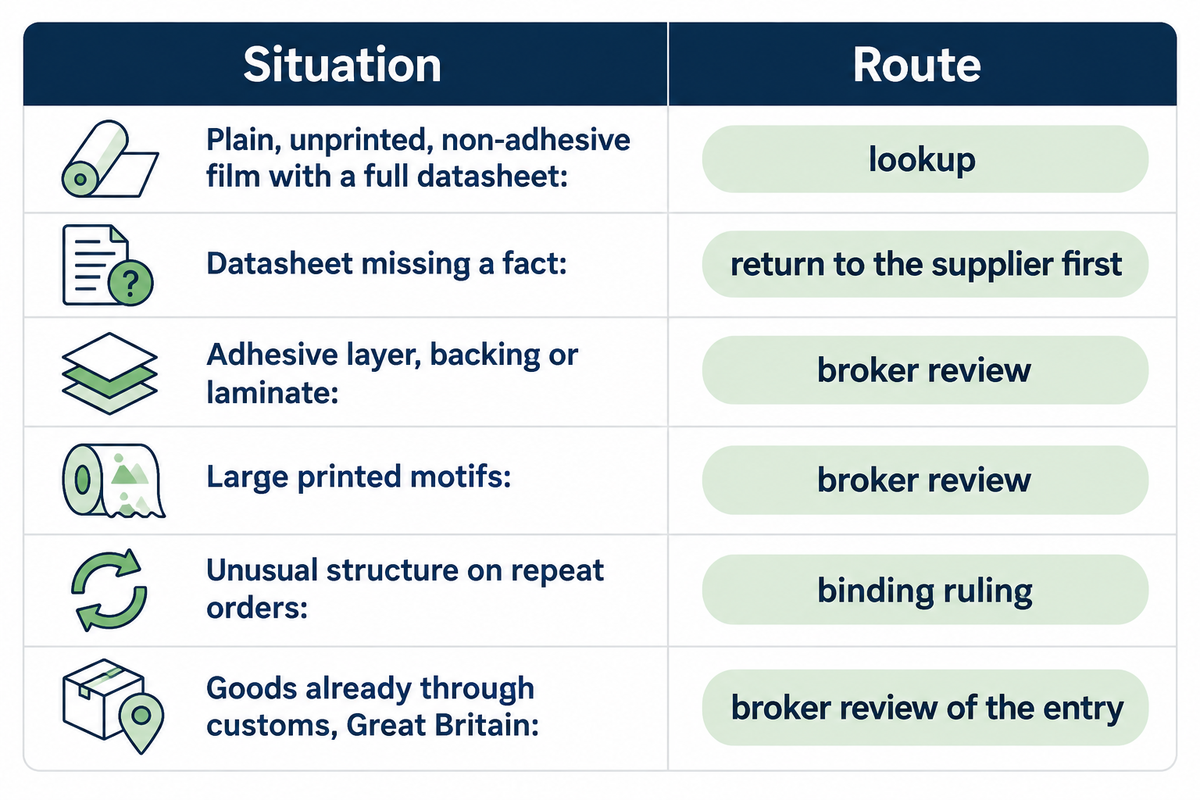
A lookup is enough for a plain, unprinted, non-adhesive polyethylene film with a full datasheet. For a film with an adhesive layer, backing or an unusual structure, ask a broker to classify it. Request a binding ruling before the goods enter: for Great Britain, an Advance Tariff Ruling must be applied for before customs procedures are completed.
A “ruling” is a written statement issued by the Headquarters Office or the appropriate office of Customs as provided in this part that interprets and applies the provisions of the Customs and related laws to a specific set of facts.
| Situation | Route | Why |
|---|---|---|
| Plain, unprinted, non-adhesive PE film with a full datasheet | Lookup on UK Trade Info or the USITC HTS | The six groups of facts match the line wording |
| A datasheet missing a fact from the 6-Fact Code Sheet | Return to the supplier first | The broker cannot pick the line from a bare product name |
| Adhesive layer, backing, or a laminate or support layer of another material | Broker review | The 3920 wording does not cover these, so the broker decides the heading |
| Large printed motifs | Broker review | Section Note 2 can send the goods to Chapter 49 |
| An unusual structure, imported on repeat orders | Binding ruling | A written decision covers those exact facts |
| Goods already through customs, Great Britain | Broker review of the entry | HMRC can refuse a ruling application after clearance |
If the datasheet shows an adhesive layer on one face, Question 1 answers yes, so the route is broker review, then a ruling if the structure remains unusual. For Great Britain, HMRC’s Advance Tariff Ruling is a binding decision on the commodity code, and the application must come before all customs procedures are completed. Northern Ireland and the EU, on the other hand, use a Binding Tariff Information decision.
A US ruling letter is issued in response to a written request, and it covers only the facts in that request. CBP ruling N346793 states the same: if the facts change, a new ruling request is needed. The guide itself isn’t a binding classification.
Frequently Asked Questions About Stretch Film HS Codes
Q: What is the HS code for stretch film?
The HS subheading for plain polyethylene stretch film, non-cellular and free of adhesive and backing, is 3920.10: plates, sheets, film, foil and strip of non-cellular polymers of ethylene.
Those first 6 digits are shared worldwide. UK Trade Info shows 39 20 10 24 for unprinted, non-cellular polyethylene stretch film up to 0.125 mm thick with a specific gravity below 0.94, and the US HTS shows 3920.10.00.00.
Q: What is the HSN code for stretch wrapping film?
For plain polyethylene stretch wrapping film, India’s HSN starts with the same 6 digits as the HS code, 3920.10.
Those 6 digits are extended in India’s own customs tariff, so read the full HSN line there rather than from a supplier page. HSN is the Indian name for the HS code, and plain polyethylene stretch film sits under the same six-digit subheading in both.
Q: What is another name for stretch film?
Stretch film is also called stretch wrap, pallet wrap or pallet wrapping film.
Names such as hand stretch film, machine stretch film and LLDPE stretch wrap film describe the application or the resin. On a purchase order, put the supplier’s product name beside the datasheet facts, so the broker can match the quoted product to the film that arrives.
Q: Does the HS code change with film thickness?
No, thickness leaves 3920.10 unchanged. The UK line 39 20 10 24 stops at 0.125 mm with a specific gravity under 0.94 and no printing, so thicker film belongs to another UK line, while the US line 3920.10.00.00 has no thickness split.
Q: What freight class is stretch film?
Stretch film has no freight class tied to its HS code: the class of a pallet comes from the carrier’s National Motor Freight Classification (NMFC) item and the density of the packed pallet.
The two systems answer different questions: the HS code tells customs what the film is and which duty line applies, and the freight class tells a carrier how to price the move. Where the carrier’s NMFC item is density-based, a pallet that falls into a lower-density band is assigned a higher class. Two shipments of the same film can then carry different classes while both keep the code 3920.10. Read the class from the carrier’s quote for the packed pallet.
Q: Can I use my supplier’s HS code on the customs entry?
Treat the supplier’s code as a proposal to check. Its first 6 digits are the shared HS part and are right only if the film facts match the heading wording, and the rest must match the importing country’s schedule.
The US requires 10 digits for imports, so an HSN or other national code can’t go onto a US entry unchanged. A broker checks the line against the invoice description, which for plastic film of headings 3920 and 3921 must state cellular status, plastic type, flexibility and any combination with other material.
References & Sources
- UK Integrated Online Tariff, Chapter 39 (UK Government)
- Harmonized System (HS) codes (trade.gov)
- ASTM D792-20 (ASTM International)
- UK Integrated Online Tariff, heading 3919 (UK Government)
- UK Integrated Online Tariff, heading 3921 (UK Government)
- UK Trade Info, commodity code 39201024 (HMRC)
- HTS search, 3920.10 (2026 Revision 23) (USITC)
- CBP ruling N346793, March 27, 2025 (CBP)
- CBP CSMS 67844987 (CBP)
- CBP CSMS 67834313 (CBP)
- HS 2028 amendments effective from 1 January 2028 (WCO)
- 19 CFR 141.86 (eCFR)
- 19 CFR 141.89 (eCFR)
- 19 CFR 177.1 (eCFR)
- Advance Tariff Ruling (HMRC)
- Binding Tariff Information decision (HMRC)
How This Stretch Film Code Guide Was Checked
The codes and duty lines in this guide were read on the UK Trade Info and USITC HTS pages on 15 November 2026. Each quotation comes from the official pages linked above. The 6-Fact Code Sheet and the 3-Question Heading Test are UD Packaging’s way of organising those official wordings, not official tools. Reviewed by the UD Packaging technical team.