Get in touch with UD Packaging Company

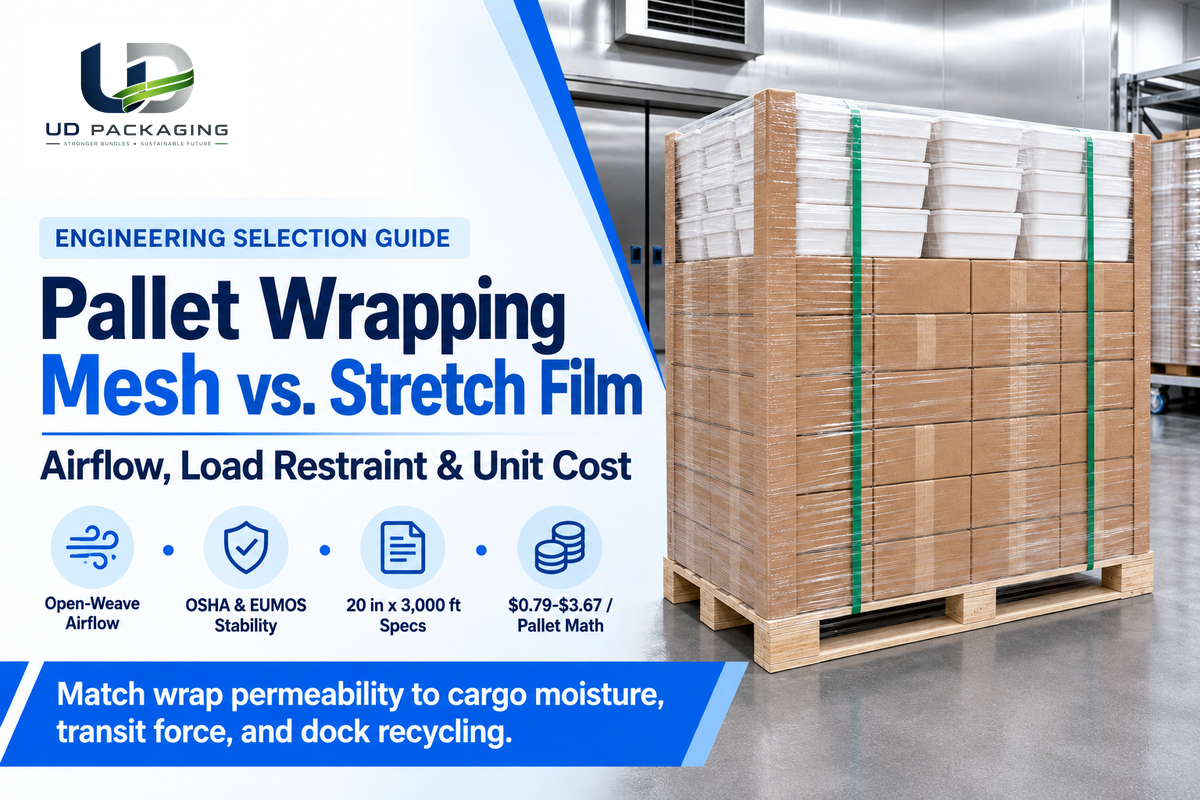
Pallet wrapping mesh (known as pallet netting or pallet net wrap) is an open-weave high-density polyethylene (HDPE) grid for palletized cargo. Standard US distributor rolls such as Uline S-9964 are 20 inches (508 mm) wide, and let heat and water vapor escape freely. Choose mesh when maximum ventilation for fresh produce, blast cooling, or hot-fill cargo outweighs dust shielding. Choose solid stretch film when pallets face outdoor rain exposure, sharp carton corners, or heavy road-transit inertia. Choose perforated film when indoor loads need airflow and film cling.
Trade-offs in mechanics and costs are evident when switching from traditional stretch wrap to breathable mesh for items that require ventilation. Open netting can’t match high powered pre-stretch of LLDPE stretch film, which increases material cost per load. Below is an engineering analysis of airflow, load restraint standards, wrapper set up, published catalog prices, and a controlled five pallet trial.
What Is Pallet Wrapping Mesh and How Does It Prevent Condensation?
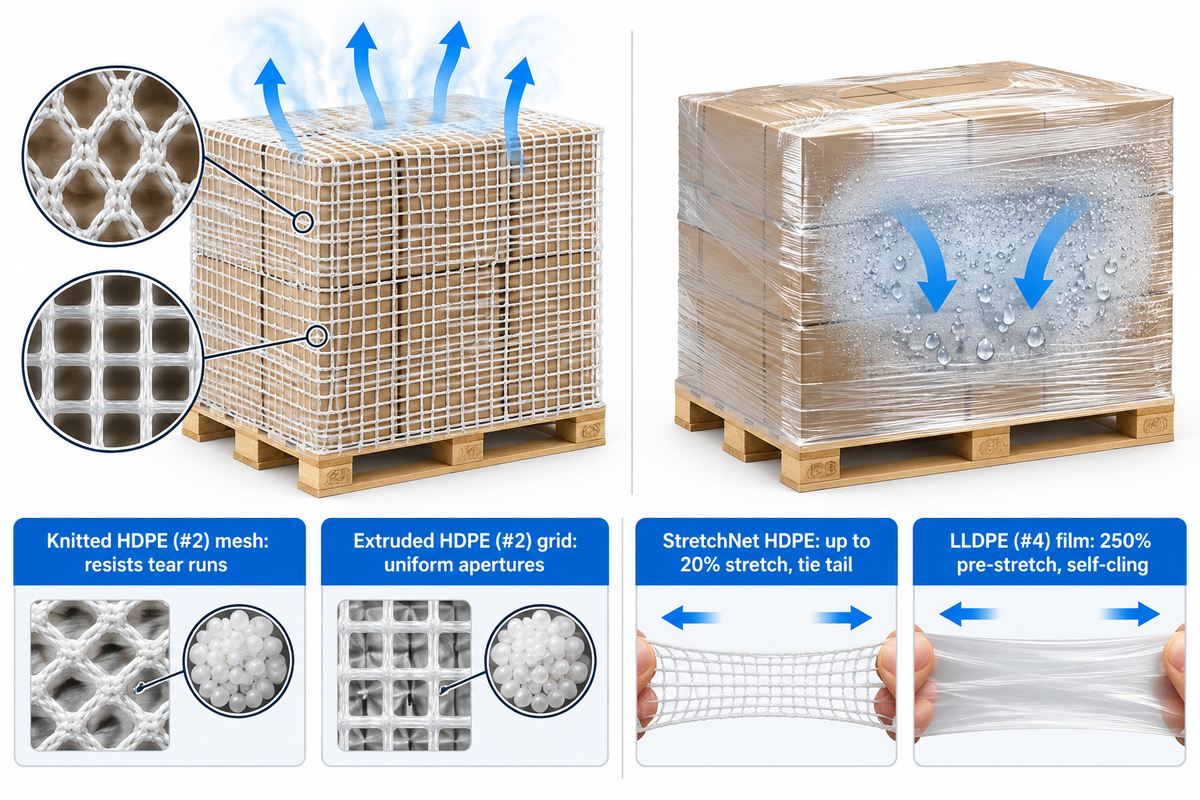
Pallet wrapping mesh is a knitted or extruded HDPE plastic netting applied under tension to hold cartons, crates, or sacks, and won’t seal the stack. Solid LLDPE stretch film is a continuous skin that traps warm, humid air against a cool surface, allowing water to condense. Open-weave netting lets water vapor escape into ambient air, and lowers the chance that dew-point droplets form in the wrap.
As NNZ USA’s industrial pallet netting overview notes, there are two main structural formats that dominate the industrial supply:
- Knitted pallet netting: Interlacing HDPE filaments carry tension in vertical and horizontal strands. A nicked thread resists running across the roll width, making knitted netting common for irregular bagged goods and produce.
- Extruded plastic netting: A uniform diamond or square grid is formed by the polymer strands. Extruded rolls have consistent open apertures and thus steady air circulation, though localized tears spread quickly on sharp corners.
Airflow still has physical limitations. According to the Excelerate Ltd. perforated pallet wrap technical guide, a breathable wrap supports the escape of heat and moisture. However, condensation still occurs if goods enter wrapping wet, if ambient humidity rises above the dew point, or if sealed primary cartons prevent moisture escape.
What is pallet wrap made of?
Standard solid pallet wrap is extruded from linear low-density polyethylene (LLDPE, resin code #4) or low-density polyethylene (LDPE) blends for high stretch and surface cling. Disposable pallet wrapping mesh is knitted or extruded from high-density polyethylene (HDPE, resin code #2) for higher strand strength with lower elongation. Reusable pallet covers use a polypropylene, polyester, or nylon mesh and are secured with hook-and-loop straps.
This makes a difference on the warehouse floor. Powered film carriages stretch LLDPE film deeply, for example, NNZ USA rates its vented Tornado-Wrap film to a minimum 250% pre-stretch, and the tail clings to itself without knots. LLDPE film carries a lot of tension. By contrast, NNZ USA lists its StretchNet netting at up to 20% application stretch, and HDPE mesh must stay out of clear LLDPE recycling bales.
How Open-Weave Airflow Controls Pallet Sweat and Box Collapse
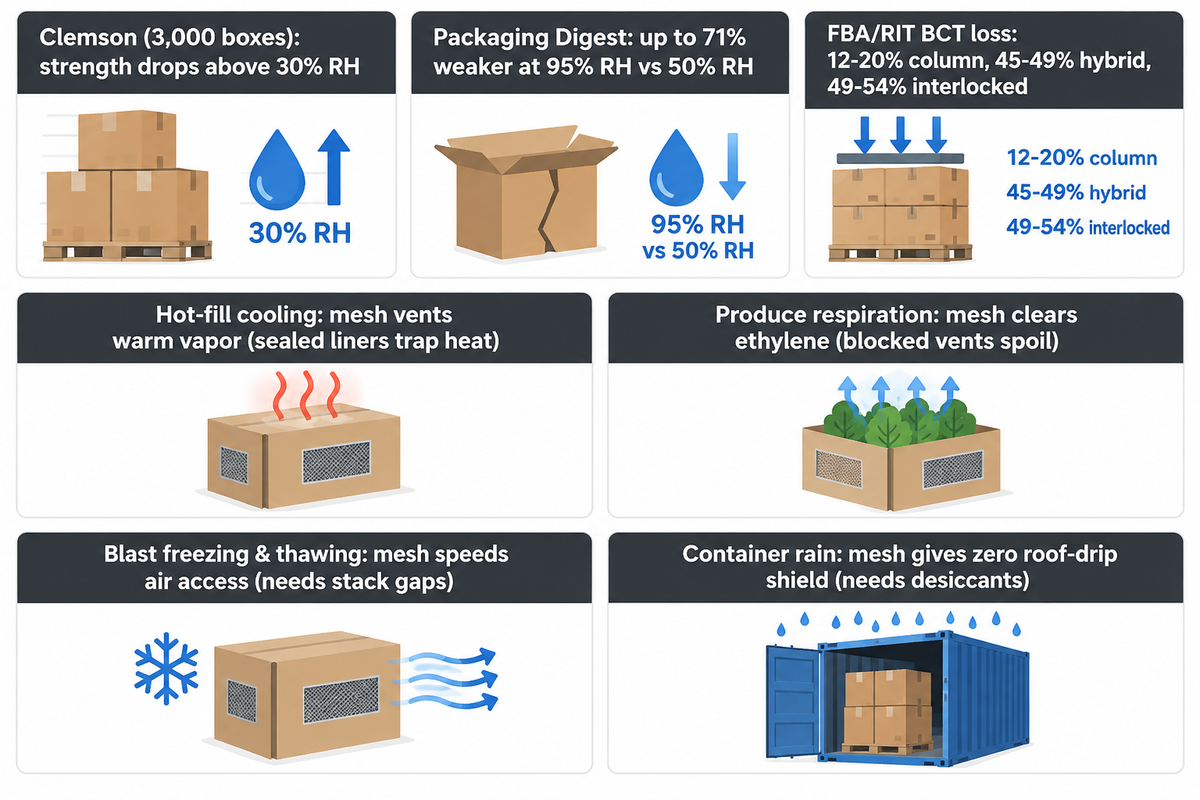
Trapped condensation inside solid stretch wrap softens corrugated paper fibers and weakens starch adhesives, turning bottom-tier boxes into collapse risks. In a 2019 Clemson University Packaging Science thesis, researchers tested 3,000 industry-supplied boxes from 30% to 90% relative humidity under TAPPI T402 and TAPPI T804. Once relative humidity exceeded 30%, box compression strength declined steadily as paper fibers absorbed moisture.
Severe moisture exposure compounds that loss quickly during humid storage or cold-chain transitions. Packaging Digest reports that corrugated board can lose up to 71% of its strength at 95% relative humidity compared with a 50% RH lab baseline. Stacking geometry cuts margin even before moisture arrives.
In a July 2021 Fibre Box Association Tech Box report, Technical Services Director Mary Alice Drain summarized Rochester Institute of Technology tests on 32 ECT and 44 ECT C-Flute boxes (19.5 × 12 × 13 in, about 45 lb). Stacking pattern alone causes large compression losses: column-aligned stacks lose about 12–20% of box compression strength, interlocked stacks 49–54%, and hybrid patterns 45–49%.
Combining interlocked stacking (49% to 54% baseline BCT loss) with trapped condensation leaves little safety margin in a cold store. Open-weave mesh removes the outer vapor skin, reducing the risk of box collapse while letting chilled air extend product shelf life. However, Excelerate’s technical guide emphasizes a frequent warehouse failure. Crews use high-open-area wrap, and cover carton vent slots with shipping labels, stack cases flush without air gaps, and park the pallet tight against a wall. Without an open path to the center, mesh helps prevent outer droplets yet fails to cool the pallet core.
| Moisture Driver | Thermal & Box Mechanism | When Mesh Helps | Where Mesh Alone Fails |
|---|---|---|---|
| Hot-fill cooling | Warm cans, bottles, or extruded bags release heat and vapor after palletizing. | Vents warm air rapidly so droplets do not soak labels or rust seams. | Sealed inner poly liners or tight non-vented master cartons trap heat internally. |
| Produce respiration | Fruits and vegetables emit respiration heat, moisture, and ethylene gas. | Allows air to circulate continuously through vented produce trays. | Blocked tray vents or dead-air staging zones still cause center spoilage. |
| Blast freezing & thawing | Solid plastic insulates the pallet perimeter and slows forced-air heat transfer. | Improves airflow access into the load to help maintain the temperature target faster. | Palletizing warm goods directly into freezing rooms with no airflow channels between stacks. |
| Container rain (export) | Day-night ocean temperature swings condense ambient container humidity onto cargo. | Prevents moisture build-up inside the wrap when container humidity stays low. | Open mesh gives zero shield against dripping container roofs; desiccants or barrier bags are needed. |
Pallet Wrapping Mesh vs. Ventilated Stretch Film vs. Solid Stretch Wrap
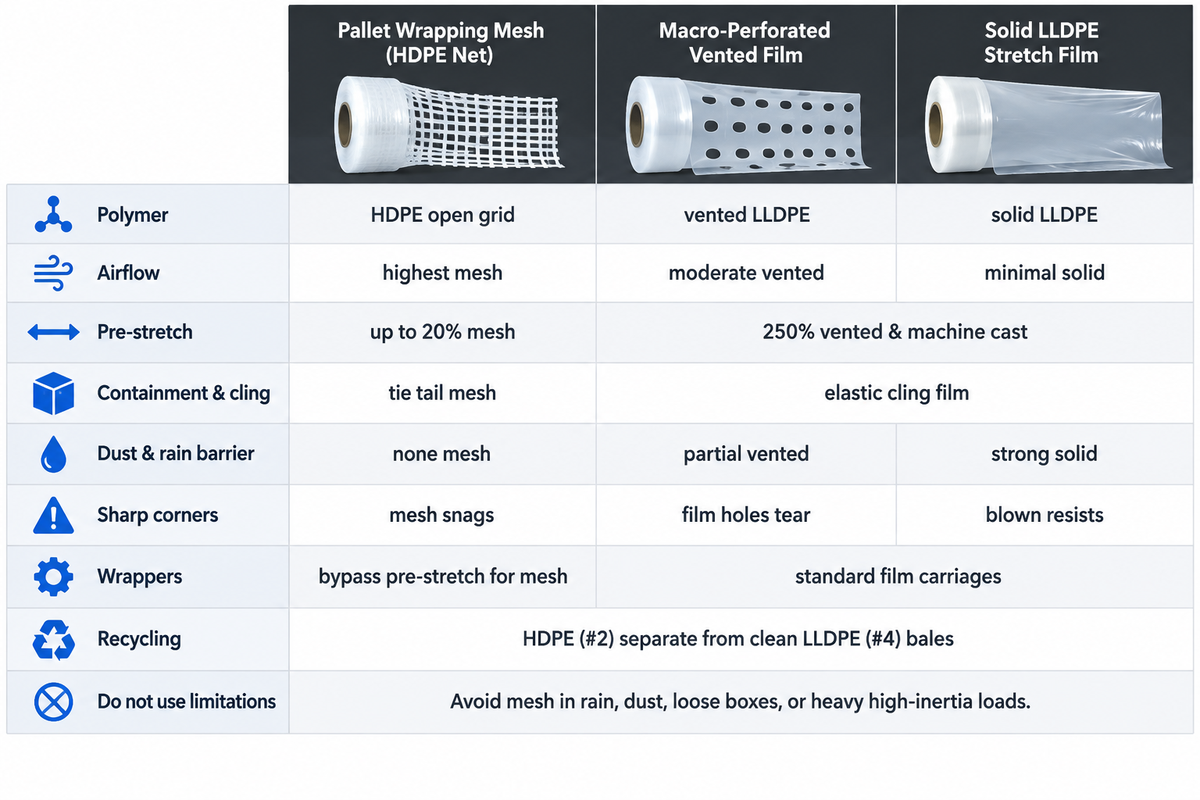
Warehouses choose pallet net wrap for stable unit loads consisting of products that require unrestricted airflow. Crews wrap pallets in macro-perforated vented stretch film when indoor pallet stacks require breathability and film cling on standard wrappers. Solid stretch wrap stays the default choice whenever dust barriers, rain shields, or high containment force is required.
A fourth breathable option rarely shown on basic charts is roped pre-stretched film. In a white paper by Orion Packaging, automated wrappers narrow pre-stretched LLDPE film into strong horizontal bands with open air gaps between passes. Orion mentioned netting and perforated film can cost almost four times per load as compared to roped pre-stretched film. However, roping fails when a pallet holds many small, loose cartons that can slip between bands. Also, stretch wrap differs fundamentally from heat-applied pallet shrink wrap. Our article on stretch film versus shrink wrap explains the reasons for this.
Engineers concerned with perforated film tearing should examine vented web geometry. For example, USPTO Patent US5935681A (“Perforated stretch wrap film”) discloses an air-permeable LLDPE stretch wrap providing ventilation and load retention on palletized cargo. Use the 4-Factor Moisture & Restraint Selector Matrix below to compare the three main wrap options across airflow, stretch, protection and recyclability criteria.
| Selection Factor | Pallet Wrapping Mesh (HDPE Net) | Macro-Perforated Vented Film | Solid LLDPE Stretch Film |
|---|---|---|---|
| Polymer & structure | Knitted or extruded HDPE open-weave grid | LLDPE film with die-cut holes or reinforced bands | Continuous cast, blown, or pre-stretched LLDPE |
| Airflow & ventilation | Highest; open grid provides excellent ventilation | Moderate to high; airflow occurs at hole zones | Minimal; full coverage blocks air exchange |
| Pre-stretch capability | Minimal to low (up to 20% on StretchNet); high stretch snaps strands | Moderate to high on reinforced webs (e.g., 250% min on Tornado-Wrap) | High on powered wrappers (e.g., 250% rated on machine cast rolls) |
| Load containment & cling | Relies on filament tension; zero cling, tail must tie | Film cling plus elastic recovery along solid bands | Highest uniform containment and self-adhering tail |
| Dust & rain barrier | None; rain and warehouse dust pass straight through | Partial splash shielding only; not weatherproof | Strong dust and side-splash barrier (pair with top sheet) |
| Sharp-corner tolerance | Openings snag on wood splinters and sharp edges | Holes act as tear-initiation points on sharp corners | Higher puncture resistance (especially blown grades) |
| Wrapper compatibility | Needs bypassed/low pre-stretch and manual or specialized clamp | Runs on most turntable wrappers with tuned tension | Universal fit across hand, semi-auto, and auto lines |
| Recycling stream | HDPE (#2); contaminates LLDPE film bales if mixed | LLDPE (#4) when mono-material and clean | Clean dry LLDPE (#4) widely accepted in film bales |
| Limitations / Do Not Use When | Avoid for outdoor rain staging, dusty yards, small loose boxes, or heavy high-inertia loads outside EUMOS 40509 deformation limits. | Avoid when respiring produce requires maximum open area or when sharp corners lack edge protection. | Avoid on hot-fill goods, wet produce, or blast-chill pallets prone to internal condensation. |
Load Restraint Limits, Weather Exposure, and Edge Protection
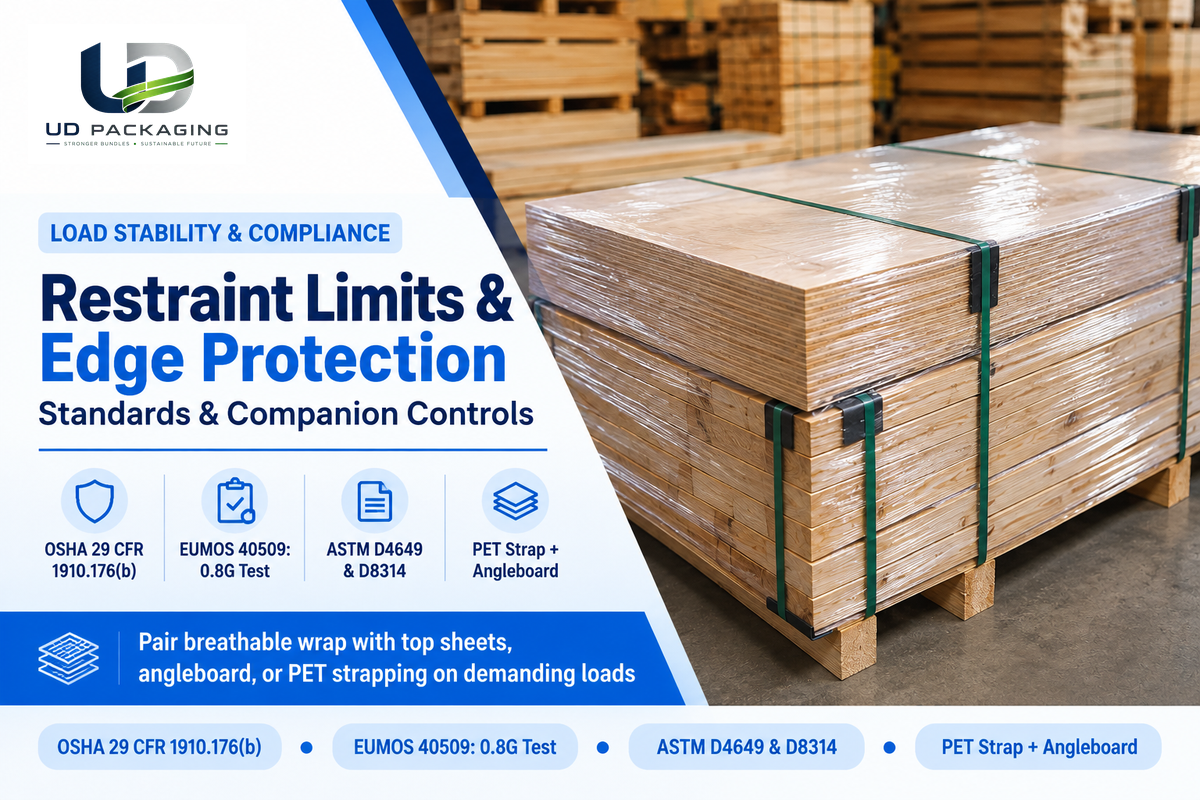
Open-weave pallet netting is an effective method for stabilizing light-to-moderate breathable stacks. It provides less friction and weather shielding than durable solid film. Netted pallet loads must remain stable and secured against sliding or collapse under OSHA 1910.176(b). Loads bound for European road transport can be tested against the EUMOS 40509 acceleration method, while ASTM D4649 and D8314 provide selection and testing guidance for stretch film rather than pass/fail limits.
“1910.176(b) Secure storage. Storage of material shall not create a hazard. Bags, containers, bundles, etc., stored in tiers shall be stacked, blocked, interlocked and limited in height so that they are stable and secure against sliding or collapse.”
Three published documents anchor stretch-wrapped load stability, and only EUMOS 40509 tests highway transport acceleration.
- EUMOS 40509:2020: Included in Annex 3 of EU Directive 2014/47/EU per EUMOS, this method evaluates elastic and plastic pallet deformation. As WarehouseLogistiek reports, loads are subjected to horizontal acceleration forces up to 0.8G.
- ASTM D4649-20(2025): Reapproved in 2025, ASTM D4649 provides selection, specification, and use guidelines for indoor stretch-wrapped unit loads in warehouses and closed containers.
- ASTM D8314-20: Mechanical performance testing of stretch films after application to a unit load or test structure is covered in ASTM D8314.
When a load needs to breathe but faces challenging dock conditions, accessory components can bridge the gap. Open netting allows rain to soak top cartons, so place pallet top sheets over the top tier, and use side mesh. For sharp cornered cartons that snag open side mesh, use laminated paperboard angleboard; our guide to strapping edge protectors and corner boards shows how wider bearing area can help avoid edge crush. Heavy freight like bricks or dense drums requires primary PET pallet strapping; follow our guide on how to strap a pallet before adding breathable containment. For ocean containers subject to change in ambient moisture, separate inner vapor barrier from outer restraint, as described in moisture barrier bags vs. stretch film.
Are there any safety concerns associated with using pallet netting wrap?
Yes. Pallet netting presents four hazards on warehouse floors. First, because of a low containment force, tiers can shift instead of remaining stable and secure against sliding or collapse as required by OSHA 1910.176(b). Second, open grids can snap off on wood splinters. Third, loose non-cling tails can snag on rotary turntables. Finally, scrap netting can damage forklift axles.
Orion Packaging’s white paper notes that removed netting contracts into loose balls that blow across aisles and tangle around lift-truck wheel bearings. Manual wrapping also creates bending and manual handling hazards documented in OSHA’s Grocery Warehousing Packaging eTool. Lessen these risks with lightweight rolls fitted with extended core handles or mechanical wrappers, secure tail knots, and scrap bins at every unwrapping dock.
Pallet Netting Specifications: Knitted vs. Extruded Rolls, Widths, and Gauges
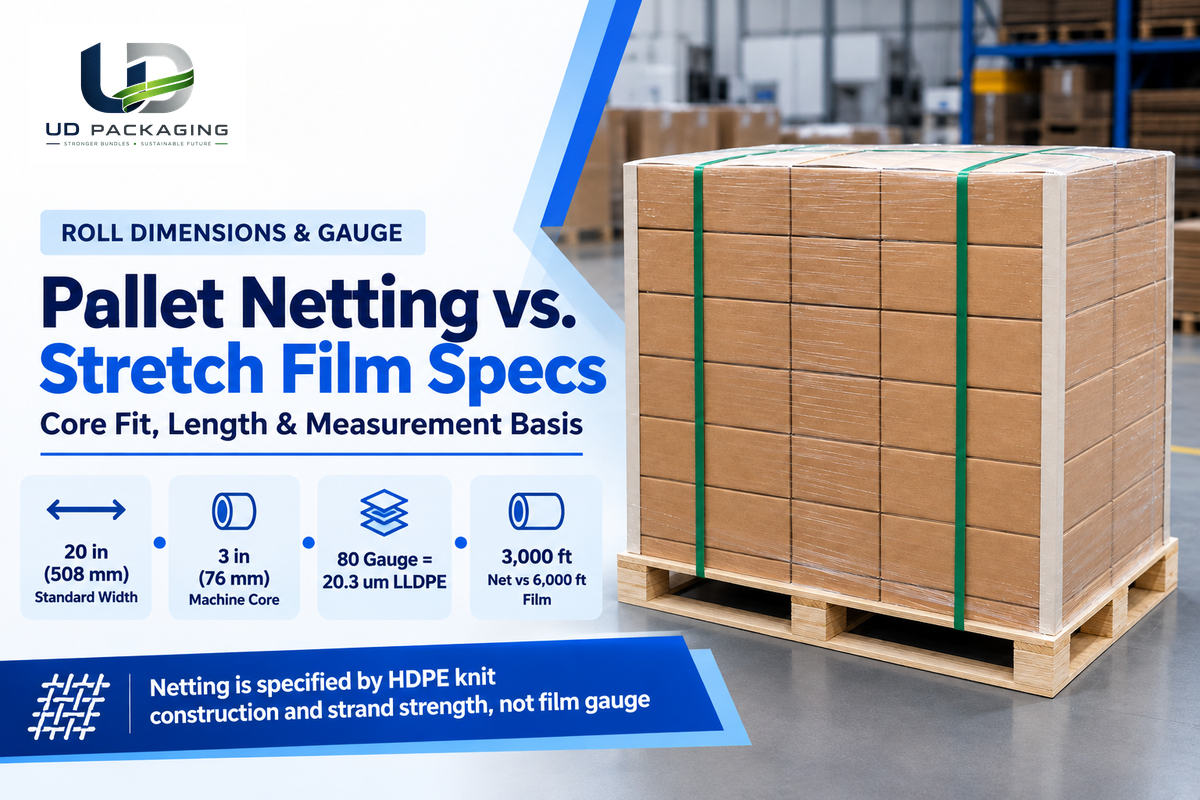
US distributor pallet netting rolls such as Uline Model S-9964 measure 20 in (508 mm) wide on a 3 in (76 mm) cardboard core. Standard industrial netting rolls such as Uline S-9964 supply 3,000 ft per roll, while extended-core hand rolls ship in lighter lengths that vary by supplier catalog. Unlike LLDPE stretch film, pallet netting is specified by knit construction, roll dimensions, and strand breaking strength rather than film gauge.
When buyers consider breathable and solid wraps, there is a tendency to relate film gauges from stretch wrap rolls to mesh strength. Machine-grade netting rolls run 20 in (508 mm) wide on a 3 in (76 mm) core, so match roll outer diameter and core inside diameter to your wrapper carriage before ordering. For exact thickness math on ventilated or solid LLDPE films, use our mils to microns film thickness conversion guide (1 mil = 100 gauge = 25.4 µm).
| Format | Common Roll Width | Typical Roll Length | Core & Handling | Stretch & Spec Basis |
|---|---|---|---|---|
| Hand knitted pallet net (e.g., WrapNet) | 20 in (508 mm) | Varies by supplier | Extended core handles (light weight) | Minimal stretch; spec by HDPE knit strength |
| Industrial pallet net roll (Uline S-9964) | 20 in (508 mm) | 3,000 ft | 3 in (76 mm) core | Low stretch; spec by construction & aperture |
| Hand cast LLDPE film (Uline S-2190) | 18 in (457 mm) | 1,500 ft | 3 in (76 mm) core | 80 gauge (20.3 µm); manual tension stretch |
| Machine cast LLDPE film (Cary #81B1X5) | 20 in (508 mm) | 6,000 ft | 3 in (76 mm) machine core | 80 gauge (20.3 µm); rated up to 250% stretch |
What gauge is pallet wrap?
US distributor catalogs such as Uline, WebstaurantStore, and The Cary Company list industrial LLDPE pallet wrap from 60 gauge (15.2 µm) for light cartons to 120 gauge (30.5 µm) for heavy freight, with 80 gauge (20.3 µm) as a common standard. Pallet wrapping mesh doesn’t have a film gauge, since the open knitted strands have no continuous sheet thickness.
Pallet Wrapping Guidelines: Base Locking, Pass Counts, and Wrapper Setup
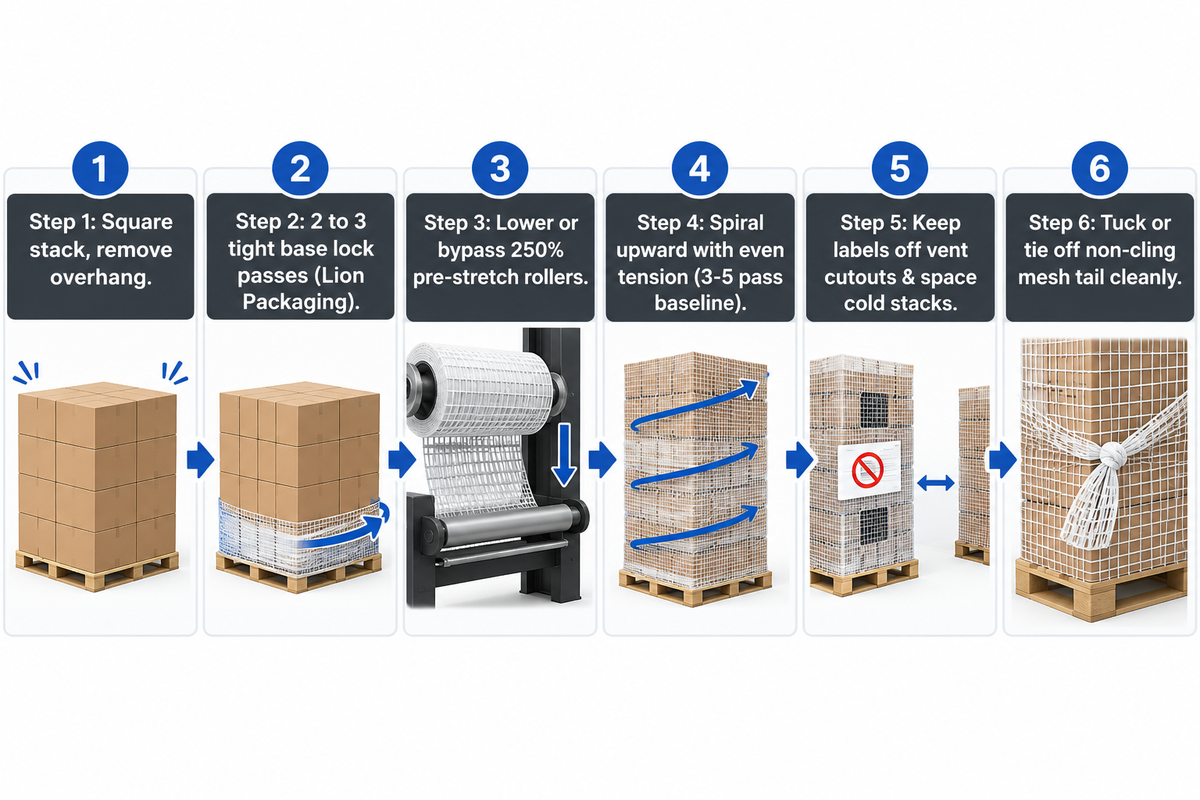
The first step for proper pallet wrapping is to lock the bottom tier to the pallet deck, without blocking forklift pockets, and give it at least 2 to 3 full revolutions as recommended by Lion Packaging. Next, build upward, with even overlap. To secure the pallet netting, you need to reduce or disable the power pre-stretch rollers and tie off the non-cling tails.
There is a lot of variation between suppliers on pass counts. Tiandi Netwrap cites 3 to 5 passes as a starting point for knitted HDPE net wrap versus 15 to 20 passes for solid film. As Lantech’s containment force guidance explains, film layers, wrap force, and pre-stretch interact continuously. Changing one variable shifts load stability, so crews measure actual holding force at the top, middle, and bottom of the stack.
- To ensure a tight load, remove the broken pallet deck boards, and square the load by removing carton overhang. Place the heaviest boxes on the bottom and finish with a flat load for safe loading and unloading.
- With the mesh lead tied to a pallet corner block, do 2 to 3 tight base revolutions to secure both the deck perimeter and the bottom cartons. Keep the pallet mesh and netting clear of the forklift tunnels.
- Lower or bypass powered pre-stretch rollers before loading HDPE mesh, as machine carriages set to a high LLDPE pre-stretch (for example, at 250% stretch) will break filaments. For wrapper-rated roll specs, see our machine stretch film qualification guide.
- With consistent and even tension, spiral up the sides of the load to avoid crushing corrugated sidewalls. Twist film into a rope-like strand around the base or upper stress zones when tall loads need extra horizontal compression.
- Shipping labels shouldn’t be placed over cold room carton vent cutouts, and space should be left between pallets to allow chilled air to reach the center stack.
- Once mesh is secured, tuck or tie the tail around a corner or under tension to keep it from catching on conveyors.
How many times should you wrap a pallet?
Lion Packaging recommends anchoring at least 2 to 3 revolutions around the pallet base before spiraling upward. Tiandi Netwrap uses 3 to 5 passes only as a starting baseline for knitted pallet netting, while the worked cost table below applies a 10-pass film scenario for material math. No exact pass count fits every SKU, as Lantech’s containment guidance sets the final revolutions based on measured holding force across the top, middle, and base tiers.
Dense stacks of slick bags behave nothing like light stacks of corrugated cardboard. Under-wrapping saves pennies on film while risking a full-pallet collapse in transit.
Which Loads Need Pallet Wrapping Mesh vs. Breathable or Solid Film?
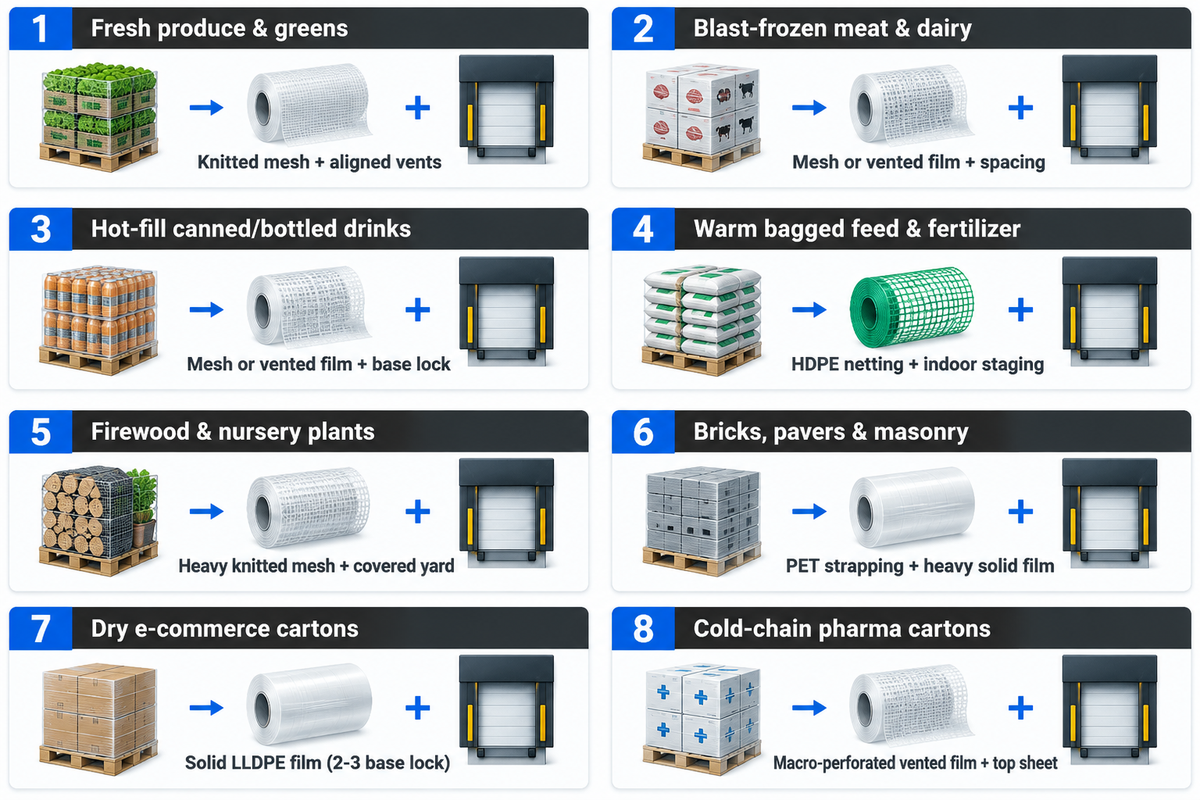
Loads that release heat, respiration gases, or residual moisture after palletizing justify the higher per-pallet material spend and zero weather barrier of pallet wrapping mesh. Dry ambient cartons, dusty storage loads, and many products on mixed-SKU pallets maximize protection at lower cost with solid stretch film.
The 8-Load Breathable Wrap Application Chart below can be used by operations with multiple product lines to route each SKU family to the appropriate wrap option based on product behavior. In humid storage, Clemson University corrugated box testing shows relative humidity above 30% weakens cartons.
| Load Type | Primary Risk Driver | Recommended Wrap | Mandatory Companion Control |
|---|---|---|---|
| 1. Fresh produce & leafy greens | Respiration heat, ethylene, rapid spoilage | Knitted pallet wrapping mesh | Aligned tray vents + corner boards |
| 2. Blast-frozen meat & dairy | Slow core freezing & frost condensation | Pallet mesh or macro-perforated vented film | Airflow spacing between cold-room pallets |
| 3. Hot-fill canned & bottled drinks | Pallet sweat, can rust, wet carton collapse | Knitted pallet netting or macro-perforated vented film | Balanced turntable tension + secure base-lock passes |
| 4. Warm bagged feed, pet food & fertilizer | Bag settling, residual heat & moisture clumping | Knitted or extruded HDPE pallet netting | Anti-slip tier sheets + covered indoor staging |
| 5. Firewood & live nursery plants | Mold growth, sap moisture, irregular edges | Heavy-duty knitted HDPE pallet netting | Covered weather-protected staging (mesh offers no rain barrier) |
| 6. Bricks, pavers & masonry blocks | Extreme inertia & abrasive edges | PET pallet strapping + heavy-gauge or roped solid stretch film | Primary PET strapping + rigid corner boards |
| 7. Dry ambient e-commerce cartons | Dust, pilferage, mixed-box shifting | Solid LLDPE stretch film | Standard 2–3 base lock revolutions |
| 8. Cold-chain pharma & clean cartons | Temperature uniformity + cleanliness | Macro-perforated vented film (clean indoor routes) | Top dust sheet if stored under high-bay airflow |
Disposable Pallet Mesh Rolls vs. Reusable Mesh Covers and Recycling
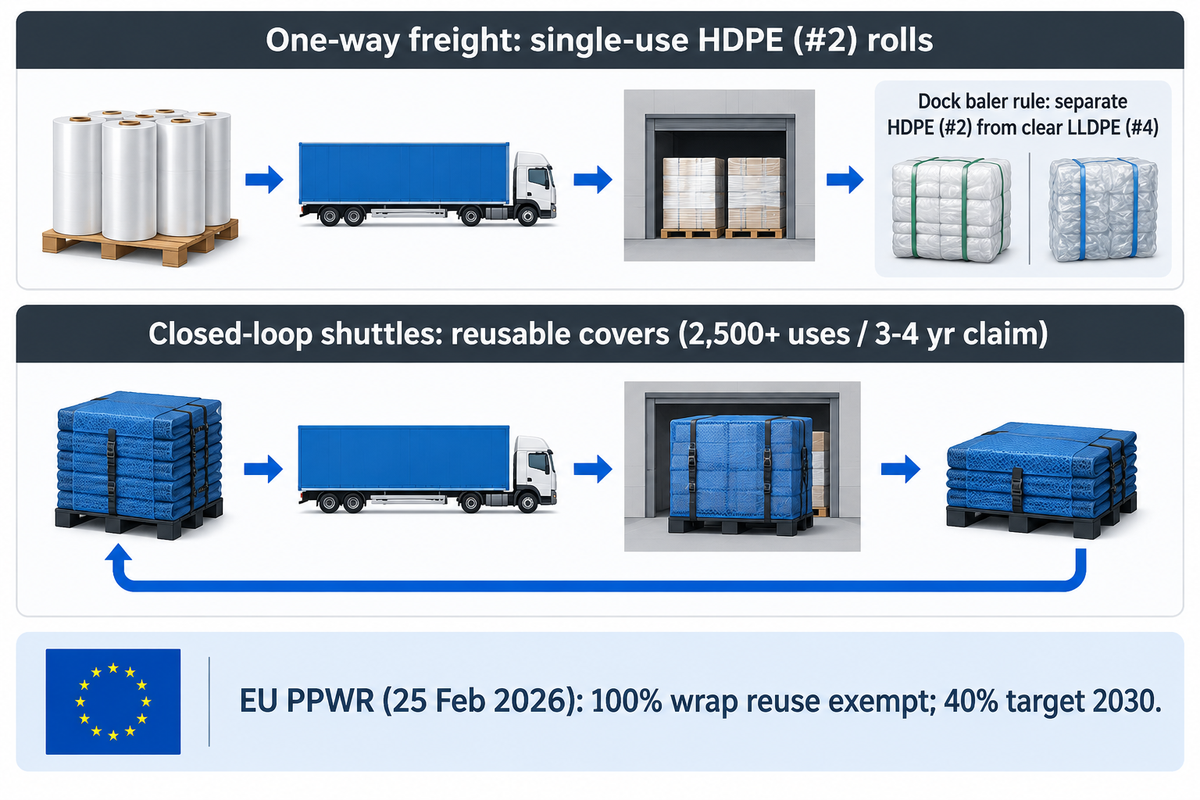
Disposable HDPE netting rolls work best in one way customer shipments where packaging never returns to the origin warehouse. Reusable ventilated mesh pallet covers only outperform disposable rolls in closed-loop shuttles or dedicated store deliveries with asset tracking. At the dock baler, keep HDPE (#2) netting separate from clear LLDPE (#4) stretch wrap to prevent recycling contamination.
Manufacturers of reusable covers like Pallet Wrapz claim their covers made with heavy-duty breathable mesh are good for 2,500+ uses over 3 to 4 years in a dock-to-dock environment. But if covers vanish on third party LTL freight, the high cost of the cover quickly eats into the payback period. Facilities modeling closed-loop return math for reusable pallet wrapping mesh systems should evaluate route level recovery and return rates before switching from disposable rolls. On low recovery routes, consider broader stretch film alternatives.
For one-way waste handling, clean mono-material LLDPE stretch film fits established mechanical recycling streams. Mixing HDPE netting into clear film bales alters melt flow and can downgrade the entire bale, so follow the dockside LLDPE film baling and resin-separation rules. For EU exporters, the European Commission adopted a Delegated Act on 25 February 2026 exempting pallet wrapping and straps from the EU PPWR 100% reuse rule. However, the broader 40% EU transport packaging reuse target still takes effect on 1 January 2030, keeping focus on clean sorting and verified recycled content.
Can pallet netting wrap be reused?
No, knitted or extruded HDPE pallet netting rolls are single-use consumables. Operators stretch, knot and cut them upon arrival. As such, they don’t allow for clean re-application. Only dedicated reusable mesh pallet covers with elastic edges, straps, or hook-and-loop closures can be removed intact for reuse across closed-loop transfers.
Re-wrapping cut disposable netting weakens load stability and leaves loose strands around forklifts. Without asset tracking across closed-loop shuttles or dedicated store deliveries, lost covers quickly offset any multi-trip savings.
How Much Does Pallet Wrap and Pallet Mesh Cost per Roll and per Load?
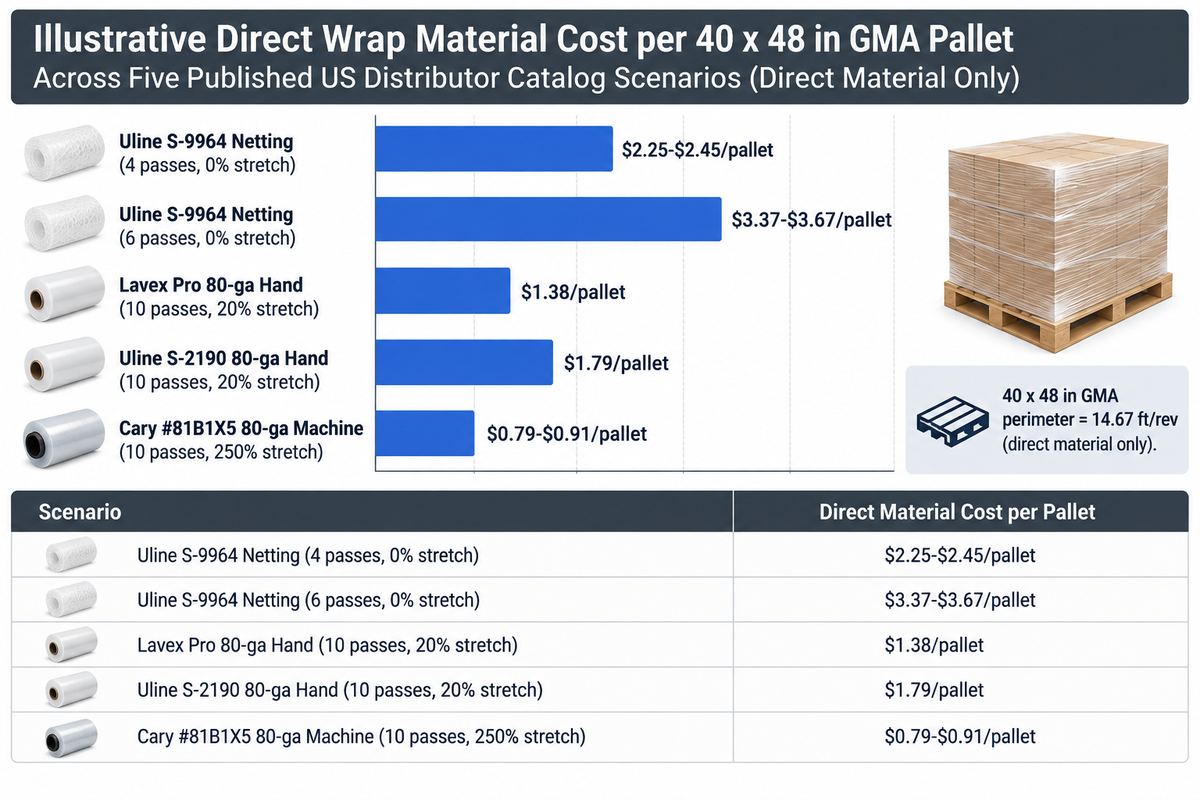
Published US distributor catalog listings verified in November 2026 show clear per-roll differences across specific SKUs. Eighty-gauge hand cast film lists at $17.00 per roll for WebstaurantStore Lavex Pro and $22.00 per roll for Uline S-2190 (both 18 in × 1,500 ft). The Cary Company #81B1X5 machine cast stretch film (20 in × 6,000 ft) lists at $112.64 per roll for 40+ rolls and $130.59 for 1 roll. Uline S-9964 pallet netting (20 in × 3,000 ft) lists at $115.00 per roll for 8+ rolls and $125.00 for 1 roll. In the worked catalog example below, 250% pre-stretched machine film comes to $0.79 to $0.91 per load versus $2.25 to $3.67 for non-stretchable netting.
Roll sticker price alone misleads buyers, as it doesn’t include usable stretched footage and verified pass counts. A hand roll may cost less per roll, but needing extra wraps to stop load shifting results in a higher cost per pallet. The examples shown below are worked examples built from US distributor catalogs, not factory quotes.
Assumed inputs for the worked cost table: A standard GMA 40 × 48 in pallet footprint gives an exact perimeter of 2 × (40 + 48) in = 176 in = 14.67 ft (4.47 m) per revolution. Catalog benchmarks use Uline S-9964 Stretch Netting ($115.00–$125.00/roll) and Uline S-2190 80-gauge Hand Cast Film ($22.00/roll). They also include WebstaurantStore Lavex Pro 80-gauge Hand Film ($67.99/4-case, or $17.00/roll) and The Cary Company #81B1X5 80-gauge Machine Cast Film ($112.64–$130.59/roll, rated to 250% stretch). This table tracks the cost of direct wrap material only; it does not include the cost of machine depreciation, freight, labor, or neck-down waste.
| Listed Product & Catalog Source | Listed Roll Price | Assumed Stretch & Effective Length | Assumed Passes (ft / Pallet) | Illustrative Material Cost / Pallet |
|---|---|---|---|---|
| Uline S-9964 Pallet Netting (20″ × 3,000′) | $115.00–$125.00 | 0% stretch (3,000 ft) | 4 passes (58.7 ft) → 51.1 pallets | $2.25–$2.45 |
| Uline S-9964 Pallet Netting (higher wrap count) | $115.00–$125.00 | 0% stretch (3,000 ft) | 6 passes (88.0 ft) → 34.1 pallets | $3.37–$3.67 |
| WebstaurantStore Lavex Pro 80-ga Hand (18″ × 1,500′) | $17.00/roll ($67.99/4-case) | 20% hand stretch (1,800 ft) | 10 passes (146.7 ft) → 12.3 pallets | $1.38 |
| Uline S-2190 80-ga Hand Cast (18″ × 1,500′) | $22.00/roll ($88.00/4-case) | 20% hand stretch (1,800 ft) | 10 passes (146.7 ft) → 12.3 pallets | $1.79 |
| Cary Co. #81B1X5 80-ga Machine Cast (20″ × 6,000′) | $112.64–$130.59 | 250% pre-stretch (21,000 ft) | 10 passes (146.7 ft) → 143.1 pallets | $0.79–$0.91 |
In this worked example, non-stretchable netting adds $1.34 to $2.88 per pallet compared with 250% pre-stretched machine film. This comparison is also reflected in Orion Packaging’s cost difference between open netting and roped pre-stretched film. Yet if trapped condensation ruins one pallet of produce or collapses a single wet stack, shipping costs and product damage claims outweigh that material premium.
Where to Buy Pallet Wrapping and How to Run a Matched-Load Trial
Buyers purchasing wrap to secure pallets can be broadly segmented into four categories based on order volume and material type. Retail hardware stores cover single emergency rolls, while broadline distributors stock netting rolls and hand cases. Custom knitted net or reusable covers and pallet-volume contracts of pre-stretched, cast, and blown film are sourced from specialty mills and direct film suppliers, respectively.
| Channel | Examples | Best Fit | Buying Trade-Off |
|---|---|---|---|
| Big-box & online retail | Home Depot, Staples, Amazon | Single urgent hand stretch rolls | Highest cost per pallet; limited mesh inventory |
| Broadline packaging distributors | Uline, WebstaurantStore, Cary Co., Pack-Secure | Stocked pallet netting rolls, vented film, mixed cases | Fast shipping (many SKUs made in the USA); catalog pricing |
| Specialty net & reusable cover makers | NNZ USA, Pallet Wrapz, knitted net mills | Custom knitted widths, agricultural net, reusable covers | Longer lead times or MOQs on custom widths |
| Direct industrial film & strapping suppliers | Contract cast/blown film & PET strapping suppliers | Pallet-volume cast, blown, pre-stretched film, PET strap | Requires RFQ specs and matched-load qualification |
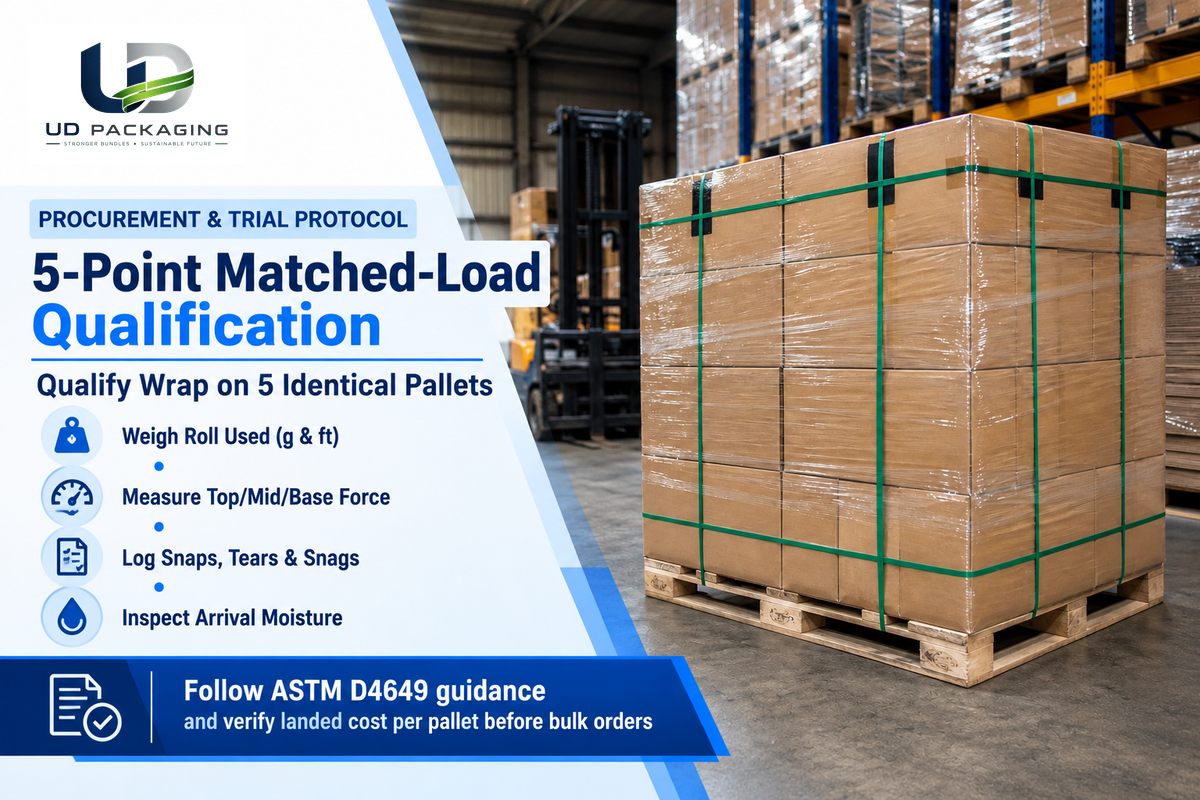
Prior to placing pallet-quantity orders, be sure to qualify candidate wraps on the loads and wrappers used in daily production. According to Excelerate Ltd, hand-wrapped pallets behave differently from machine-wrapped loads as powered carriages apply higher speed and tension. Run our 5-Point Matched-Load Qualification Protocol on at least five identical pallets for each type of wrap being evaluated. For stretch-film candidates, pair the indoor selection and specification guidance in ASTM D4649 with physical containment-force checks across the stack.
- To determine how much wrap is used on each pallet, measure the weight of the wrap roll before and after five identical loads, and calculate how much material in grams and length in feet was used.
- Measure wrap tension across the upper, middle, and bottom layers of the pallet stack to keep base-to-pallet locking consistent across shifts.
- At the normal speed of the production line, log every defect that occurs on each candidate wrap, including filament snaps, tears, corner snags, or tail-clamp slip.
- Upon arrival, inspect the moisture level of the inner layer of the bottom carton to confirm the product arrived in good condition.
- To determine the actual cost per pallet, calculate the material cost from the actual weight or length of wrap used and the landed roll price, then factor in re-wrap labor and damage claims.
| RFQ Parameter | Details to Send Suppliers | Why It Prevents Spec Mismatch |
|---|---|---|
| Pallet footprint & height | Exact L × W × H (e.g., 40 × 48 × 60 in) and gross load weight | Sizes roll width, pass count, and containment target |
| Load profile & edges | Cartons, vented produce trays, bags, or sharp corners | Identifies snag risk and corner-board needs |
| Thermal & storage route | Hot-fill temp, blast-chill dwell, outdoor staging, or ocean export | Separates airflow demand from rain/dust barrier needs |
| Wrapping equipment | Manual dispenser, turntable, or rotary arm + carriage pre-stretch % | Prevents core mismatch and high pre-stretch tearing |
| End-of-life & compliance | One-way vs. closed loop, dock baler resin (#2 vs. #4), EU PPWR scope | Avoids bale contamination and compliance gaps |
If your trials show that dust shielding, high pre-stretch or roped film fits better than netting, submit your load parameters through UD Packaging’s cast, blown, and pre-stretched pallet film catalog. Our team supports cast, blown, and pre-stretched film supply as well as PET strapping. For knitted pallet wrapping mesh rolls or reusable covers, source directly from dedicated netting distributors.
Common Questions About Pallet Wrapping Mesh
What is the main advantage of using pallet netting wrap?
The biggest advantage of pallet netting wrap is unrestricted airflow across the entire pallet face. Solid plastic stretch wrap can trap humid air. HDPE mesh, however, can vent water vapor, heat, and ethylene. This ventilation cuts pallet sweat and protects boxes from moisture collapse.
How thick is pallet wrap?
Major US catalogs such as Uline and The Cary Company stock 80 gauge (20.3 µm) LLDPE pallet stretch wrap as their daily warehouse standard, with 60 gauge (15.2 µm) for light cartons and 120 gauge (30.5 µm) for heavy, sharp-edged loads. The open structure of pallet wrapping mesh provides no film gauge rating because knitted HDPE strands form an open grid rather than a continuous film. Buyers request a mesh construction and specify characteristics like roll width, length, and breaking strength instead.
What does a pallet wrapper cost?
Published US distributor listings put manual hand wrappers such as Uline H-88 at $99 single unit and mid-volume semi-automatic turntable machines such as Uline H-1675 (4,000 lb capacity, 20 in film carriage) at $8,430. Fully automatic conveyorized rotary lines are quoted per project based on throughput, conveyors, and safety guarding. Before running mesh on any semi-auto machine, check that the carriage allows dialing down or bypassing pre-stretch.
What is pallet wrapping called?
Catalogs tend to refer to solid plastic wrap rolls as stretch film or pallet wrap. Open-weave pallet wrap rolls made of high-density polyethylene (HDPE) are also referred to as pallet wrapping mesh or pallet netting. Punched LLDPE rolls are sold as ventilated stretch film.
How does pallet netting wrap improve the transportation of perishable goods?
Pallet netting allows cold air to be evenly distributed during transportation and storage. Fresh produce, flowers, dairy, and chilled proteins generate respiration heat or move quickly between ambient docks and blast coolers. Solid stretch wrap traps condensation on cartons and labels and slows pull-down cooling. Open-weave HDPE netting removes the outer thermal skin, helps cold rooms hold target temperatures, and slows box softening. That airflow extends shelf life across cold-chain logistics routes. It works effectively provided inner tray vents stay clear and pallets keep air gaps between stacks.
Is pallet netting environmentally friendly?
Single-use HDPE pallet netting is recyclable as resin #2 where HDPE drop-off exists, separate from LLDPE (#4) streams, but it isn’t biodegradable. Reusable covers cut waste only in tracked closed loops.
How do I choose the right type of pallet netting wrap for my needs?
Select knitted HDPE pallet wrapping mesh when produce respiration, hot-fill heat, or wood drying requires maximum airflow under covered storage. For breathability with film-like holding force, use macro-perforated ventilated film or roped pre-stretched film on automated wrappers. Make sure roll width and core size match your carriage. Keep HDPE out of LLDPE recycling bales. Before purchasing bulk rolls, run a five-pallet matched-load trial measuring applied weight, containment force, snags, and arrival box condition.
Editorial & Scope Disclosure: Published catalog roll prices reflect US distributor listings for direct material benchmarking. UD Packaging supplies industrial cast, blown, and pre-stretched stretch film, PET strapping, seals, buckles, and strapping tools. UD Packaging doesn’t manufacture or stock pallet wrapping mesh, reusable mesh covers, or force-testing instruments.
Reviewed by the UD Packaging technical team
References & Sources
- Occupational Safety and Health Administration (OSHA) – General Standard 29 CFR 1910.176 Handling Materials
- Occupational Safety and Health Administration (OSHA) Grocery Warehousing Packaging eTool
- ASTM International ASTM D4649-20(2025) Standard Guide for Use of Stretch Films
- ASTM International ASTM D8314-20 Standard Guide for Performance Testing of Applied Stretch Films
- European Safe Logistics Association (EUMOS) – EUMOS 40509:2020 Load Unit Rigidity Standard
- WarehouseLogistiek / Contimeta EUMOS 40509 Pallet Stability 0.8G Test Overview
- European Commission, Directorate-General for Environment (25 February 2026) – Pallet Wrapping and Straps Exempt from 100% Reuse Requirement
- Brown, Gary Ashton (December 2019), Clemson University — Relative Humidity Effects on the Compression Strength of Corrugated Boxes
- Drain, Mary Alice (July 2021), Fibre Box Association The Tech Box: How Does Stacking Pattern Impact BCT?
- Packaging Digest Mitigating Packaging Damage in the Supply Chain
- Lantech – Containment Force Is the Key to Safe Pallet Loads
- Orion Packaging – Stretch Roping Technique for Loads that Require Breathability
- Excelerate Ltd, “Perforated Pallet Wrap UK Technical Guide”
- NNZ USA Pallet Netting for Industrial Packaging
- United States Patent US5935681A Perforated Stretch Wrap Film Patent